Book Appointment Now

Türkiye (Turkey): A profile of Türkiye’s economy and its relations with Bangladesh
1. Country Profile
Geographical Location
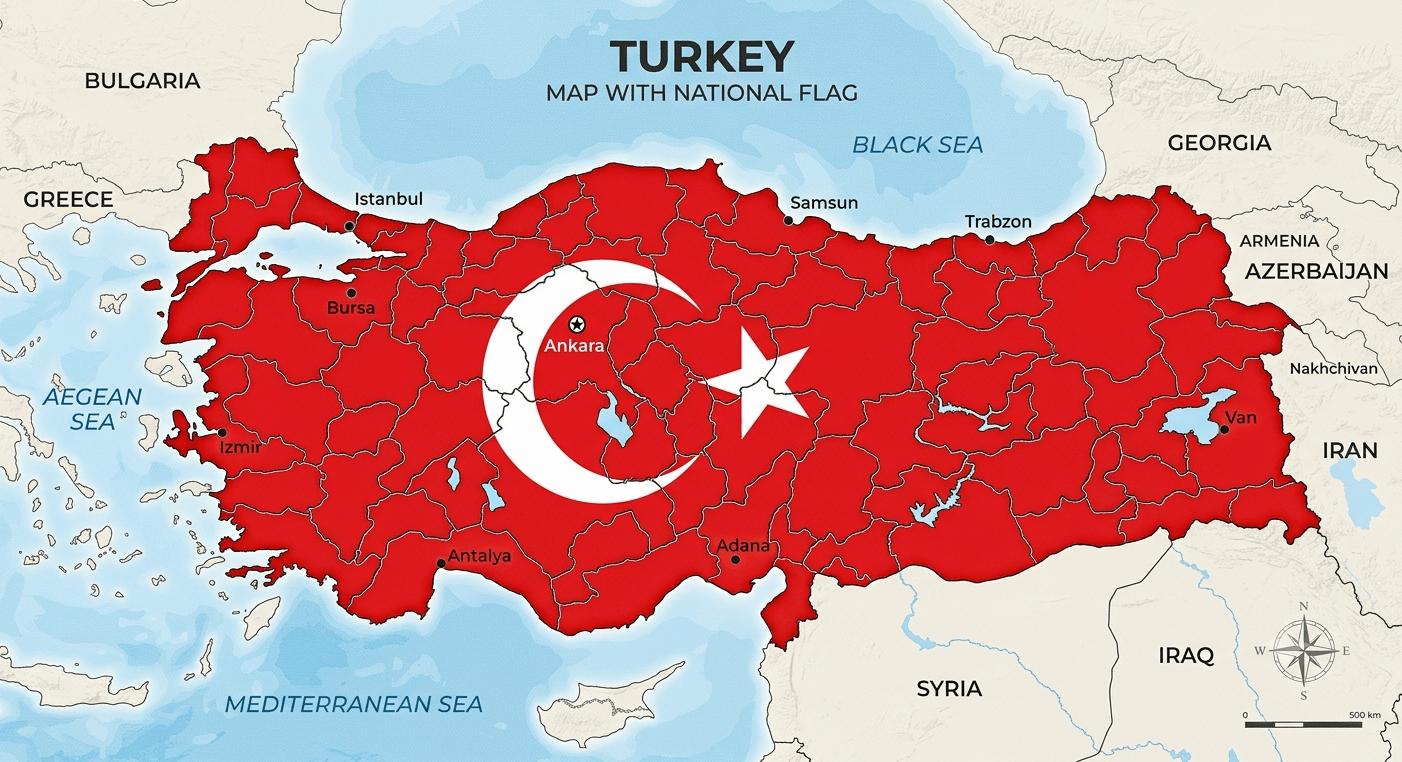
Türkiye sits at the meeting point of Europe and Asia, bordered by the Black Sea to the north, the Aegean Sea to the west, and the Mediterranean to the south. It shares land borders with Greece, Bulgaria, Georgia, Armenia, Azerbaijan, Iran, Iraq, and Syria, giving it a natural role as a land and sea bridge between Europe, the Middle East, and Central Asia.
Official Political Name and System
The country’s official name is the Republic of Türkiye, a unitary presidential republic with executive power held by the President and a unicameral parliament, the Grand National Assembly. Recep Tayyip Erdoğan has led the country since the 2018 shift to the presidential system, and Türkiye is a founding member of the OECD and a G20 economy.
Economic Overview
Türkiye is the 17th largest economy in the world, with GDP reaching around $1.6 trillion in 2025. Real growth averaged 5.4% between 2002 and 2022, pushing the country into upper-middle-income status and cutting poverty from above 20% in 2007 to around 4% today. The economy has been in a difficult stabilization phase since mid-2023, with tight monetary policy used to bring down inflation that had climbed well above 60%. Growth slowed to 3.2% in 2024 and should hold near 3.1% in 2025, before regional tensions and energy costs weigh on 2026.
Agricultural Sector
Agriculture remains an important employer even though its share of GDP has shrunk to roughly 5-6%. Türkiye is a major global producer of hazelnuts, dried apricots, figs, cherries, and cotton, and is largely self-sufficient in wheat and other staple grains, supporting a significant share of rural livelihoods, particularly in central and eastern Anatolia.
Industrialization and Manufacturing
Manufacturing is the backbone of the modern Turkish economy, contributing around a fifth of GDP. The automotive industry, built around plants supplying European carmakers, is the single largest export earner. Textiles and apparel, iron and steel, home appliances, and defense manufacturing (led by firms like Turkish Aerospace and Baykar) round out an industrial base built up since the 1980s trade liberalization.
2. Trade and Economic Profile
Export and Import Overview
Türkiye’s goods exports totaled around $262 billion in 2024, while imports reached roughly $344 billion, leaving a trade deficit close to 2.4% of GDP. Manufactured goods make up over 94% of exports. Germany, the United States, the United Kingdom, Iraq, and Italy are the leading export destinations, while China, Russia, Germany, and the United States dominate imports.
Major Export and Import Products
Leading exports include motor vehicles and parts, jewelry and gold, iron and steel, machinery, and textiles and apparel. On the import side, mineral fuels and oil dominate, followed by machinery, vehicles, electrical equipment, and gold, reflecting heavy reliance on imported energy.
GDP and Growth Analysis
GDP per capita stood at roughly $18,600 in 2025. Services contribute the largest share of output, followed by manufacturing, with construction and agriculture contributing less. The World Bank projects growth near 3.1% for 2025, moderating in 2026 on regional conflict spillovers before recovering toward 3.7-4.3% by 2027-2028. Inflation, down sharply from its 2022 peak, should stay near 28-29% through 2025, and the government deficit is projected near 4-5% of GDP as earthquake reconstruction costs and interest payments keep fiscal pressure elevated.
Major Industrial Products
Passenger vehicles and commercial trucks, home appliances (Türkiye is one of Europe’s largest white-goods producers), textiles, steel, cement, ceramics, and an increasingly capable defense and aerospace industry are among the country’s flagship industrial products.
3. Education
Overview of the Education System
Education in Türkiye is compulsory for 12 years, split into four-year primary, middle, and high school stages, after which students sit a central university entrance exam. The Ministry of National Education oversees the system, and public universities are complemented by a fast-growing private and foundation university sector. Türkiye also runs one of the world’s largest international scholarship programs, Türkiye Scholarships (Türkiye Bursları), which brings in thousands of foreign students yearly.
Literacy Rate and Human Capital
Adult literacy stands at around 97%, with near-universal literacy among younger age groups. Educational attainment has risen steadily, and Türkiye now ranks 45th of 193 countries on the UN Human Development Index, in the “very high human development” category. Investment in vocational training and STEM education is helping the country move up the manufacturing value chain, though regional disparities in education quality between western and eastern provinces remain a policy challenge.
4. Health and Social Indicators
World Bank data places Türkiye firmly in the upper-middle to high-income bracket on most social indicators. Life expectancy is above 78 years, and the country has made large gains in maternal and child health, with under-five mortality now below regional averages. The poverty rate, measured against the $8.30-a-day upper-middle-income line, fell from about 13% in 2021 to under 11% in 2022 and has kept declining. Unemployment sits around 8.5%, though labor force participation, especially among women, still lags OECD norms, and informal employment remains widespread. Nutrition indicators are generally strong, with malnutrition rare outside pockets of rural poverty, though obesity and diet-related disease are a growing concern. Türkiye’s HDI score of roughly 0.855-0.86 reflects solid outcomes across health, education, and income, though inequality-adjusted rankings drop due to regional and gender gaps.
5. Bangladesh-Türkiye Bilateral Relations
Türkiye recognized Bangladesh’s independence in February 1974 at an OIC summit in Lahore, after a difficult early period shaped by Ankara’s Cold War-era ties with Pakistan. Türkiye opened its embassy in Dhaka in 1976, and Bangladesh opened its embassy in Ankara in 1981; both maintain consulates too (Türkiye in Chittagong, Bangladesh in Istanbul). Relations have not always been smooth: tensions flared in 2016 when Türkiye reacted sharply to the execution of a Jamaat-e-Islami leader convicted of 1971 war crimes, but ties recovered after Bangladesh’s public support for the Turkish government following the failed 2016 coup attempt. The relationship has strengthened considerably in the past decade. Türkiye has been an active advocate for the Rohingya refugee cause in the UN, the OIC, and the G20, and Turkish agencies such as TIKA, AFAD, and the Turkish Red Crescent have funded schools, hospitals, and relief facilities in Cox’s Bazar. Both countries co-founded the Developing-8 (D-8) group in 1998 and hold regular Foreign Office Consultations, with the fourth round hosted in Dhaka in October 2025. A 2022 memorandum of understanding covers counterterrorism, cybercrime, and intelligence sharing, and defense cooperation has expanded, including a Turkish naval goodwill visit to Chattogram in 2024. On trade, both sides have signaled interest in deepening commercial ties: at the Antalya Diplomacy Forum in April 2025, Türkiye’s trade minister and Bangladesh’s information adviser discussed investment opportunities and proposed a Joint Economic Commission meeting in Dhaka.
6. Bilateral Trade Analysis
Bilateral trade exceeded $1.1 billion in 2023 and has continued to grow, though figures vary depending on whether they come from Bangladeshi or Turkish customs data. Bangladesh exported goods worth about $495.8 million to Türkiye in FY2022-23 and imported roughly $380.3 million, while more recent Turkish import data (UN COMTRADE) puts Bangladeshi shipments to Türkiye at around $875-876 million in 2024, driven almost entirely by ready-made garments.
What Bangladesh Exports to Türkiye
Knit and woven garments dominate, together with jute yarn and other jute products, footwear, and smaller volumes of leather goods and made-up textile articles. Per the Export Promotion Bureau, garments and jute goods together account for the overwhelming majority of Bangladesh’s export earnings from the Turkish market, mirroring the RMG-led export structure Bangladesh has with most Western markets.
What Türkiye Exports to Bangladesh
Türkiye’s exports to Bangladesh are led by raw cotton, a key input for local textile mills, followed by textile processing and dyeing machinery, finishing chemicals, other machinery, electrical equipment, and small volumes of pharmaceuticals and food products.
Banking and Financial Linkages
Bangladesh Bank’s annual reporting on trade financing shows Türkiye as an active corridor for letters of credit tied to cotton and textile machinery imports, alongside LC-backed garment export proceeds flowing back through Bangladeshi commercial banks. Correspondent banking and trade finance lines with Turkish banks are expected to expand as trade grows, though they remain modest next to Bangladesh’s LC exposure to China, India, and the EU.
7. International Cooperation
Bangladesh and Türkiye are both members of the Organisation of Islamic Cooperation (OIC), the United Nations, and the WTO, and co-founded the Developing-8 (D-8) Organization for Economic Cooperation in 1998, alongside Egypt, Indonesia, Iran, Malaysia, Nigeria, and Pakistan. Shared OIC and D-8 membership gives the two countries a platform for coordinating positions on trade preferences and South-South cooperation, and Türkiye has used these fora, along with the G20 and MIKTA, to back Bangladesh on the Rohingya crisis. Regular Foreign Office Consultations and proposals for a Joint Economic Commission show this multilateral overlap translating into more structured bilateral engagement, though both governments still call the commercial relationship underdeveloped relative to its potential.
8. Opportunities for Bangladeshi Citizens in Türkiye
Higher Education
Türkiye Scholarships (Türkiye Bursları) funds undergraduate, master’s, and PhD study for international students, including a growing number of Bangladeshis, covering tuition, accommodation, a monthly stipend, and Turkish language training.
Employment and Labor Migration
Türkiye’s construction, textile, and manufacturing sectors employ migrant labor, and Turkish companies operating in Bangladesh also create channels for professional exchange and technical training.
Visa Facilities
Bangladeshi citizens can apply for Turkish e-visas or visas on arrival for short visits, with fuller documentation required for student, work, or investor visas.
Export and Residency Opportunities
Türkiye’s tariff-free access to the EU customs union makes it an attractive re-export and value-addition base for Bangladeshi garment and textile firms, while its citizenship-by-investment program (currently a $400,000 real estate purchase or equivalent) is open to Bangladeshi nationals on the same terms as other foreign investors.
9. Opportunities for Türkiye from Bangladesh
High-Potential Import Products
Bangladesh’s ready-made garments, jute products, leather goods, frozen seafood, and pharmaceuticals (many made to GMP standards) all offer Turkish importers competitively priced sourcing options as they diversify input supply.
Investment and Industrial Cooperation
More than 100 Turkish firms already have a presence in Bangladesh, and about 20 run substantial businesses in garments, textiles, chemicals, construction, and energy. Bangladesh’s economic zones offer tax holidays and duty concessions attractive for textile machinery and energy projects, while its domestic market, projected to be the ninth largest globally by 2030, gives Turkish firms a long runway for expansion.
Other Sectors
Defense, aerospace, pharmaceuticals, and renewable energy stand out as newer areas of potential cooperation, building on the defense ties and aviation talks already underway between the two governments.
10. Trade Associations and Future Prospects
FBCCI has hosted Turkish business delegations, including visits led by the Türkiye-Bangladesh Business Council, and both sides have discussed reactivating a Joint Economic Commission. The Turkish Ambassador to Bangladesh and FBCCI leadership have both flagged Bangladesh’s economic zones as a priority investment area. Both governments want to expand trade beyond the current $1.1-plus billion in bilateral volume, and recent high-level visits point toward a more institutionalized relationship, even though a bilateral trade agreement has not yet been concluded.
11. Recommendations
- Pursue a Bangladesh-Türkiye trade agreement, or at least a sector-specific arrangement on textiles, to cut tariffs on garment and jute exports and cotton and machinery imports.
- Reactivate the Joint Economic Commission on a fixed annual schedule, rather than relying on ad hoc ministerial visits.
- Encourage Turkish investment in Bangladesh’s economic zones, especially textile machinery and energy, through joint roadshows by FBCCI and Turkish bodies such as DEIK.
- Expand Türkiye Bursları scholarship intake for Bangladeshi students, paired with return-and-reinvest programs to build a pipeline of Turkish-trained professionals.
- Strengthen trade finance and correspondent banking links between Bangladeshi and Turkish banks to cut the cost and delay of LC-based transactions.
- Diversify Bangladesh’s export basket beyond garments and jute, promoting pharmaceuticals, leather goods, and frozen seafood through EPB-led trade missions.
- Use shared OIC and D-8 platforms more deliberately to align positions on trade facilitation, rather than treating multilateral cooperation and bilateral trade as separate tracks.