Book Appointment Now

Singapore: Bangladesh–Singapore Bilateral Relations, Trade and Investment Potential
1. Country Profile
1.1 Geographical Location
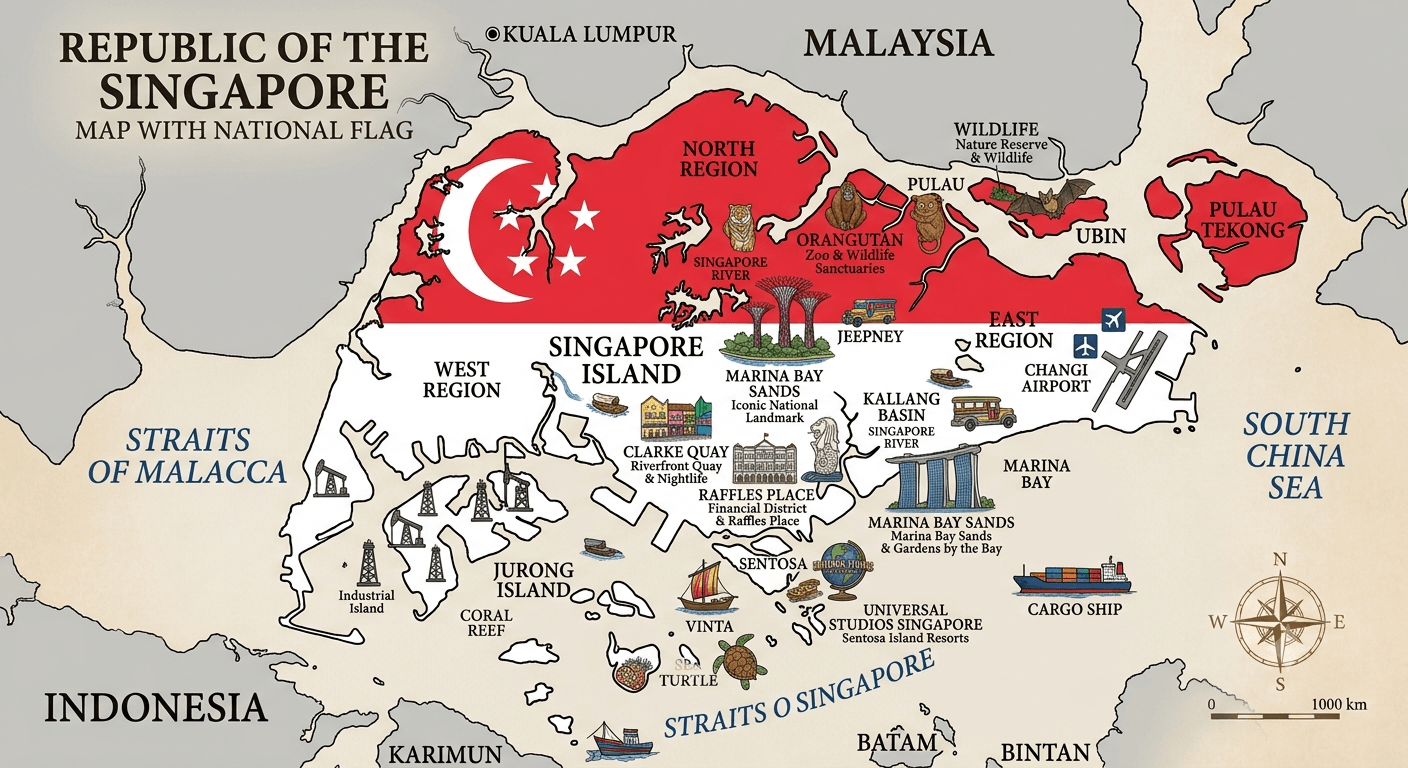
Singapore is a sovereign island city-state in Southeast Asia, situated at the southern tip of the Malay Peninsula, separated from Malaysia by the Straits of Johor to the north and from Indonesia’s Riau Islands by the Singapore Strait to the south. The territory comprises one main island and around 60 smaller islands, with a total land area of approximately 734.3 sq km, substantially expanded through land reclamation. Its position astride the Strait of Malacca, one of the world’s busiest shipping lanes, has made it a pivotal global maritime and aviation hub.
1.2 Official Political Name and Political System
The country’s official name is the Republic of Singapore. It is a unitary parliamentary republic with a Westminster-style multi-party system, though it has been governed continuously by the People’s Action Party (PAP) since independence in 1965. The Head of State is the President (Tharman Shanmugaratnam, since September 2023), while executive power rests with the Prime Minister (Lawrence Wong, since May 2024) and the Cabinet. Singapore ranks 3rd of 193 countries on the UN E-Government Development Index (EGDI value 0.969, 2024) and scores strongly on governance and rule-of-law indices.
Source: UN DESA e-Government Knowledge Base 2024; Government of Singapore.
1.3 Economic Overview
Singapore is a high-income, highly open advanced economy and one of the world’s leading financial, trade and logistics hubs. Nominal GDP stood at US$547.4 billion in 2024 (World Bank) and is estimated by the IMF at US$659.6 billion in 2026, with GDP per capita around US$107,758 (IMF, 2026). The economy expanded 4.4% in 2024 and around 4.0% in 2025, aided by resilient electronics and trade-related services; the Ministry of Trade and Industry projects 2026 growth of 1.0%–3.0% amid global trade uncertainty. Services contribute about 75% of GDP, industry about 25%, and agriculture under 0.5%.
Source: World Bank Open Data (NY.GDP.MKTP.CD); IMF World Economic Outlook, April 2026; Singapore Ministry of Trade and Industry (MTI), 3Q2025 release.
1.4 Agricultural Sector
Agriculture contributes less than 0.5% of GDP and under 1% of employment, reflecting Singapore’s land scarcity (under 1% of land is farmed). To reduce import dependence—over 90% of food is currently imported—the government’s ’30 by 30′ strategy targets locally produced food meeting 30% of nutritional needs by 2030 through high-tech vertical farming, aquaculture and alternative-protein production.
Source: Singapore Food Agency (SFA); World Bank sectoral data.
1.5 Industrialization and Manufacturing Sector
Industry (including manufacturing, construction and utilities) accounts for roughly 25% of GDP. Manufacturing is anchored by electronics and semiconductors, petroleum refining and petrochemicals, biomedical sciences and pharmaceuticals, precision engineering, and marine and offshore engineering. Jurong Island hosts an integrated petrochemicals cluster, while Singapore is also a top-five global semiconductor equipment and wafer-fabrication location.
Source: SingStat; Economic Development Board (EDB), Singapore.
2. Trade and Economic Profile
2.1 Export and Import Overview
Singapore’s total merchandise trade reached S$1,397.7 billion in 2025 (exports S$739.4 billion; imports S$658.3 billion), up 8.7% from S$1,285.9 billion in 2024. Non-oil domestic exports remain dominated by electronics. Singapore’s top merchandise-trade partners in 2025 were Mainland China, Taiwan, the United States, Malaysia and the EU.
| Partner (2025) | Exports (S$ bil) | Imports (S$ bil) |
| Mainland China | 162.9 | 170.3* |
| United States | 139.2 | 104.4* |
| Malaysia | 145.0* | — |
| Hong Kong | 87.5* | — |
| Taiwan | — | 170.3 |
| EU | 104.4 | — |
Source: SingStat, ‘Singapore International Trade’ infographic, 2025 data (*indicates combined trade-value bubble; figures approximate).
2.2 Major Export Products
- Machinery & transport equipment (incl. semiconductors, telecom equipment): S$439.3 billion — 69.2% of non-oil exports (2025)
- Chemicals & chemical products: S$66.0 billion — 10.4% of non-oil exports (2025)
- Miscellaneous manufactured articles, mineral fuels, and refined petroleum products
2.3 Major Import Products
- Machinery & transport equipment: S$379.7 billion — 68.2% of non-oil imports (2025)
- Chemicals & chemical products: S$38.9 billion — 7.0% of non-oil imports (2025)
- Manufactured goods, food & live animals, and mineral fuels
Source: Singapore Department of Statistics (SingStat), Merchandise Trade tables, 2025.
2.4 Gross Domestic Product (GDP)
| Indicator | Value | Year |
| Nominal GDP (World Bank) | US$547.4 billion | 2024 |
| Nominal GDP (IMF estimate) | US$659.6 billion | 2026 |
| GDP per capita (IMF) | US$107,758 | 2026 |
| GDP growth rate | 4.4% | 2024 |
| GDP growth rate (MTI estimate) | ~4.0% | 2025 |
| GDP growth forecast (MTI) | 1.0%–3.0% | 2026 |
Source: World Bank Open Data; IMF WEO April 2026; Singapore MTI, 3Q2025 GDP release.
2.5 Detailed GDP Analysis
By sector, services contribute approximately 75.2% of GDP, industry 24.8%, and agriculture 0.5% (latest available structural estimate). Growth in 2025 was driven by trade-related and financial services and by a rebound in electronics output; 3Q2025 GDP grew 4.2% year-on-year. Singapore’s high trade-to-GDP ratio (over 300% including re-exports) underscores its dependence on external demand and global supply chains, making growth sensitive to trade-policy shifts among major partners such as the US and China.
Source: SingStat 3Q2025 GDP release; World Bank/CIA sectoral GDP composition.
2.6 Major Industrial Products
- Semiconductors, integrated circuits and electronic components
- Refined petroleum and petrochemical products
- Biomedical and pharmaceutical products
- Precision engineering equipment and machinery
- Marine, offshore and shipbuilding equipment
3. Education
3.1 Overview of the Education System
Education is administered by the Ministry of Education (MOE) under a bilingual policy requiring English alongside a designated mother tongue (Mandarin, Malay or Tamil). The system spans six years of primary education, four to five years of secondary education, and post-secondary pathways through junior colleges, polytechnics, the Institute of Technical Education, and universities. The national education budget was S$13.2 billion in 2022, and total enrolment across all levels was 422,555 students in 2022.
Source: Singapore Ministry of Education (MOE), Education Statistics Digest.
3.2 Literacy Rate
The adult literacy rate (population aged 15 and above) was 97.6% in 2021 (the most recent census-linked figure), comprising 98.9% among males and 96.4% among females, both well above global averages.
Source: SingStat / World Bank, SE.ADT.LITR.ZS.
3.3 Educational Status and Human Capital Development
Singaporean students consistently rank among global leaders in the OECD’s PISA assessments in mathematics, science and reading. Secondary-level attainment reaches 99% and post-secondary diploma attainment 63.1%. Singapore’s strong human-capital base underpins its transition into high-value knowledge industries such as biomedical sciences, fintech and advanced manufacturing.
Source: MOE Education Statistics Digest; OECD PISA.
4. Health and Social Indicators
| Indicator | Singapore | Bangladesh (comparator) |
| Human Development Index (2023) | 0.946 (Very High, rank ~12–13) | 0.685 (Medium) |
| Life expectancy at birth (2024) | 83.0 years | 75.2 years |
| Adult literacy rate | 97.6% (2021) | ~77% (latest census) |
| GDP per capita (2025/26) | ~US$100,000+ | ~US$2,700 |
| Population (2025) | 6.11 million | ~173 million |
Source: UNDP Human Development Report 2025 (Statistical Annex); World Bank Open Data (life expectancy, literacy, GDP per capita, population).
4.1 Social and Economic Development
Singapore’s HDI value of 0.946 (2023) places it among the ‘very high human development’ group, having climbed from 37th to roughly 12th–13th globally over recent decades—one of the largest rank improvements of any country. Inequality-adjusted HDI (IHDI) is 0.823. Universal healthcare coverage, near-full home ownership, and a comprehensive social-security (CPF) system underpin these outcomes.
4.2 Nutrition and Human Development
Infant mortality is among the world’s lowest, at roughly 2.7 per 1,000 live births, and life expectancy at birth reached 83.0 years in 2024 (male and female combined), reflecting strong nutrition, sanitation and healthcare-access indicators. By contrast, Bangladesh’s life expectancy stood at 75.2 years, illustrating the development gap and the rationale for continued technical and health-sector cooperation.
Source: World Bank Open Data; WHO; Health in Singapore statistics.
5. Bangladesh–Singapore Bilateral Relations
Bangladesh and Singapore established diplomatic relations in February 1972, marking over five decades of ties in 2025. Bangladesh opened a Trade Commission in Singapore in 1973, upgraded to a full High Commission in 1983; Ferdousi Shahriar has served as Bangladesh’s High Commissioner to Singapore since November 2024. Singapore is represented in Bangladesh through its High Commission in Dhaka (Gulshan Avenue); Singapore does not yet maintain a large resident mission structure comparable to Bangladesh’s in Singapore, though full diplomatic representation exists on both sides.
Cooperation spans trade, investment promotion, technical assistance, defence and people-to-people links. Bangladesh hosts a large Singaporean-linked economic-zone interest, particularly in infrastructure and power, while Singapore is a major destination for Bangladeshi labour migration and a source of portfolio and direct investment.
Source: High Commission for the People’s Republic of Bangladesh, Singapore; Ministry of Foreign Affairs, Singapore; ISAS Brief No. 906 (NUS).
6. Bilateral Trade Analysis
6.1 Trade Flows
Singapore is consistently among Bangladesh’s top ten import-source countries. Singapore’s exports to Bangladesh were valued at approximately US$3.23 billion in 2023 (UN Comtrade), dominated by mineral fuels, machinery and electronics, while Bangladesh’s exports to Singapore are comparatively modest, historically in the range of US$250–300 million, led by apparel and ships/floating structures.
| Product Group (HS Chapter) | Approx. Value (latest data) | Direction |
| Mineral fuels, oils (HS 27) | US$1.08 billion | Singapore → Bangladesh |
| Machinery, boilers, reactors (HS 84) | US$320.8 million | Singapore → Bangladesh |
| Electrical & electronic equipment (HS 85) | US$252.2 million | Singapore → Bangladesh |
| Plastics (HS 39) | US$158.5 million | Singapore → Bangladesh |
| Iron and steel (HS 72) | US$102.8 million | Singapore → Bangladesh |
| Ships, boats, floating structures (HS 89) | US$109.9 million | Bangladesh → Singapore |
| Apparel, not knit (HS 62) | US$35.6 million | Bangladesh → Singapore |
| Apparel, knit or crocheted (HS 61) | US$34.7 million | Bangladesh → Singapore |
| Cereal, flour, starch preparations (HS 19) | US$29.6 million | Bangladesh → Singapore |
Source: UN Comtrade via Trading Economics (Singapore exports to Bangladesh, 2023; Bangladesh exports to Singapore, most recent Comtrade-reported year); figures are illustrative of product composition rather than the latest single-year totals — the Export Promotion Bureau (EPB) online HS-code portal (epb.gov.bd) is the authoritative source for current fiscal-year Bangladeshi export figures by country and HS code.
6.2 Banking and Trade Financing (Bangladesh Bank)
Commercial activity between the two countries is channelled mainly through Letters of Credit (LCs) for machinery, electronics and fuel imports from Singapore, correspondent-banking arrangements, and remittance transfers. Singapore is a significant remittance-sending corridor: Bangladesh Bank and BMET data show remittance inflows reaching a record cumulative US$32 billion in 2025, with Singapore consistently ranking among the top five source countries alongside Saudi Arabia, the UAE and Qatar.
Source: Bangladesh Bank, Annual Report and monthly remittance data; Bureau of Manpower, Employment and Training (BMET).
7. International Cooperation
Bangladesh and Singapore are both full members of the United Nations (Bangladesh since 1974, Singapore since 1965), the Commonwealth of Nations, the World Trade Organization, and the Indian Ocean Rim Association (IORA). Shared membership provides regular platforms for coordination on trade liberalisation, maritime cooperation and sustainable-development issues, and both governments have expressed convergent positions in WTO and Commonwealth forums. Singapore, additionally a founding ASEAN member and party to CPTPP and RCEP, functions as a bridge connecting Bangladesh to broader Southeast Asian economic integration, an avenue Dhaka is exploring through its long-standing interest in closer ASEAN engagement.
Source: Wikipedia (UN membership pages); Australian Institute of International Affairs; DFAT (IORA); Ministry of Foreign Affairs, Singapore.
8. Opportunities for Bangladeshi Citizens in Singapore
- Higher Education: Access to globally ranked universities (NUS, NTU, SMU) and polytechnics; growing numbers of Bangladeshi students pursue STEM, business and engineering degrees.
- Employment and Labour Migration: Singapore remains a top-five overseas employment destination for Bangladeshi workers — about 70,004 Bangladeshis were deployed to Singapore in 2025 (BMET), mainly in construction, marine, manufacturing and services.
- Visa Facilities: Work Permit, S Pass and Employment Pass categories are available depending on skill level and salary; short-term business and tourist visas are processed through the Singapore High Commission in Dhaka.
- Export Opportunities: Preferential access exists for apparel, leather goods, agro-processed foods, ships and light engineering products given Singapore’s open, near-zero-tariff trade regime.
- Long-term Residency: Permanent Residency and, in limited cases, citizenship are available to skilled professionals and long-term Employment Pass holders meeting Singapore’s selective criteria.
- Remittance Channel: Singapore is among the top five sources of remittances to Bangladesh, supporting household incomes and foreign-exchange reserves.
Source: BMET/Ministry of Expatriates’ Welfare and Overseas Employment; The Business Standard, January 2026; Bangladesh Bank.
9. Opportunities for Singapore from Bangladesh
- High-potential import products: Ready-made garments and knitwear (Bangladesh is the world’s second-largest RMG exporter, with global RMG exports of US$38.48 billion in 2024 and US$39.35 billion in FY2024-25), leather and footwear, jute and jute goods, agro-processed foods, and light engineering/ship-building products.
- Investment opportunities: Special Economic Zones, the proposed Bangladesh–Singapore-linked economic zone for exclusive Singaporean investment, power and energy infrastructure, ports and logistics, and digital/fintech services.
- Industrial cooperation: Petrochemicals, electronics assembly, pharmaceuticals and renewable energy present scope for joint ventures leveraging Singapore’s capital and Bangladesh’s manufacturing labour base.
- Other sectors: Marine and shipbuilding (Bangladesh already exports vessels to Singapore), halal food processing, and IT/ITES outsourcing.
Source: Textile Focus/BGMEA export data, 2025; High Commission for Bangladesh, Singapore; Invest Bangladesh (BIDA).
10. Trade Associations and Future Prospects
Bangladeshi trade bodies — including the Federation of Bangladesh Chambers of Commerce and Industry (FBCCI), BGMEA and the Dhaka Chamber of Commerce and Industry (DCCI) — periodically engage with the Singapore Business Federation (SBF) and Enterprise Singapore through business forums, trade delegations and matchmaking events, though a dedicated bilateral chamber of commerce remains underdeveloped relative to Bangladesh’s ties with India, China or the EU. Institutional cooperation exists through Singapore’s technical-assistance programmes (Singapore Cooperation Programme) that have trained Bangladeshi civil servants, and through periodic Joint Trade/Business Council discussions.
Looking ahead, both sides have significant scope to expand ties: Bangladesh’s LDC graduation (expected 2026) will change its preferential-access landscape, increasing the value of direct Singaporean investment and technology transfer; Singapore’s role as a re-export and financial hub can help Bangladeshi exporters reach ASEAN and broader Asia-Pacific markets under RCEP and CPTPP frameworks even without direct Bangladeshi membership.
Source: Australian Institute of International Affairs (2022); FBCCI; Singapore Business Federation.
11. Recommendations
- Negotiate a bilateral or regional trade/investment facilitation arrangement to reduce the wide trade imbalance (Singapore’s exports to Bangladesh are roughly ten times Bangladesh’s exports to Singapore) by expanding RMG, leather, agro-processed and light-engineering exports.
- Establish a dedicated Bangladesh–Singapore Business/Chamber Council to formalise trade-association cooperation alongside existing FBCCI–SBF engagement.
- Encourage Singaporean investment in Bangladesh’s Special Economic Zones, particularly power, port infrastructure and logistics, building on the High Commission’s proposed exclusive-investment economic zone.
- Deepen technical and vocational cooperation to raise the skill profile of Bangladeshi migrant workers in Singapore, improving wages and protections while increasing remittance value.
- Pursue Bangladesh’s LDC-graduation transition support and closer engagement with ASEAN-linked frameworks (RCEP, ASEAN dialogue-partner status) using Singapore as a gateway.
- Improve trade-data transparency and joint statistical reconciliation between the EPB, Bangladesh Bank, and SingStat/Enterprise Singapore to give both governments a consistent, up-to-date bilateral trade picture for policy planning.