Book Appointment Now

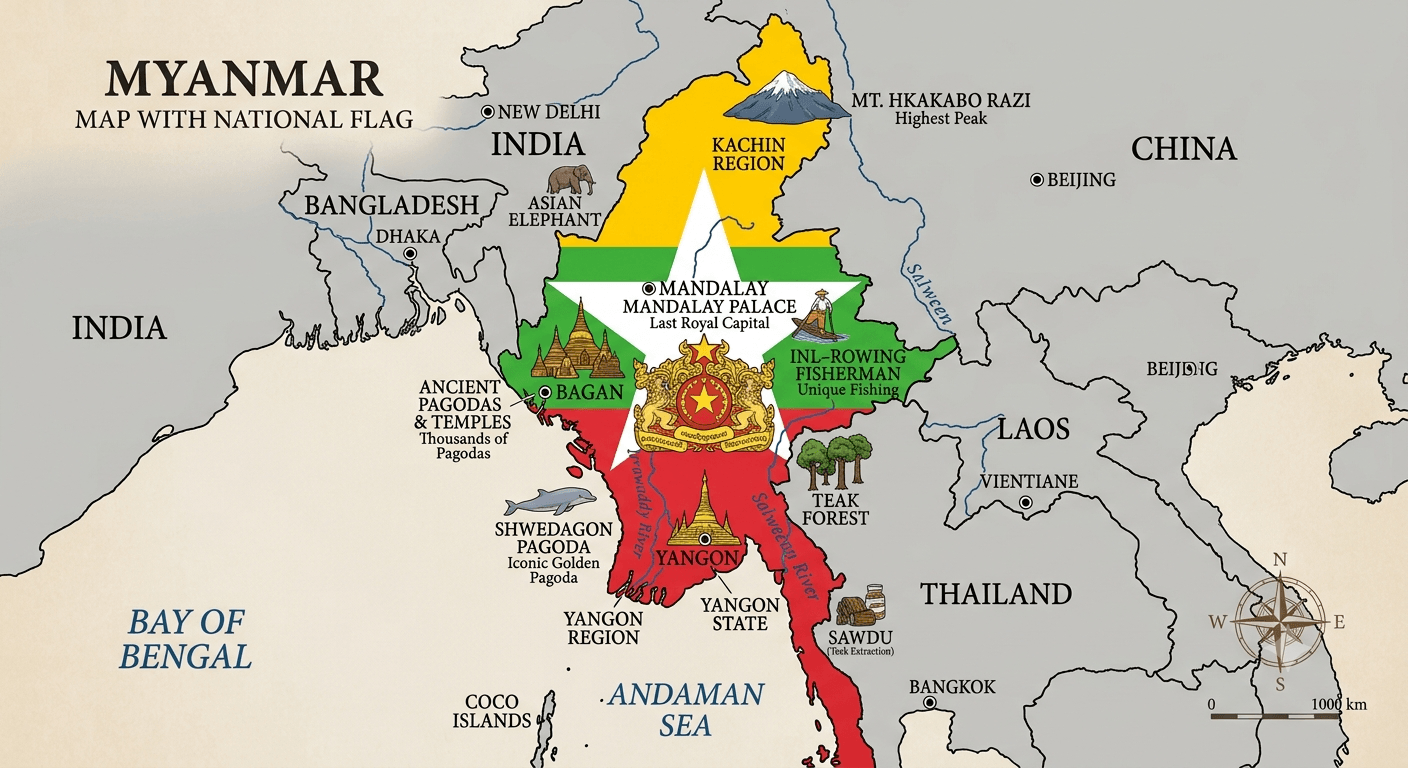
Myanmar: Prepared for bilateral market and trade assessment purposes
1. Country Profile
Myanmar, officially the Republic of the Union of Myanmar, lies in Southeast Asia, bordered by Bangladesh and India to the west, China to the northeast, and Laos and Thailand to the east, with a coastline along the Bay of Bengal and Andaman Sea. It spans approximately 676,578 square kilometres and shares a roughly 271-kilometre land and maritime border with Bangladesh (The Business Standard, 2023).
Since the military coup of February 2021, Myanmar has been governed by the State Administration Council (SAC) under Senior General Min Aung Hlaing, while a parallel National Unity Government (NUG) formed by ousted lawmakers claims legitimacy. The country remains in protracted civil conflict, disrupting administration, statistical reporting, and economic activity (BTI, 2024).
Myanmar is classified as a Least Developed Country by the UN and a lower-middle-income economy by the World Bank. Nominal GDP was estimated at USD 83.83 billion in 2026 (IMF/Worldometer, 2026), with per capita GDP of approximately USD 1,519. The economy remains reliant on agriculture, natural resource extraction, and low-value manufacturing, compounded since 2021 by conflict, currency depreciation, and sanctions-related trade disruption (World Bank, Myanmar Economic Monitor, June 2025).
Agriculture contributes approximately 36 percent of GDP and employs the largest workforce share; rice, pulses, beans, and oilseeds are principal crops (Trading Economics, 2024). Industry contributes around 26 percent of GDP, concentrated in garments, food processing, construction materials, and gems/jade, with Yangon and the Thilawa Special Economic Zone as key hubs. Services contribute the remaining 38 percent, led by trade, transport, and telecommunications (Trading Economics, 2024).
2. Trade and Economic Profile
Myanmar’s external trade has contracted since 2021 amid conflict, banking restrictions, and currency volatility. World Bank reporting (Myanmar Economic Monitor, June 2025; Macro Poverty Outlook, 2025-2026) notes continued external fragility, with a current account deficit of approximately 5.5 percent of GDP, and food and non-food inflation easing to 16.2 percent and 20.8 percent respectively by December 2025, still elevated relative to pre-coup levels.
Major exports include natural gas, ready-made garments, agricultural commodities (rice, pulses, beans), gems/jade, and wood products. Major imports include machinery and transport equipment, refined petroleum, construction materials, fertilizers, and consumer goods.
| Indicator | 2024 | 2025 (e) | 2026 (f) | Source |
| Nominal GDP (USD bn) | ~74.1 | ~81.0 | 83.83 | IMF/Worldometer, Trading Economics |
| GDP growth (annual %) | -1.0 | -2.0 | 3.0 | Central Bank of Myanmar; World Bank MPO |
| GDP per capita (USD) | 1,158 | 1,502 | 1,519 | IMF/Worldometer |
| GDP per capita, PPP (USD) | 5,276 | – | 5,168 | IMF/Worldometer |
Note: estimates diverge across sources — the World Bank projects a contraction of approximately 2.0 percent for FY2025/26, reflecting the March 2025 earthquake, while IMF-based compilations show a return to approximately 3.0 percent growth in 2026. Given the absence of a national census-based rebasing since the coup, all figures should be treated as indicative rather than precise official statistics.
Major industrial products include ready-made garments and textiles, processed foods and beverages, cement and construction materials, wood products, and gems and jewellery. Garments remain the largest manufactured export category, though international buyer withdrawal since 2021 has weakened this sub-sector.
3. Education
Myanmar’s education system is administered by the Ministry of Education across primary, secondary, and tertiary levels, historically supplemented by monastic schooling in rural areas. Since 2021, the sector has been disrupted by a nationwide civil disobedience movement, conflict-related school closures, and low public education expenditure (around 1.2 percent of GDP pre-coup).
Per the 2014 Myanmar Census, the most recent census-based measurement, national literacy stood at 89.5 percent (male 92.6 percent, female 86.9 percent). More recent World Bank/UNESCO modelled estimates place adult literacy at approximately 93.5 percent (2020), though these are model-based given the absence of a post-coup census. Youth (15-24) literacy is estimated at 92.4 percent (male) and 86.3 percent (female), with a gross enrollment ratio of 112.3 percent, indicating over-age rather than universal timely enrollment (BTI, 2024).
Human capital development remains constrained by conflict, teacher shortages, and gender disparities in secondary/tertiary access, particularly in ethnic-minority and conflict-affected states (BTI, 2024).
4. Health and Social Indicators
Myanmar’s Human Development Index (HDI) was recorded at 0.608 in the most recent sub-national compilation (2022 data, Global Data Lab), medium human development, though regional disparities are pronounced — from 0.697 in Yangon to 0.529 in Shan State. UNDP’s Human Development Report (2021-22 cycle) placed Myanmar at 0.585, also medium human development, ranked 149th globally.
| Indicator | Value | Source / Year |
| Life expectancy at birth | 69.9 years | CIA World Factbook / UN estimate, 2022 |
| Infant mortality rate | 32.9 per 1,000 live births | CIA World Factbook, 2022 |
| Adult literacy rate | 89.5%-93.5% | 2014 Census; World Bank/UNESCO modelled, 2020 |
| Population | ~54.6-55.2 million | UN/Worldometer estimate, 2024-2026 |
| Current account balance | -5.5% of GDP | World Bank/Trading Economics, 2025 |
Nutrition and food security have deteriorated since 2021, compounded by the 2025 earthquake and conflict displacement. FAO/WFP joint monitoring (Data in Emergencies household surveys, 2023-2025) documents elevated food insecurity in conflict-affected townships, though nationally representative post-2021 nutrition data remains limited. Several indicators above rely on pre-2021 baselines updated with partial modelled estimates, a limitation to note for planning purposes.
5. Bangladesh-Myanmar Bilateral Relations
Diplomatic relations between Bangladesh and Myanmar are longstanding but strained, dominated principally by the Rohingya refugee crisis. Since the August 2017 exodus, Bangladesh has hosted over one million Rohingya refugees in Cox’s Bazar, and repatriation remains the central, largely unresolved bilateral agenda item. A China-brokered pilot repatriation program was discussed in 2023, though large-scale repatriation has not materialized (The Business Standard, 2023).
Myanmar maintains an embassy in Dhaka, and Bangladesh an embassy in Yangon, providing channels for consular and diplomatic engagement. A Joint Task Force on trade, investment, and border infrastructure was established in 2018 to identify corridors including the Teknaf-Maungdaw/Sittwe route, though implementation has been limited by Myanmar’s post-2021 instability.
6. Bilateral Trade Analysis
Bilateral trade between Bangladesh and Myanmar remains modest relative to each country’s overall trade volume and is characterized by a narrow product base concentrated in border and formal maritime trade.
| Myanmar’s exports to Bangladesh (2024) | Value (USD) | HS Chapter (approx.) |
| Coffee, tea, mate and spices | 22.15 million | HS 09 |
| Fish, crustaceans and molluscs | 17.63 million | HS 03 |
| Edible fruits and nuts | 8.65 million | HS 08 |
| Food industry residues, animal fodder | 5.64 million | HS 23 |
| Edible vegetables and roots | 2.57 million | HS 07 |
| Apparel (woven) and rubber | 1.60m / 1.30m | HS 62 / HS 40 |
| Total Myanmar exports to Bangladesh | 67.18 million | UN Comtrade, 2024 |
| Bangladesh’s exports to Myanmar (2018)* | Value (USD) | HS Chapter (approx.) |
| Pharmaceutical products | 20.19 million | HS 30 |
| Apparel, knit or crocheted | 1.23 million | HS 61 |
| Products of animal origin | 1.03 million | HS 05 |
| Other made textile articles | 0.97 million | HS 63 |
| Electrical and electronic equipment | 0.68 million | HS 85 |
| Total Bangladesh exports to Myanmar | 28.43 million | UN Comtrade, 2018* |
*2018 is the most recent year with a verifiable disaggregated, product-level UN Comtrade breakdown for Bangladesh’s exports to Myanmar. Bangladesh’s pharmaceutical exports to Myanmar were reported at approximately USD 11.8 million in 2015, projected toward USD 27 million by 2021 (The Business Standard, 2023), consistent with pharmaceuticals remaining Bangladesh’s leading export line.
Full 8-digit HS code listings specific to Bangladesh-Myanmar trade, as published by the Export Promotion Bureau (EPB), were not accessible in real time during this research; the Bangladesh Trade Portal and EPB’s statistical tables (epb.gov.bd) should be consulted directly for exact HS code and consignment-level detail.
Publicly available Bangladesh Bank Annual Report editions do not separately disaggregate Letters of Credit, trade financing, or correspondent banking data specific to Myanmar; bilateral commercial banking is understood to rely primarily on standard LC mechanisms and border cash settlement, given limited formal bilateral banking ties. This is a data limitation, not a confirmed finding, and should be verified against the relevant Bangladesh Bank Annual Report and Foreign Exchange Policy Department circulars.
7. International Cooperation
Bangladesh and Myanmar are both members of the United Nations, the World Trade Organization, the Asian Development Bank, and BIMSTEC (Bay of Bengal Initiative for Multi-Sectoral Technical and Economic Cooperation). Myanmar is not a member of the Organisation of Islamic Cooperation (OIC), of which Bangladesh is a member; the OIC has instead served as a channel through which Bangladesh and fellow members have raised the Rohingya issue vis-à-vis Myanmar.
Shared membership in BIMSTEC and the ADB provides a multilateral framework for regional connectivity and trade-facilitation dialogue, but has not translated into a substantially deepened bilateral commercial relationship, which remains constrained primarily by the unresolved Rohingya crisis and Myanmar’s internal conflict.
8. Opportunities for Bangladeshi Citizens in Myanmar
- Higher education: formal academic exchange remains limited; Myanmar is not currently a mainstream destination for Bangladeshi students.
- Employment and labour migration: no significant formal corridor exists; opportunities are constrained by security conditions and limited institutional agreements.
- Visa facilities: Myanmar previously offered e-visa and visa-on-arrival facilities, though these have been affected by post-2021 instability and should be reconfirmed against current immigration notices before travel.
- Export opportunities: pharmaceuticals, garment inputs, and agro-processed goods are Bangladesh’s strongest existing export lines, with scope for expansion once conditions normalize.
- Citizenship or long-term residency: no significant provisions exist for Bangladeshi nationals.
Current political and security conditions materially constrain practical opportunities for Bangladeshi citizens in Myanmar across nearly all categories except limited goods trade.
9. Opportunities for Myanmar from Bangladesh
- High-potential import products: pharmaceuticals, readymade garments/textiles, agro-processed foods, ceramics, plastics, and light engineering goods.
- Investment opportunities: potential interest in energy (given Myanmar’s gas resources), telecommunications, and financial services, contingent on political stabilization.
- Industrial cooperation: backward-linkage cooperation in garment raw materials, and fisheries/agro-processing given complementary resource endowments.
- Other sectors: cross-border connectivity and logistics infrastructure (Teknaf-Sittwe corridor), and pharmaceutical manufacturing technology transfer.
10. Trade Associations and Future Prospects
Bangladesh’s apex trade body, the Federation of Bangladesh Chambers of Commerce and Industry (FBCCI), has historically engaged with Myanmar’s Union of Myanmar Federation of Chambers of Commerce and Industry (UMFCCI) through joint business council discussions, particularly around the 2018 Joint Task Force initiative. Institutional cooperation has remained largely dormant since 2021 amid Myanmar’s internal conflict.
Future prospects for bilateral trade and investment remain contingent on political stabilization, resolution of the Rohingya repatriation impasse, and normalization of banking and logistics channels. Incremental gains are more likely through border trade formalization and BIMSTEC-facilitated connectivity than large-scale formal investment.
11. Recommendations
- Formalize and expand border trade channels (Teknaf-Maungdaw/Sittwe) with simplified customs procedures to capture currently informal cross-border commerce in fishery and agricultural products.
- Strengthen correspondent banking and trade-financing arrangements to reduce reliance on cash settlement and support SME participation in bilateral trade, subject to compliance with prevailing sanctions and financial-integrity requirements.
- Pursue durable, internationally-monitored Rohingya repatriation as a precondition for fuller normalization of political and commercial relations, leveraging UN and BIMSTEC platforms.
- Encourage a renewed institutional memorandum of understanding between FBCCI and UMFCCI once conditions permit, focused on pharmaceuticals, agro-processing, and garment-sector cooperation.
- Prioritize pharmaceutical and agro-processed exports, Bangladesh’s demonstrated areas of comparative advantage in the Myanmar market, for near-term promotional focus by the Export Promotion Bureau.
- Monitor World Bank, IMF, and ADB country updates closely, given the pace at which Myanmar’s economic and political conditions are evolving, and treat all forecasts in this profile as indicative pending fresh official data releases.
References
Bangladesh Trade Portal / Export Promotion Bureau (EPB), Government of Bangladesh — epb.gov.bd
BTI (Bertelsmann Stiftung) Country Report 2024 — Myanmar
Central Bank of Myanmar, national accounts data (via Trading Economics)
FAO and World Food Programme, Data in Emergencies (DIEM) Monitoring System, Myanmar household surveys, 2023-2025
International Monetary Fund, World Economic Outlook data (via Worldometer compilation, 2026)
The Business Standard, “Bangladesh-Myanmar trade and investment: Opportunities and way forward”, 2023
UN Comtrade database, Myanmar-Bangladesh bilateral trade statistics, 2018 and 2024
UNDP, Human Development Report, 2021-22; Global Data Lab, sub-national HDI series
World Bank, Myanmar Economic Monitor, June 2025; Macro Poverty Outlook, Myanmar, 2025-2026
World Bank Open Data, World Development Indicators — data.worldbank.org/country/myanmar