Book Appointment Now

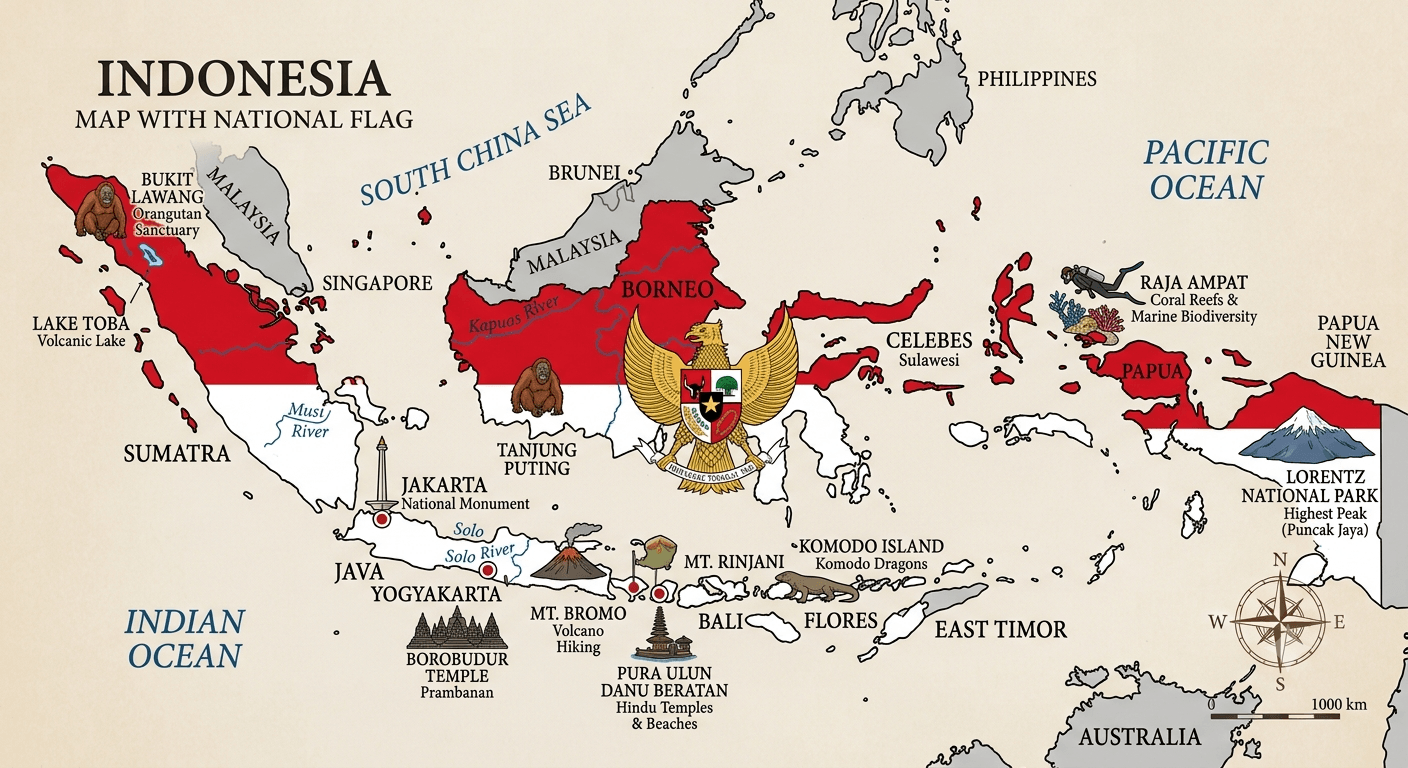
Indonesia (Republik Indonesia): world’s largest archipelagic state
1. Country Profile
Geographical Location: Indonesia is the world’s largest archipelagic state, comprising over 17,000 islands across Southeast Asia, straddling the equator between the Indian and Pacific Oceans. It shares land borders with Malaysia, Papua New Guinea, and Timor-Leste, and maritime boundaries with Singapore, the Philippines, Australia, and India.
Official Political Name: Republic of Indonesia (Republik Indonesia).
Political System: Indonesia is a presidential republic with a multi-party democratic system. The President serves as both head of state and head of government, elected directly for a five-year term. Legislative authority rests with the People’s Consultative Assembly (MPR), comprising the House of Representatives (DPR) and the Regional Representative Council (DPD).
Economic Overview: Indonesia is Southeast Asia’s largest economy and the world’s largest archipelagic economy, with a GDP of approximately USD 1.44 trillion in 2025 (World Bank), ranking among the world’s top 20 economies. The economy expanded by 5.11% in 2025, an improvement on 5.03% growth in 2024, with GDP per capita reaching approximately USD 5,083 (BPS-Statistics Indonesia). The World Bank projects average annual growth of 4.8% over 2025–2027, supported by investment, the sovereign wealth fund Danantara, and government housing initiatives, though downside risks stem from global trade tensions and commodity price volatility.
Agricultural Sector: Agriculture, forestry, and fisheries remain a significant pillar, contributing approximately 13.1% of GDP in 2025 (BPS), while employing a considerably larger share of the workforce than its GDP contribution suggests. Palm oil is the sector’s dominant output and Indonesia’s single largest export commodity.
Industrialization and Manufacturing Sector: Manufacturing is the largest contributor to national output, accounting for 19.07% of GDP in 2025 (BPS), followed by wholesale/retail trade (13.17%) and construction (9.83%). Key manufacturing sub-sectors include food processing, textiles, automotive assembly, electronics, and petrochemicals. The processing industry has also been the principal driver of non-oil and gas export growth.
2. Trade and Economic Profile
Export and Import Overview: According to BPS-Statistics Indonesia, full-year 2025 exports reached USD 282.91 billion (up 6.15% year-on-year), while imports totaled USD 241.86 billion (up 2.83%), producing a trade surplus of USD 41.05 billion — the country’s 61st consecutive month of surplus as of mid-2025. Non-oil and gas exports drove the surplus, with manufacturing contributing USD 227.1 billion of total exports.
Major Export Products: Palm oil and fractions (~USD 20.2 billion, Jan–Oct 2025), coal (~USD 20.1 billion), ferroalloys (~USD 13.35 billion), iron and steel, nickel products, and electronics/semiconductors. China is the largest destination (USD 64.82 billion in non-oil/gas exports in 2025), followed by the United States (USD 30.96 billion) and India (USD 18.32 billion); ASEAN absorbed USD 51.58 billion.
Major Import Products: Imports are dominated by raw materials and intermediate/auxiliary goods (USD 166.3–209.1 billion range), alongside capital goods and oil and gas products (non-oil/gas imports rose 5.11% in 2025).
Gross Domestic Product (GDP): Nominal GDP reached IDR 23,821.1 trillion (~USD 1.44 trillion) in 2025 at current prices, up from IDR 22,139.0 trillion in 2024.
Detailed GDP Analysis: Real GDP growth was 5.11% in 2025 (vs. 5.03% in 2024), with Q4 2025 growth accelerating to 5.39% y-o-y — the fastest quarterly pace since Q3 2022. Sectoral shares: manufacturing 19.07%, trade 13.17%, agriculture 13.10%, construction 9.83%, mining 8.75% (contracted -0.66% in 2025). GDP per capita stood at USD 5,083.4 (IDR 83.7 million), up from USD 4,960.3 in 2024. The IMF has raised its 2026 growth forecast for Indonesia to 5.1%.
Major Industrial Products: Petroleum and natural gas derivatives, textiles and garments, automotive and components, electrical appliances, palm oil derivatives, cement, and processed food and beverages.
3. Education
Overview of the Education System: Indonesia operates a 12-year compulsory basic education framework (6 years primary, 3 years junior secondary, 3 years senior secondary), overseen by the Ministry of Education, Culture, Research and Technology, alongside a separate religious education stream (madrasah) under the Ministry of Religious Affairs. Government education expenditure was approximately USD 17.8 billion in 2023, equivalent to about 1.3% of GDP — below the global average of roughly 4.3% (UNESCO).
Literacy Rate: The adult literacy rate (population aged 15+) stands at approximately 96.0%, above the global average of 86.4% (UNESCO Institute for Statistics/World Bank).
Educational Status and Human Capital Development: Expected years of schooling reached 13.21 years in 2024 (up from 13.15 in 2023), while mean years of schooling for adults aged 25+ rose to 8.85 years (from 8.77 years), according to BPS. Educational attainment thins at higher levels: 83.8% of adults over 25 complete elementary school, 56.7% complete lower secondary, and only 39.1% complete upper secondary (UNESCO/OECD data), indicating persistent gaps in higher-level human capital formation relative to peer economies.
4. Health and Social Indicators
Human Development: Indonesia’s national Human Development Index (BPS methodology) reached 75.02 in 2024, up 0.85% from 74.39 in 2023, with an average annual increase of 0.75% over 2020–2024, reflecting improvements across health, education, and living-standard dimensions.
Social and Economic Development: Life expectancy at birth reached 74.15 years in 2024 (up from 73.93), while the standard-of-living dimension, measured by adjusted real per capita expenditure, rose by 3.71% year-on-year.
Literacy and Illiteracy: As above, adult literacy is around 96%, though regional disparities remain, with eastern provinces such as East Nusa Tenggara recording HDI values markedly below the national average (69.14 in 2024).
Nutrition and Other Indicators: The World Bank and UN agencies continue to flag childhood stunting as a persistent development challenge in Indonesia, though the government’s national stimulus and housing programs (including a USD 3.8 billion annual public housing investment) aim to improve living conditions and broader welfare outcomes. Labor market data show real wages declined by 1.1% annually between 2018 and 2024 despite macroeconomic stability, per World Bank’s December 2025 Indonesia Economic Prospects report.
5. Bangladesh–Indonesia Bilateral Relations
Bangladesh and Indonesia established diplomatic relations on 1 May 1972 (some sources cite recognition on 25 February 1972), with Indonesia among the first Muslim-majority nations to recognize Bangladesh’s independence. Both countries marked the Golden Jubilee (50 years) of ties in 2022. Indonesia maintains an embassy in Dhaka, and Bangladesh maintains an embassy in Jakarta. Diplomatic engagement has intensified recently, with Indonesia publicly supporting Bangladesh’s bid for ASEAN Sectoral Dialogue Partner status, and both sides describing Indonesia as a “strategic gateway” for Bangladesh’s Southeast Asian integration (Bangladeshi Ambassador to Indonesia, December 2025). Cooperation spans trade, defense, tourism, aviation, and education, with a Preferential Trade Agreement (PTA) reportedly signed in 2023.
6. Bilateral Trade Analysis
Indonesia’s Exports to Bangladesh: Indonesia’s exports to Bangladesh were valued at approximately USD 3.58 billion in 2023 (UN Comtrade), following a peak of USD 3.89 billion in 2022 (a 32.99% rise over 2021). Leading categories include animal/vegetable fats and oils (HS 15, led by palm oil, ~USD 1.3–1.5 billion), mineral fuels and oils (HS 27, ~USD 1.3 billion), man-made staple fibers, and organic chemicals (HS 29, ~USD 27–39 million range in recent annual data).
Bangladesh’s Exports to Indonesia: Bangladesh’s exports to Indonesia are considerably smaller and less diversified, reflecting a structural trade imbalance favoring Indonesia. Reported categories include jute and jute goods (Bangladesh exports jute products to 138 countries including Indonesia, per the Ministry of Textiles and Jute), and smaller volumes of readymade garments and other textile items. Bangladesh has formally requested Indonesia to increase imports of pharmaceutical products and raw materials, citing world-class manufacturing standards recognized in over 150 export markets (Ministry of Foreign Affairs, Bangladesh).
EPB HS-Code Level Data: EPB maintains detailed, HS-code-level country-wise export statistics (epb.gov.bd) covering RMG (HS 61/62), jute and jute goods (HS 53), leather and footwear (HS 41/42/64), agricultural products, and pharmaceuticals (HS 30) destined for Indonesia; a verified, current-fiscal-year HS-code breakdown specific to Indonesia was not available at the time of this report and should be obtained directly from EPB’s country-wise data portal.
Bangladesh Bank Commercial Activity: Bangladesh Bank’s Annual Report tracks bilateral banking flows, including Letters of Credit opened for imports from Indonesia (predominantly palm oil, chemicals, and fibers) and export-proceeds realization for Bangladeshi shipments; a disaggregated, Indonesia-specific breakdown was not confirmed in sources reviewed and should be verified against the latest Annual Report and Economic Trends publication.
7. International Cooperation
Bangladesh and Indonesia are both members of the United Nations, the Organisation of Islamic Cooperation (OIC), the Non-Aligned Movement (NAM), the World Trade Organization (WTO), the Developing 8 Countries (D-8), the Indian Ocean Rim Association (IORA), and the ASEAN Regional Forum (ARF), among other bodies. These shared platforms have reinforced diplomatic alignment on South-South cooperation, Global South solidarity, and multilateral trade and development issues, and have provided recurring venues (e.g., the Bali Process, ASEAN Summit sidelines) for bilateral ministerial engagement. Indonesia’s support for Bangladesh’s ASEAN Sectoral Dialogue Partner candidacy represents a notable, concrete outcome of this multilateral overlap.
8. Opportunities for Bangladeshi Citizens in Indonesia
Higher Education: Indonesia offers Bangladeshi students two principal scholarship channels via its Dhaka embassy: Darmasiswa (non-degree study of Bahasa Indonesia, arts, and culture across 45 institutions) and KNB (fully funded Master’s programs, one year of language preparation plus two years of study, at 13 partner universities), alongside periodic technical training programs. Indonesia’s comparatively low tuition costs make it an increasingly attractive study destination for Bangladeshi students.
Employment and Labour Migration: Formal, large-scale labour migration channels remain limited compared with Bangladesh’s traditional Gulf and Southeast Asian destinations (Malaysia, Singapore); opportunities exist principally through technical and vocational training exchanges under bilateral cooperation frameworks.
Visa Facilities: Scholarship recipients apply for Short Visit Visa (VITAS) or Social Visit Visa (VKSB) through the Indonesian Embassy in Dhaka; tourist visas cannot be converted for study purposes.
Export Opportunities: Bangladeshi exporters have identified pharmaceuticals, leather goods, jute products, and readymade garments as priority categories for expanded market access in Indonesia, given the current trade imbalance favoring Indonesian exporters.
Citizenship/Residency: No preferential long-term residency or citizenship pathway specific to Bangladeshi nationals was identified in available sources; standard Indonesian immigration provisions apply.
9. Opportunities for Indonesia from Bangladesh
High-Potential Import Products: Bangladesh’s globally competitive pharmaceutical sector (exported to 150+ countries) represents the clearest near-term opportunity for increased Indonesian imports, alongside jute and jute diversified products, leather and footwear, and select readymade garment categories.
Investment Opportunities: Bangladesh has actively sought Indonesian direct investment in its pharmaceutical manufacturing sector, alongside broader interest in joint ventures within its export processing zones and economic zones.
Industrial Cooperation: Areas of potential cooperation include textile and RMG value-chain linkages, agro-processing, and technical/vocational skills exchange, building on existing ministerial-level dialogue on trade and investment facilitation.
Other Sectors: Tourism, aviation connectivity, and defense-related cooperation have also been cited by both governments as areas with unrealized bilateral potential.
10. Trade Associations and Future Prospects
Bangladeshi trade bodies — including the Federation of Bangladesh Chambers of Commerce and Industry (FBCCI), BGMEA, and BKMEA — engage in broader ASEAN and D-8 business networking channels in which Indonesian counterparts (KADIN Indonesia) participate, though dedicated bilateral chamber-to-chamber mechanisms remain less developed than Bangladesh’s engagement with other major Asian trade partners. The 2023 Preferential Trade Agreement (PTA) signals institutional intent to deepen trade ties. Future prospects hinge on formalizing tariff concessions under the PTA, expanding direct shipping and aviation links, and translating diplomatic goodwill from the 50th-anniversary period into measurable increases in two-way, non-commodity trade.
11. Recommendations
1. Rebalance bilateral trade by prioritizing Bangladeshi pharmaceutical, jute-diversified, and leather product registration and market access in Indonesia, leveraging existing government-to-government requests already on record.
2. Operationalize the 2023 PTA with clear tariff-line schedules and monitoring mechanisms to convert diplomatic commitments into measurable trade flows.
3. Expand institutional linkages between FBCCI/BGMEA/BKMEA and KADIN Indonesia through regular joint business councils and trade fairs.
4. Pursue Indonesian investment in Bangladesh’s pharmaceutical and light manufacturing sectors, building on the 2023 ministerial-level investment discussions.
5. Support Bangladesh’s ASEAN Sectoral Dialogue Partner candidacy, using Indonesian backing as a platform for broader Southeast Asian market access.
6. Strengthen education and people-to-people ties by expanding awareness of Darmasiswa/KNB scholarship uptake and exploring mutual recognition of professional and academic qualifications, particularly in medical and pharmaceutical education.
7. Verify and formalize trade-finance data by requesting a disaggregated, Indonesia-specific breakdown from Bangladesh Bank’s Annual Report and EPB’s country-wise HS-code export database to support more precise bilateral trade policy planning.