Book Appointment Now

Cambodia: Economic Overview and Bilateral Trade Potential with Bangladesh
1. Country Profile
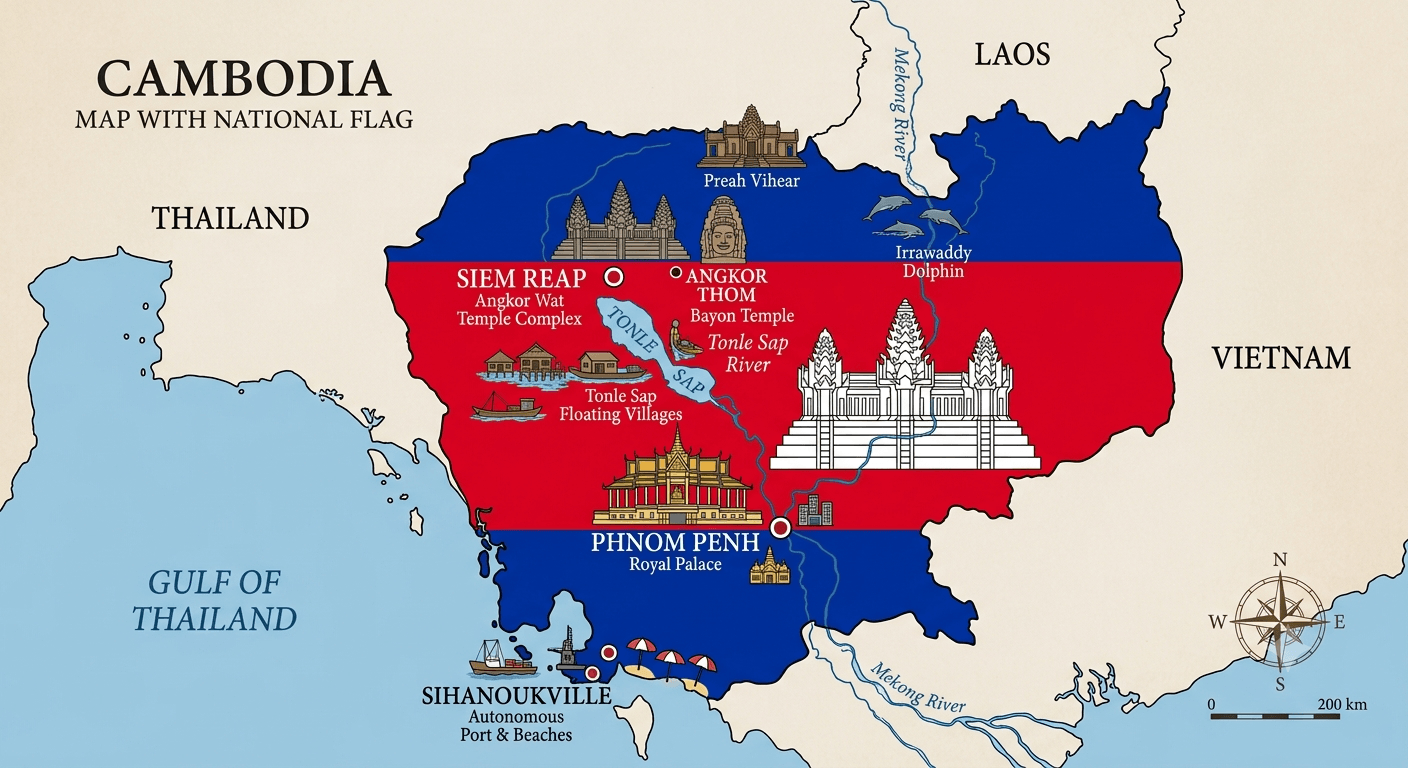
Cambodia, officially the Kingdom of Cambodia, is a constitutional monarchy in Southeast Asia bordered by Thailand, Laos, Vietnam, and the Gulf of Thailand, covering approximately 181,035 sq. km, with Phnom Penh as capital. It is a member of ASEAN, WTO, and RCEP, pursuing an export-oriented, manufacturing-led growth model.
Politically, King Norodom Sihamoni is head of state and Prime Minister Hun Manet has led the government since August 2023, with the Cambodian People’s Party holding a dominant legislative position.
Cambodia’s economy averaged 8.2 percent annual growth between 2000 and 2019, among the fastest globally, driven by tourism, garments, real estate, and construction (World Bank). GDP contracted 3.6 percent in 2020 (COVID-19), recovered to 6.0 percent growth in 2024, and is projected at 4.8 percent in 2025 amid softer external demand, a property-sector slowdown, and trade restrictions (World Bank, Cambodia Economic Update, December 2025). Cambodia reached lower-middle-income status in 2015 but remains a UN-classified Least Developed Country, with graduation deferred over concerns about losing trade preferences.
Agricultural Sector
Agriculture employs about one-third of the workforce (~3.1 million people) and contributed an estimated 25.3 percent of GDP in 2023 (World Bank). Rice is the leading crop and export commodity; Cambodia also ranks among the world’s largest cassava exporters.
Industrialization and Manufacturing
Industry contributed an estimated 32.8 percent of GDP in 2023. Export-oriented garment, travel-goods and footwear (GTF) manufacturing alone accounts for over 40 percent of economic output and about 19 percent of formal employment, but remains highly exposed to shifts in global trade policy, including recent US tariff measures (World Bank, June 2025).
2. Trade and Economic Profile
Export and Import Overview
Merchandise trade expanded strongly through 2025: Q4 2025 exports rose 23.2 percent year-on-year to USD 8.0 billion and imports rose 25.7 percent to USD 9.35 billion (Cambodia Customs/National Bank of Cambodia). Full-year 2024 exports totalled USD 38.7 billion, up from USD 27.4 billion in 2019 (OEC/UN Comtrade), with an overall 2025 merchandise trade deficit of roughly USD 2.7 billion.
| Indicator | Value | Period |
| Total exports | USD 38.7 billion | 2024 |
| Q4 exports | USD 8.0bn (+23.2% YoY) | Q4 2025 |
| Q4 imports | USD 9.35bn (+25.7% YoY) | Q4 2025 |
| Top export market | US – 43.1% of exports | Q4 2025 |
| Top import source | China – 53.7% of imports | Q4 2025 |
Source: General Dept. of Customs and Excise / National Bank of Cambodia; OEC (UN Comtrade); Khmer Times (Feb. 2026).
Major Export and Import Products
Leading 2024 exports: knit sweaters (USD 3.11bn), trunks/travel cases (USD 3.04bn), non-knit women’s suits (USD 2.52bn), knit women’s suits (USD 1.94bn), and rice (USD 1.9bn) (OEC). Leading imports: gold (USD 5.35bn), refined petroleum (USD 2.93bn), and knitted/crocheted fabrics.
GDP and Detailed Analysis
Nominal GDP is estimated at USD 49.8 billion for 2025 (GDP per capita ~USD 2,870); PPP GDP was estimated at USD 150 billion. Sectoral shares (2023): services 41.9%, industry 32.8%, agriculture 25.3%.
| Indicator | Value |
| GDP growth, 2024 / 2025(e) | 6.0% / 4.8% |
| Inflation (avg., 2025) | 2.7% |
| Public debt | ~26% of GDP |
| Reserves cover | ~7.5 months of imports |
| FDI inflows, H1 2025 | USD 2.3bn (+28.4% YoY) |
Source: World Bank, Cambodia Economic Update (December 2025).
China supplies 65.5 percent of Cambodia’s net FDI inflows, while the United States remains its single largest export market.
Major Industrial Products
Key output includes knitted and woven garments, footwear, travel goods, bicycles, construction materials, and processed agricultural products, concentrated in Special Economic Zones around Phnom Penh, Sihanoukville, and Bavet.
3. Education
Cambodia’s education system (Ministry of Education, Youth and Sport) spans pre-school through tertiary and technical-vocational levels. Per the Cambodia Inter-Censal Population Survey 2024 (CIPS 2024), Khmer-language literacy (age 7+) rose to 85.6 percent in 2024 from 80.4 percent in 2019 (male 88.7%, female 82.6%). Khmer-English bilingual literacy more than doubled, from 5.1% to 11.7% (16.8% in urban areas), signalling improving readiness for internationally integrated sectors. However, an estimated 88 percent of employment remains informal (UNDP, 2024), and only about 30 percent of the population has basic digital skills (Royal Government of Cambodia, 2022).
4. Health and Social Indicators
Cambodia’s HDI stood at 0.600 in 2023 (medium human development, rank 146 of 191), up 56.9 percent since 1990 (UNDP, 2024 Regional Human Development Report); inequality-adjusted HDI reflects a 19.2 percent loss, near the global average. The Multidimensional Poverty Index fell from 0.17 (2014) to 0.07 (2021/22), with multidimensional poverty incidence nearly halved, from ~37% to 17%. Monetary poverty was 14.2 percent in 2022 (World Bank); the Gini coefficient was 23.6, comparatively low regionally.
Child stunting fell from 32.4% (2014) to 21.9% (2021), on track to meet national targets, but wasting remains near 10% with no improvement, and exclusive breastfeeding declined from 65.2% to 47.1% over the same period (EU/UNICEF/WHO/World Bank Joint Malnutrition Estimates, 2024). Anaemia affects close to half of women of reproductive age.
5. Bangladesh–Cambodia Bilateral Relations
Friendly relations date to 1972 (King Norodom Sihanouk and Bangabandhu Sheikh Mujibur Rahman); formal diplomatic relations were established in 1993. Neither country maintains a resident embassy in the other’s capital: Bangladesh’s interests in Cambodia are covered by its Embassy in Bangkok, also accredited to Cambodia, while Cambodia has no resident mission in Dhaka; an Honorary Consul of Bangladesh has been appointed in Phnom Penh to supplement coverage.
Institutional cooperation includes a 2010 joint-commission agreement, a 2013 visa waiver for diplomatic passport holders, a 2014 joint trade council agreement and cultural cooperation accord, and a renewable 2017 MoU on labour migration and vocational training. Both governments have expressed intent to deepen commercial ties in garments, agriculture, and tourism, though most mechanisms appear largely dormant.
6. Bilateral Trade Analysis
Bilateral merchandise trade remains small: Bangladesh’s Ministry of Commerce reported exports to Cambodia of approximately USD 5.39 million against imports of USD 0.4 million in the most recent fiscal year cited around the 2022 fiftieth-anniversary commemorations (versus USD 5.0 million/USD 0.57 million in 2016) — a balance strongly favouring Bangladesh.
Cambodia’s exports to Bangladesh comprise mainly cotton, edible oil, fertiliser, clinker, staple fibre, and yarn. Bangladesh’s exports to Cambodia are reported to include pharmaceuticals, garments, footwear and leather goods, jute products, ceramics, agro-processed foods, spices, and light-engineering items, typically routed via Thailand or Vietnam in the absence of direct shipping links.
A verified, HS-code-level breakdown specific to Cambodia was not identified within the Export Promotion Bureau’s (EPB) publicly available country-wise statistics, which are structured principally by product and destination-region rather than granular bilateral tables for smaller partners. No Bangladesh Bank Annual Report disclosure on Letters of Credit or trade-financing activity specific to Cambodia was identified either; given modest trade volumes, such transactions likely fall within aggregate ‘other countries’ categories. Direct verification through EPB’s Statistics and Research Division and Bangladesh Bank’s Statistics Department is recommended before citing granular figures in a final client deliverable.
7. International Cooperation
Bangladesh and Cambodia are both members of the United Nations, WTO, the Asian Development Bank, the Non-Aligned Movement, the Group of 77, and UN ESCAP. Cambodia is not a member of the OIC, given its Buddhist-majority profile, and is instead anchored in ASEAN, AFTA, and RCEP, blocs in which Bangladesh does not participate. Shared multilateral platforms have therefore provided limited direct commercial leverage; cooperation has advanced mainly through the bilateral instruments noted above rather than joint multilateral frameworks.
8. Opportunities for Bangladeshi Citizens in Cambodia
- Higher Education: Cambodian universities have limited international profile; opportunities remain narrow compared with destinations such as Malaysia or India.
- Employment and Labour Migration: The 2017 MoU provides a framework for labour and vocational cooperation, though documented worker deployment remains limited.
- Visa Facilities: Cambodia offers e-visa access for tourism/business travel; the 2013 waiver applies only to diplomatic passport holders.
- Export Opportunities: Pharmaceuticals, jute goods, agro-processed foods, ceramics, and light-engineering products face limited competition in Cambodia’s market.
- Residency/Citizenship: Cambodia offers renewable business/investment-linked visas, but no verified citizenship-by-investment scheme was confirmed in sources reviewed; this should be verified with Cambodia’s Ministry of Interior.
9. Opportunities for Cambodia from Bangladesh
Cambodia’s garment sector depends heavily on imported fabric and accessories, making Bangladeshi textiles and yarn a high-potential import category. Bangladesh’s competitive generic pharmaceutical industry offers a further opportunity given Cambodia’s reliance on imported medicines. Bangladeshi RMG and leather manufacturers could consider investment within Cambodia’s Special Economic Zones to diversify production and leverage Cambodia’s preferential market access, while agro-processing, ceramics, light engineering, and technical/vocational training collaboration—an area Cambodia has prioritised under its National Strategic Development Plan 2024–2028—also hold promise.
10. Trade Associations and Future Prospects
No significant, publicly documented collaboration between major Bangladeshi trade bodies (FBCCI, BGMEA, DCCI) and Cambodian counterparts (Cambodia Chamber of Commerce, GMAC) was identified, an underdeveloped channel relative to both countries’ garment-sector scale. Future prospects appear favourable given complementary industrial structures, Cambodia’s continued export growth (23.2 percent year-on-year in Q4 2025), and stated governmental interest in expanding cooperation across garments, agriculture, and tourism.
11. Recommendations
- Establish an MoU between FBCCI/BGMEA and GMAC/Cambodia Chamber of Commerce for institutionalised business engagement.
- Pursue direct shipping/transshipment arrangements via Thailand or Vietnam to reduce logistics costs.
- Prioritise pharmaceuticals, jute products, and textile/yarn exports, supported by EPB facilitation and Cambodian trade-fair participation.
- Reactivate the 2014 joint trade council and joint commission to set measurable trade targets and resolve non-tariff barriers.
- Encourage reciprocal investment: Bangladeshi RMG/leather manufacturers in Cambodian SEZs, and Cambodian investment in Bangladesh’s agro-processing and light industry.
- Commission direct data verification with EPB and Bangladesh Bank for current, product-level bilateral trade and banking data.