Book Appointment Now

Brunei Darussalam: Market and Economic Profile, with a Focus on Bangladesh–Brunei Darussalam Bilateral Relations
1. Country Profile
Geographical Location and Political Identity
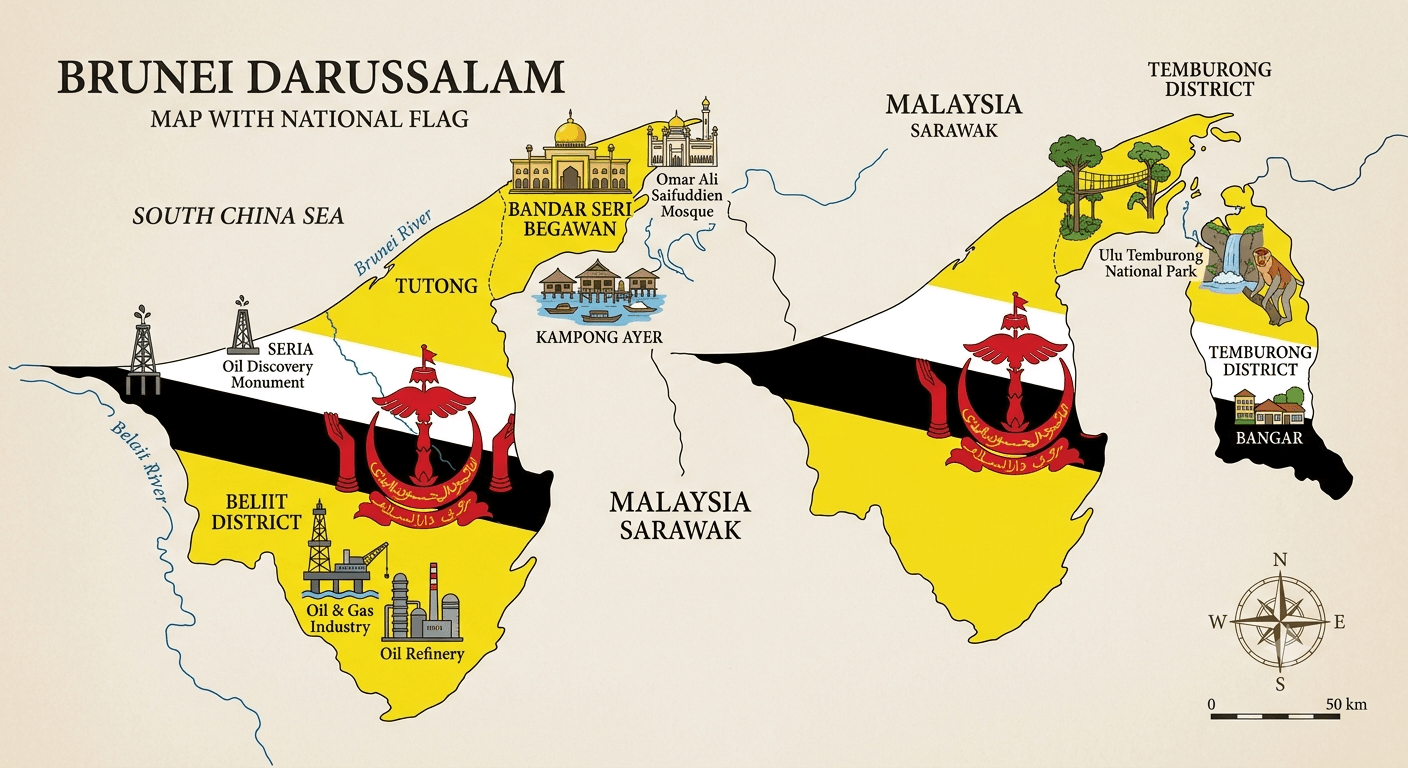
Brunei Darussalam is a small sovereign state located on the northern coast of the island of Borneo in Southeast Asia, bordered entirely by the Malaysian state of Sarawak and facing the South China Sea to the north. The country covers a land area of approximately 5,765 square kilometres and had a population of roughly 462,700–469,800 in 2024–2026 (Worldometer/IMF-based estimates). The official political name of the country is Negara Brunei Darussalam (State of Brunei, Abode of Peace). Brunei Darussalam is governed as an absolute Islamic monarchy under His Majesty Sultan Haji Hassanal Bolkiah, who serves as both Head of State and Head of Government; the state philosophy of Melayu Islam Beraja (Malay Islamic Monarchy) underpins its constitutional and legal framework.
Economic Overview
Brunei Darussalam operates a hydrocarbon-dependent, high-income economy. According to the World Bank, nominal GDP stood at USD 15.46 billion in 2024, while the IMF’s 2024 Article IV Consultation reported real GDP growth of 1.4% in 2023, following two consecutive years of recession, driven mainly by non-oil and gas (non-O&G) activity and new production from the Salman oil field. The IMF projects GDP growth of around 2.6% for 2026. According to the WTO Trade Policy Review (2024), GDP at current prices was BND 20.3 billion in 2023, with the oil and gas (O&G) sector contributing 47.4% and the non-O&G sector 52.6%; by 2024, per the Petroleum Authority of Brunei Darussalam, GDP reached BND 20.7 billion, with the energy sector’s share narrowing further to 46.7% against 53.3% for non-O&G activity, reflecting the government’s Wawasan Brunei 2035 diversification agenda.
Agricultural Sector
Agriculture, together with fisheries and forestry, contributes only around 1% of GDP (East Asia Forum, 2025), reflecting Brunei’s limited arable land and historical reliance on food imports. The Ministry of Primary Resources and Tourism reports that domestic food production rose 41% between 2017 and 2024, from BND 525 million to BND 742 million. Self-sufficiency levels vary sharply by commodity: eggs (103%) and chicken meat (100%) already exceed domestic demand, tropical vegetables (72%) and fish (74%) are relatively advanced, while rice (8%, up from 4.8% in 2017) and beef/buffalo meat (approximately 2.3%) remain heavily import-dependent. The FAO has recognised Brunei for maintaining undernourishment below 5% of the population since 1990. Food security is designated a national priority under Wawasan Brunei 2035, with the government targeting expanded self-sufficiency in rice, livestock and aquaculture.
Industrialization and Manufacturing Sector
Brunei’s industrial base remains concentrated in oil, gas and downstream petrochemicals. The Hengyi Industries refinery and petrochemical complex on Pulau Muara Besar—a USD 3.45 billion joint venture between China’s Zhejiang Hengyi Group (70%) and the Brunei Economic Development Board (30%), operational since 2019—has become the single largest driver of non-O&G industrial output, contributing an estimated 9–10% of GDP and around 55% of total exports in 2022 (The Bruneian, 2023). A Phase 2 expansion, expected onstream by 2029, would raise refining capacity to 11 million tonnes per annum and could lift Hengyi’s GDP contribution toward 30%. Other notable industrial ventures include the Brunei Methanol Company and Brunei Fertilizer Industries, whose Sungai Liang ammonia-urea plant can produce 2,200 metric tons of ammonia daily and 1.36 million metric tons of urea annually, mostly for regional agricultural export markets.
2. Trade and Economic Profile
Export and Import Overview
Brunei’s external trade is dominated by hydrocarbons. Per the UN Comtrade database (via the Observatory of Economic Complexity), Brunei exported USD 2.11 billion of crude petroleum in 2024 (its 3rd-largest export product), principally to Australia (USD 535 million), Thailand (USD 481 million), Indonesia (USD 306 million), Singapore (USD 260 million) and India (USD 230 million). LNG exports, tracked by Brunei’s Department of Economic Planning and Statistics (via CEIC), totalled BND 3.20 billion in 2024, down from BND 3.43 billion in 2023, reflecting maintenance-related downstream disruptions. On the import side, Brunei imported USD 4.19 billion of crude petroleum in 2024—its top import product—primarily as refinery feedstock from Malaysia (USD 1.47 billion), Russia (USD 825 million), Australia (USD 542 million), the UAE (USD 505 million) and Kazakhstan (USD 185 million), underscoring the Hengyi refinery’s role in reshaping Brunei’s trade structure from a pure crude exporter toward a refined-products processor.
GDP Analysis: Growth, Structure and Per Capita Income
| Indicator | Value | Year/Source |
| Nominal GDP | USD 15.46 billion / BND 20.7 billion | 2024 (World Bank / PABD) |
| Real GDP growth | 1.4% | 2023 (IMF Article IV, 2024) |
| IMF GDP growth projection | 2.6% | 2026 (IMF) |
| GDP per capita (nominal) | USD 29,606 (2024); USD 34,678 (2025 IMF est.) | World Bank / IMF |
| GDP per capita, PPP | USD 79,184 | 2024 (World Bank) |
| Oil & gas share of GDP | 46.7% | 2024 (PABD) |
| Non-oil & gas share of GDP | 53.3% (up from 20% in 2003) | 2024 (PABD) / IMF Article IV |
| Inflation | 0.4% | 2023 (IMF), down from 3.7% in 2022 |
The steady rise of the non-O&G share—from roughly 20% in 2003 to over 53% in 2024—reflects the cumulative impact of downstream petrochemical investment, finance, transport and hospitality sector growth, although the East Asia Forum (2025) cautions that, excluding downstream activities, the underlying non-O&G private sector remains narrow, with agriculture near 1% of GDP and most services sub-sectors contributing only 1–3% each. Brunei’s economy therefore remains structurally exposed to global energy price cycles even as headline diversification indicators improve.
Major Industrial Products
Key industrial outputs include crude oil and condensate, liquefied natural gas, refined petroleum products (diesel, jet fuel, naphtha), petrochemicals (paraxylene, benzene), methanol, and nitrogenous fertilisers (ammonia and urea). Non-hydrocarbon industrial activity remains comparatively limited, concentrated in construction materials, food processing and small-scale manufacturing serving the domestic market.
3. Education
Brunei’s education system, overseen by the Ministry of Education (established 1984), provides free education from pre-school through university for citizens, structured along a British-influenced model alongside Islamic religious education (Ugama). Tertiary institutions include Universiti Brunei Darussalam (UBD), Universiti Teknologi Brunei (UTB) and Universiti Islam Sultan Sharif Ali (UNISSA). According to UNESCO Institute for Statistics data (cited via Macrotrends), the adult literacy rate reached 97.59% in 2021, up from 96.09% in 2011 and 92.67% in 2001, with male literacy (97.5%) marginally exceeding female literacy (94.5%) per earlier estimates. Government expenditure on education has historically been around 3.7% of GDP. The UNDP Human Development Report 2025 records expected years of schooling in Brunei at 13.7 years and mean years of schooling at 9.2–9.3 years, indicating a well-developed but still-maturing human capital base relative to regional high-income peers such as Singapore (16.9 and 11.9 years, respectively).
4. Health and Social Indicators
| Indicator | Value | Source/Year |
| Human Development Index (HDI) | 0.837 (Very High); global rank 60 of 193 | UNDP HDR 2025 (2023 data) |
| Life expectancy at birth | 75.3 years | World Bank/UNDP, 2023 |
| GNI per capita, PPP | USD 75,827 | UNDP HDR 2025 |
| Adult literacy rate | 97.6% | UNESCO/World Bank, 2021 |
| Undernourishment prevalence | Below 5% of population (since 1990) | FAO |
Brunei is classified in the “Very High” human development tier and ranked fifth in East and Southeast Asia (behind Hong Kong, Singapore, South Korea and Japan) in the UNDP Human Development Report 2023/24, with its HDI recovering to 0.837 in 2023 from 0.823 in 2022. Nutrition indicators remain strong by regional standards given the low undernourishment prevalence, though the country’s heavy reliance on food imports (approximately 70% of consumption, per Bangladesh’s High Commission in Bandar Seri Begawan) exposes it to global supply-chain and price risk. Social development is further supported by universal free healthcare and education, funded largely through hydrocarbon revenues and sovereign wealth reserves managed by the Brunei Investment Agency.
5. Bangladesh–Brunei Darussalam Bilateral Relations
Bangladesh and Brunei Darussalam established diplomatic relations on 5 May 1984, shortly after Brunei’s independence. Bangladesh opened a High Commission in Bandar Seri Begawan in July 1985 (closed in 1988 and reopened in 1997), while Brunei established its Embassy in Dhaka on 29 July 1999, located at Baridhara. Relations have been reinforced at the highest levels, including the Prime Minister of Bangladesh’s visit to Brunei in April 2019 and the reciprocal visit of the Sultan of Brunei to Bangladesh in October 2022. The two countries have signed multiple Memoranda of Understanding covering LNG supply, agriculture, fisheries, livestock, youth and sports, culture and arts, employment of Bangladeshi workers, recognition of seafarers’ certificates, and an Air Services Agreement, though direct flight connectivity has not yet been operationalised. Bangladesh’s High Commission notes that around 15,500 Bangladeshi workers and roughly 300 Bangladeshi-owned or joint-venture companies are currently active in Brunei, concentrated in construction of roads, housing and infrastructure—sectors in which Bangladeshi engineers played a pioneering role during Brunei’s early nation-building.
6. Bilateral Trade Analysis
Bilateral merchandise trade between Bangladesh and Brunei remains marginal relative to each country’s total trade. According to UN Comtrade data (via Trading Economics), Brunei’s exports to Bangladesh totalled only USD 570,350 in 2023, dominated by machinery and mechanical appliances (USD 539,640), with negligible amounts of rubber, plastics, base-metal tools, iron and steel articles, and electrical equipment; in 2022, mineral fuels and oils were a notably larger line item (USD 28.36 million), indicating volatility driven by occasional fuel shipments rather than a stable trade pattern.
| Direction | Product Category | Value | Year |
| Brunei → Bangladesh | Machinery, boilers, nuclear reactors | USD 539,640 | 2023 |
| Brunei → Bangladesh | Mineral fuels, oils, distillation products | USD 28.36 million | 2022 |
| Brunei → Bangladesh | Rubber, plastics, base-metal tools (combined) | under USD 15,000 | 2023 |
Disaggregated, HS-code-level data on Bangladesh’s exports to Brunei were not available through EPB’s public reporting interface at the time of this review; the Bangladesh Trade Portal and EPB’s Trade Information Centre (TIC) maintain this granularity but require direct data-desk access for country-specific HS-6 extraction. Based on Bangladesh’s overall export basket—dominated by knit and woven apparel (HS 61–62), which together account for the large majority of national export earnings—readymade garments are presumed to constitute Bangladesh’s principal, if still limited, export line to Brunei, though this could not be independently verified against EPB’s bilateral country data within the sources reviewed. Similarly, no publicly disclosed data from Bangladesh Bank’s Annual Report specifically quantifying Letters of Credit, trade financing or other banking transactions between Bangladesh and Brunei were identified; given the low trade volumes recorded above, such financial flows are likely modest, and this should be verified directly with Bangladesh Bank’s Statistics Department or the relevant authorised dealer banks before inclusion in client-facing figures.
7. International Cooperation
Bangladesh and Brunei Darussalam are both members of the United Nations, the Organisation of Islamic Cooperation (OIC), and the Commonwealth of Nations, providing recurring multilateral platforms for engagement. Brunei is additionally a founding member of ASEAN, which has constrained its scope for unilateral positioning on regional issues affecting Bangladesh—for instance, Brunei’s approach to the Rohingya crisis is calibrated through the ASEAN Five-Point Consensus rather than independent bilateral action, even as it continues to support Bangladesh’s search for a durable solution through the OIC and the UNHCR. Shared OIC and Commonwealth membership has facilitated diplomatic goodwill and periodic high-level exchanges, though this has not yet translated into a substantial increase in bilateral trade or investment volumes, which remain well below the potential implied by Brunei’s high import dependency and Bangladesh’s export capacity.
8. Opportunities for Bangladeshi Citizens in Brunei Darussalam
- Employment and labour migration: An established base of approximately 15,500 Bangladeshi workers and 300 Bangladeshi-owned or joint-venture firms in Brunei’s construction sector provides a foundation for continued labour migration, particularly as Brunei pursues infrastructure expansion tied to Hengyi’s Phase 2 and broader Wawasan 2035 diversification projects.
- Higher education: Brunei’s universities (UBD, UTB, UNISSA) and the country’s Islamic education framework may offer scholarship or self-financed study opportunities for Bangladeshi students, though bilateral education MoUs signed to date have focused more on youth/sports and cultural exchange than on formal scholarship pipelines; this remains an area for further institutional negotiation.
- Export opportunities: With roughly 70% of Brunei’s consumption needs met through imports, Bangladeshi agricultural products (rice, vegetables, processed foods), garments and light manufactured goods have room to expand from their currently negligible base, provided market access, logistics and direct trade linkages are strengthened.
- Visa facilities and residency: Brunei does not offer routine long-term residency or citizenship pathways to foreign workers, including Bangladeshi nationals; labour migration is generally structured around fixed-term work permits, and no evidence in reviewed sources indicates a shift toward permanent residency or naturalisation options for the Bangladeshi diaspora.
9. Opportunities for Brunei Darussalam from Bangladesh
- High-potential import products: Rice, fresh and processed vegetables, poultry products, and pharmaceuticals—categories where Bangladesh has developed export capacity and Brunei retains structural self-sufficiency gaps (notably rice, at only 8% self-sufficiency, and beef/buffalo meat, at approximately 2.3%).
- Workforce and construction cooperation: Continued deployment of Bangladeshi skilled and semi-skilled labour and Bangladeshi-owned construction firms supports Brunei’s infrastructure and housing development needs at competitive cost.
- LNG and energy-sector cooperation: The bilateral MoU on LNG supply signals potential for Brunei to diversify its LNG export relationships toward South Asia, complementing Bangladesh’s (Petrobangla-managed) LNG import requirements, subject to commercial and logistical feasibility studies.
- Industrial cooperation: Bangladesh’s established RMG (readymade garment), leather, light engineering and pharmaceutical industries could support Brunei’s downstream diversification strategy through joint ventures, contract manufacturing or supply-chain partnerships, particularly as Brunei seeks to reduce dependence on hydrocarbon revenue.
10. Trade Associations and Future Prospects
Institutional linkages between Bangladeshi trade bodies—such as the Federation of Bangladesh Chambers of Commerce and Industry (FBCCI) and the Dhaka Chamber of Commerce and Industry (DCCI)—and their Bruneian counterparts, including the Brunei Darussalam National Chamber of Commerce and Industry (BDNCCI), remain limited and were not substantiated by dedicated cooperation agreements in the sources reviewed for this report. Existing institutional cooperation is concentrated at the intergovernmental level through the MoUs referenced in Section 5, rather than through business-to-business chamber partnerships. Future prospects for deepening bilateral trade and investment hinge on: operationalising direct air connectivity under the existing Air Services Agreement; establishing a Bangladesh-Brunei Joint Business Council or Joint Economic Commission; and leveraging Brunei’s participation in the Regional Comprehensive Economic Partnership (RCEP) and ASEAN economic integration as an indirect gateway for Bangladeshi goods into wider Southeast Asian value chains.
11. Recommendations
- Commission a dedicated EPB and Bangladesh Bank data-desk review to establish accurate, HS-code-level baseline figures for Bangladesh’s exports to Brunei and associated trade financing flows, given the data limitations identified in Section 6.
- Prioritise diversification of Bangladesh’s export basket to Brunei beyond the currently negligible base, targeting rice, processed foods, pharmaceuticals and RMG products aligned with Brunei’s identified import-dependency gaps.
- Pursue formal government-to-government or private-sector negotiation to operationalise the 2022 Air Services Agreement, as direct connectivity is a precondition for scaling trade, tourism and business travel between the two countries.
- Strengthen labour-migration governance by ensuring the bilateral employment MoU is actively monitored, protecting the approximately 15,500 Bangladeshi workers currently in Brunei and supporting orderly expansion of labour flows tied to Brunei’s infrastructure diversification projects.
- Establish a formal Bangladesh-Brunei Joint Business Council linking FBCCI/DCCI with the BDNCCI to translate government-level goodwill into concrete trade and investment facilitation.
- Explore feasibility of LNG supply cooperation building on the existing bilateral MoU, subject to commercial viability assessments given Brunei’s declining LNG export volumes (BND 3.20 billion in 2024, down from BND 3.43 billion in 2023).
- Use shared OIC and Commonwealth platforms to advance economic, rather than purely diplomatic, cooperation agendas, including joint positions on trade facilitation and technical assistance.