Book Appointment Now

Botswana: Bilateral Trade, Investment and Diplomatic Relations with Bangladesh
1. Country Profile
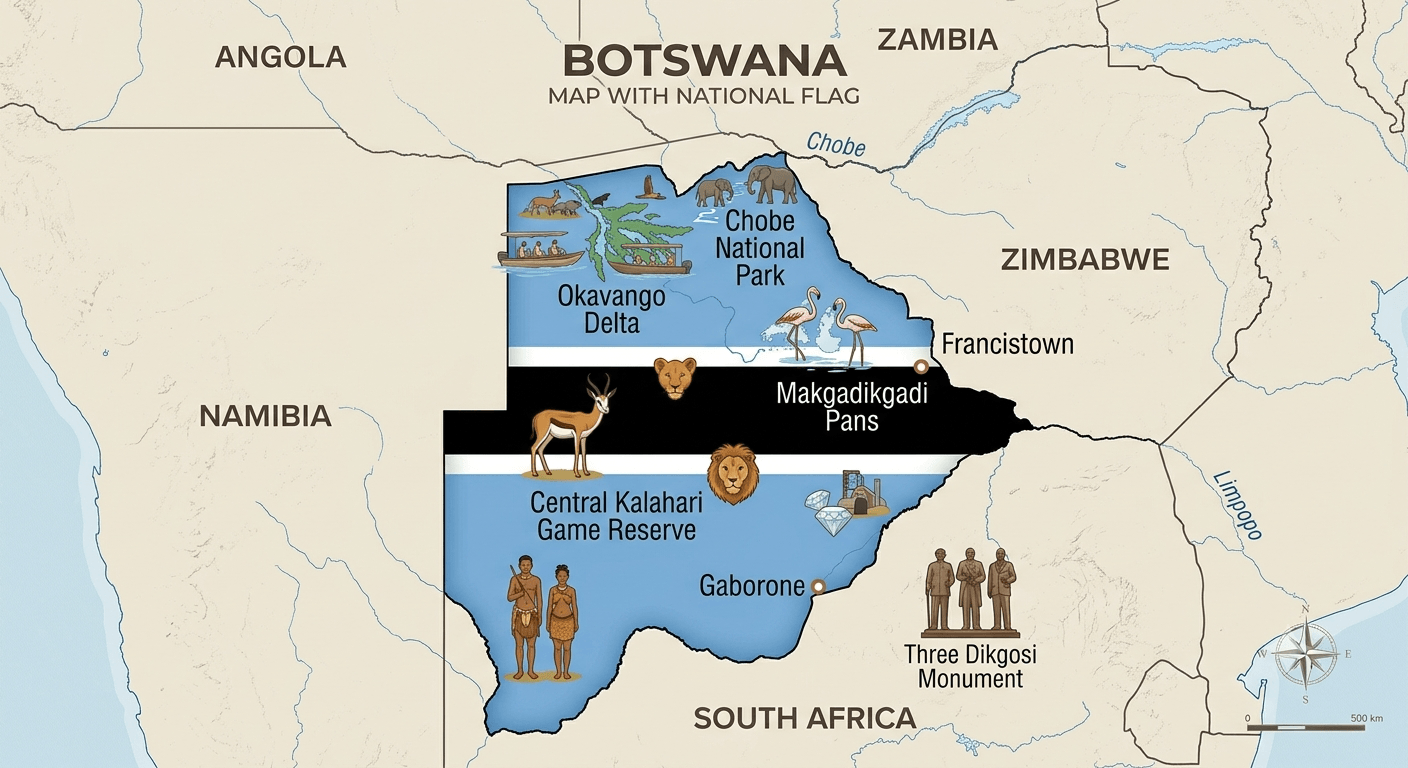
Botswana, officially the Republic of Botswana, is a landlocked country in Southern Africa covering an area of 581,730 sq km, bordering South Africa, Namibia, Zambia and Zimbabwe. The capital is Gaborone. Botswana is a unitary parliamentary republic operating on the Westminster model, with a unicameral National Assembly and an executive President who serves as both head of state and head of government. Following the October 2024 general election, the United Democratic Congress ended 58 years of continuous rule by the Botswana Democratic Party, with Advocate Duma Boko assuming the presidency.
Sources: CIA World Factbook (2026); Wikipedia – Politics of Botswana, citing Government of Botswana.
Botswana is an upper-middle-income economy (World Bank classification) with GDP of approximately US$19.4 billion in 2024. The economy remains narrowly based and heavily dependent on diamond mining through Debswana, a government–De Beers joint venture, accounting for roughly 90 percent of export earnings and 30 percent of government revenue. Agriculture, historically anchored by cattle ranching, contributes a small share of GDP (est. 1.8 percent); industry — dominated by mining — contributes roughly 27.5 percent, and services 70.6 percent. Manufacturing remains shallow, concentrated in beef processing, textiles, soda ash and light assembly, reflecting a long-standing but only partially realised diversification agenda.
Sources: World Bank, World Development Indicators (2024); African Development Bank, Botswana Economic Outlook (2026); Sunday Standard, citing World Bank Global Economic Prospects (Jan 2024).
2. Trade and Economic Profile
Export and Import Overview
According to World Bank/WITS data, Botswana’s total merchandise exports stood at US$5,503 million in 2023, against imports of US$6,417 million, resulting in a persistent trade deficit financed largely through mineral revenue and reserves. Export earnings remain highly concentrated: diamonds alone accounted for over 75 percent of shipment value in 2023–2024.
Major Export and Import Products (2023, HS6 level)
| Top Exports | Value (US$ mn) | Top Imports | Value (US$ mn) |
| Diamonds, unworked | 3,174.4 | Petroleum oils (refined) | 1,129.1 |
| Diamonds, n.e.s. | 1,101.5 | Diamonds, unworked | 396.0 |
| Copper ores & concentrates | 506.8 | Diamonds, n.e.s. | 299.5 |
| Ignition wiring sets | 122.7 | Diamonds, unsorted/worked | 252.6 |
| Disodium carbonate (soda ash) | 56.3 | Electrical energy | 155.8 |
Source: World Integrated Trade Solution (WITS), World Bank, Botswana Country Snapshot 2023.
Botswana’s principal export destinations in 2023 were the United Arab Emirates (29.8%), Belgium (17.9%), India (12.3%), South Africa (11.9%) and China (6.4%), reflecting the global diamond cutting-and-polishing value chain. Imports are dominated by South Africa (65.0%), reflecting Southern African Customs Union (SACU) integration, followed by Namibia (7.7%), Canada (4.9%) and China.
Gross Domestic Product and Detailed Analysis
| Indicator | Value | Year |
| GDP, current prices | US$19.4 billion | 2024 |
| GDP, PPP | US$52.65 billion | 2025 (est.) |
| GDP per capita, nominal | US$6,940 | 2025 (est.) |
| Real GDP growth | -0.7% (contraction) | 2025 (est.) |
| Real GDP growth | 2.8% | 2024 |
| Inflation (avg. CPI) | 2.7% | 2025 (est.) |
| Fiscal balance | -9.4% of GDP | 2025 (est.) |
| Public debt | 40.7% of GDP | 2025 (est.) |
| Unemployment rate | 23.4% | 2023 |
Sources: African Development Bank, Botswana Economic Outlook (2026); World Bank WDI; Wikipedia, Economy of Botswana citing IMF/World Factbook.
The African Development Bank attributes the 2025 contraction to reduced diamond output amid weak global demand and subdued government spending, widening the fiscal deficit and raising public debt from 33.1% of GDP in 2024. Reserves fell to an estimated US$3.1 billion (4.4 months of import cover) by end-2025. Major industrial products are rough and cut diamonds, copper-nickel matte, soda ash, beef products and textiles, with mining remaining the principal driver of industrial output.
Source: African Development Bank, Botswana Economic Outlook (2026).
3. Education
Botswana operates a free primary and secondary system structured as seven years of primary, three years of lower secondary and two years of upper secondary education, with the University of Botswana (est. 1976, Gaborone) as the principal tertiary institution. Adult literacy (ages 15+) stood at 86.8 percent as of the latest available UNESCO Institute for Statistics estimate, among the ten highest in Africa. However, UNESCO/EPDC analysis flags retention challenges: Grade 1 repetition is 9.0 percent, and nearly 18 percent of female and 15 percent of male secondary-age youth remain out of school, suggesting human capital development lags literacy gains alone.
Sources: UNESCO Institute for Statistics / World Bank, World Development Indicators; Education Policy and Data Center (EPDC), Botswana National Education Profile.
4. Health and Social Indicators
Botswana’s Human Development Index (HDI) stood at 0.731 in 2023 — UNDP’s “high human development” category and among the higher-ranked economies in Sub-Saharan Africa, up from 0.708 in 2022. WHO data record life expectancy of 69.7 years (2022), infant mortality of 38.2 and under-five mortality of 39.6 per 1,000 live births (2023). Health expenditure was 5.73 percent of GDP, or roughly US$477 per capita (2022), reflecting sustained investment amid a historically high HIV/AIDS burden that, alongside rising non-communicable disease incidence, remains a stated strategic priority. An estimated 16.3 percent of the population lived below the national poverty line (2016), with a Gini coefficient of 45.5, indicating moderate-to-high inequality despite upper-middle-income status.
Sources: UNDP, Human Development Report (2023/2024); WHO Regional Office for Africa, Botswana Country Statistics; World Bank, World Development Indicators.
5. Bangladesh-Botswana Bilateral Relations
Bangladesh and Botswana maintain cordial but modest diplomatic relations; neither maintains a resident High Commissioner in the other’s capital, with Bangladesh’s coverage of Botswana administered through its regional mission. Engagement has been episodic and government-led. In 2009 the two countries signed an MoU on cooperation in capacity building, exchange of economic and commercial information, export development, image building, and SMME investment promotion. The same year, a Bangladeshi delegation led by the then president of the Bangladesh Knitwear Manufacturers and Exporters Association (BKMEA) visited Botswana to explore trade and investment, followed in 2013 by an official visit from Bangladesh’s Ministry of Commerce. Botswana has specifically requested cooperation in joint-venture textile industries, pharmaceutical sector development, and deployment of Bangladeshi agricultural expertise; cultural and sporting cooperation, including cricket development, has also been raised politically.
Source: Wikipedia, Bangladesh–Botswana relations, citing Bangladesh Ministry of Commerce and Financial Express reporting.
6. Bilateral Trade Analysis
Bilateral merchandise trade remains minimal in absolute terms, though it has grown rapidly off a very low base. UN Comtrade data (via the Observatory of Economic Complexity) show Bangladesh’s exports to Botswana rising from US$4,140 in 2017 to US$339,000 in 2022 — a 141 percent annualised rate, albeit off a negligible base. Botswana-side Comtrade data for 2023 recorded total imports from Bangladesh of US$244,510.
Bangladesh Exports to Botswana — Leading Products
| Product (indicative HS Code) | Value (US$) | Year |
| Medicaments, unpackaged / bulk (HS 3004) | 235,000 | 2022 |
| Medicaments, packaged for retail (HS 3004) | 170,180 / 59,500 | 2023 / 2022 |
| Knitted men’s suits & apparel (HS 61) | 34,400 / 20,600 | 2023 / 2022 |
| Woven apparel, not knitted (HS 62) | 17,510 | 2023 |
| Articles of stone/cement/plaster (HS 68) | 17,330 | 2023 |
| Footwear (HS 64) | 3,780 | 2023 |
Sources: Observatory of Economic Complexity (OEC), UN Comtrade bilateral data, 2022; Trading Economics / UN Comtrade, Botswana imports from Bangladesh, 2023.
Botswana’s recorded exports to Bangladesh are negligible to nil in UN Comtrade data for recent years, meaning the trade relationship is almost entirely one-directional, led by Bangladeshi pharmaceuticals and readymade garments. Bangladesh Bank’s published Annual Reports do not disaggregate Letters of Credit, trade financing, or remittance flows by individual country for a market as small as Botswana; given the trade volumes involved, exposure of the domestic banking sector to Botswana-related trade financing is correspondingly limited and is not separately reported.
Source: Bangladesh Bank, Annual Report (country-wise trade finance data not separately published for Botswana).
7. International Cooperation
Botswana is not a member of the Organisation of Islamic Cooperation (OIC); no shared OIC platform therefore exists between the two countries. Bangladesh and Botswana do, however, share membership of the United Nations, the World Trade Organization, the Commonwealth of Nations, the Non-Aligned Movement and the Group of 77. These shared multilateral platforms have facilitated periodic diplomatic contact — including through UN peacekeeping cooperation, where Bangladesh is a leading troop contributor across Southern and Central Africa — but have not, to date, translated into a structured bilateral trade or investment framework beyond the 2009 MoU.
Sources: Commonwealth Secretariat; UN membership records; Wikipedia, Bangladesh–Africa relations.
8. Opportunities for Bangladeshi Citizens in Botswana
- Higher education: The University of Botswana and the Botswana International University of Science and Technology offer STEM, mining engineering and business programmes, though Bangladeshi student enrolment remains negligible at present.
- Employment and labour migration: Botswana’s stated economic diversification agenda and skill gaps in construction, healthcare, textiles and agriculture present openings for Bangladeshi professional and skilled labour under standard work-permit arrangements.
- Visa facilities: Bangladeshi passport holders are not visa-exempt; Botswana requires an eVisa for tourism and business travel, unlike most other Commonwealth nationalities — a practical constraint on business and labour mobility that warrants bilateral facilitation.
- Export opportunities: Bangladeshi RMG, pharmaceuticals and footwear already have a demonstrated, if small, market foothold and scope for expansion.
- Residency/citizenship: No bilateral migration, residency or social security agreement exists; standard Botswana immigration and work-permit procedures apply to Bangladeshi nationals.
Sources: Wikipedia, Visa policy of Botswana; embassy and visa-advisory compilations, 2025–2026.
9. Opportunities for Botswana from Bangladesh
- High-potential import products: readymade garments, generic pharmaceuticals, footwear, leather goods, agro-processed food and ceramics, building on the existing trade base.
- Investment opportunities: joint-venture textile manufacturing, as specifically requested by Botswana in 2009, would support import substitution and export diversification away from diamonds.
- Industrial cooperation: technology transfer and joint ventures in pharmaceutical manufacturing, an area in which Botswana has explicitly sought Bangladeshi assistance.
- Agricultural cooperation: deployment of Bangladeshi agricultural expertise to support Botswana’s food-security and farm-productivity objectives, given the country’s reliance on food imports.
Source: Wikipedia, Bangladesh–Botswana relations.
10. Trade Associations and Future Prospects
Available records indicate no institutionalised chamber-to-chamber cooperation agreement between Bangladeshi trade bodies (such as FBCCI or BKMEA) and their Botswana counterparts (such as the Botswana Confederation of Commerce, Industry and Manpower, BOCCIM); engagement to date has been government-led rather than private-sector driven, centred on the 2009 MoU and subsequent ministerial visits. Future prospects for expanded trade and investment will depend on Botswana’s continued economic diversification away from diamonds, Bangladesh’s broader “Look Africa” trade policy emphasis, and the extent to which private-sector chambers on both sides institutionalise direct engagement.
Sources: Wikipedia, Bangladesh–Botswana relations; The Business Standard, “Bangladesh eyes enhanced diplomatic, economic ties with Africa” (Nov 2024).
11. Recommendations
- Formalise reciprocal accreditation or resident diplomatic representation to reduce the transaction costs currently associated with non-resident coverage.
- Facilitate a chamber-to-chamber MoU between Bangladeshi trade bodies (FBCCI, BKMEA) and BOCCIM to shift engagement from government-led missions toward sustained private-sector partnership.
- Prioritise EPB-supported market development for RMG, pharmaceuticals and agro-processed exports, which already hold a demonstrated, expandable foothold in the Botswana market.
- Explore BIDA-facilitated outward joint-venture investment in textile and pharmaceutical manufacturing within Botswana, directly responding to Botswana’s own stated diversification requests.
- Position Botswana as a gateway to the wider SACU and SADC markets, leveraging its regional trade integration to extend the reach of Bangladeshi exports beyond a single small economy.
- Encourage bilateral discussion on visa facilitation for business travellers, given that Bangladesh is one of the few Commonwealth nationalities not visa-exempt in Botswana.
References
African Development Bank (2026). Botswana Economic Outlook.
Bangladesh Bank. Annual Report (various years).
Central Intelligence Agency. The World Factbook: Botswana (2026).
Observatory of Economic Complexity (OEC). Bangladesh–Botswana Bilateral Trade Profile (2022 data).
Trading Economics / UN Comtrade. Botswana Imports from Bangladesh (2023 data).
UNDP. Human Development Report 2023/2024.
UNESCO Institute for Statistics / World Bank. World Development Indicators — Education and Literacy.
WHO Regional Office for Africa. Botswana Country Statistics.
Wikipedia. Bangladesh–Botswana relations; Economy of Botswana; Politics of Botswana; Visa policy of Botswana (accessed July 2026).
World Bank / World Integrated Trade Solution (WITS). Botswana Country Snapshot 2023.