Book Appointment Now

Chad: Market and Economic Overview | Prepared for Bangladesh–Chad Trade Assessment
1. Country Profile
Geographical Location and Political Identity
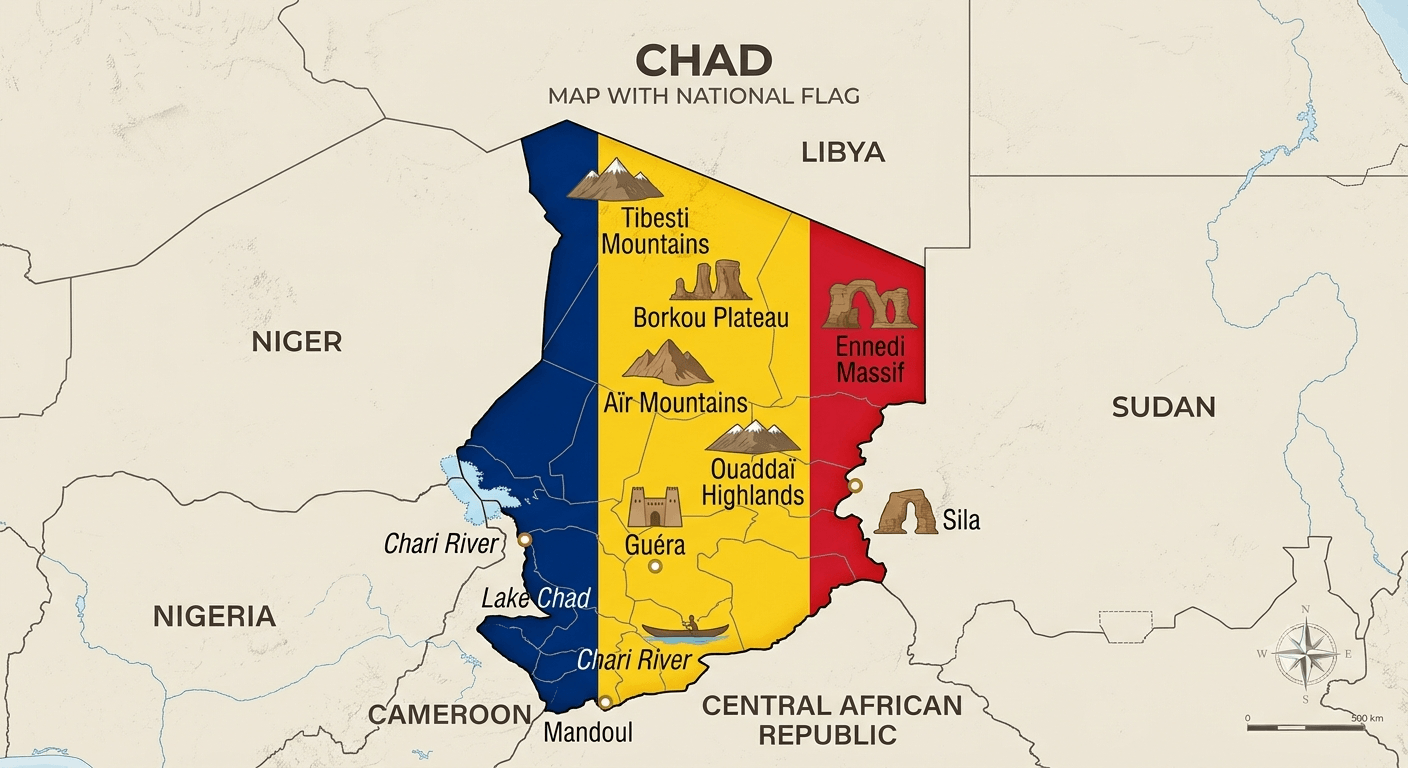
The Republic of Chad (République du Tchad) is a landlocked Central African country of roughly 1,284,000 sq km, bordering Libya, Sudan, the Central African Republic, Cameroon, Nigeria and Niger. N’Djamena is the capital.
Chad is a presidential republic. Following President Idriss Déby’s death in April 2021, a Transitional Military Council governed until a new constitution was adopted in December 2023; Mahamat Idriss Déby was elected President in May 2024. Governance remains fragile, compounded by regional insecurity, including spillover from Sudan’s conflict (World Bank, Chad Overview, 2025).
Economic Overview
Chad’s economy is dependent on oil and subsistence agriculture. Real GDP growth was 5.0% in 2024, decelerating to an estimated 3.4% in 2025, as a 0.7% oil-GDP contraction offset 4.2% non-oil growth (World Bank, 2025). AfDB projects 3.5–3.6% growth for 2026–2027, led by agricultural recovery from the 2024 floods. Inflation eased to 3.9% in 2025 from 5.1% in 2024. Public debt stood at approximately 32% of GDP by end-2024, following a 2022 restructuring agreement (AfDB; Lloyds Bank Trade Portal, 2024).
Agricultural Sector
Agriculture, livestock and fishing employ an estimated 80% of the labour force and contribute approximately 52.7% of GDP on the latest available sectoral breakdown (World Bank sectoral data; disaggregated recent official figures should be verified against Chad’s national statistics institute, INSEED). Cotton, livestock, cereals (sorghum, millet) and gum arabic are the principal outputs, with performance highly sensitive to flooding, as seen in 2022 and 2024.
Industrialization and Manufacturing Sector
Industry contributes only about 6.7% of GDP versus 40.6% for services (World Bank sectoral data). Principal industries are petroleum extraction and refining, cotton ginning and textiles, meatpacking, brewing, natron extraction, soap, cigarettes and construction materials, concentrated around N’Djamena and the Doba oil basin.
2. Trade and Economic Profile
Export and Import Overview
Chad recorded merchandise exports of approximately USD 1.70 billion and imports of approximately USD 2.26 billion in the most recent years with disaggregated public data (2018–2019 estimates, CIA World Factbook), reflecting reliance on crude-oil receipts to offset a persistent non-oil trade deficit. More current product-level data were not identified and should be verified against the World Bank’s WITS database and Chad’s INSEED.
| Indicator | Value | Year | Source |
| Nominal GDP | USD 18.79 billion | 2025 (est.) | World Economics/World Bank |
| GDP per capita (nominal) | USD 991 | 2025 (est.) | World Bank-sourced estimate |
| Real GDP growth | 3.4% | 2025 | World Bank, AfDB |
| Inflation (CPI) | 3.9% | 2025 | AfDB |
| Public debt (% GDP) | ~32% | 2024 | AfDB |
| Merchandise exports | USD 1.70 billion | 2018 (est.) | CIA World Factbook |
| Merchandise imports | USD 2.26 billion | 2019 (est.) | CIA World Factbook |
| National poverty rate | 44.8% | 2022 | World Bank |
| Extreme poverty ($2.15/day PPP) | 36.5% | 2024 | World Bank |
| Human Development Index | 0.394 (rank ~189–190/193) | 2024 | UNDP |
Major Export and Import Products
- Major export products: crude oil (dominant), cattle and livestock, raw cotton, gum arabic.
- Major export partners: United States (58.5%), India (13.3%), Japan (11.3%), China (10.1%) — 2024 estimates (Wikipedia/Trade Map compilation).
- Major import products: machinery and transport equipment, industrial goods, foodstuffs, textiles and refined petroleum products.
- Major import partners: France (25.4%), China (14.2%), Germany (11%), United States (10.4%) — 2025 estimates.
Detailed GDP Analysis
GDP composition remains agriculture-heavy relative to regional peers: agriculture over half of output, industry under 7%, services around 41%. GDP per capita of approximately USD 991 (nominal, 2025 est.) ranks 171st globally, reflecting narrow diffusion of oil wealth. The current account swung from a 0.4% of GDP surplus in 2024 to an estimated 2.5% deficit in 2025 on a weaker non-oil trade balance. The fiscal deficit narrowed to 2.3% of GDP in 2025 from 2.7% in 2024, within the CEMAC 3% convergence ceiling (World Bank; AfDB, 2025).
Major Industrial Products
Refined petroleum, ginned cotton and cotton textiles, processed meat, beer, soap, cigarettes, natron, and basic construction materials are Chad’s principal manufactured outputs, mostly consumed domestically given limited industrial export diversification.
3. Education
Chad’s system comprises six years of primary, four of lower-secondary and three of upper-secondary education, constrained by weak infrastructure, teacher shortages and low enrolment, particularly for girls and rural populations (UNESCO Institute for Lifelong Learning, GAL Country Profile, Chad, 2022).
| Indicator | Value | Year |
| Adult literacy rate (15+, both sexes) | 27.28% | 2022 |
| Adult literacy rate — male | 35.4% | 2022 |
| Adult literacy rate — female | 18.2% | 2022 |
| Youth literacy rate (15–24) | ~26.8% | 2022 |
| Net primary enrolment (both sexes) | ~77.7% | 2022 |
Chad has the lowest recorded adult literacy rate among UN member states (UNESCO/World Bank, 2022, latest year available). Education-expenditure and tertiary-enrolment figures were not identified with sufficient recency and should be verified against Chad’s Ministry of Education. The Project for the Urgent Reinforcement of Education and Literacy in Chad (PUREAT) targets foundational literacy, though coverage remains limited relative to need (UNESCO/IICBA, 2024).
4. Health and Social Indicators
Chad ranks 189th–190th of 193 countries on the UNDP Human Development Index (0.394, low human development), below both the Sub-Saharan African average (0.568) and the least-developed-country average (0.560) (UNDP/AfDB, 2025).
- Social development: World Bank Human Capital Index of 0.30 — a child born today will be only 30% as productive as an adult with full education and healthcare access (World Bank, 2025).
- Economic development: National poverty rate 44.8% (2022); extreme poverty ($2.15/day PPP) rose to 36.5% in 2024, projected at 45.4–47.6% by 2025–2027 amid the Sudan refugee crisis, with up to 900,000 additional refugees/returnees expected by end-2025 (World Bank, 2025).
- Literacy and illiteracy: Adult literacy 27.28% (2022); illiteracy affects roughly 73% of adults, the highest rate recorded globally (UNESCO/World Bank).
- Nutrition: Chad faces chronic and acute food insecurity linked to recurrent floods and droughts; verified national malnutrition-prevalence figures were not identified here and should be sourced from FAO/WFP Chad briefs before final submission.
- Other indicators: population estimated at approximately 19 million (derived from GDP and per-capita data, World Bank/World Economics, 2025), young and increasingly refugee-affected.
5. Bangladesh–Chad Bilateral Relations
Formal diplomatic engagement is minimal and not comparable in scale to Bangladesh’s relations with larger African economies (Egypt, Nigeria, Kenya, South Africa, Morocco). Bangladesh’s published list of 80 diplomatic missions does not include a resident mission in N’Djamena; its African presence is limited to Algiers, Cairo, Addis Ababa, Nairobi, Tripoli, Rabat, Abuja and Pretoria (Wikipedia, List of Ambassadors of Bangladesh, 2024–2025). No authoritative source confirms a resident Chadian embassy in Dhaka. Some third-party consular directories reference a Bangladeshi mission in Chad, but this could not be corroborated against Bangladesh’s Ministry of Foreign Affairs and should be treated as unverified.
In the absence of resident missions, diplomatic and commercial matters are most likely handled on a non-resident or concurrent-accreditation basis, common for Bangladesh’s relations with smaller African states. No bilateral trade agreement, joint economic commission, or MoU was identified.
6. Bilateral Trade Analysis
Bilateral trade appears negligible and is not separately itemised in EPB’s published country-wise export statistics or in Bangladesh Bank’s Annual Report, both of which report primarily on major and mid-tier partners. No HS-code-level export data from Bangladesh to Chad, or import data from Chad to Bangladesh, could be verified; where trade exists, it likely routes through third-country intermediaries or falls within aggregated ‘other Africa, n.e.s.’ categories. No Bangladesh Bank disclosure of Letters of Credit or correspondent banking specific to Chad was identified.
This should be read as a documented data gap rather than an assumption of zero trade; a definitive figure would require direct data requests to EPB, Bangladesh Bank, and Chad’s customs authority (Direction Générale des Douanes).
7. International Cooperation
Bangladesh and Chad are both members of the United Nations, WTO, the Organisation of Islamic Cooperation (OIC), the Non-Aligned Movement, and the Group of 77. Chad additionally belongs to the African Union and AfCFTA; Bangladesh to SAARC and SAFTA. Shared OIC/UN membership offers a multilateral platform, but no evidence was found of it translating into concrete bilateral outcomes to date. Bangladesh’s broader Africa outreach — including the Africa–Bangladesh Business Forum (Conakry, June 2024) and 2026 Foreign Office Consultations with Morocco and South Africa — signals intent to deepen African engagement, into which Chad could in principle be incorporated, though no Chad-specific initiative was identified (Wikipedia, Bangladesh–Africa relations, 2026).
8. Opportunities for Bangladeshi Citizens in Chad
- Higher education: no bilateral scholarship/exchange arrangement identified; opportunities would depend on multilateral (OIC, Islamic Development Bank) schemes rather than direct bilateral channels.
- Employment and labour migration: no formal agreement exists; Chad is not a traditional destination for Bangladeshi overseas workers (concentrated in the Gulf, Southeast Asia and select African markets like Libya). Opportunities likely limited to small-scale trading, construction subcontracting, or NGO/UN-linked employment given Chad’s humanitarian operations.
- Visa facilities: no bilateral waiver identified; Bangladeshi nationals face Chad’s standard third-country visa requirements.
- Export opportunities: individual traders could explore Chad’s demand for garments, pharmaceuticals and consumer goods, though logistics are constrained by Chad’s landlocked status and reliance on Cameroonian/Nigerian port corridors.
- Residency/citizenship: no preferential pathway identified.
9. Opportunities for Chad from Bangladesh
- High-potential import products: generic pharmaceuticals, RMG and knitwear, jute products, leather and footwear, ceramics and light consumer manufactures — sectors where Bangladesh has established export competitiveness aligning with Chad’s import basket.
- Investment opportunities: joint ventures in cotton ginning/textiles (leveraging Chad’s raw cotton output) and generic pharmaceutical manufacturing/distribution, against Chad’s underdeveloped industrial base (6.7% of GDP).
- Industrial cooperation: capacity-building in textiles, agro-processing and vocational training, areas of Bangladesh’s comparative institutional expertise.
- Other sectors: humanitarian/development-linked procurement, given Chad’s large refugee-response operations, could offer indirect market access via UN/NGO procurement channels.
10. Trade Associations and Future Prospects
No institutional collaboration between Bangladeshi trade bodies (FBCCI, BGMEA, BKMEA) and Chadian counterparts (the Chamber of Commerce, Industry, Agriculture, Mines and Crafts of Chad) was identified. This mirrors Bangladesh’s other lesser-engaged African relationships, where institutional ties typically follow resident diplomatic presence or dedicated trade missions (cf. Bangladesh–Botswana and Bangladesh–Trinidad and Tobago, where MoUs followed trade-delegation visits).
Prospects for bilateral trade and investment remain modest near-term, constrained by the absence of direct diplomatic representation, Chad’s landlocked geography, and its narrow oil-and-agriculture-dominated structure. Prospects would improve with: (i) non-resident or resident diplomatic coverage, (ii) inclusion of Chad in Bangladesh’s Africa business-forum initiatives, and (iii) targeted trade-delegation exchanges of the kind that have preceded MoUs with other African states.
11. Recommendations
- Establish non-resident diplomatic accreditation for Chad through a regional Bangladesh mission (e.g., Abuja or Cairo) for formal commercial and consular engagement.
- Commission a dedicated trade-data request to EPB, Bangladesh Bank, and Chad’s customs/statistics authorities to establish an accurate baseline, given the absence of published disaggregated data.
- Prioritise pharmaceutical and RMG/textile trade missions to Chad, given Bangladesh’s export strength and Chad’s import dependence in these categories.
- Explore agro-industrial joint ventures in cotton textiles, leveraging Chad’s raw cotton output and Bangladesh’s textile-processing expertise.
- Leverage OIC and Islamic Development Bank platforms for scholarship, technical-assistance or trade-financing cooperation absent direct bilateral instruments.
- Encourage FBCCI/BGMEA outreach to Chad’s Chamber of Commerce, potentially via the Africa–Bangladesh Business Forum, ahead of formal trade delegations.
- Verify all time-sensitive statistics against primary sources (World Bank, IMF, UNDP, AfDB, EPB, Bangladesh Bank) prior to client submission.
References
World Bank, “Chad Overview,” 2025 (worldbank.org/ext/en/country/chad).
African Development Bank, “Chad Economic Outlook,” 2025 (afdb.org/en/countries/central-africa/chad/chad-economic-outlook).
Lloyds Bank Trade Portal, “The Economic Context of Chad,” 2024 (lloydsbanktrade.com).
World Economics, “Chad GDP (Nominal) 2025” (worldeconomics.com).
Wikipedia, “Economy of Chad,” sourcing World Bank/CIA World Factbook data (accessed July 2026).
UNESCO Institute for Statistics / World Bank, “Literacy Rate, Adult Total — Chad,” data.worldbank.org.
UNESCO Institute for Lifelong Learning, “GAL Country Profile: Chad,” 2022.
UNESCO/IICBA, “Chad: Education Country Brief,” 2024.
UNDP, Human Development Index country data, as cited in AfDB Chad Economic Outlook, 2025.
Wikipedia, “List of Ambassadors of Bangladesh,” 2024–2025.
Wikipedia, “Bangladesh–Africa Relations,” 2026.
Wikipedia, “Bangladesh–Botswana Relations” and “Bangladesh–Trinidad and Tobago Relations” (institutional-cooperation precedents).
Export Promotion Bureau (Bangladesh) and Bangladesh Bank Annual Report — referenced for absence of Chad-specific disaggregated data; direct verification recommended.