Book Appointment Now

South Africa: Trade, Economic and Bilateral Relations Assessment (Bangladesh Perspective)
1. Country Profile
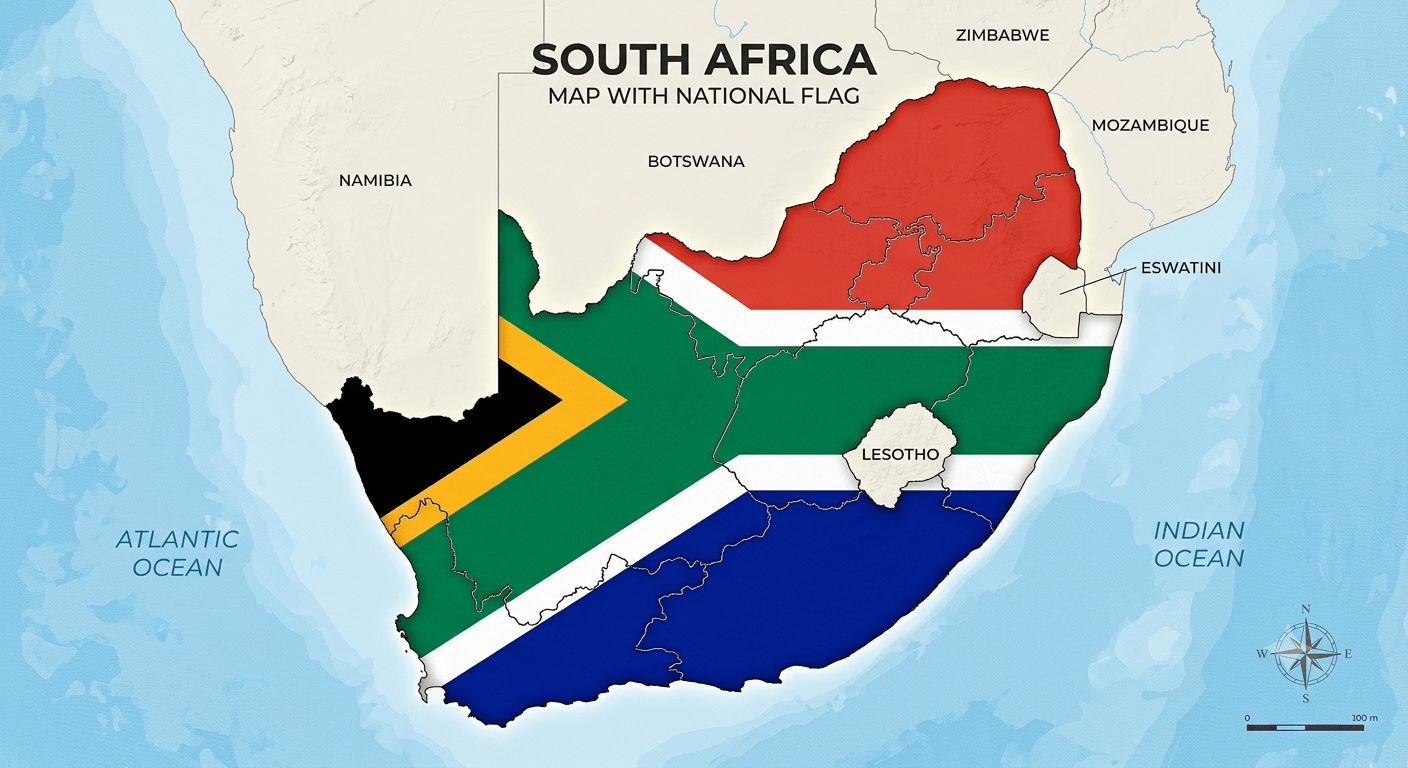
South Africa (official name: Republic of South Africa) lies at the southern tip of the African continent, bordered by Namibia, Botswana, Zimbabwe, Mozambique and Eswatini, and entirely surrounding Lesotho. It has three capitals — Pretoria (administrative), Cape Town (legislative) and Bloemfontein (judicial). Population is estimated at approximately 63–65.5 million (2024–26 est.), with life expectancy of 66.5 years and a fertility rate of 2.41 children per woman.
South Africa is a parliamentary republic with a multi-party constitutional democracy; the President is both head of state and government, elected by the National Assembly. Since the 2024 general election, the country has been governed by a Government of National Unity (GNU) coalition led by the African National Congress. South Africa is the only African member of the G20 and held the G20 Presidency in 2025.
Economic Overview
South Africa’s GDP was approximately US$400.3 billion in 2024 and an estimated US$427.2 billion in 2025 (current prices), making it the second-largest economy in Africa after Nigeria. GDP per capita stood at US$6,253 in 2024 (World Bank), rising toward an estimated US$7,503 by 2026. Real GDP growth was a modest 0.6% in 2024 and an estimated 1.1%–1.4% in 2025, with the IMF and World Bank projecting 1.4%–1.5% for 2026 and a medium-term average near 1.8% (2026–28). Trade (exports plus imports of goods and services) equalled close to 60% of GDP in 2024, reflecting a highly open economy. Unemployment remained a critical constraint, averaging 32.4% in 2025 and affecting more than 8 million people (World Bank).
Agricultural Sector
Agriculture, forestry and fishing contributed roughly 2.6% of GDP in value-added terms (2023, World Bank/Statista) but is a major employer and foreign-exchange earner. The sector was the standout performer in 2025, expanding 17.4% year-on-year and contributing R134.8 billion to GDP (Stats SA), driven by record field-crop and horticultural output. South Africa’s top agricultural export destinations in 2025 were the Netherlands (R27.5 billion), Zimbabwe (R19.4 billion), the United Kingdom (R19.3 billion), Mozambique (R14.1 billion) and Botswana (R13.4 billion).
Industrialization and Manufacturing Sector
Industry (mining, manufacturing, construction, utilities) contributed about 24.6% of GDP in 2023, with services at 62.6%. Manufacturing alone contracted 1.2% in 2025 and contributed roughly R517 billion to GDP for the year, weighed down by weak motor-vehicle and transport-equipment output; mining contributed roughly R208.5 billion in Q4 2025 alone. Key industrial sub-sectors include automotive assembly, chemicals, steel and metals, agro-processing, and platinum-group-metal (PGM) refining.
2. Trade and Economic Profile
South Africa exported a total of US$151 billion in goods in 2024 (OEC/UN Comtrade), ranking 35th globally, up from US$117 billion in 2019. China is now South Africa’s largest single trading partner for both exports and imports.
Major Export and Import Products
| Top Exports (2024/25) | Value (approx.) | Top Imports (2025) | Value (approx.) |
| Gold | US$29.0 billion | Refined petroleum | ZAR 42.3 billion/mo |
| Platinum (PGMs) | US$15.8 billion | Vehicles | ZAR 8.3 billion/mo |
| Motor vehicles | US$8.7 billion | Telephones | ZAR 5.3 billion/mo |
| Coal & briquettes | US$7.8 billion | Computers | ZAR 3.9 billion/mo |
| Iron ore/Chromium ore | — | Machinery & chemicals | — |
Source: OEC/UN Comtrade 2024 annual exports; Statistics South Africa / Trading Economics April 2026 monthly import data.
Detailed GDP Analysis
| Indicator | Value | Year/Source |
| GDP (current US$) | US$400.26 billion | 2024, World Bank |
| GDP (current US$, est.) | US$427.18 billion | 2025, Macrotrends/WB |
| GDP per capita (current US$) | US$6,253 | 2024, World Bank |
| Real GDP growth | 0.6% / ~1.1–1.4% | 2024 / 2025 (IMF, Treasury) |
| GDP growth forecast | 1.4%–1.5% | 2026, IMF/World Bank |
| Agriculture share of GDP | 2.6% | 2023, World Bank |
| Industry share of GDP | 24.6% | 2023, World Bank |
| Services share of GDP | 62.6% | 2023, World Bank |
| Trade (% of GDP) | ~60% | 2024, WITS/World Bank |
Major Industrial Products
Motor vehicles and components, refined petroleum products, iron, steel and basic metals, chemicals and fertilizers, processed foods and beverages, platinum-group-metal catalytic converters, and machinery for mining are the principal industrial outputs, concentrated in Gauteng, KwaZulu-Natal and the Eastern Cape.
3. Education
Basic education (Grades R–12) falls under the Department of Basic Education, while the Department of Higher Education and Training oversees universities and technical/vocational colleges (TVET). South Africa has 26 public universities and a large TVET college network aimed at expanding artisan and technical skills.
The national adult (15+) literacy rate is estimated at 95% (2025, national statistics), among the highest in Sub-Saharan Africa, though UNESCO/World Bank series based on the 2021 census round it closer to 90%. The Human Rights Measurement Initiative estimates South Africa is meeting only 57.1% of its income-adjusted obligation on the right to education, reflecting persistent quality and access gaps between historically under-resourced and well-resourced schools. Human capital development remains constrained by learning-poverty indicators and the 32%+ youth-heavy unemployment rate, underscoring the gap between school enrolment (near-universal at primary level) and labour-market-ready skills.
4. Health and Social Indicators
| Indicator | Value | Source/Year |
| Human Development Index (HDI) | 0.741 (High) | UNDP HDR 2025 |
| Life expectancy at birth | 66.5 years | 2024 est. |
| Population below lower-bound poverty line | 37.9% (~23 million) | 2025, Stats SA |
| Population below upper-middle-income poverty line | ~60% | World Bank 2025 |
| Unemployment rate | 32.4% | 2025, World Bank |
| Child stunting (under-5) | ~1 in 4 children | Dept. of Health, 2024 |
| Inflation (CPI) | 3.2% | 2025, World Bank |
South Africa is classified in the “High Human Development” category with an HDI of 0.741 in the UNDP’s 2025 Human Development Report, though inequality-adjusted HDI is markedly lower given a Gini coefficient among the highest in the world. Nutrition indicators remain concerning: government data reported 1,457 child deaths from acute malnutrition between January 2023 and November 2024, concentrated in KwaZulu-Natal, Limpopo, Eastern Cape and Gauteng, and roughly one in four children nationally are stunted.
5. Bangladesh–South Africa Bilateral Relations
Bangladesh and South Africa established formal diplomatic relations on 10 September 1994, shortly after Nelson Mandela’s inauguration ending apartheid. Bangladesh opened a resident High Commission in Pretoria on 27 February 1995 — one of only a handful of Bangladeshi missions in Sub-Saharan Africa. South Africa’s High Commission accredited to Bangladesh is based in Colombo, Sri Lanka, on a non-resident basis; South Africa does not currently maintain a resident mission in Dhaka. Both countries are members of the Commonwealth of Nations, and diplomatic engagement has included visits at the ministerial level, including discussions on expanding pharmaceutical exports.
Trade relations remain modest relative to both countries’ overall trade volumes but have shown a rising trend, supported by growing Bangladeshi interest in African markets under Dhaka’s ‘Look Africa’ policy launched in the mid-2010s.
6. Bilateral Trade Analysis
South Africa’s imports from Bangladesh were valued at US$131.88 million in 2025 (UN Comtrade, mirror data), up from historical levels near US$85 million in 2015 — indicating steady growth over the past decade. South African exports to Bangladesh were recorded at roughly US$852 million as far back as 2014, reflecting South Africa’s role as a supplier of primary and intermediate goods to Bangladesh’s manufacturing base.
| Direction | Indicative HS Chapters/Codes | Key Products |
| Bangladesh → South Africa | 61, 62 (Knitted/Woven Apparel); 3004 (Pharmaceuticals); 0303/0304 (Frozen Fish); 5310 (Jute Fabrics) | Ready-Made Garments, Generic Medicines, Frozen Shrimp/Fish, Jute And Jute Goods |
| South Africa → Bangladesh | 26 (Ores, Incl. Chromium/Manganese); 47 (Wood Pulp); 28 (Inorganic Chemicals); 08 (Citrus Fruit); 72 (Iron & Steel) | Mineral Ores, Wood Pulp, Industrial Chemicals, Citrus Fruit, Steel |
Source: Export Promotion Bureau (EPB) Bangladesh trade classification practice and UN Comtrade/Trading Economics mirror statistics; exact bilateral HS-level tables were not separately published by EPB at the time of writing.
Bangladesh Bank’s Annual Report does not publish a South Africa-specific breakdown of Letters of Credit (L/C) or trade-financing data; bilateral trade is settled through standard commercial banking channels — usance and sight L/Cs opened by Authorized Dealer banks — and is captured within Bangladesh Bank’s broader Africa/Rest-of-World trade-financing aggregates rather than as a distinct country line item.
7. International Cooperation
Both countries are members of the United Nations, World Trade Organization, the Commonwealth of Nations, the Non-Aligned Movement, and the Group of 77. South Africa is a full G20 member (and 2025 G20 host); Bangladesh has participated as an invited guest country at recent G20 summits. Bangladesh is not a member of BRICS or the African Union, and South Africa is not a member of the OIC, SAARC or D-8, so shared institutional overlap is concentrated in universal bodies (UN system, WTO) and the Commonwealth rather than regional blocs. This shared multilateral space has provided venues for ministerial contact but has not yet translated into a dedicated bilateral trade or investment treaty.
8. Opportunities for Bangladeshi Citizens in South Africa
- Higher Education: South African universities (e.g., University of Pretoria, Wits, University of Cape Town) offer comparatively affordable, English-medium postgraduate programmes with growing numbers of South Asian students, though numbers of Bangladeshi students remain small.
- Employment and Labour Migration: South Africa operates a Critical Skills Work Visa regime targeting engineering, ICT, artisan and health professions — sectors where Bangladeshi skilled workers could qualify, subject to demand-list matching.
- Visa Facilities: Bangladeshi nationals require a visa for South Africa; e-visa and visa-on-arrival facilities are limited, so advance application through the High Commission in Dhaka-adjacent missions or Pretoria is typically required.
- Export Opportunities: Bangladeshi garment, pharmaceutical and jute exporters can access the South African market both directly and as a gateway to the wider 16-nation Southern African Development Community (SADC).
- Long-Term Residency: South Africa offers permanent residency and eventual naturalization pathways (typically after 5 years of qualifying residence) for investors, critical-skills workers and spouses of citizens.
9. Opportunities for South Africa from Bangladesh
- High-potential imports: affordable ready-made garments and home textiles, generic pharmaceuticals (Bangladesh is a major LDC producer), jute-based eco-friendly packaging as a substitute for plastics, and processed frozen seafood.
- Investment opportunities: joint ventures in Bangladesh’s export-processing zones and economic zones offer South African investors low-cost manufacturing access serving South Asian and European markets.
- Industrial cooperation: potential collaboration in leather goods, light engineering, and ICT/software outsourcing, where Bangladesh has a growing and cost-competitive base.
- Other sectors: shipping/maritime logistics cooperation and skills exchange in agro-processing given Bangladesh’s dense agricultural value chains.
10. Trade Associations and Future Prospects
Bangladeshi trade bodies such as the Federation of Bangladesh Chambers of Commerce and Industry (FBCCI) and the Dhaka Chamber of Commerce & Industry (DCCI) have organized trade missions and participated in fairs targeting African markets, including South Africa, while the Bangladesh Association of Software and Information Services (BASIS) promotes IT/software exports. Institutionalized, standing cooperation frameworks between Bangladeshi and South African chambers remain limited and largely event-driven rather than treaty-based. Given rising two-way trade (South Africa’s imports from Bangladesh grew from roughly US$85 million in 2015 to nearly US$132 million in 2025) and both governments’ interest in South-South cooperation, prospects exist for a bilateral Trade and Investment Framework, reciprocal trade fairs, and direct shipping/logistics arrangements to reduce transshipment costs currently routed via the Middle East or Europe.
11. Recommendations
- Negotiate a bilateral Trade and Investment Cooperation Agreement or MoU to provide an institutional anchor for expanding two-way trade beyond the current sub-US$150 million level.
- Encourage South Africa to establish a resident High Commission in Dhaka to match Bangladesh’s resident mission in Pretoria, improving visa processing and commercial diplomacy.
- Support direct business-to-business linkages between FBCCI/DCCI and South African chambers (e.g., through SADC business councils) to institutionalize trade promotion beyond ad hoc fairs.
- Diversify Bangladeshi exports toward pharmaceuticals and jute-based packaging, capitalizing on South Africa’s demand for affordable generics and sustainable packaging alternatives.
- Explore direct shipping routes/logistics arrangements to cut freight costs and transit times currently incurred via third-country transshipment.
- Use shared Commonwealth, UN and WTO platforms to advance technical cooperation on customs facilitation, standards harmonization, and preferential tariff discussions.