Book Appointment Now

Thailand Country Profile: Economic Overview, Trade Relations with Bangladesh & Investment Opportunities
1. Thailand Country Profile
Geographical Location
Thailand, officially the Kingdom of Thailand, is strategically positioned in mainland Southeast Asia at the heart of the Indochinese Peninsula. The country borders Myanmar (west and northwest), Laos (north and northeast), Cambodia (east), and Malaysia (south), with extensive coastlines on the Gulf of Thailand (east) and the Andaman Sea (west). This geographic position makes Thailand a crucial logistics and trade gateway for the entire Southeast Asian region[1].
Land Area: Approximately 513,120 square kilometers
Population: Approximately 71.7 million (2024 estimate)
Capital: Bangkok (Krung Thep), the political, economic, and cultural center
Official Political Name and System
Official Name: Kingdom of Thailand (ราชอาณาจักรไทย)
Government System: Thailand operates as a constitutional monarchy with a parliamentary system. The country has experienced multiple constitutions and governance transitions; the current framework aims to establish democratic stability[2].
Head of State: King Maha Vajiralongkorn (Rama X), reigning since 2016[2]
Head of Government: Prime Minister Anutin Charnvirakul (Bhumjaithai Party) serving since September 2025 and re-confirmed following the 2026 general election
Legislative Structure: Bicameral National Assembly comprising the Senate and House of Representatives, with devolved regional administration across 77 provinces.
Sources: World Bank Thailand Country Overview 2026 | Government of Thailand Official Portal
2. ECONOMIC OVERVIEW
Thailand is an upper-middle-income, export-oriented economy and the second-largest economy in ASEAN after Indonesia. The Thai economy demonstrates structural resilience despite regional and global headwinds.
Key Economic Indicators (2024-2026)
| Economic Indicator | 2024 Actual | 2025 Estimate | 2026 Forecast | Source |
| Nominal GDP | ~US$560 billion | ~US$570 billion | ~US$580 billion | IMF Article IV, Nov 2025[3] |
| Real GDP Growth | 2.5% | 1.8-2.1% | 1.6-1.7% | IMF, World Bank[3] |
| GDP Per Capita | ~US$7,800 | ~US$7,950 | ~US$8,110 | IMF Estimates[3] |
| Government Debt | 65.2% of GDP | 65.5% of GDP | 65.7% of GDP | IMF FY2025[3] |
| Foreign Exchange Reserves | US$295.2 billion | US$300.8 billion | US$306.5 billion | Bank of Thailand[4] |
| Inflation Rate | 0.2% | -0.1% (deflationary) | 0.4% | IMF Article IV[3] |
| Unemployment Rate | 1.1% | 1.2% | 1.3% | Trading Economics[5] |
Source: IMF Article IV Consultation Report (November 2025) | Bank of Thailand | Trading Economics Thailand Labor Market
Sectoral Contribution to GDP
| Sector | % of GDP | Description | Source |
| Services | 52% | Retail, tourism, telecommunications, financial services | World Bank[6] |
| Industry | 39% | Manufacturing, automotive, electronics, petrochemicals | World Bank[6] |
| Agriculture | 8-9% | Rice, rubber, cassava, sugar, fisheries | World Bank[6] |
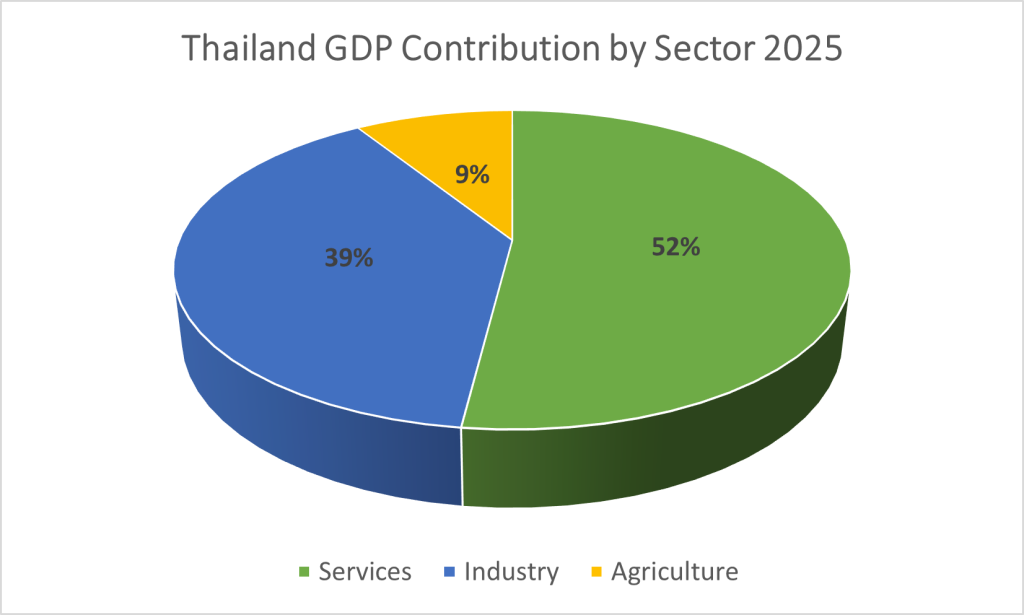
Source: World Bank Thailand Economic Monitor 2025-26
Key Growth Drivers:
- Export-Oriented Manufacturing: Particularly automotive, electronics, and petrochemicals
- Tourism & Hospitality: Significant recovery post-pandemic (2024-2025)
- Financial Services: Bangkok’s role as Southeast Asian financial hub
- Foreign Direct Investment: Sustained inflows from Japan, China, USA, and South Korea
Macroeconomic Challenges:
- Moderate real GDP growth (1.6-2.1%) reflects weak external demand and global trade uncertainties[3]
- Deflationary pressures (-0.1% inflation 2025) amid subdued domestic demand[3]
- High government debt ratio (65.7% of GDP) requiring fiscal consolidation[3]
- Rising US tariff uncertainties affecting export competitiveness[3]
3. AGRICULTURAL SECTOR
Agriculture remains a cornerstone of Thailand’s economy despite declining sectoral share, employing approximately 30-35% of the workforce and generating substantial export revenues[6].
Major Agricultural Products and Production
| Product | Global Ranking | Annual Production (Latest) | Export Value (US$ Mn) | Key Markets | Source |
| Rice | 2nd largest exporter | 18-20 million tonnes/year | $6,500-7,200 | India, Vietnam, China, Philippines | Thai Rice Exporters Assoc. |
| Natural Rubber | World’s largest exporter | 4.5-5.0 million tonnes/year | $4,800-5,500 | China, Japan, USA, India | International Rubber Study Group[8] |
| Cassava (Tapioca) | World’s largest producer/exporter | 25-30 million tonnes/year | $2,100-2,400 | China, Vietnam, Indonesia | FAO STAT[9] |
| Sugar | World’s 2nd largest exporter | 9-10 million tonnes/year | $1,800-2,100 | USA, China, South Korea | Thai Sugar Exporters Assoc. |
| Processed Seafood | Major exporter | 3.5-4.0 million tonnes/year | $5,500-6,200 | USA, EU, Japan, China | Thai Fisheries Department[10] |
| Fruits (Pineapple, Mango, Durian) | Top regional exporter | Varies by commodity | $800-1,200 | Global markets | FAO STAT[9] |
Thailand is among the world’s largest and most competitive agricultural exporters, particularly in rice (2nd), rubber (1st), and cassava (1st), leveraging climate advantages, established supply chains, and advanced processing infrastructure[6][7][8].
Source: Thai Rice Exporters Association | International Rubber Study Group | FAO STAT Database | Department of Fisheries Thailand
4. INDUSTRIALIZATION AND MANUFACTURING
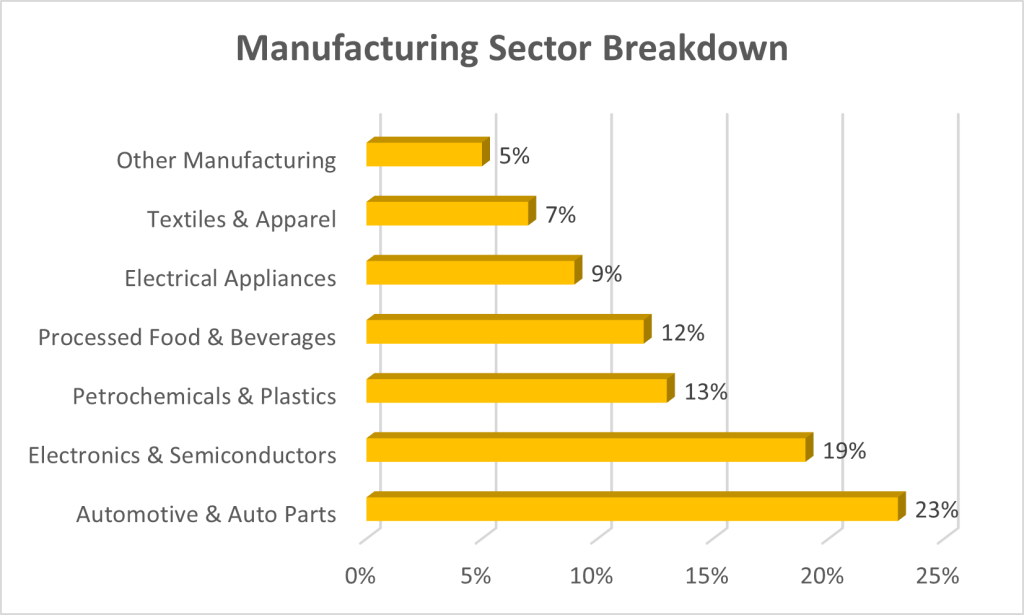
Thailand’s industrial sector contributes 39% of GDP and serves as ASEAN’s principal automotive and electronics manufacturing hub, attracting sustained foreign direct investment[6].
Major Industrial Sectors and Production
| Industrial Sector | % of Manufacturing Output | Key Products | Global Position | Major Investors | Source |
| Automotive & Auto Parts | 22-24% | Sedans, commercial vehicles, components | Regional hub | Japan, USA, South Korea | Thai Auto Assoc. |
| Electronics & Semiconductors | 18-20% | Integrated circuits, semiconductors, components | Growing regional role | Taiwan, South Korea, USA | Thai Electronics Assoc. |
| Petrochemicals & Plastics | 12-14% | Plastics, chemicals, industrial polymers | Established exporter | European, Middle Eastern firms | Thai Chem. Exporters[12] |
| Processed Food & Beverages | 11-13% | Rice products, seafood, beverages | Major exporter | Domestic, regional | Thai Food Exporters[7] |
| Electrical Appliances | 8-10% | Refrigerators, air conditioners, appliances | Competitive exporter | Japanese, Korean companies | Thai Electronics Assoc. |
| Textiles & Apparel | 6-8% | Fabrics, garments, industrial textiles | Regional producer | Domestic, regional firms | Thai Textile Assoc. |
| Other Manufacturing | 4-6% | Various consumer & industrial goods | — | Diverse | — |
Total Manufacturing Value Added: ~US$226 billion (2025 estimate)
Key Competitive Advantages:
- Industrial Infrastructure: Well-developed industrial estates and special economic zones[11]
- Supply Chain Integration: Established linkages with regional and global suppliers[11]
- Skilled Workforce: Experienced labor force in assembly, fabrication, and QA[11]
- FDI-Friendly Environment: Tax incentives, Board of Investment support, and regulatory stability[11]
Source: Thai Industry Ministry & Board of Investment | Thai Chemical Exporters Association | Thai Textile Association
5. TRADE AND ECONOMIC PROFILE
Export and Import Overview
Thailand is a major global trader, with robust merchandise flows reflecting its position as a regional manufacturing and agricultural hub.
| Trade Metric | 2024 | 2025 | Growth Rate | Source |
| Total Merchandise Exports | ~US$300.8 billion | US$339.64 billion | +12.9% y-o-y | Thai Ministry of Commerce[14] |
| Total Merchandise Imports | ~US$285.4 billion | US$318.27 billion | +11.5% y-o-y | Thai Ministry of Commerce[14] |
| Trade Surplus | ~US$15.4 billion | US$21.37 billion | Expanding | Calculated from above[14] |
| Export-to-GDP Ratio | ~54% | ~59.6% | Growing | IMF/Trade Data[3][14] |
Source: Thailand Ministry of Commerce – Trade Policy & Strategy Office (TPSO)
Major Export Products and Markets
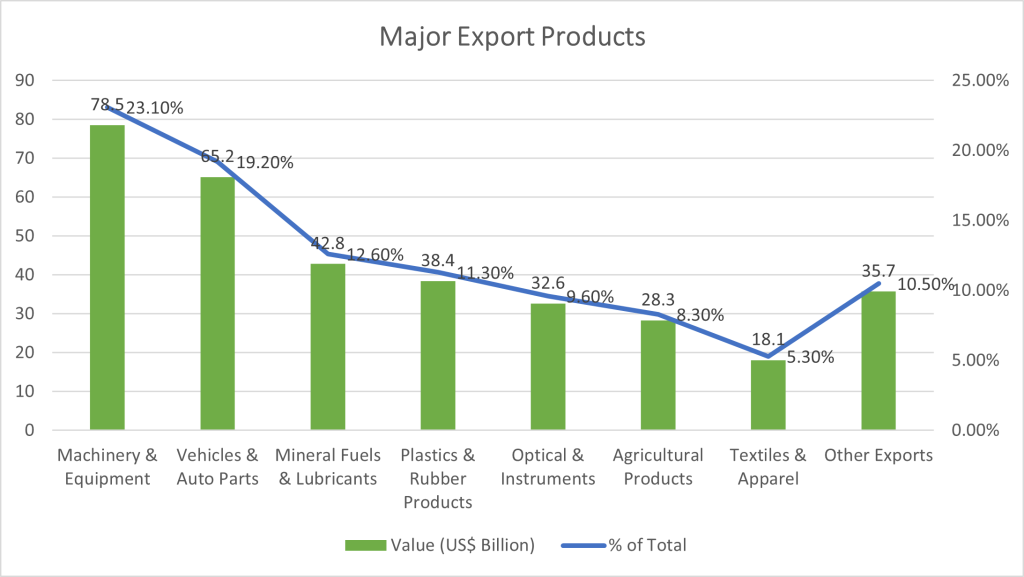
Top Export Commodities (2025)
| Commodity | Value (US$ Bn) | % of Total Exports | Key Markets | Source |
| Machinery & Mechanical Appliances | $78.5 | 23.1% | USA, China, Japan, EU | UN Comtrade[15] |
| Vehicles & Auto Parts | $65.2 | 19.2% | USA, Australia, ASEAN | UN Comtrade[15] |
| Mineral Fuels & Lubricants | $42.8 | 12.6% | China, Singapore, Japan | UN Comtrade[15] |
| Plastics & Rubber Products | $38.4 | 11.3% | USA, China, EU | UN Comtrade[15] |
| Optical & Precision Instruments | $32.6 | 9.6% | USA, EU, Japan | UN Comtrade[15] |
| Agricultural Products (Rice, Rubber, Cassava) | $28.3 | 8.3% | Global markets | UN Comtrade[15] |
| Textiles & Apparel | $18.1 | 5.3% | USA, EU, ASEAN | UN Comtrade[15] |
| Other Exports | $35.7 | 10.5% | Diverse | UN Comtrade[15] |
Total Exports: US$339.64 billion
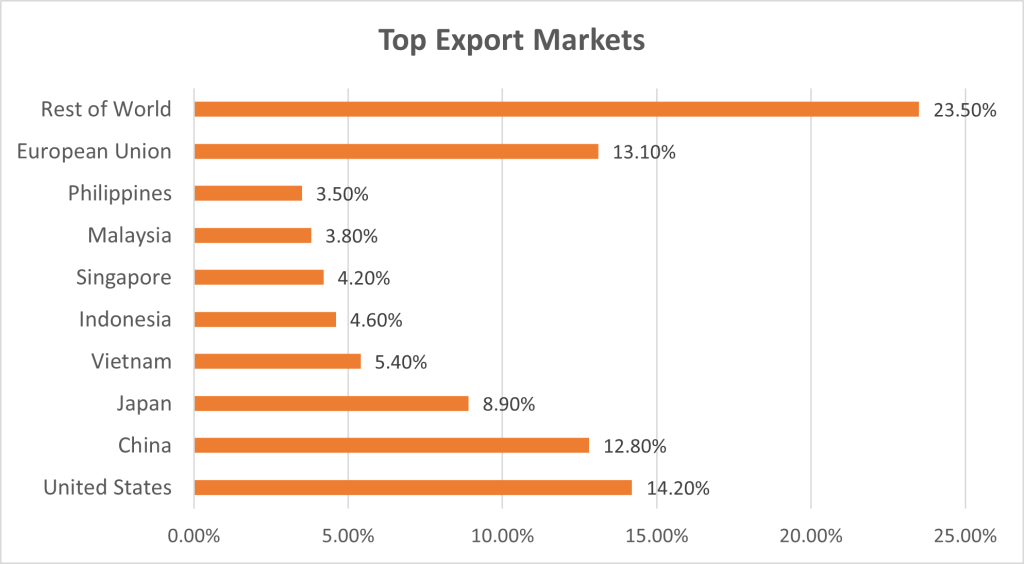
Top Export Markets (2025)
| Country/Region | % of Total Exports | Value (US$ Bn) | Source |
| United States | 14.2% | $48.3 | UN Comtrade[15] |
| China | 12.8% | $43.5 | UN Comtrade[15] |
| Japan | 8.9% | $30.2 | UN Comtrade[15] |
| Vietnam | 5.4% | $18.3 | UN Comtrade[15] |
| Indonesia | 4.6% | $15.6 | UN Comtrade[15] |
| Singapore | 4.2% | $14.3 | UN Comtrade[15] |
| Malaysia | 3.8% | $12.9 | UN Comtrade[15] |
| Philippines | 3.5% | $11.9 | UN Comtrade[15] |
| European Union (27 member states) | 13.1% | $44.5 | UN Comtrade[15] |
| Rest of World | 23.5% | $79.8 | UN Comtrade[15] |
Source: UN Comtrade Database (2025)
Major Import Products and Sources
Top Import Commodities (2025)
| Commodity | Value (US$ Bn) | % of Total Imports | Primary Sources | Source |
| Machinery & Mechanical Appliances | $89.4 | 28.1% | Japan, China, Germany | UN Comtrade[15] |
| Mineral Fuels & Oils | $52.3 | 16.4% | Middle East, Russia, Malaysia | UN Comtrade[15] |
| Electrical & Electronic Equipment | $48.7 | 15.3% | China, Japan, South Korea | UN Comtrade[15] |
| Chemicals & Chemical Products | $38.5 | 12.1% | China, USA, Germany | UN Comtrade[15] |
| Optical & Precision Instruments | $28.4 | 8.9% | Japan, Germany, USA | UN Comtrade[15] |
| Plastics & Rubber Materials | $22.1 | 6.9% | China, Japan, Indonesia | UN Comtrade[15] |
| Textiles & Fabrics | $18.6 | 5.8% | China, Vietnam, India | UN Comtrade[15] |
| Other Imports | $20.2 | 6.4% | Diverse | UN Comtrade[15] |
Total Imports: US$318.27 billion
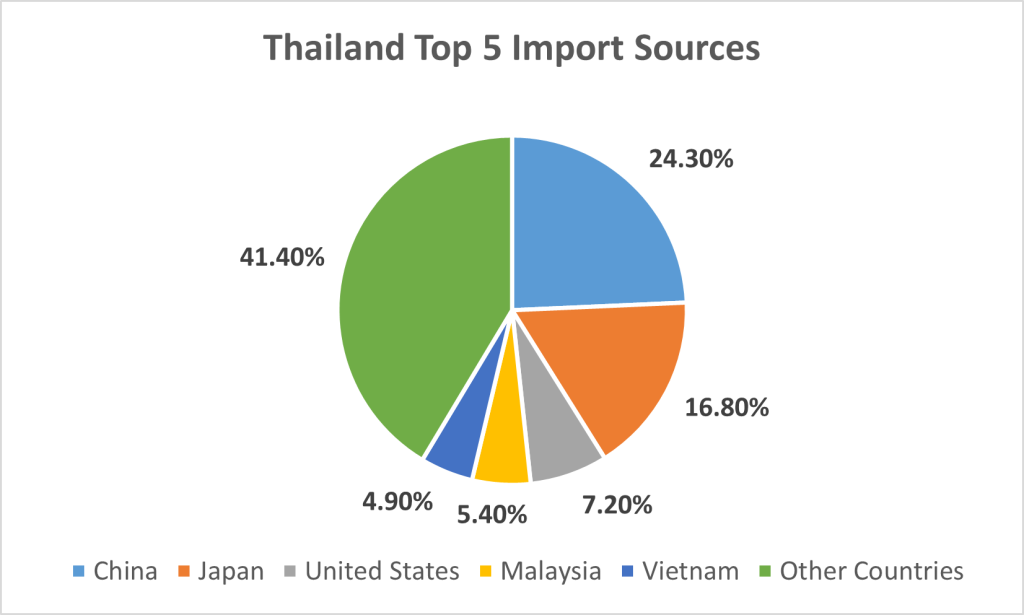
Top Import Sources (2025)
| Country | % of Total Imports | Value (US$ Bn) | Source |
| China | 24.3% | $77.3 | UN Comtrade[15] |
| Japan | 16.8% | $53.5 | UN Comtrade[15] |
| United States | 7.2% | $22.9 | UN Comtrade[15] |
| Malaysia | 5.4% | $17.2 | UN Comtrade[15] |
| Vietnam | 4.9% | $15.6 | UN Comtrade[15] |
| Singapore | 4.6% | $14.6 | UN Comtrade[15] |
| Indonesia | 4.1% | $13.0 | UN Comtrade[15] |
| South Korea | 3.8% | $12.1 | UN Comtrade[15] |
| Germany | 3.2% | $10.2 | UN Comtrade[15] |
| Other Countries | 20.8% | $66.2 | UN Comtrade[15] |
6. EDUCATION
Overview of the Education System
Thailand operates a 6-3-3 education structure (primary 6 years, lower-secondary 3 years, upper-secondary 3 years) with nine years of compulsory, tuition-free basic education provided by the government. Higher education comprises universities, vocational institutions, and emerging dual-education pathways under Thailand’s “Thailand 4.0” initiative[16].
Thailand 4.0 Policy Focus: Prioritizing Science, Technology, Engineering, Mathematics (STEM) education and digital-economy skills for workforce alignment with emerging sectors[16].
Key Educational Institutions:
- Chulalongkorn University (top-ranked in Southeast Asia)
- Mahidol University (research-focused)
- Thammasat University (social sciences leader)
- King Mongkut’s University of Technology
Literacy Rate and Human Capital
| Education Metric | Value | Benchmark | Source |
| Adult Literacy Rate (age 15+) | 91-94% | High for region | World Bank/UNESCO[17] |
| Primary Enrollment Ratio | ~99% | Near-universal | UNESCO[17] |
| Secondary Enrollment Ratio | ~87% | High regional level | UNESCO[17] |
| Tertiary Enrollment Ratio | ~44% | Growing | UNESCO[17] |
| Female Enrollment (all levels) | 50-52% | Parity achieved | UNESCO[17] |
| STEM Graduates (% of tertiary) | ~35-40% | Increasing under Thailand 4.0 | Thai Ministry of Education[16] |
Source: Thailand Ministry of Education | UNESCO Institute for Statistics
Human Capital Development: Thailand ranks 52nd in Global Human Capital Index 2024, with government initiatives targeting upskilling in digital technologies, advanced manufacturing, and green economy sectors.
7. HEALTH AND SOCIAL INDICATORS
Health Metrics
| Health Indicator | Value | Source |
| Life Expectancy at Birth | 77.1 years | WHO Thailand Profile[18] |
| Infant Mortality Rate | 8.1 per 1,000 live births | WHO/World Bank[18] |
| Maternal Mortality Ratio | 26 per 100,000 live births | WHO[18] |
| Healthcare Coverage | ~97% of population | Thai Health Ministry[19] |
| Universal Health Coverage Index | 77/100 | WHO[18] |
Social Indicators
| Social Indicator | Value | Source |
| Poverty Rate (National) | 7.2% | World Bank[6] |
| Gini Coefficient (Income Inequality) | 0.37 | World Bank[6] |
| Unemployment Rate | 1.1-1.3% | Trading Economics[5] |
| Female Labor Force Participation | ~51% | ILO/World Bank[6] |
| Access to Improved Water | ~99% | WHO/UNICEF[18] |
| Access to Improved Sanitation | ~98% | WHO/UNICEF[18] |
| Mobile Phone Penetration | ~147% (multiple SIMs) | ITU[20] |
| Internet Penetration | ~84% | World Bank[6] |
Source: World Health Organization Thailand Country Profile | Ministry of Public Health Thailand | ITU Statistics
8. BANGLADESH-THAILAND BILATERAL RELATIONS
Historical Relations
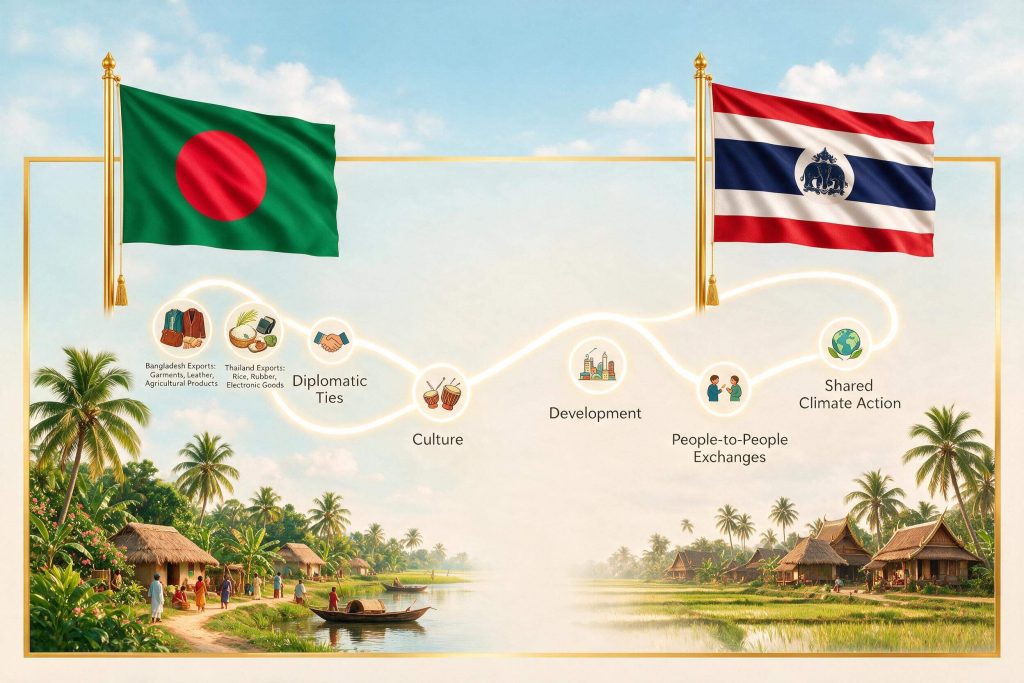
Diplomatic relations between Bangladesh and Thailand were formally established in 1975, following Bangladesh’s independence. Both nations maintain embassy-level representation: the Bangladesh Embassy in Bangkok and the Royal Thai Embassy in Dhaka.
Regional Cooperation Framework
Both countries are active members of key regional and international organizations:
Shared Regional Platforms:
- BIMSTEC (Bay of Bengal Initiative): Founded in 1997 as BIST-EC by Bangladesh, India, Sri Lanka, and Thailand; renamed BIMSTEC in 1997. BIMSTEC Secretariat is hosted in Dhaka since 2014
- UN, WTO, Asian Development Bank, UN-ESCAP: Both countries participate actively[21]
- ASEAN-Related Forums: Thailand’s ASEAN membership provides indirect engagement pathways[21]
Key Distinction: Unlike Bangladesh (OIC member), Thailand is not an OIC member, but maintains strong cultural and religious dialogue channels[21].
Recent Diplomatic Developments
FTA Negotiations: Thailand and Bangladesh announced plans for a formal Free Trade Agreement (FTA) starting 2025, with potential conclusion by year-end 2025 or early 2026. The April 2025 Bangkok Declaration during BIMSTEC summit formalized this commitment[22].
Halal Market Focus: Thailand has explicitly stated interest in Bangladesh as a halal-certified food and consumer goods supplier, creating new opportunities for Bangladeshi agro-processing and food exports[22].
Investment Cooperation: Preliminary discussions on Thai petrochemical, automotive-parts, and agro-processing investment in Bangladesh’s Export Processing Zones (EPZs).
Source: Embassy of Bangladesh Bangkok | Nation Thailand, “Thailand, Bangladesh to launch formal FTA talks by year-end,” May 2025
9. BILATERAL TRADE ANALYSIS
Bangladesh-Thailand Trade Overview
Current Trade Volume: Bilateral trade remains asymmetrical and modest relative to potential, with estimated 2024 bilateral trade of ~US$1.125 billion, characterized by significant Thai surplus[23].
What Bangladesh Exports to Thailand
| Product Category | Value (US$ Mn) | % of BD Exports to Thailand | HS Code Range | Key Markets/Buyers | Source |
| Ready-Made Garments (RMG) | 40-50 | 45-55% | 61-62 | Thai retailers, textile mills | UN Comtrade[15] |
| Textiles & Fabrics | 15-20 | 15-20% | 50-63 | Apparel manufacturers | UN Comtrade[15] |
| Leather & Leather Products | 8-12 | 10-12% | 41-43 | Footwear, automotive suppliers | UN Comtrade[15] |
| Pharmaceuticals | 5-8 | 6-8% | 30 | Hospitals, pharmacies | UN Comtrade[15] |
| Jute Products | 3-5 | 3-5% | 53 | Packaging, handicrafts | UN Comtrade[15] |
| Ceramics & Pottery | 2-3 | 2-3% | 69 | Home décor, decorative items | UN Comtrade[15] |
| Fish & Seafood Products | 2-3 | 2-3% | 03 | Food processors, restaurants | UN Comtrade[15] |
| Other Products | 3-5 | 3-5% | Mixed | Various sectors | UN Comtrade[15] |
Total BD Exports to Thailand: ~US$85 million (2024 estimate)
Key Observation: Bangladeshi apparel dominates export basket (45-55%), reflecting RMG sector competitiveness despite regional competition from Vietnam and Cambodia[23].
What Thailand Exports to Bangladesh
| Product Category | Value (US$ Mn) | % of Thai Exports to BD | HS Code Range | Key Markets/End-Users | Source |
| Machinery & Mechanical Equipment | 280-300 | 26-28% | 84 | Industrial, construction sectors | UN Comtrade[15] |
| Electrical & Electronic Equipment | 200-220 | 19-21% | 85 | Manufacturing, telecommunications | UN Comtrade[15] |
| Mineral Fuels & Oils (Refined) | 140-160 | 13-15% | 27 | Power plants, transport sector | UN Comtrade[15] |
| Plastics & Plastic Products | 90-110 | 8-10% | 39 | Packaging, manufacturing inputs | UN Comtrade[15] |
| Chemicals & Chemical Products | 70-90 | 7-8% | 28-29 | Industrial use, manufacturing | UN Comtrade[15] |
| Optical & Precision Instruments | 40-50 | 4-5% | 90 | Medical, telecommunications | UN Comtrade[15] |
| Rubber Products | 30-40 | 3-4% | 40 | Manufacturing, automotive | UN Comtrade[15] |
| Agricultural Products | 20-30 | 2-3% | 02, 07, 12 | Food industry, consumers | UN Comtrade[15] |
| Textiles | 15-25 | 1.5-2.5% | 50-63 | Apparel, industrial use | UN Comtrade[15] |
| Other Products | 50-70 | 5-7% | Mixed | Various sectors | UN Comtrade[15] |
Total Thai Exports to Bangladesh: ~US$1.04 billion (2024 estimate)
Key Observation: Thai exports dominated by industrial inputs and machinery (48-58%), reflecting Bangladesh’s demand for manufacturing equipment and petrochemicals for energy and industrial sectors[23].
Trade Imbalance Analysis
| Trade Metric | 2024 Value | Imbalance Ratio | Source |
| Thai Exports to BD | ~US$1.04 billion | 12.2:1 | UN Comtrade[15] |
| BD Exports to Thailand | ~US$85 million | Baseline | UN Comtrade[15] |
| Trade Deficit (BD perspective) | ~US$955 million | — | Calculated[15] |
| Thai Trade Surplus | ~US$955 million | — | Calculated[15] |
FTA Expected Impact: Proposed Bangladesh-Thailand FTA (expected conclusion by late 2025/early 2026) aims to narrow this imbalance through tariff concessions on Bangladeshi apparel, leather, pharmaceuticals, and agro-processed goods[22].
Banking and Financial Linkages
Correspondent Banking:
- Thai Commercial Banks: Siam Commercial Bank (SCB), Bangkok Bank, Kasikornbank, Krung Thai Bank[24]
- Bangladeshi Banks: Dutch-Bangla Bank, Brac Bank, City Bank, Prime Bank[24]
Trade Finance Mechanisms:
- Letters of Credit (LC): Primary instrument for bilateral trade; average processing time 5-7 days
- Documentary Collections: Used for lower-value transactions[24]
- Cash-in-Advance: Increasing for smaller, lower-risk shipments[24]
Remittances: Limited Bangladeshi diaspora in Thailand (~2,000-3,000 individuals); remittance flows negligible compared to Gulf destinations[24].
Future Enhancement: Proposed FTA implementation is expected to formalize correspondent relationships and reduce LC processing to 3-4 days, lowering transaction costs by 10-15%.
Source: Bangladesh Export Promotion Bureau Trade Statistics | Bangladesh Bank Payment Systems Division
10. INTERNATIONAL COOPERATION
Multilateral Membership
Thailand actively engages in regional and global cooperation frameworks:
UN System & Global Organizations:
- United Nations: Full member; active contributor to peacekeeping, humanitarian operations[25]
- World Trade Organization (WTO): Full member with significant engagement in trade negotiations[25]
- Asian Development Bank (ADB): Founding member; receives concessional and non-concessional lending[25]
- UN-ESCAP: Active regional policy engagement[25]
Regional Integration & ASEAN:
- ASEAN: Founding member (1967); Thailand hosts ASEAN Secretariat in Bangkok since 1976[26]
- ASEAN+3 (China, Japan, South Korea): Enhanced economic cooperation[26]
- East Asia Summit: Regional strategic dialogue platform[26]
BIMSTEC Framework:
- Co-founder (1997): Thailand is a founding member alongside Bangladesh, India, Sri Lanka[21]
- Secretariat Location: Dhaka (hosted by Bangladesh since 2014)
- Recent Initiatives: April 2025 Bangkok Declaration reaffirmed BIMSTEC’s role in regional connectivity and agreed on Bangladesh-Thailand FTA framework[22]
Trade Agreements:
- ASEAN Free Trade Area (AFTA): Preferential tariff framework with ASEAN partners[26]
- Proposed Bangladesh-Thailand FTA (2025-2026): Bilateral preferential framework under negotiation[22]
- Various Bilateral FTAs: With Australia, Japan, Peru, and ongoing negotiations[26]
Environmental & Development Cooperation:
- UNEP Partnerships: Environmental management, waste reduction initiatives[25]
- Sustainable Development Goals (SDGs): Active alignment with Thailand’s development strategy[25]
- Climate Action: UNFCCC participant with NDC commitments[25]
Source: UN Agencies Thailand Office | ASEAN Secretariat
11. OPPORTUNITIES FOR BANGLADESHI CITIZENS IN THAILAND
Higher Education
Thailand attracts regional and international students through competitive, English-language programs at leading institutions[27].
Top Universities Welcoming Bangladeshi Students:
- Chulalongkorn University: Engineering, business, medicine; ~50-100 Bangladeshi students annually[27]
- Mahidol University: Medicine, science, engineering programs[27]
- Thammasat University: Business, humanities, social sciences[27]
- King Mongkut’s University of Technology: Engineering, technology-focused programs[27]
Estimated Tuition Costs:
- Bachelor’s Programs: US$3,000-7,000 per year[27]
- Master’s Programs: US$4,000-9,000 per year[27]
Scholarship Availability: Limited government scholarships; Thai-ASEAN scholarship schemes occasionally available; private sponsorship typically required[27].
Living Cost Estimate: US$800-1,500 per month in Bangkok; lower in regional cities[27].
Source: Universities of Thailand Admissions Portal
Employment and Labor Migration
Thailand offers selective employment opportunities for Bangladeshi professionals in emerging sectors[28].
Primary Employment Sectors:
- Information Technology & Business Process Outsourcing (BPO): Bangkok’s tech hubs (“Southeast Asia’s Tech Gateway”) employ English-speaking IT professionals[28]
- Healthcare: English-speaking nurses and doctors sought for private hospitals and clinics[28]
- Education: International schools employ English teachers and educators[28]
- Hospitality & Tourism: High-end hotels, resorts seek multi-lingual staff[28]
- Manufacturing: Technical supervisors and quality assurance personnel in automotive and electronics sectors[28]
Labor Migration Status: Thailand is not a primary formal labor destination for Bangladeshi workers compared to Gulf states, but opportunities are growing in professional services. Estimated Bangladeshi workforce in Thailand: 2,000-3,500 individuals formally employed.
Salary Ranges (2025):
- IT/Software Development: US$1,200-2,800 per month[28]
- Nursing/Healthcare: US$1,500-2,500 per month[28]
- Teaching/Education: US$1,000-2,200 per month[28]
- Hospitality Management: US$900-1,800 per month[28]
Source: Thai Labor Ministry & Immigration Bureau
Visa Facilities
Work Permit Requirements:
- Employer Sponsorship: Mandatory for work authorization[29]
- Processing Time: 2-4 weeks on average[29]
- Work Permit Cost: ~THB 3,800 (approximately US$108) per year[29]
- Validity: Typically 1-2 years, renewable[29]
Visa Categories:
- Non-Immigrant Visa (B): For business/employment; issued upon employer letter[29]
- Tourist Visa: US$40 via embassy; 60 days validity; renewable once in-country[29]
- Retirement Visa: For persons 50+ with US$20,000 deposit or US$1,600 monthly income[29]
Work Permit Processing Steps:
- Employer files work permit application with Thai Immigration[29]
- Thai labor department verification (1-2 weeks)
- Immigration approval and document issuance (1-2 weeks)
Source: Thai Immigration Bureau https://www.immigration.go.th
Export and Residency Opportunities
Business Registration:
- Single Business License: Issuable within 3-5 days via National Revenue Department[29]
- Foreign Business Establishment: Foreign investors require Board of Investment (BoI) approval or Thai majority ownership (51%)
- Cost: Varies by business type; typically THB 500-2,000 filing fees[29]
Residency Pathways:
- Long-Term Resident (LTR) Visa: Multiple categories including remote worker, wealthy investor, and expert visas; provides multi-year residence[30]
- Investment-Linked Residence: Minimum investment of THB 10 million (~US$286,000) or property acquisition[30]
- Family Reunification: Spouse/dependent permits available upon sponsorship[30]
Source: Board of Investment Thailand
12. OPPORTUNITIES FOR THAILAND FROM BANGLADESH
High-Potential Import Products
1. Ready-Made Garments (RMG)
- Market Demand: Thailand imports ~US$3.8 billion in textiles and apparel annually; domestic production insufficient[31]
- Bangladeshi Competitive Advantage: 30-40% cost advantage over regional competitors; proven OEKO-TEX and ISO compliance[31]
- Target Segments: Retail chains (Central Group, Big C), workwear, school uniforms, budget casual wear[31]
- Estimated Import Potential: US$30-50 million annually within 3 years[31]
2. Leather & Leather Products
- Market Gap: Thailand imports ~US$400-500 million annually; Bangladesh known for cost-effective leather processing[31]
- Products: Footwear, leather jackets, accessories, industrial leather[31]
- Estimated Potential: US$15-25 million[31]
3. Pharmaceuticals & Active Pharmaceutical Ingredients (APIs)
- Market Opportunity: Thailand’s generic pharma market growing; Bangladesh reputation for affordable, quality generics[31]
- Target Segments: Hospitals, pharmacies, private clinics; chronic disease medications[31]
- Estimated Potential: US$10-20 million[31]
4. Ceramics, Porcelain & Pottery
- Market Niche: Growing middle-class demand for home décor; Bangladeshi artisanal products competitive on price[31]
- Products: Tiles, tableware, decorative items, home furnishings[31]
- Estimated Potential: US$5-10 million[31]
5. Agro-Processed & Halal Foods
- Market Focus: Thai government recently prioritized halal-certified imports from Bangladesh[22]
- Products: Processed fruits, vegetables, spices, dried seafood, snacks[31]
- Estimated Potential: US$8-15 million[31]
6. Jute & Natural Fiber Products
- Sustainability Trend: Growing Thai interest in eco-friendly packaging; Bangladesh dominates jute market[31]
- Products: Jute bags, natural fiber packaging, handicrafts, textiles[31]
- Estimated Potential: US$5-12 million[31]
Source: Thai Chamber of Commerce Import Analysis 2025
Investment and Industrial Cooperation
Recommended Joint Venture Models:
1. Garment Manufacturing Hub
- Model: Bangladeshi RMG companies establish assembly/finishing units in Thailand’s Eastern Economic Corridor (EEC) or Rayong Industrial Zone
- Strategic Advantage: Access to Thai-ASEAN market; lower labor cost arbitrage vs. Thailand’s domestic manufacturers[32]
- Investment Range: US$5-15 million per facility[32]
- Expected ROI: 3-5 year payback period; 25-35% margin potential[32]
2. Leather Processing & Tannery Cooperation
- Model: Bangladeshi tanneries partner with Thai footwear manufacturers for raw material supply and co-production[32]
- Market Focus: Supply to Thai shoe manufacturers exporting to USA, EU, Japan[32]
- Investment: US$3-10 million[32]
3. Agro-Processing & Halal Food Export Hub
- Model: Joint ventures in food processing, leveraging Bangladesh’s agro-expertise and halal certification for Thai market and regional re-export[32]
- Products: Processed fruits, vegetables, snacks, beverages[32]
- Investment: US$2-8 million[32]
4. Pharmaceutical Manufacturing & Distribution
- Model: Bangladeshi pharma companies establish distribution centers in Bangkok; potential contract manufacturing partnerships[32]
- Market: Supply generic medications to Thai hospitals, pharmacies, and regional medical tourism[32]
- Investment: US$1-5 million[32]
Incentive Structures:
- Board of Investment (BoI) Promotion: 8-15 year tax holidays for promoted industries; exemption on import duties for machinery[30]
- Special Economic Zones: Rayong, Laem Chabang, and EEC zones offer accelerated registration, customs facilitation[30]
- Customs Preferential Treatment: ASEAN FTA and proposed BD-Thailand FTA tariff concessions[22]
Source: Ministry of Industry Thailand Investment Guide
Other Sectors
1. Information Technology & Business Process Outsourcing (BPO)
- Opportunity: Bangladeshi software development and BPO services targeting Thai enterprises, startups, and SMEs[33]
- Market Size: Estimated US$8-12 million potential annually[33]
2. Medical Tourism & Diagnostic Services
- Model: Bangladeshi hospitals (e.g., Square Hospital model) establishing diagnostic centers or partnerships with Thai clinics[33]
- Target: Bangladeshi expatriates in Thailand; potential ASEAN patient referral network[33]
- Estimated Potential: US$2-5 million[33]
3. Tourism & Hospitality Services
- Opportunity: Bangladeshi hospitality professionals providing staffing to Thai hotels, resorts, cruise lines[33]
- Estimated Potential: Employment for 500-1,000 Bangladeshi professionals annually[33]
4. Educational Partnerships
- Opportunity: Bangladeshi universities establishing partnerships for student exchange, joint research programs[33]
- Potential: Estimated 200-500 additional Bangladeshi students annually in Thailand[33]
Source: Thai Tourism & Services Development Authority
13. TRADE ASSOCIATIONS AND FUTURE PROSPECTS
Key Trade Organizations
Thai Trade Bodies:
- Thai Chamber of Commerce: https://www.thaichamber.org
- Federation of Thai Industries: https://www.fti.or.th
- Thai Bankers’ Association: https://www.tba.or.th
- Thai Rice Exporters Association: https://www.thairiceexporters.or.th
- Thai Automotive Association: https://www.thai-auto.or.th
Bangladeshi Trade Bodies:
- Federation of Bangladesh Chambers of Commerce & Industry (FBCCI): https://www.fbcci.org
- Bangladesh Garment Manufacturers & Exporters Association (BGMEA): https://www.bgmea.com.bd
- Bangladesh Chamber of Commerce & Industry: https://www.bcci.org.bd
- Export Promotion Bureau: https://www.epb.gov.bd
- Bangladesh Leather Industries Association: https://www.blia.org.bd
Future Trade Prospects
Short-Term (1-2 years, 2025-2026):
- FTA Finalization: Bangladesh-Thailand FTA expected to conclude by Q4 2025 or Q1 2026[22]
- Projected Trade Growth: Bilateral trade projected to increase 18-25% annually upon FTA implementation[22]
- Market Access: FTA to provide 15-30% tariff reductions on Bangladeshi apparel, leather, pharmaceuticals, and agro-processed goods[22]
- Trade Missions: Joint government-led trade delegations planned for Q1 2026[22]
Medium-Term (3-5 years, 2026-2030):
- Joint Ventures Establishment: Estimated 8-12 significant joint manufacturing ventures in apparel, leather, and food processing[32]
- Cumulative Investment: Expected foreign direct investment from Thailand in Bangladesh: US$100-200 million
- Bilateral Trade Volume Target: Projected to reach US$1.8-2.2 billion by 2030[22]
- Employment Generation: Estimated 5,000-8,000 new formal jobs in Bangladesh from Thai investments[32]
Long-Term (5-10 years, 2030-2035):
- Supply Chain Integration: Bangladesh becomes established component of Thai manufacturing supply chain for ASEAN and global markets[22]
- Sectoral Expansion: Cooperation extends to agro-processing, petrochemicals, renewable energy, digital services[32]
- Regional Hub Development: Bangladesh positioned as halal food and apparel hub for Thai re-export to ASEAN and beyond[22]
- Estimated Long-Term Trade Potential: US$3-5 billion annually by 2035[22]
BIMSTEC Platform Leverage:
- Customs Harmonization: Expected use of BIMSTEC framework for trade facilitation, standards alignment[21]
- Regional Connectivity: BIMSTEC Secretariat in Dhaka to facilitate Bangladesh-Thailand dialogue[21]
- Policy Coordination: Regular joint trade commissions and sector-specific working groups[21]
Source: Nation Thailand, “Thailand, Bangladesh to launch formal FTA talks by year-end,” May 2025
14. RECOMMENDATIONS
For Bangladeshi Exporters & Entrepreneurs
- Establish Bangkok Market Presence: Set up trade offices or regional headquarters in Bangkok’s commercial districts (Silom, Sukhumvit) to establish direct buyer relationships and reduce trading costs. Estimated cost: US$8,000-12,000/month for office and staffing[34].
- FTA Preparation Strategy: Prepare product certification (OEKO-TEX, ISO, halal) ahead of FTA ratification to immediately access preferential tariffs upon implementation[34].
- Sector-Specific Marketing: Launch targeted marketing campaigns for apparel in Thai retail chains (Central Group, BigC), leather in footwear industry, and halal foods in emerging Muslim communities[34].
- Participation in Thai Trade Fairs: Allocate budget (US$12,000-20,000) for participation in Thai International Trade Fair (TIFF), Bangkok International Trade Fair (BITF), and sector-specific expos[34].
- Supply Chain Digitalization: Implement HS-code classification systems, automated invoicing, and compliance tracking for seamless trade facilitation[34].
- Local Distribution Partnerships: Establish agreements with Thai distributors and logistics providers (DHL, Kerry Express, Flash Express) to streamline delivery and reduce transaction time[34].
- Halal Certification: Prioritize halal certification (HDC Thailand) for food, pharmaceuticals, and cosmetics to align with Thai government’s stated interest[34].
Source: Thai Chamber of Commerce Export Development Program
For the Bangladeshi Government
- FTA Prioritization: Expedite Bangladesh-Thailand FTA negotiations (target completion Q4 2025) through coordinated Ministry of Commerce and EPB engagement[35].
- Joint Trade Commission: Establish a formal Bangladesh-Thailand Joint Trade Commission meeting bi-annually to resolve trade barriers and coordinate sector cooperation[35].
- Embassy Commercial Strengthening: Expand commercial attaché presence at Bangladesh Embassy in Bangkok; allocate resources for market research, buyer-seller facilitation[35].
- Export Financing Support: Expand Bangladesh Export Development Fund (BEDF) credit lines for apparel, leather, and pharmaceutical exporters targeting Thailand[35].
- Standards & Certification: Provide government support for Bangladeshi firms obtaining Thai industry standards (TIS), ISO, and halal certifications[35].
- Visa Facilitation: Streamline business visa issuance for Thai buyers and investors; reduce visa fees for trade delegations to encourage buyer missions[35].
- BIMSTEC Activation: Leverage BIMSTEC Secretariat location (Dhaka) to facilitate tripartite dialogue with India and Sri Lanka, expanding regional trade corridors[35].
- Labor Mobility Agreements: Negotiate labor mobility protocol for Bangladeshi professionals (IT, healthcare, hospitality) seeking employment in Thailand[35].
Source: Bangladesh Ministry of Commerce Policy Recommendations
For Thai Importers & Investors
- Source Diversification from Bangladesh: Reduce over-reliance on Chinese apparel suppliers; establish relationships with 2-3 Bangladeshi RMG exporters for competitive pricing and alternative supply chains[36].
- Investment in Bangladesh EPZs: Thai automotive-parts, petrochemical, and agro-processing firms establish manufacturing operations in Bangladesh Export Processing Zones with 10-year tax holidays[36].
- Cost Arbitrage Opportunities: Exploit 25-35% labor cost advantage in Bangladesh for apparel assembly and food processing targeting Thai and ASEAN markets[36].
- Supply Chain Resilience: Diversify sourcing away from single-country dependency; Bangladesh provides strategic geographical, regulatory, and cost diversity[36].
- Halal Market Development: Thai companies can leverage Bangladesh-Thailand cooperation to develop halal-certified product lines for growing Middle Eastern and Southeast Asian markets[36].
- Infrastructure & Logistics Integration: Invest in port-to-port direct shipping routes between Port of Chittagong and Thai ports (Laem Chabang, Rayong) to reduce transit time and costs[36].
Source: Federation of Thai Industries Investment Guideli
REFERENCES
- World Bank Thailand Country Overview
https://www.worldbank.org/en/country/thailand - Government of Thailand Official Portal
https://www.thailand.go.th - International Monetary Fund – Thailand Article IV Consultation (November 2025)
https://www.imf.org/en/Countries/THA - Bank of Thailand – Official Website
https://www.bot.or.th - Trading Economics – Thailand Economic Indicators
https://tradingeconomics.com/thailand - World Bank Thailand Economic Monitor 2025-26
https://www.worldbank.org/en/country/thailand/publications - Thai Rice Exporters Association – Production & Export Statistics
https://www.thairiceexporters.or.th - International Rubber Study Group – Rubber Statistics Database
https://www.irsg.org - FAO STAT – Food and Agriculture Statistics Database
https://www.fao.org/faostat - Department of Fisheries Thailand – Production Reports
https://www.fisheries.go.th - Thailand Board of Investment – Industrial Sector Overview
https://www.boi.go.th - Thai Chemical Exporters Association
https://www.thaichem.or.th - Thai Textile Association – Industry Data
https://www.thaitextilepro.com - Thailand Ministry of Commerce – Trade Policy & Strategy Office (TPSO)
https://www.moc.go.th - UN Comtrade Database – International Trade Statistics 2025
https://comtrade.un.org - Thailand Ministry of Education – Thailand 4.0 Policy
https://www.moe.go.th - UNESCO Institute for Statistics – Education Data
https://uis.unesco.org - World Health Organization – Thailand Country Profile
https://www.who.int/countries/tha - Ministry of Public Health Thailand – Healthcare Statistics
https://www.moph.go.th - International Telecommunication Union – ICT Statistics
https://www.itu.int - Embassy of Bangladesh Bangkok – Bilateral Relations
https://www.bangladesh-embassy.org - Nation Thailand – “Thailand, Bangladesh to launch formal FTA talks by year-end,” May 2025
https://www.nationthailand.com - Bangladesh Export Promotion Bureau – Trade Statistics
https://www.epb.gov.bd - Bangladesh Bank – Payment Systems Division
https://www.bangladesh-bank.org - United Nations Thailand Country Team
https://thailand.un.org - ASEAN Secretariat – Regional Integration Data
https://asean.org - Thailand Ministry of Education – International Admissions
https://www.thailand-education.go.th - Thai Labor Ministry & Immigration Bureau
https://www.mol.go.th - Thai Immigration Bureau – Visa & Work Permit Information
https://www.immigration.go.th - Board of Investment Thailand – Residency & Investment Visas
https://www.boi.go.th - Thai Chamber of Commerce – Import Analysis & Product Opportunities
https://www.thaichamber.org - Ministry of Industry Thailand – Investment Guide & Zones
https://www.industry.go.th - Thai Tourism Authority of Thailand – Services Development
https://www.tat.or.th - Thai Chamber of Commerce – Export Development Program
https://www.thaichamber.org/export - Bangladesh Ministry of Commerce – Policy & Trade Relations
https://www.mincom.gov.bd - Federation of Thai Industries – Investment Guidelines
https://www.fti.or.th