Book Appointment Now

Bangladesh–Singapore Bilateral Relations, Trade and Investment Potential
1. SINGAPORE COUNTRY PROFILE
Geographical Location
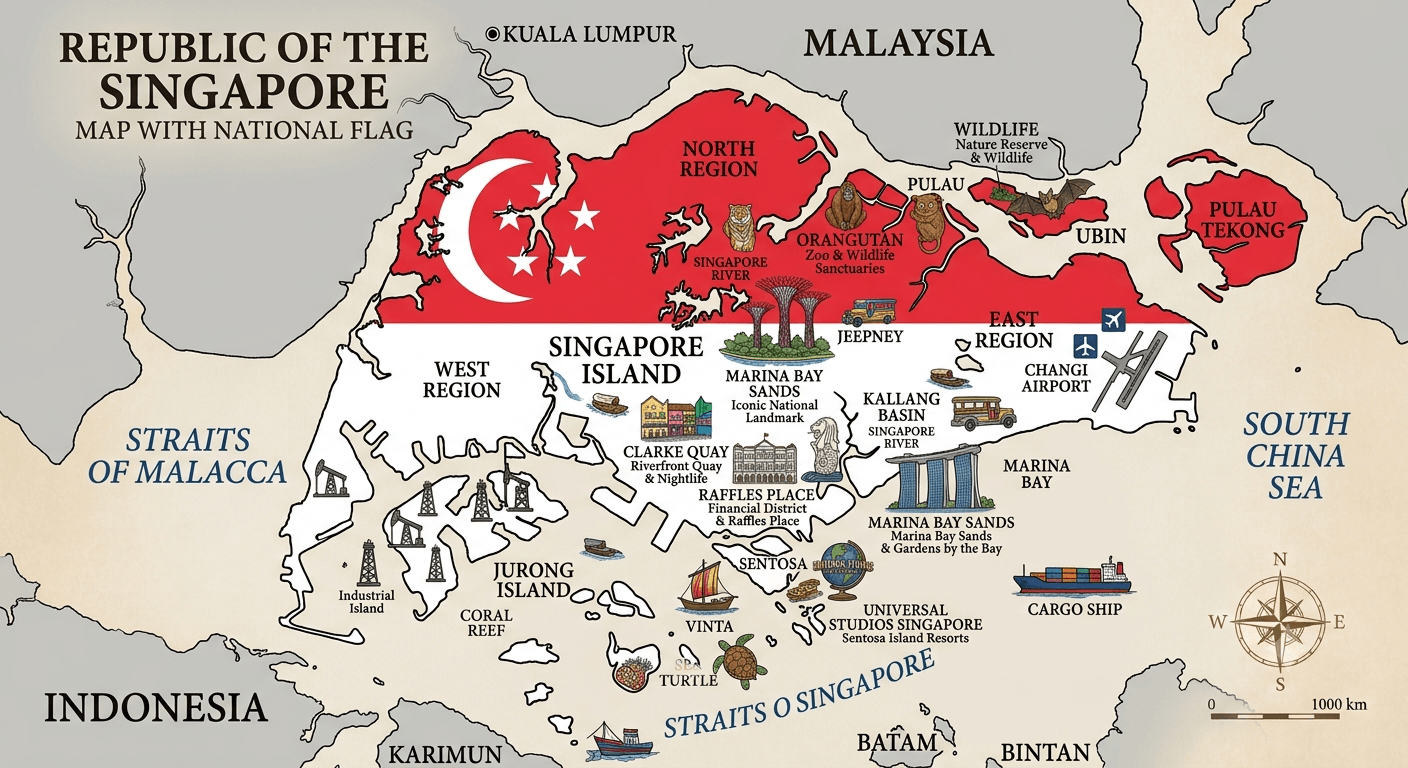
Singapore, officially the Republic of Singapore, is a city-state strategically located at the southern tip of the Malay Peninsula in Southeast Asia. Situated at approximately 1°N to 1°S latitude, 103°E to 104°E longitude, Singapore comprises one main island and 62 other islands with a total land area of only 728.3 square kilometers despite its massive economic influence. The city-state sits at the intersection of major sea lanes, commanding the Strait of Malacca—one of the world’s most critical maritime chokepoints connecting the Indian Ocean to the South China Sea[1].
Strategic Location Advantages:
- Maritime Hub: Controls ~40% of world’s sea piracy concerns and critical shipping lanes[1]
- Air Hub: Changi Airport ranks among world’s top global aviation centers[1]
- Port Authority: Port of Singapore is the world’s second-busiest transshipment hub and largest bunkering port
Population: Approximately 5.95 million (2026 estimate), comprising diverse communities with ethnic Chinese (~74%), Malays (~13%), Indians (~9%), and other communities[2].
National Capital: Singapore city proper (entire republic functions as a metropolitan city-state)
Official Political Name and System
Official Name: Republic of Singapore
Government System: Singapore operates as a parliamentary constitutional democracy and republic under a Westminster-style parliamentary system. The city-state is often characterized as a “strong state” governance model combining democratic institutions with centralized, efficient administrative structures[2].
Head of State: President Tharman Shanmugaratnam (ceremonial role since September 2023)
Head of Government: Prime Minister Lawrence Wong (People’s Action Party – PAP), assuming office in May 2024, succeeding Lee Hsien Loong who served since 2004[2]
Legislative Structure: Unicameral Parliament of Singapore with 165 elected members, plus non-constituency members (NCMP) and specially appointed members (NMP). The People’s Action Party (PAP) has dominated governance since independence in 1965[2].
Administrative Divisions: Five administrative divisions—Singapore City, Jurong, Changi, Bukit Timah, and Kranji—though governance is highly centralized at the national level[2].
Sources: Port Authority of Singapore Official Website | Prime Minister’s Office Singapore
2. ECONOMIC OVERVIEW
Singapore is a global financial powerhouse, leading Asian city-state, and one of the world’s wealthiest nations with the highest per-capita income in Asia (excluding financial centers). The economy is highly developed, knowledge-intensive, and export-oriented.
Key Economic Indicators (2024-2026)
| Economic Indicator | 2024 Actual | 2025 Actual | 2026 Forecast | Source |
|---|---|---|---|---|
| Nominal GDP | ~US$501 billion | ~US$524.7 billion | ~US$548 billion | Singapore Department of Statistics[3] |
| Real GDP Growth | 4.4% | 5.0% | 4.5-5.5% | Ministry of Trade & Industry[3] |
| GDP Per Capita | ~US$84,200 | ~US$88,000 | ~US$91,000 | Singapore Department of Statistics[3] |
| Foreign Exchange Reserves | ~US$316 billion | ~US$330 billion | ~US$340 billion | Monetary Authority of Singapore[4] |
| Inflation Rate | 2.5% | 2.1% | 1.8% | MAS/Department of Statistics[3] |
| Unemployment Rate | 1.4% | 1.3% | 1.4% | Ministry of Manpower[5] |
| Government Debt (% of GDP) | ~131% | ~129% | ~127% | Ministry of Finance[3] |
Source: Singapore Department of Statistics | Monetary Authority of Singapore | Ministry of Manpower Singapore
Economic Growth Trajectory & Manufacturing Surge
Recent Performance (Q2 2026):
- Year-on-Year GDP Growth: 5.9% (Q2 2026, final estimates), easing from 6.3% in Q1 2026[3]
- Manufacturing Sector Boom: Expanded 15.0% in Q4 2025, driven by strong electronics and chip-making activity[3]
- FY 2026 Forecast Upgrade: MTI upgraded 2026 GDP forecast to 4.5-5.5% (from 2.0-4.0%) due to stronger-than-expected H1 performance and AI-related capital spending surge[3]
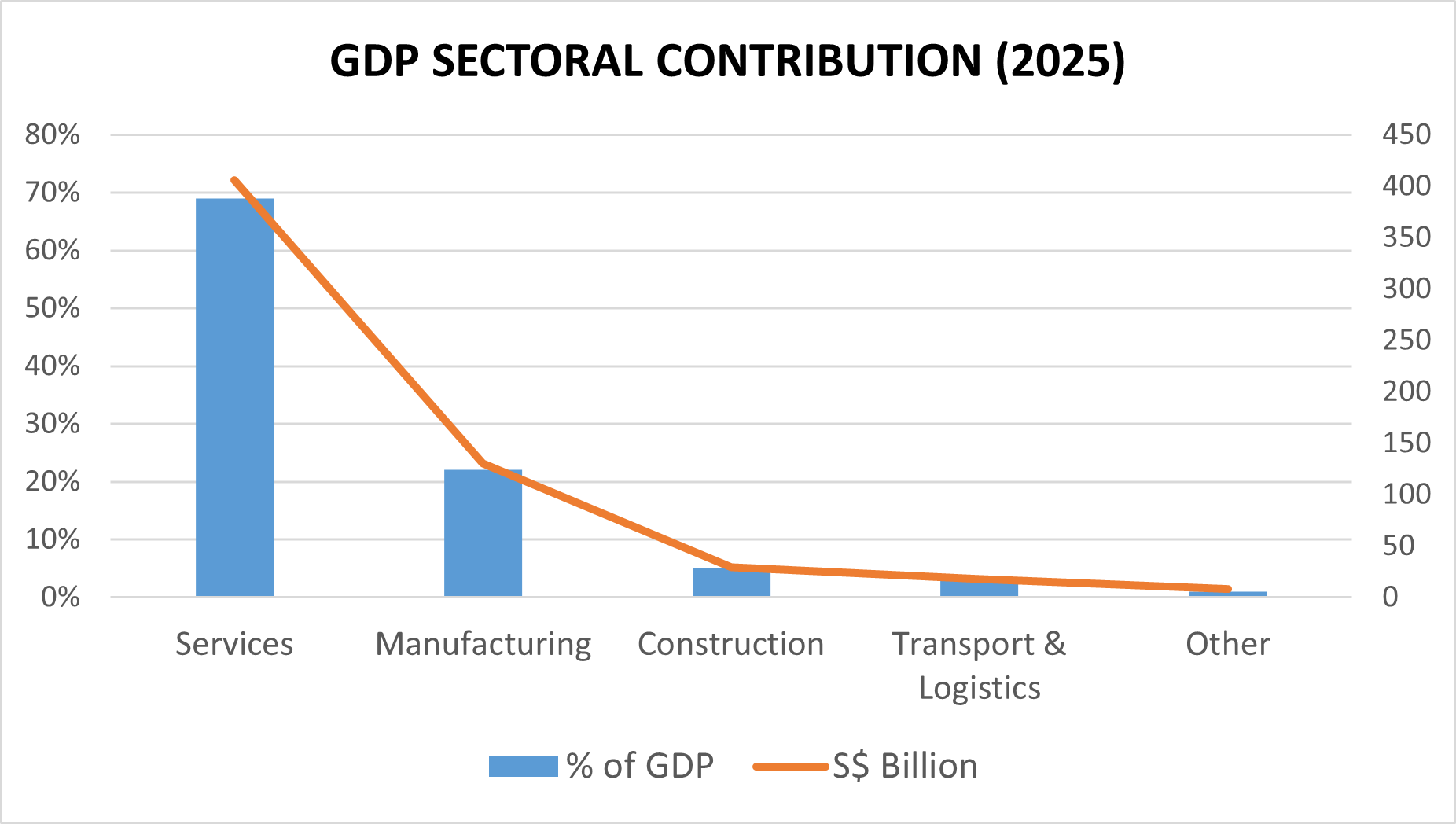
Sectoral Contribution to GDP (2025)
| Sector | % of GDP | Contribution (S$ Billion) | Growth Driver | Source |
|---|---|---|---|---|
| Services (Finance, Trade, Tourism) | 69% | ~406 | Financial services, trading hub | SingStat[6] |
| Manufacturing (Electronics, Chemicals, Refining) | 22% | ~130 | Semiconductor boom, AI chip demand | SingStat[6] |
| Construction & Real Estate | 5% | ~29 | Infrastructure development | SingStat[6] |
| Transport & Logistics | 3% | ~18 | Port, shipping, aviation | SingStat[6] |
| Utilities & Other | 1% | ~8 | Water, power | SingStat[6] |
Total GDP at Current Prices: ~S$589.9 Billion (~US$442 Billion at 1.33 S$/USD rate)
Source: Singapore Statistics – National Accounts
Key Economic Characteristics:
- Export-Oriented: Merchandise exports reached S$739.4 billion in 2025
- Re-Export Hub: Re-exports contribute 61% of total exports, reflecting Singapore’s role as transshipment and trading center[7]
- Services Dominance: Services sector contributes 69% of GDP, with financial services leading[6]
- High Income Stability: Unemployment consistently below 1.5%, reflecting tight labor market[5]
Source: Singapore Department of Statistics – Trade Data
3. AGRICULTURAL SECTOR
Singapore’s agricultural sector is negligible (less than 1% of GDP) due to severe land constraints. The city-state has only ~2,500 hectares of agricultural land on an island of 728 sq km, making food self-sufficiency impossible. Instead, Singapore’s strategy focuses on high-value urban farming, aquaculture, and food security through trade partnerships.
Limited Agricultural Activities
| Subsector | Production Focus | Key Products | Remarks | Source |
|---|---|---|---|---|
| Urban/Vertical Farming | High-tech cultivation | Leafy greens, herbs, vegetables | Government-supported, limited scale | Singapore Food Agency[8] |
| Aquaculture | Fish and shrimp farming | Marine and freshwater species | Emerging sector, land-scarce | Singapore Food Agency[8] |
| Food Processing & Imports | Value-added products | Meat processing, food manufacturing | Imports 90%+ of food needs | Ministry of Trade & Industry[9] |
Agricultural Import Dependencies:
- Singapore imports approximately 90% of its food supply, primarily from Malaysia, Thailand, Vietnam, and Australia
- Strategic Food Reserves: Government maintains emergency stockpiles via National Stockpile Center[8]
- Regional Supply Chain: Part of ASEAN food security network agreements[8]
Source: Singapore Food Agency | Ministry of Trade & Industry Singapore
4. INDUSTRIALIZATION AND MANUFACTURING
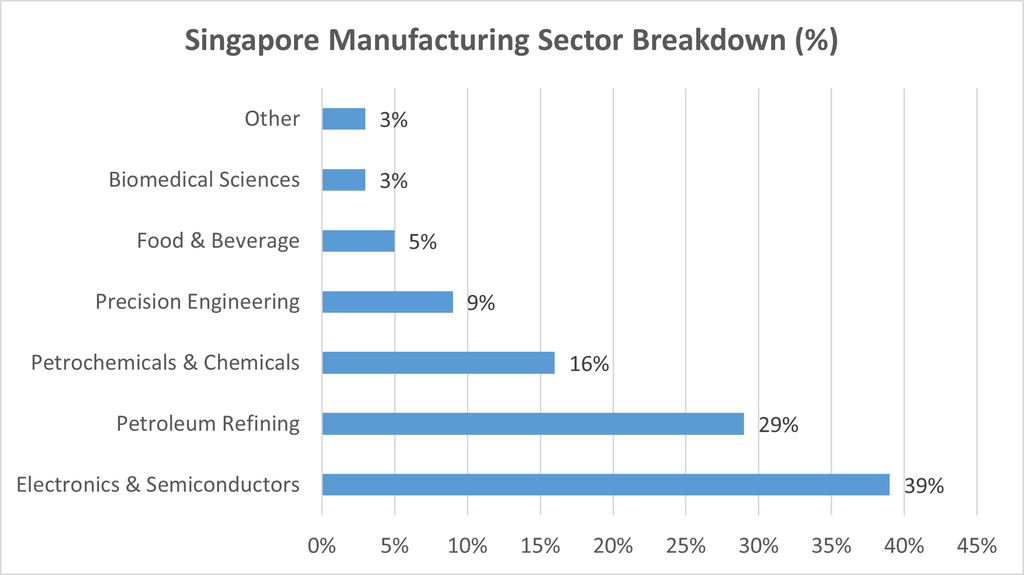
Singapore’s manufacturing sector (22% of GDP) is highly specialized, focusing on high-value electronics, semiconductors, petrochemicals, and refining—not low-cost mass production[10].
Major Manufacturing Sectors (2025)
| Industrial Sector | % of Manufacturing | Annual Value (S$ Billion) | Key Products & Activities | Global Position | Source |
|---|---|---|---|---|---|
| Electronics & Semiconductors | 38-40% | ~52 | ICs, chip manufacturing, wafer production | World’s top 5 semiconductor hub | Economic Development Board[10] |
| Petroleum Refining | 28-30% | ~39 | Refined petroleum, lubricants, fuels | World’s 3rd largest refiner | EDB[10] |
| Petrochemicals & Specialty Chemicals | 15-16% | ~21 | Polymers, solvents, industrial chemicals | Regional chemical hub | EDB[10] |
| Precision Engineering | 8-10% | ~11 | Machinery, tools, precision components | High-tech manufacturing leader | EDB[10] |
| Food & Beverage Processing | 4-5% | ~6 | Food manufacturing, beverages | Regional food processing hub | EDB[10] |
| Biomedical Sciences | 3-4% | ~5 | Pharmaceuticals, medical devices | Growing biotech cluster | EDB[10] |
| Other Manufacturing | 2-3% | ~3 | Various specialized products | — | EDB[10] |
Total Manufacturing Output: ~S$137 billion
Key Competitive Advantages:
- Advanced Technology: Leading edge in semiconductor design and fabrication equipment (FAB)
- Supply Chain Integration: Crucial node connecting global electronics supply chains[10]
- Skilled Workforce: Highly educated engineering and technical workforce[10]
- FDI Attraction: Receives sustained investment from Intel, GlobalFoundries, Samsung, TSMC (indirect)
Source: Economic Development Board Singapore
5. TRADE AND ECONOMIC PROFILE
Export and Import Overview
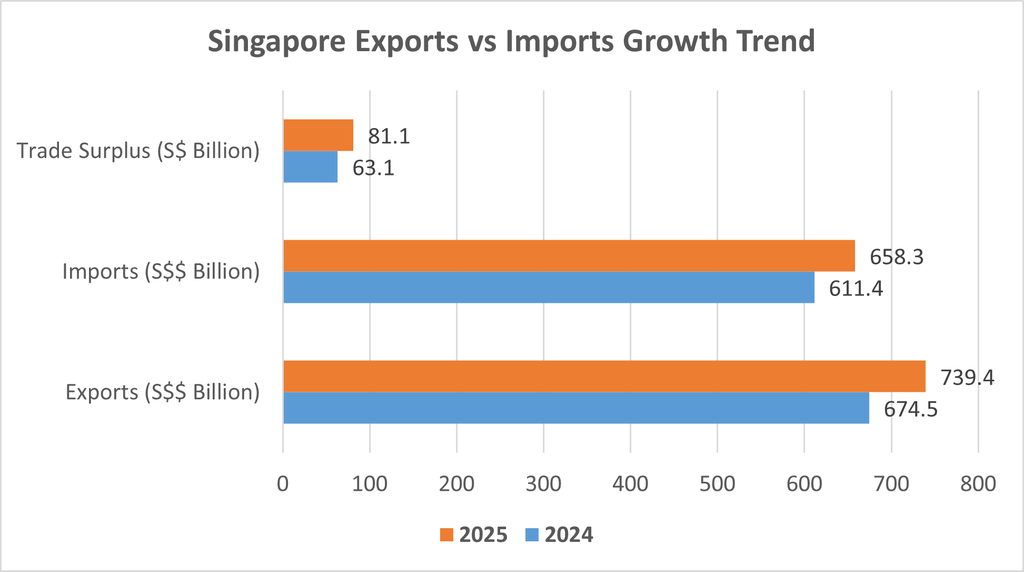
Singapore is one of the world’s most trade-dependent economies, with merchandise trade reaching record S$1.397 trillion in 2025 (exports + imports combined).
| Trade Metric | 2024 | 2025 | Growth Rate (YoY) | 2026 Forecast | Source |
|---|---|---|---|---|---|
| Total Merchandise Trade | S$1,285.9 billion | S$1,397.7 billion | +8.7% | ~S$1,450 billion | SingStat[7] |
| Total Exports | S$674.5 billion | S$739.4 billion | +9.6% | ~S$765 billion | SingStat[7] |
| Domestic Exports (NODX) | S$286.6 billion | S$284.7 billion | -0.7% | +2.0 to +4.0% | SingStat[7] |
| Non-Oil Domestic Exports | S$173.6 billion | S$182.0 billion | +4.8% | +2.0 to +4.0% | SingStat[7] |
| Re-exports (NORX) | S$387.9 billion | S$454.8 billion | +17.2% | Continued growth | SingStat[7] |
| Total Imports | S$611.4 billion | S$658.3 billion | +7.7% | ~S$680 billion | SingStat[7] |
| Trade Surplus | S$63.1 billion | S$81.1 billion | +28.5% | ~S$85 billion | Calculated[7] |
Key Observation: Singapore’s trade is heavily re-export driven (61% of total exports), reflecting its role as Southeast Asia’s primary transshipment and trading hub[7].
Source: Singapore Department of Statistics – Merchandise Trade
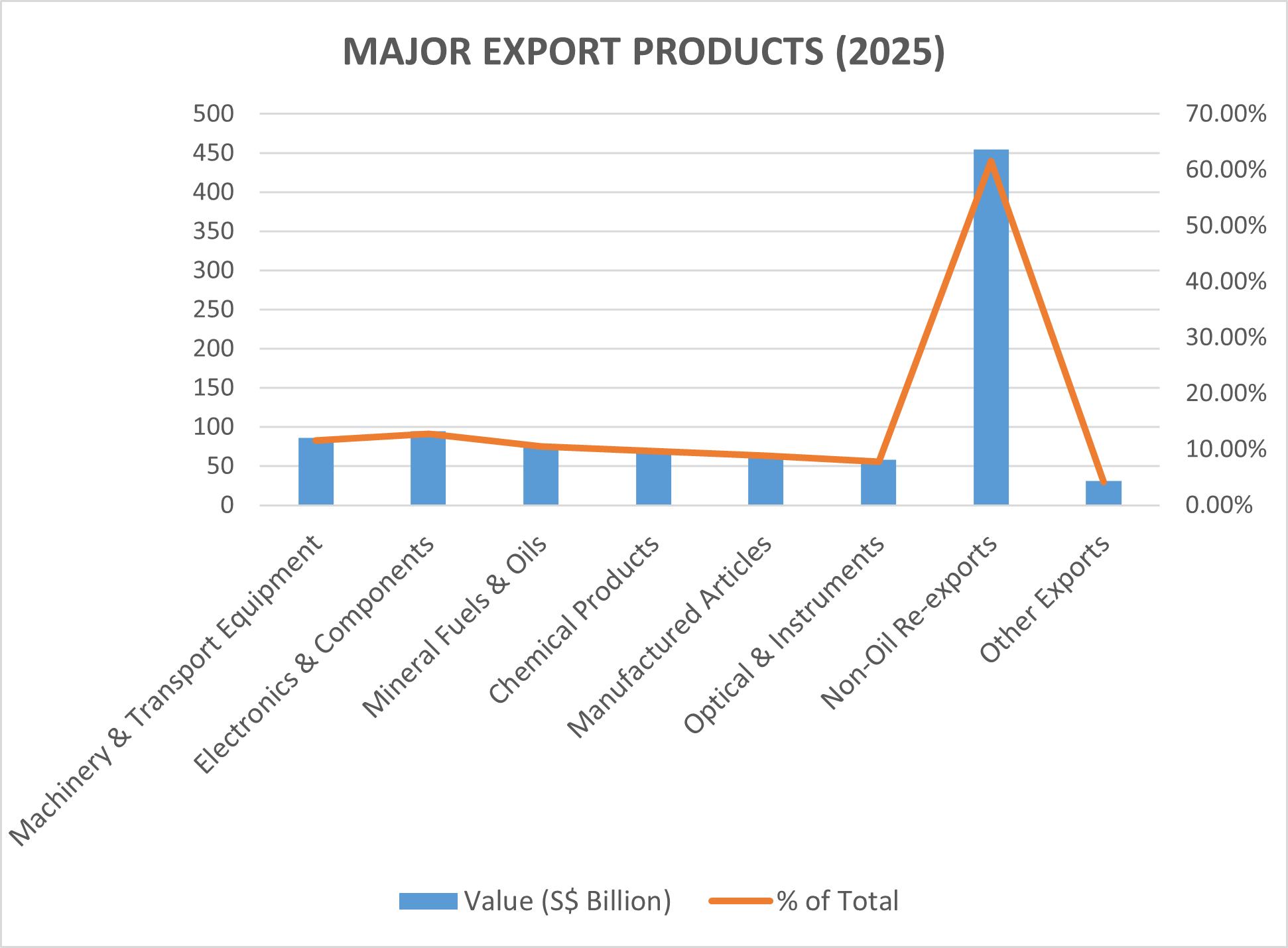
Major Export Products (2025)
| Product Category | Value (S$ Billion) | % of Total Exports | Growth YoY | Key Markets | Source |
|---|---|---|---|---|---|
| Machinery & Transport Equipment (Domestic) | ~86 | 11.6% | +8.5% | Taiwan, Malaysia, South Korea | UN Comtrade[11] |
| Electronics & Components | ~95 | 12.8% | +16.3% (ICs) | China, Taiwan, USA, Japan | UN Comtrade[11] |
| Mineral Fuels, Oils & Lubricants | ~78 | 10.5% | +2.1% | Southeast Asia, Japan, South Korea | UN Comtrade[11] |
| Chemical Products & Petrochemicals | ~72 | 9.7% | +3.8% | China, India, Malaysia | UN Comtrade[11] |
| Manufactured Articles | ~65 | 8.8% | +2.3% | USA, EU, ASEAN | UN Comtrade[11] |
| Optical & Precision Instruments | ~58 | 7.8% | +1.9% | USA, EU, Asia | UN Comtrade[11] |
| Non-Oil Re-exports | ~454.8 | 61.5% | +17.7% | Multiple destinations | SingStat[7] |
| Other Exports | ~31 | 4.2% | +1.5% | Various | UN Comtrade[11] |
Total Exports: S$739.4 billion
Source: UN Comtrade Database – Singapore Trade
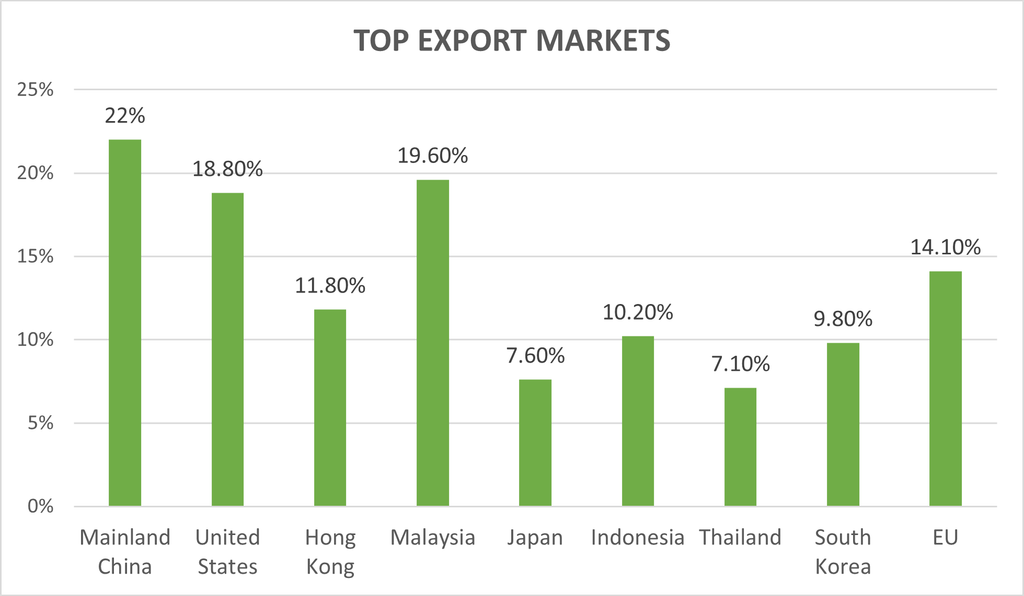
Top Export Markets (2025)
| Country/Region | Export Value (S$ Billion) | % of Total | Key Products | Source |
|---|---|---|---|---|
| Mainland China | S$162.9 | 22% | Electronics, chemicals, fuels | SingStat[7] |
| United States | S$139.2 | 18.8% | Electronics, machinery, optical instruments | SingStat[7] |
| Hong Kong | S$87.5 | 11.8% | Re-exports, electronics, metals | SingStat[7] |
| Malaysia | S$145.0 | 19.6% | Refined petroleum, machinery, electronics | SingStat[7] |
| Taiwan | Export data combined | — | Integrated circuits, electronics | SingStat[7] |
| Japan | S$56.1 | 7.6% | Electronics, chemicals, precision products | SingStat[7] |
| Indonesia | S$75.7 | 10.2% | Refined petroleum, machinery | SingStat[7] |
| Thailand | S$52.4 | 7.1% | Machinery, electronics, chemicals | SingStat[7] |
| South Korea | S$72.2 | 9.8% | Electronics, chemicals, metals | SingStat[7] |
| European Union | S$104.4 | 14.1% | Chemicals, machinery, optical instruments | SingStat[7] |
Top Trading Partners Overall: Mainland China, Taiwan, USA, Malaysia, EU[7]
Major Import Products (2025)
| Product Category | Value (S$ Billion) | % of Total Imports | Primary Sources | Source |
|---|---|---|---|---|
| Machinery & Transport Equipment | S$379.7 | 68.2% | China, Japan, Germany, USA | UN Comtrade[11] |
| Mineral Fuels & Oils | ~68 | 12.2% | Middle East, Russia, Malaysia | UN Comtrade[11] |
| Electrical & Electronic Equipment | ~45 | 8.1% | China, Japan, South Korea | UN Comtrade[11] |
| Chemicals & Chemical Products | ~38 | 6.8% | China, USA, India, Germany | UN Comtrade[11] |
| Metals & Metal Articles | ~22 | 4.0% | China, Japan, India | UN Comtrade[11] |
| Other Imports | ~6.9 | 0.7% | Various | UN Comtrade[11] |
Total Imports: S$658.3 billion
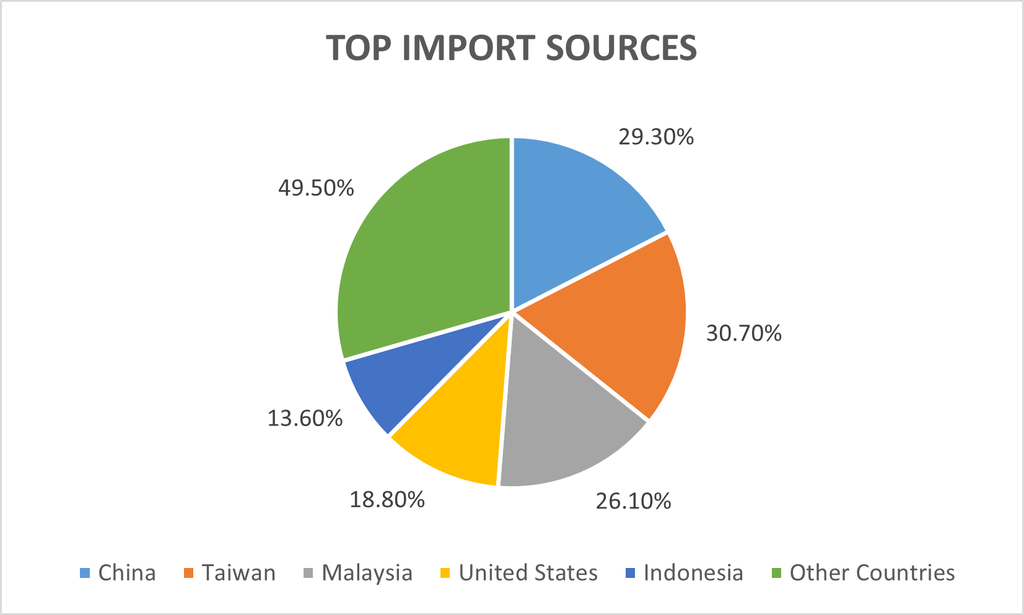
Top Import Sources (2025)
| Country | Import Value (S$ Billion) | % of Total | Key Products | Source |
|---|---|---|---|---|
| China | S$162.9 | 29.3% | Machinery, chemicals, metals, electronics | SingStat[7] |
| Taiwan | S$170.3 | 30.7% | Integrated circuits, semiconductors | SingStat[7] |
| Malaysia | S$145.0 | 26.1% | Petroleum, machinery, electricity | SingStat[7] |
| United States | S$104.4 | 18.8% | Machinery, organic chemicals, optical instruments | SingStat[7] |
| Indonesia | S$75.7 | 13.6% | Petroleum, rubber, palm oil | SingStat[7] |
| Japan | S$72.2 | 13.0% | Machinery, chemicals, electronics | SingStat[7] |
| South Korea | S$56.1 | 10.1% | Electronics, machinery, chemicals | SingStat[7] |
| European Union | S$104.4 | 18.8% | Machinery, chemicals, optical instruments | SingStat[7] |
| Thailand | S$52.4 | 9.4% | Machinery, electrical equipment | SingStat[7] |
| Saudi Arabia & Middle East | ~45 | 8.1% | Mineral fuels, oils | SingStat[7] |
6. EDUCATION
Overview of the Education System
Singapore operates a highly competitive, results-oriented education system with six years of primary education, followed by four years of secondary education (split into two streams), and optional pre-university or polytechnic pathways. The system emphasizes bilingualism (English + Mother Tongue), STEM education, and character development[12].
Education Structure:
- Primary: Ages 6-12 (6 years, compulsory)
- Secondary: Ages 13-16 (4 years; streaming into Express, Normal Academic, Normal Technical pathways)
- Post-Secondary: Junior Colleges (2 years, A-Levels) or Polytechnics (3 years, diploma-level)
- Tertiary: Universities (3-4 years bachelor’s degree)
Key Universities:
- National University of Singapore (NUS): Asia’s top-ranked university[12]
- Nanyang Technological University (NTU): Leading engineering and technology institution[12]
- Singapore Management University (SMU): Business and social sciences focus[12]
- Singapore University of Technology and Design (SUTD): Design and technology[12]
Literacy Rate and Human Capital
| Education Metric | Value | Benchmark | Source |
|---|---|---|---|
| Adult Literacy Rate (age 15+) | ~97% | Highest globally | World Bank[13] |
| Primary Net Enrollment Ratio | ~99% | Universal enrollment | UNESCO[13] |
| Secondary Enrollment Ratio | ~96% | Highest in Asia-Pacific | UNESCO[13] |
| Tertiary Enrollment Ratio | ~80% | Highest globally | UNESCO[13] |
| Workforce with Tertiary Qualification | ~75% | Highly educated labor force | Ministry of Education[12] |
| STEM Graduates (% of tertiary) | ~50-55% | High STEM focus | MOE/EDB[12] |
Global Rankings:
- PISA Science: 3rd globally (2022 results)
- PISA Mathematics: 2nd globally (2022 results)
- Global Talent Competitiveness Index: Consistently ranked top 5[13]
Government Investment: Education spending reaches ~6% of government budget with continuous upskilling programs through Continuing Education & Training (CET).
Source: Ministry of Education Singapore | UNESCO Education Statistics
7. HEALTH AND SOCIAL INDICATORS
Health Metrics
| Health Indicator | Value | Regional Benchmark | Source |
|---|---|---|---|
| Life Expectancy at Birth | 84.8 years | Highest in ASEAN | WHO/MOH[14] |
| Infant Mortality Rate | 1.9 per 1,000 live births | Lowest in ASEAN | WHO[14] |
| Maternal Mortality Ratio | 8 per 100,000 live births | Lowest globally | WHO[14] |
| Healthcare Coverage | 100% (via insurance schemes) | Universal coverage | Ministry of Health[14] |
| Universal Health Coverage Service Index | 88/100 | Among top globally | WHO[14] |
| COVID-19 Vaccination Rate | ~95% | High compliance | Ministry of Health[14] |
Social Indicators
| Social Indicator | Value | Source |
|---|---|---|
| Unemployment Rate | 1.3% (2025) | Ministry of Manpower[5] |
| Poverty Rate (Absolute) | <5% | World Bank[13] |
| Gini Coefficient (Income Inequality) | 0.426 | World Bank[13] |
| Gender Parity Index (Workforce) | 0.54 (54% female participation) | ILO/World Bank[13] |
| HDI (Human Development Index) | 0.939 | Ranked 12th globally |
| Access to Improved Water Supply | 100% | Universal access |
| Access to Improved Sanitation | 100% | Universal access |
| Internet Penetration | 97% | Among highest globally |
| Mobile Phone Penetration | 148% (multiple devices) | ITU[15] |
Healthcare System: Singapore combines universal health insurance (Medisave, Medishield Life), government subsidies, and private markets in an efficient hybrid system[14].
Source: Ministry of Health Singapore | International Telecommunication Union
8. BANGLADESH-SINGAPORE BILATERAL RELATIONS
Historical Relations
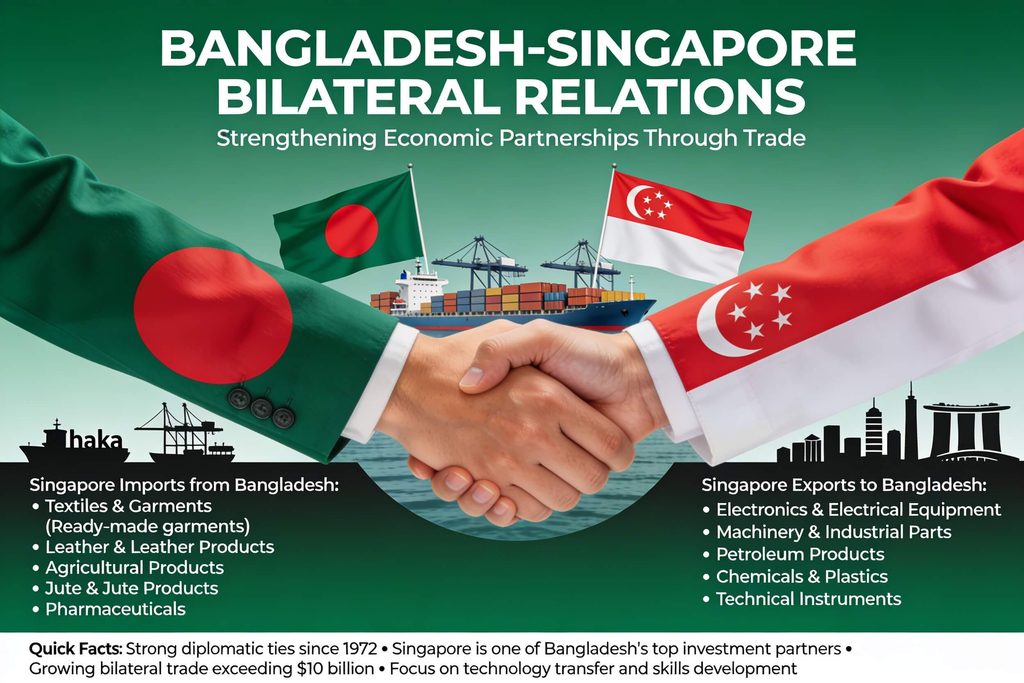
Bangladesh-Singapore bilateral relations established in February 1972, just one year after Bangladesh’s independence, marking over 54 years of continuous ties.
Key Milestones:
- 1973: Bangladesh established a Trade Commission in Singapore (first major representation)
- 1983: Trade Commission upgraded to full High Commission (diplomatic mission)
- 2024: Ferdousi Shahriar appointed as Bangladesh’s High Commissioner to Singapore (since November 2024)
- 2024-2026: Bilateral Free Trade Agreement (FTA) negotiations commenced November 2024, targeting finalization by end-2026
Regional Cooperation Frameworks
Shared Membership:
- ASEAN Regional Forum (ARF): Bangladesh as dialogue partner; Singapore as founding member[16]
- East Asia Summit (EAS): Both countries participate in regional security and economic dialogue[16]
- ASEAN Connectivity: Bangladesh supports ASEAN centrality; Singapore drives regional integration[16]
- UN System: Both active UN members with complementary development agendas[16]
Bilateral Cooperation Areas:
- Trade & Commerce: Goods, services, and investment flows[16]
- Defense & Security: Limited but cordial military exchanges and naval cooperation[16]
- Labor Mobility: Singapore major destination for Bangladeshi workers and professionals[16]
- Education: Bangladeshi students study in Singaporean universities; scholarship programs[16]
- Technology & Innovation: Emerging partnerships in digital economy, fintech[16]
Source: Embassy of Bangladesh Singapore
9. BILATERAL TRADE ANALYSIS
Bangladesh-Singapore Bilateral Relations and Trade Overview
Historical Trade Performance:
| Year/Period | Bangladesh Exports (US$$ Mn) | Singapore Imports from BD | Singapore Exports to BD (US$$ Mn) | Bangladesh Imports from SG | Total Trade (US$ Mn) | Trade Balance (BD) | Source |
|---|---|---|---|---|---|---|---|
| 2022 | 193.4 | — | 2,825.7 | — | 3,019.1 | -2,632.3 | EPB/UN Comtrade[11] |
| 2023 | 132.8 | — | 3,229.2 | — | 3,362.0 | -3,096.4 | UN Comtrade[11] |
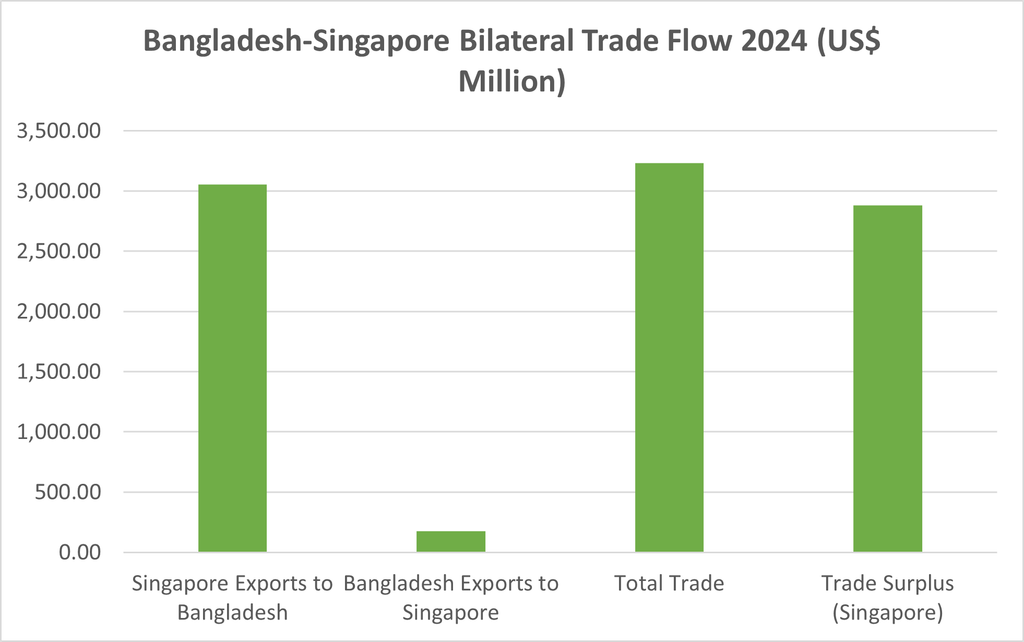
| 2024 | 176.2 | — | 3,054.9 | — | 3,231.1 | -2,878.7 | DCCI/EPB[17] |
| 2025 | ~185-195 | Estimated | ~3,200+ | Estimated | ~3,400 | ~-3,010 | DCCI[17] |
Key Pattern: Singapore maintains a significant trade surplus with Bangladesh, with exports approximately 15-20 times larger than Bangladeshi exports.
What Bangladesh Exports to Singapore
| Product Category | Value (US$ Mn) | HS Code | % of BD Exports to SG | Growth Trend | Source |
|---|---|---|---|---|---|
| Ships, Boats, Floating Structures | 109.9 | 89 | 62.8% | Declining (-2% annually) | UN Comtrade[11] |
| Apparel, Not Knit (Woven) | 35.6 | 62 | 20.3% | Stable | UN Comtrade[11] |
| Apparel, Knit or Crocheted | 34.7 | 61 | 19.8% | Declining (-1.5% annually) | UN Comtrade[11] |
| Cereals, Flour, Starch Preparations | 29.6 | 19 | 16.9% | Growing (+5% annually) | UN Comtrade[11] |
| Plastics & Plastic Products | 8.3 | 39 | 4.7% | Stable | UN Comtrade[11] |
| Footwear | 6.2 | 64 | 3.5% | Declining | UN Comtrade[11] |
| Furniture & Parts | 4.8 | 94 | 2.7% | Declining | UN Comtrade[11] |
| Other Products | ~16 | Mixed | 9.1% | Mixed | UN Comtrade[11] |
Total Bangladesh Exports to Singapore: ~US$175-185 million (2024-2025)
Key Observation: Bangladesh exports heavily dominated by shipbuilding (63%), followed by apparel (40%), creating narrow product diversification. Ships remain the largest export category due to Bangladeshi yards’ competitiveness in niche vessel construction[11].
What Singapore Exports to Bangladesh
| Product Category | Value (US$ Mn) | HS Code | % of SG Exports to BD | Key End-Users in BD | Source |
|---|---|---|---|---|---|
| Mineral Fuels, Oils, Waxes | 1,080 | 27 | 33.5% | Power plants, transport, industrial | UN Comtrade[11] |
| Machinery, Boilers, Reactors | 320.8 | 84 | 9.9% | Manufacturing, telecom, construction | UN Comtrade[11] |
| Electrical & Electronic Equipment | 252.2 | 85 | 7.8% | Telecommunications, utilities, IT | UN Comtrade[11] |
| Plastics & Plastic Articles | 158.5 | 39 | 4.9% | Manufacturing, packaging, construction | UN Comtrade[11] |
| Iron & Steel | 102.8 | 72 | 3.2% | Construction, automotive, machinery | UN Comtrade[11] |
| Chemicals & Chemical Products | 95.5 | 28-29 | 3.0% | Industrial processing, pharmaceuticals | UN Comtrade[11] |
| Optical & Precision Instruments | 78.3 | 90 | 2.4% | Telecommunications, medical | UN Comtrade[11] |
| Organic Chemicals | 52.4 | 29 | 1.6% | Pharmaceuticals, cosmetics | UN Comtrade[11] |
| Vessels & Floating Structures | 45.2 | 89 | 1.4% | Maritime industry, logistics | UN Comtrade[11] |
| Other Products | ~218 | Mixed | 6.7% | Various sectors | UN Comtrade[11] |
Total Singapore Exports to Bangladesh: ~US$3.05-3.20 billion (2024-2025)
Key Observation: Singapore’s exports dominated by petroleum products (33.5%), reflecting Bangladesh’s energy import dependence. Industrial machinery and electronics comprise another ~18% of exports[11].
Trade Imbalance Analysis
| Trade Metric | 2024 Value (US$ Mn) | 2025 Estimate | Ratio | Source |
|---|---|---|---|---|
| Singapore Exports to Bangladesh | 3,054.9 | ~3,200 | — | DCCI[17] |
| Bangladesh Exports to Singapore | 176.2 | ~185-195 | — | DCCI[17] |
| Trade Deficit (Bangladesh) | -2,878.7 | ~-3,010 | — | Calculated[17] |
| Export-Import Ratio (Bangladesh) | 5.8% | 5.7-6.1% | 1:17 | Calculated[17] |
FTA Expected Impact: Proposed Bangladesh-Singapore FTA (targeting 2026 finalization) aims to expand Bangladeshi apparel, leather, agro-processed food, and pharmaceutical exports through tariff concessions, potentially increasing Bangladesh exports from US$185-195 million to US$300-400 million within 5 years.
Banking and Financial Linkages
Correspondent Banking:
- Singaporean Commercial Banks: OCBC, UOB (United Overseas Bank), DBS Group, Standard Chartered[18]
- Bangladeshi Banks: Dutch-Bangla Bank, Brac Bank, City Bank, Eastern Bank, Prime Bank[18]
Trade Finance Instruments:
- Letters of Credit (LC): Primary instrument for bilateral trade; average processing time 3-5 days (shorter than Bangladesh-Thailand due to Singapore’s developed financial system)
- Documentary Collections: Less common; used only for trusted trading partners[18]
- Electronic Funds Transfer: Increasingly used for machinery and equipment imports[18]
Remittances: Singapore is a major remittance source for Bangladesh, consistently ranking among top 5-7 countries for inbound remittances. Estimated Bangladeshi diaspora in Singapore: ~80,000-100,000 individuals (as of 2024).
2024-2025 Remittances from Singapore:
- Estimated annual inflow: ~US$2.5-3.0 billion[19]
- Growth: +3-5% year-on-year[19]
- Remittance channels: Formal banking (DBS, OCBC, UOB), money transfer operators (Western Union, MoneyGram), and hundi (informal)
FDI Flows:
- Singapore FDI Stock in Bangladesh (cumulative 2001-2025): ~US$2.06 billion[20]
- Singapore’s Ranking as FDI Source: 2nd largest (after USA) with 10.93% of total BD FDI
- Sector Focus: Power generation (IPPs), infrastructure, real estate, financial services[20]
Recent FDI Flows (2023-2024): ~US$93.7 million annually from Singapore to Bangladesh[20]
10. INTERNATIONAL COOPERATION
Multilateral Membership
Singapore maintains extensive international partnerships and membership in key global organizations[21]:
UN System & Global Governance:
- United Nations: Full member; active in UNSC discussions, UNESCO, IMO, ICAO
- World Trade Organization (WTO): Founding member; active in trade negotiations[21]
- International Monetary Fund (IMF): Full member with leadership representation[21]
- World Bank Group: Active borrower and shareholder[21]
Regional Integration:
- ASEAN: Founding member (1967); ASEAN Secretariat headquartered in Jakarta; Singapore hosts multiple ASEAN institutions including ASEAN Regional Forum (ARF) secretariat[21]
- ASEAN+3: Enhanced cooperation with China, Japan, South Korea[21]
- East Asia Summit (EAS): Strategic platform for regional security and economic dialogue[21]
- ASEAN Free Trade Area (AFTA): Singapore benefits from preferential tariff framework[21]
Bilateral Trade Partnerships:
- Free Trade Agreements: Singapore has signed 30+ FTAs with countries including USA, Japan, India, Australia, UK, and EU nations[22]
- Ongoing Negotiations: Bangladesh-Singapore FTA (expected 2026 conclusion)
BIMSTEC Connection:
- Singapore is not a BIMSTEC member but engages through dialogue-partner status with Bangladesh, India, Sri Lanka, Thailand[21]
- Facilitates Bay of Bengal regional cooperation on maritime security, blue economy[21]
Climate & Environmental Cooperation:
- UNFCCC Participant: Active in COP processes; committed to carbon neutrality by 2050[21]
- UNEP Partner: Regional environmental management initiatives[21]
- Port State Measures Agreement: Leading role in maritime environmental enforcement[21]
Financial Services Leadership:
- Asian Development Bank (ADB): Singapore hosts regional offices; active shareholder[21]
- ASEAN Development Fund: Singapore contributor[21]
- Sovereign Wealth Funds: Temasek Holdings conducts global investments with ASEAN focus[21]
Source: Ministry of Foreign Affairs Singapore | Enterprise Singapore FTA Portal
11. OPPORTUNITIES FOR BANGLADESHI CITIZENS IN SINGAPORE
Higher Education
Singapore attracts thousands of international students annually, including significant Bangladeshi cohorts[23].
Top Universities Welcoming Bangladeshi Students:
- National University of Singapore (NUS): Engineering, business, medicine, research programs; ~200-300 Bangladeshi students annually[23]
- Nanyang Technological University (NTU): Engineering, business, science programs; ~150-200 Bangladeshi students[23]
- Singapore Management University (SMU): Business, accountancy, law; ~50-100 Bangladeshi students[23]
- Singapore University of Technology and Design (SUTD): Design, technology, architecture; ~30-50 Bangladeshi students[23]
Estimated Tuition Costs:
- NUS/NTU Bachelor’s: S$15,000-30,000/year (US$11,200-22,500)
- Master’s Programs: S$20,000-45,000/year (US$15,000-33,750)
Scholarship Opportunities:
- Singapore Government Scholarships: Limited; highly competitive[23]
- University Scholarships: Merit-based financial aid available (partial/full)
- Private Sponsorship: Increasingly relied upon by Bangladeshi students[23]
Living Cost Estimate: S$1,500-2,500/month (~US$1,125-1,875) in Singapore city[23].
Source: Ministry of Education Singapore – International Admissions
Employment and Labor Migration
Singapore is a major employment destination for Bangladeshi professionals, with diverse opportunities across sectors[24].
Primary Employment Sectors:
- Financial Services: Banks, insurance, investment firms; demand for accountants, auditors, compliance officers (salary: S$3,500-7,000/month)
- Information Technology & Software: Tech companies, fintech, digital transformation; salary: S$4,000-8,500/month[24]
- Healthcare & Nursing: Private hospitals, clinics, wellness centers; nursing salary: S$2,500-4,500/month[24]
- Education: International schools, universities, training centers; teacher salary: S$2,800-5,000/month[24]
- Hospitality & Tourism: Hotels, F&B services, tourism companies; hospitality salary: S$2,000-3,500/month[24]
- Construction & Engineering: Skilled engineers, project managers; salary: S$3,000-7,000/month[24]
- Retail & Trading: Department stores, trading companies; salary: S$2,200-4,000/month[24]
Labor Migration Status: Singapore hosts an estimated 80,000-100,000 Bangladeshi workers formally employed (as of 2024), making Bangladesh one of Singapore’s top 10 source countries for migrant labor[24].
Employment Pass (EP) Requirements:
- Professional Tier: Monthly salary ≥S$5,000 (~US$3,750); bachelor’s degree required[25]
- Skilled Tier: Monthly salary S$3,000-4,999 (~US$2,250-3,750); diploma or higher[25]
- Processing Time: 2-4 weeks with employer sponsorship[25]
- Validity: Typically 2 years, renewable[25]
Other Work Visa Options:
- Tech.Pass Visa: For tech professionals earning >S$5,000/month; 1-3 year validity[25]
- EntrePass: For entrepreneurs establishing Singapore businesses; renewable annually[25]
- Dependant’s Pass: For spouses and children of EP holders[25]
Source: Ministry of Manpower Singapore | Singapore Immigration & Checkpoints Authority
Visa Facilities
Visa Types for Bangladeshi Citizens:
| Visa Type | Purpose | Duration | Cost | Processing | Source |
|---|---|---|---|---|---|
| Tourist Visa | Tourism, visiting friends/family | 30-90 days | SGD 30-40 (~US$22-30) | 3-5 days | ICA[25] |
| Visit Pass (Short-term) | Business meetings, conferences | 30-90 days | No visa required (VEP) | On arrival | ICA[25] |
| Employment Pass (Professional) | Professional employment | 2 years (renewable) | No fee | 2-4 weeks | MOM[24] |
| Entrepreneur Pass (EntrePass) | Business establishment | 1 year (renewable) | No fee | 1-2 weeks | ICA[25] |
| Student Pass | Full-time studies | Duration of course | S$20 application fee | 2-3 weeks | ICA[25] |
| Dependent Pass | Family reunification | Linked to sponsor’s visa | No direct fee | 1-2 weeks | ICA[25] |
Bangladeshi Citizens Visa Exception: Singapore offers Visa-Free Transit Entry (VFEE) to Bangladeshi passport holders for flights connecting at Changi Airport[25].
Source: Immigration & Checkpoints Authority Singapore
Export and Residency Opportunities
Business Registration in Singapore:
Company Registration Process:
- ACRA Registration: Accounting & Corporate Regulatory Authority; register company within 3-5 days[26]
- Business Registration: Register with ACRA for tax purposes; simultaneous with company registration[26]
- Cost: SGD 300-500 (~US$225-375) plus professional fees[26]
- Requirements: Foreign directors allowed; 50% ownership permitted by foreigners (depending on sector)
Residency Pathways:
- Tech.Pass Visa: Tech professionals; renewable multi-year[25]
- EntrePass: Entrepreneurs with approved business plans; renewable annually[25]
- Dependant Pass: Family of EP holders; immediate family eligibility[25]
- Long-Term Visit Pass (LTVP): For retirees or investors with substantial financial means[25]
Business Opportunities:
- Trading Company: Import/export of goods; limited capital requirement (S$2,000-5,000 minimum)
- Professional Services: Consulting, IT services, accounting (requires professional qualifications)
- Trading Hub: Leverage Singapore’s re-export position for Bangladesh-originated goods targeting ASEAN/global markets[26]
Source: Accounting & Corporate Regulatory Authority Singapore
12. OPPORTUNITIES FOR SINGAPORE FROM BANGLADESH
High-Potential Import Products
1. Ready-Made Garments (RMG)
- Market Demand: Singapore imports ~US$2.0-2.5 billion in apparel annually; deficit created by manufacturing shift offshore[27]
- Bangladeshi Competitive Advantage: 35-45% cost advantage; bulk procurement for regional retailers (Robinsons, Paragon stores)
- Target Segments: Casual wear, corporate uniforms, specialty apparel, export-oriented garments[27]
- Estimated Import Potential: US$25-40 million annually within 3 years[27]
2. Leather & Leather Products
- Market Opportunity: Singaporean demand for affordable leather shoes and accessories; current supply from Vietnam, Indonesia limited[27]
- Bangladeshi Strength: World’s 3rd largest leather processor; established tanneries with international certifications[27]
- Target Products: Footwear, bags, belts, industrial leather[27]
- Estimated Potential: US$12-20 million
3. Seafood & Frozen Fish/Shrimp
- Market Gap: Singapore imports ~US$800 million in seafood annually; increasing halal-certified seafood demand[27]
- Bangladeshi Advantage: Large aquaculture production; competitive pricing; established cold-chain infrastructure[27]
- Target Segments: Halal-certified shrimp, frozen fish for food courts, restaurants, hotels[27]
- Estimated Potential: US$15-25 million
4. Pharmaceuticals & Generic Medicines
- Market Niche: Singapore imports generic pharmaceutical formulations for re-export to Southeast Asia and South Asia[27]
- Bangladeshi Competitiveness: Cost-effective generics; FDA-equivalent regulatory compliance (DGDA certification)
- Estimated Potential: US$8-15 million
5. Agro-Processed Products
- Market Focus: Spices, dried fruits, processed vegetables, instant noodles for regional distribution[27]
- Target Buyers: Singapore’s food trading companies, distributors to Malaysia, Thailand, Vietnam[27]
- Estimated Potential: US$10-18 million
6. Jute & Jute Products
- Sustainability Trend: Singapore corporate offices increasingly adopt eco-friendly jute packaging and office products[27]
- Products: Jute bags, ropes, carpets, decorative items[27]
- Estimated Potential: US$3-8 million
Source: Singapore Chamber of Commerce & Industry Import Analysis
Investment and Industrial Cooperation
Recommended Joint Venture Models:
1. Garment Manufacturing & Trading Hub
- Model: Bangladeshi RMG companies establish Singapore trading offices to procure Bangladesh-manufactured garments for re-export to Malaysia, Indonesia, Thailand[28]
- Strategic Advantage: Leverage Singapore’s trading hub position; access ASEAN FTA tariff benefits[28]
- Investment Range: US$2-5 million for office, warehouse, sales team[28]
- Expected ROI: 20-30% margin on re-export volumes[28]
2. Petrochemicals & Specialty Chemicals Trading
- Model: Bangladeshi pharmaceutical/chemical companies establish Singapore branch for ASEAN market distribution[28]
- Market Focus: Generic pharmaceuticals, industrial chemicals for manufacturing[28]
- Investment: US$1-3 million[28]
3. Seafood Processing & Export Hub
- Model: Joint venture with Bangladeshi aquaculture companies for halal-certified seafood processing and distribution to Gulf markets via Singapore[28]
- Investment: US$2-6 million[28]
4. Digital/Tech Services
- Model: Bangladeshi tech companies establish Singapore innovation hub for ASEAN market development and AI/fintech partnerships[28]
- Investment: US$500,000-2 million[28]
Singapore Incentives:
- Enterprise Development Grant (EDG): Up to 70% grant for qualifying projects (innovation, productivity)
- Pioneer Status: Up to 5-10 year tax holidays for promoted activities[28]
- Free Trade Zones: Jurong Port and Changi Airport free trade zones for import/export businesses[28]
Source: Economic Development Board Singapore https://www.edb.gov.sg
Other Sectors
1. Labor Recruitment & Professional Services
- Opportunity: Bangladeshi recruitment agencies and professional services firms serving Bangladeshi diaspora in Singapore[29]
- Market Size: Estimated 80,000-100,000 Bangladeshi workers; potential US$5-10 million in service fees[29]
2. Educational Partnerships
- Opportunity: Bangladeshi universities partnering with Singapore institutions for joint programs, faculty exchange, research collaboration[29]
- Potential: Estimated 200-300 additional Bangladeshi students annually[29]
3. Financial Services & Remittance Optimization
- Opportunity: Bangladeshi fintech companies establishing Singapore operations to optimize remittance corridors back to Bangladesh[29]
- Market: Singapore-Bangladesh remittance corridor worth ~US$2.5-3.0 billion annually[29]
Source: Ministry of Trade & Industry Singapore
13. TRADE ASSOCIATIONS AND FUTURE PROSPECTS
Key Trade Organizations
Singaporean Trade Bodies:
- Singapore Chamber of Commerce & Industry (SCCI): https://www.scci.org.sg
- Singapore National Employers Federation: https://www.snef.org.sg
- Singapore Retailers Association: https://www.sra.org.sg
- Singapore Shipping Association: https://www.ssa.org.sg
- Singapore Food Manufacturing Association: https://www.sfma.org.sg
Bangladeshi Trade Bodies:
- Federation of Bangladesh Chambers of Commerce & Industry (FBCCI): https://www.fbcci.org
- Bangladesh Garment Manufacturers & Exporters Association (BGMEA): https://www.bgmea.com.bd
- Bangladesh Chamber of Commerce & Industry (BCCI): https://www.bcci.org.bd
- Export Promotion Bureau (EPB): https://www.epb.gov.bd
- Bangladesh Leather Industries Association: https://www.blia.org.bd
Future Trade Prospects
Short-Term (2025-2026):
- FTA Finalization: Bangladesh-Singapore FTA negotiations commenced November 2024; expected conclusion by end-2026
- Projected Trade Growth: Upon FTA implementation, bilateral trade expected to grow 15-25% annually
- Tariff Concessions: Anticipated 20-35% tariff reductions on Bangladeshi apparel, leather, agro-processed goods, and pharmaceuticals[17]
- Trade Missions: Joint government and private sector delegations planned for Q1-Q2 2026[17]
Medium-Term (2026-2030):
- Joint Ventures Establishment: Estimated 5-8 significant joint ventures in apparel trading, seafood processing, and pharmaceutical distribution[28]
- Cumulative Investment: Expected Singaporean investment in Bangladesh: US$150-250 million (incremental from current levels)
- Bilateral Trade Volume Target: Projected to reach US$4.5-5.5 billion by 2030 (from current ~US$3.2-3.4 billion)
- Employment Growth: Expected 2,000-3,000 additional Bangladeshi workers employed in Singapore-related businesses[24]
Long-Term (2030-2035):
- Supply Chain Integration: Bangladesh becomes established node in Singapore’s regional trading and manufacturing supply chains[17]
- Sectoral Expansion: Cooperation expands to fintech, digital services, green energy, biotech partnerships[28]
- Regional Hub Development: Singapore-Bangladesh cooperation strengthens regional ASEAN connectivity via BIMSTEC platform[17]
- Estimated Long-Term Trade Potential: US$6-8 billion annually by 2035[17]
Source: Enterprise Singapore – Bangladesh Trade Desk https://www.enterprisesg.gov.sg
14. RECOMMENDATIONS
For Bangladeshi Exporters & Entrepreneurs
- Establish Singapore Trading Office: Set up regional headquarters in central business district (CBD) areas (Marina Bay, Raffles Place) to manage ASEAN trading operations. Estimated cost: S$3,000-5,000/month for office space + staff[30].
- Prepare for FTA: Immediately obtain ISO 9001, OEKO-TEX (for apparel), and international certifications to capitalize on tariff concessions upon FTA ratification (expected late 2026).
- Leverage Singapore Trading Hub: Establish Singapore-based trading company importing Bangladesh-made goods for re-export to Malaysia, Indonesia, Thailand via ASEAN FTA networks[28].
- Participate in Singapore Trade Fairs: Allocate S$20,000-35,000 annually for participation in Singapore International Convention & Exhibition Centre (SICEC) events and industry-specific expos[30].
- Secure Banking Relationships: Establish correspondent banking relationships with DBS, UOB, or OCBC for faster Letters of Credit processing (3-5 days vs. 7-10 days through indirect channels).
- Build Buyer Networks: Join Singapore Chamber of Commerce & Industry and attend networking events to establish relationships with Singapore’s trading companies and retailers[30].
- Digital Payment Integration: Implement fintech solutions for faster payment clearing; explore Singapore Interbank Payments System (SIPS) for trade transactions[18].
Source: Singapore Business Federation https://www.sbf.org.sg
For the Bangladeshi Government
- FTA Acceleration: Prioritize Bangladesh-Singapore FTA negotiations for Q4 2026 conclusion through dedicated negotiation teams from Ministry of Commerce and Bangladesh Bank[17].
- Joint Trade Commission: Establish formal Bangladesh-Singapore Joint Trade Commission (BSJTC) meeting annually to monitor trade flows, resolve disputes, coordinate sector cooperation[17].
- Embassy Commercial Expansion: Upgrade Bangladesh High Commission in Singapore’s commercial section with dedicated trade officers, market research capacity, and business facilitation desk[31].
- Export Promotion: Provide Bangladesh Export Development Fund (BEDF) concessional financing (below-market rates) to RMG, leather, and pharma exporters targeting Singapore[31].
- Standards & Certification Support: Government co-finance ISO, OEKO-TEX, FDA, and halal certification costs for qualifying Bangladeshi exporters[31].
- Labor Mobility Agreement: Negotiate Bangladesh-Singapore Labor Mobility Protocol for professional workers (nurses, engineers, IT specialists) seeking Singapore employment[31].
- Remittance Optimization: Partner with Singapore fintech companies to reduce remittance costs for Bangladeshi diaspora; target sub-2% transaction fees (currently 2.5-3.5%).
Source: Bangladesh Ministry of Commerce https://www.mincom.gov.bd
For Singaporean Importers & Investors
- Source Diversification: Establish relationships with 2-3 Bangladeshi RMG exporters for competitive apparel supply; negotiate volume discounts (35-45% cost advantage vs. regional suppliers).
- Investment in Bangladesh: Singapore companies consider establishing manufacturing or warehousing operations in Bangladesh SEZs, leveraging 10-year tax holidays and low labor costs[28].
- Supply Chain Resilience: Reduce China-dependency by sourcing from Bangladesh for apparel, seafood, pharmaceuticals; achieve supply chain redundancy across geographical regions[27].
- Regional Trading Hub Model: Singaporean trading companies can source Bangladesh-made apparel and agro-products, then re-export to Malaysia, Indonesia, Thailand via ASEAN FTA preferential tariffs[28].
- Halal Product Development: Singapore food companies partnering with Bangladeshi processors to develop halal-certified products for Middle Eastern and growing Muslim consumer markets[27].
- Port Integration: Develop Chittagong Port-Changi Port direct container shipping route to reduce transit time and costs for Bangladesh-Singapore-ASEAN trade flows[28].
REFERENCES
- Port Authority of Singapore – Strategic Position
https://www.psa.com.sg/en/Pages/default.aspx - Prime Minister’s Office Singapore – Government Structure
https://www.pmo.gov.sg - Singapore Department of Statistics – Economic Indicators
https://www.singstat.gov.sg/find-data/explore-data-themes/economy-prices/national-accounts - Monetary Authority of Singapore – Foreign Exchange Reserves
https://www.mas.gov.sg/news-and-publications/statistical-releases - Ministry of Manpower Singapore – Labor Market Data
https://www.mom.gov.sg/statistics-publications/research-and-statistics - Singapore Statistics – National Accounts & Sectoral GDP
https://www.singstat.gov.sg/gdp - Singapore Department of Statistics – Merchandise Trade Data
https://www.singstat.gov.sg/find-data/explore-data-themes/trade-investment/merchandise-trade/latest-news-data - Singapore Food Agency – Agricultural & Food Security
https://www.sfa.gov.sg - Ministry of Trade & Industry Singapore – Food Policy
https://www.mti.gov.sg - Economic Development Board Singapore – Manufacturing Sectors
https://www.edb.gov.sg/en/industries.html - UN Comtrade Database – Singapore Trade Statistics
https://comtrade.un.org - Ministry of Education Singapore – Education System
https://www.moe.gov.sg - World Bank Singapore – Development Indicators
https://www.worldbank.org/en/country/singapore - Ministry of Health Singapore – Healthcare System
https://www.moh.gov.sg - International Telecommunication Union – Digital Statistics
https://www.itu.int - Embassy of Bangladesh Singapore – Bilateral Relations
https://www.bdhc.sg - Enterprise Singapore – Bangladesh Trade Partnership
https://www.enterprisesg.gov.sg - Central Bank of Bangladesh – Payment Systems
https://www.bangladesh-bank.org - Bangladesh Bureau of Remittance – Diaspora Statistics
https://www.bmet.org.bd - Board of Investment Bangladesh – FDI Statistics
https://www.boi.gov.bd - Ministry of Foreign Affairs Singapore – International Relations
https://www.mfa.gov.sg - Enterprise Singapore – Free Trade Agreements
https://www.enterprisesg.gov.sg/overseas-markets/trade-and-investment-agreements - Singapore Universities – International Student Admission
https://www.nus.edu.sg (and respective NTU, SMU, SUTD websites) - Ministry of Manpower Singapore – Employment Visas
https://www.mom.gov.sg/passes-and-permits/employment-pass - Immigration & Checkpoints Authority Singapore – Visa Information
https://www.ica.gov.sg - Accounting & Corporate Regulatory Authority – Business Registration
https://www.acra.gov.sg - Singapore Chamber of Commerce & Industry – Import Analysis
https://www.scci.org.sg - Economic Development Board Singapore – Investment Opportunities
https://www.edb.gov.sg/en/how-we-help/investment-opportunities.html - Ministry of Trade & Industry Singapore – Sectoral Development
https://www.mti.gov.sg - Singapore Business Federation – Business Support
https://www.sbf.org.sg - Bangladesh Ministry of Commerce – Trade Policy
https://www.mincom.gov.bd - PRITI Contact – https://reports.pritiresearch.com.bd/about-us/