Book Appointment Now

Gabon Country Profile: Prepared for market entry and trade-relations assessment purposes
1. GEOGRAPHICAL LOCATION AND POLITICAL IDENTITY
Where Is Gabon? A Geographic Overview
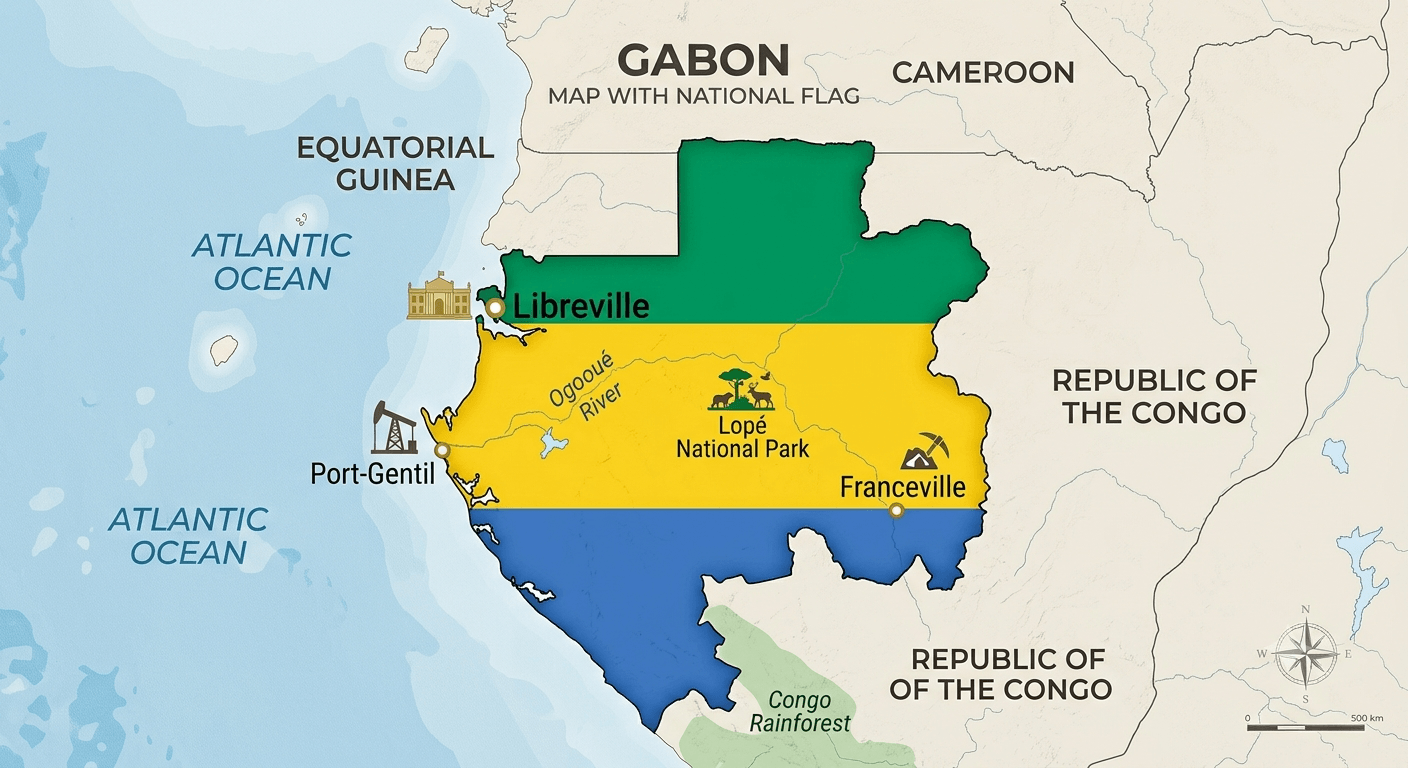
The Gabonese Republic (République Gabonaise) is located on the west coast of Central Africa, straddling the Equator on the Gulf of Guinea. Gabon shares land borders with Equatorial Guinea and Cameroon to the north and the Republic of the Congo to the east and south, with the capital, Libreville, situated on the Atlantic coast[1].
Key Geographic Features:
- Total Land Area: Approximately 267,668 square kilometers (world’s 76th largest; roughly the size of the United Kingdom)
- Coastline: ~885 kilometers along the Atlantic Ocean; ports at Libreville, Port-Gentil, and Owendo[1]
- Forest Cover: ~88-91.5% of land area is forested — among the highest forest coverage ratios in the world[2]
- Equatorial Climate: Hot, humid year-round; two rainy seasons; substantial hydroelectric potential[1]
- Major Rivers: Ogooué (longest, ~1,200 km) and Nyanga, draining the interior to the Atlantic[1]
Strategic Geographic Advantages:
- Atlantic Access: Direct deep-water port access to European, American and Asian shipping routes — a rare advantage in Central Africa, where most neighbours are landlocked or have limited port capacity[1]
- Equatorial Position: Enables year-round agricultural production of rubber, oil palm, cocoa, and coffee[2]
- Regional Hub Potential: Libreville and Port-Gentil function as logistics nodes for CEMAC regional trade[1]
Population: Approximately 2.59 million (2025 World Bank estimate), growing at 2.1% annually — one of the least densely populated countries in Africa at just 10 persons per square kilometer.
Demographic Note: Gabon is overwhelmingly urban (92.1% of the population) — the highest urbanization rate in Central Africa. Approximately 37.7% of urban residents live in Libreville alone[3].
Capital: Libreville (population ~899,225 in the urban agglomeration)
Sources: World Bank Gabon Country Overview 2025 | FAO Forest Resources Assessment | World Bank Open Data — Gabon
Government and Political System
Official Name: Gabonese Republic (République Gabonaise)
Government System: Gabon is a presidential republic with a unicameral legislature under its Fifth Republic constitution, adopted after the August 2023 political transition[4].
Head of State & Government: President Brice Clotaire Oligui Nguema — leader of the Committee for the Transition and Restoration of Institutions (CTRI); inaugurated as transitional president in September 2023 and elected to a full term in the April 2025 presidential election
Political Transition Context: Gabon has undergone the most significant political shift in its post-independence history. In August 2023, a military transition ended over five decades of rule by the Bongo family and the Gabonese Democratic Party (PDG). A November 2024 constitutional referendum introduced the Fifth Republic, restructuring executive powers and establishing a new institutional framework. The April 2025 election formally concluded the transitional period[4].
Legislative Structure:
- National Assembly: Unicameral under Fifth Republic arrangements; transitional and elected members[4]
- Former Senate: Abolished under the Fifth Republic restructuring[4]
Administrative Divisions: 9 provinces, subdivided into departments and districts[4]
Governance Priorities of the Oligui Administration:
- Economic diversification beyond oil — manganese, timber, agriculture, and value-added processing[5]
- Anti-corruption reforms and restructuring of state-owned enterprises[4]
- Debt management — public debt breached the CEMAC convergence ceiling of 70% of GDP in 2024[5]
- Fiscal consolidation amid declining oil revenues[5]
Source: Wikipedia — Foreign Relations of Gabon / Politics of Gabon | RioTimes Online, “Gabon economy faces oil decline as Oligui bets on mining,” 2026
2. ECONOMIC LANDSCAPE: OIL REVENUE AND DIVERSIFICATION PRESSURE
Gabon is classified as an upper-middle-income country and ranks among Africa’s wealthiest nations by per capita income. However, as this economic analysis shows, the economy remains deeply commodity-dependent, with oil, manganese, and timber accounting for 83-97% of total exports.
Key Economic Indicators (2024-2026)
| Economic Indicator | 2024 | 2025 Estimate | 2026 Forecast | Source |
|---|---|---|---|---|
| Nominal GDP (US$ Billion) | ~US$20.9-21.4 | ~US$21.43-21.46 | ~US$23.36 | World Bank / IMF[6] |
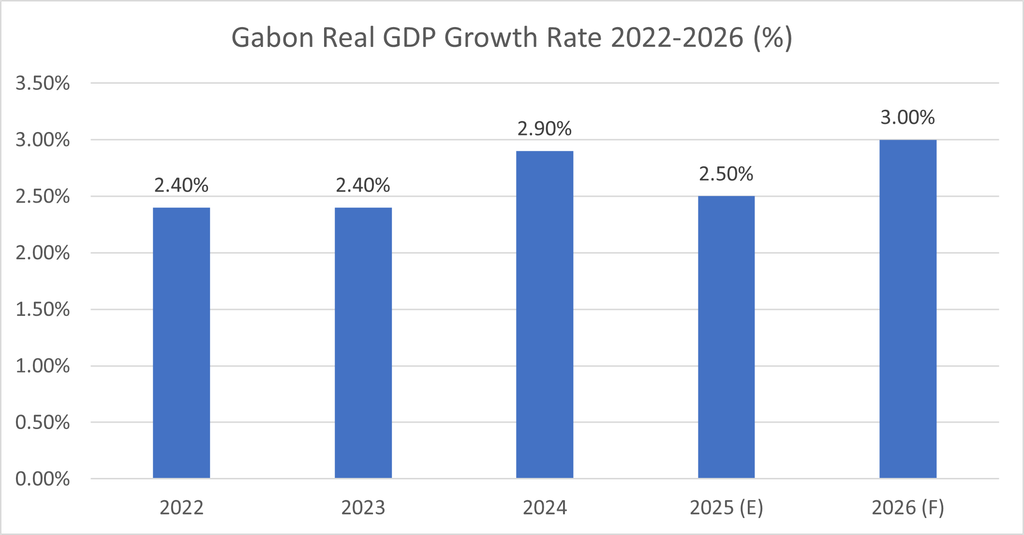
| Real GDP Growth | 2.9% | 2.5% | 2.7-3.0% | World Bank / IMF WEO[6] |
| GDP Per Capita (Current US$) | ~US$8,100 | ~US$8,263 | ~US$9,918 | World Bank / IMF[6] |
| GDP Per Capita (PPP, Int’l $) | ~US$23,000 | ~US$24,739 | ~US$25,847 | IMF WEO[6] |
| Inflation (Year-on-Year) | ~2.0% | 1.6% (Dec) | ~2.5% | World Bank / BEAC[6] |
| Unemployment Rate | ~20.1% overall; 36.0% youth | ~20-21% | ~20-22% | AfDB 2026[7] |
| Government Debt (% of GDP) | 74.7-81.9% | ~81.9% | ~86.1% | World Bank / IMF[7] |
| Policy Rate (BEAC) | 4.50% | 4.75% (Dec 2025) | ~4.75% | BEAC[6] |
| Exports (Goods) | ~US$12.7 billion | ~US$12-13 billion | — | WITS/UN Comtrade[8] |
Fiscal Warning: Gabon’s public debt reached 74.7% of GDP in 2024 (World Bank estimate) and 81.9% in 2025 on the broader measure, breaching CEMAC’s 70% convergence ceiling. The government revised its 2026 growth forecast downward from 6.5% to 4.0% in a May 2026 amending finance law — still above the IMF’s 2.7% projection[5].
Source: World Bank Gabon Economic Update 2025 | IMF World Economic Outlook | African Development Bank, Gabon Economic Outlook 2026 | WITS/UN Comtrade — Gabon Trade Summary 2023
Sectoral Contribution to GDP (2024-2025)
| Sector | % of GDP | Key Activities | Growth Status | Source |
|---|---|---|---|---|
| Oil Sector (Upstream & Downstream) | ~30-38% | Crude extraction, refining, associated gas | +4.6% (2024); declining from 2025 | World Bank Economic Update[9] |
| Services (Government, Trade, Finance, Transport) | ~35-40% | Public administration, retail, logistics, telecom | Supported by public investment | World Bank[9] |
| Mining (Manganese, Iron, Gold) | ~5-7% | Manganese ore, iron ore, gold | Manganese affected by transport/logistics issues in 2025 | World Bank / AfDB[9] |
| Timber & Wood Processing | ~3-5% | Sawn wood, veneer, plywood (log export ban in force) | Constrained by demand and logistics | World Bank[9] |
| Agriculture (Rubber, Palm Oil, Cocoa, Coffee) | ~4-6% | Rubber, oil palm, cocoa, subsistence farming | Growing; long-cycle crop investment | World Bank / FAO[9] |
| Construction & Public Works | ~5-8% | Roads, public buildings, infrastructure | Strong growth driver | World Bank[9] |

Key Economic Realities:
- Oil Dominance — Structural Decline: Oil output grew 4.6% in 2024 (~11 million tonnes) on new fields and lower OPEC+ restrictions, but is projected to contract -2.1% in 2025 and -5.8% in 2026. The World Bank describes this as structural, not cyclical — maturing fields will steadily reduce output[9]
- Three Commodities, 97% of Exports: Oil, manganese, and wood together account for 97% of total exports; oil alone accounts for ~50% of tax revenues
- Diversification Drive: Growth from 2025 onward is expected from mining, wood, and agriculture rather than hydrocarbons[9]
- Manganese Emergence: Manganese ore exports reached ~US$2.95 billion (2024) — a major second pillar, with China and Indonesia as primary buyers[8][11]
- Log Export Ban: Gabon’s ban on raw log exports has driven value addition, with over US$700 million in primary processed wood exports and over 50% of forest product exports directed to Asia
- Post-Oil Transition Urgency: TotalEnergies’ Gabon operations produced 16,000 barrels/day in 2025, a 6% decline, with revenues down 10% to US$418 million — a microcosm of the sector-wide trend[5]
Source: World Bank Gabon Economic Update 2025 | Coface Gabon Country Risk Assessment | FreightAmigo Gabon Exports & Economy Guide 2026 | World Bank Gabon Economic Update — Wood Sector Analysis
3. EXPORT STRUCTURE: PETROLEUM, MANGANESE AND PROCESSED TIMBER
Major Export Products (Latest Available Data)
| Product Category | HS Code | Value (US$ Million) | % of Total Exports | Key Markets | Source |
|---|---|---|---|---|---|
| Crude Petroleum Oils | 270900 | 6,579.5 | ~52% | China, India, Europe | WITS/UN Comtrade[13] |
| Manganese Ores & Concentrates | 260200 | 2,952.9 | ~23% | China, Indonesia | WITS/UN Comtrade[13] |
| Floating/Submersible Drilling Platforms | 890520 | 667.9 | ~5% | (Re-exports/oil services) | WITS/UN Comtrade[13] |
| Floating Docks & Specialised Vessels | 890590 | 644.1 | ~5% | (Oil services) | WITS/UN Comtrade[13] |
| Sawn Wood & Veneer (Processed Timber) | 440799 | 432.4 | ~3% | EU, China, India, Italy | WITS/UN Comtrade[13] |
| Total Exports | — | 12,695 | 100% | 133 export partners | WITS/UN Comtrade[13] |

Exports at a Glance (2023-2024):
- Total goods exports: ~US$12.7 billion
- Oil exports: ~US$5.23 billion in 2024 (55-65% of total exports)
- Manganese exports: ~US$1.7 billion in 2024 (14-21% of total exports)
- Sawn wood & veneer: ~US$0.5-0.7 billion (5-7% of total exports)
Note on Export Share Variance: Different sources report different shares for oil (52-69%) and manganese (14-23%) depending on the reference year and whether oil services vessels (HS 89) are counted within “exports.” The ranges presented reflect this variance transparently.
Source: WITS / UN Comtrade — Gabon Trade Summary, latest available
Top Export Destinations
| Export Market | Trade (US$ Million) | Partner Share (%) | Key Products | Source |
|---|---|---|---|---|
| China | 3,516 | 27.70% | Crude oil, manganese ore, timber | WITS/UN Comtrade[13] |
| France | 1,341 | 10.56% | Crude oil, timber, agri-products | WITS/UN Comtrade[13] |
| Spain | 755 | 5.95% | Crude oil, timber | WITS/UN Comtrade[13] |
| Netherlands | 724 | 5.70% | Crude oil, timber | WITS/UN Comtrade[13] |
| Israel | 680 | 5.36% | Crude oil | WITS/UN Comtrade[13] |
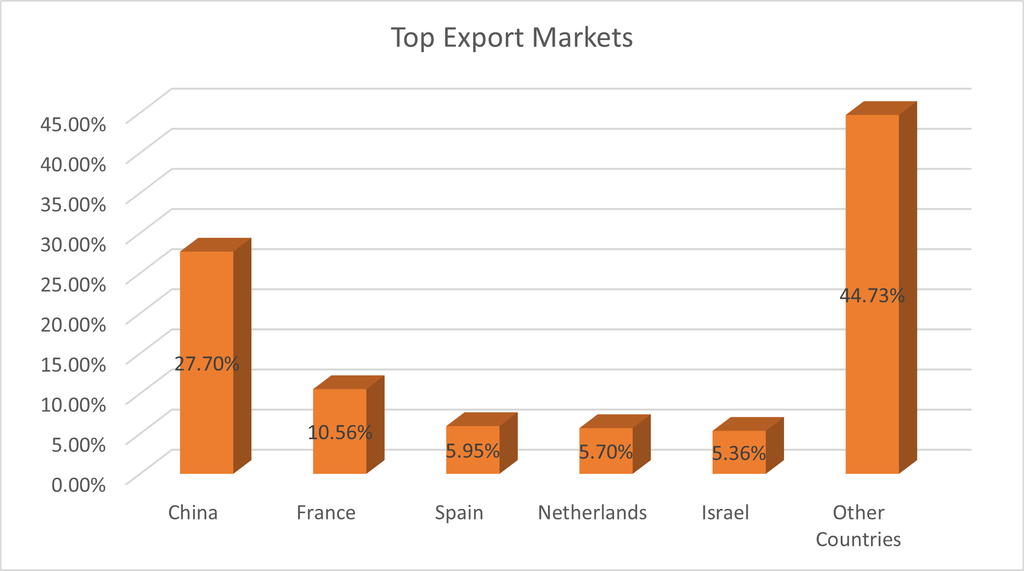

Key Insight: China alone absorbs more than a quarter of Gabon’s exports, and Asian markets consumed about two-thirds of total export value in 2023. Over 50% of forest product exports now go to Asia[12][13].
Top Import Sources
| Import Source | Trade (US$ Million) | Partner Share (%) | Key Products | Source |
|---|---|---|---|---|
| South Korea | 560 | 13.29% | Petroleum products, machinery, vessels | WITS/UN Comtrade[13] |
| France | 549 | 13.01% | Machinery, food, pharmaceuticals, vehicles | WITS/UN Comtrade[13] |
| China | 490 | 11.61% | Machinery, electronics, textiles, consumer goods | WITS/UN Comtrade[13] |
| United States | 318 | 7.55% | Machinery, chemicals, equipment | WITS/UN Comtrade[13] |
| India | 164 | 3.89% | Pharmaceuticals, textiles, machinery | WITS/UN Comtrade[13] |

Top Import Products (HS 6-digit):
- Floating/submersible drilling platforms — US$735.5 million (oil industry capital equipment)
- Refined petroleum oils & preparations — US$226.4 million[13]
Source: WITS/UN Comtrade — Gabon Trade Summary
4. AGRICULTURAL AND FORESTRY SECTOR: THE DIVERSIFICATION FRONTIER
Gabon possesses approximately five million hectares of fertile land, yet agriculture contributes only a modest share of GDP and the country remains ~60% dependent on food imports. This represents both a vulnerability and a major diversification opportunity[12][14].
Major Agricultural and Forestry Products
| Product | Role | Status (2024-25) | Key Detail | Source |
|---|---|---|---|---|
| Rubber | Export crop; long-cycle investment | Growing | Major plantation crop following oil palm expansion | World Bank[12] |
| Oil Palm | Domestic edible oil + export potential | Growing | Prioritised under agricultural diversification plan | World Bank / FAO[12] |
| Cocoa & Coffee | Traditional smallholder crops | Stable/declining | Recognised as diversification candidates | World Bank[12] |
| Timber (Sawn Wood, Veneer, Plywood) | Third-largest export earner | Log export ban in force; value addition expanding | >US$700 Mn in processed wood exports (2022) | World Bank[12] |
| Manganese (mining, adjacent agriculture) | Second-largest export earner | Transport/logistics constrained in 2025 | ~US$1.7-2.95 Bn in exports | WITS[13] |
| Cassava, Plantain, Maize | Food security staples | Subsistence-dominant | Limited commercialisation | FAO[14] |
Agricultural Characteristics:
- Food Import Dependency: Gabon imports roughly 60% of its food, concentrated in cereals, processed foods, beverages, and dairy — creating natural demand for Bangladesh’s processed food and pharmaceutical exporters[14]
- Fertile Land Underused: Of ~5 million hectares of fertile land, only a small fraction is under commercial cultivation[12]
- Structural Constraints: High labour costs, small domestic market, and imported input costs limit agricultural competitiveness[12]
- Forest Sector Value Strategy: The raw log export ban (introduced to force domestic processing) has successfully shifted exports toward sawn wood, veneer, and plywood, though demand and logistics challenges emerged in 2025[9]
Source: World Bank Gabon Economic Update 2025 — Agriculture and Wood Sector Analysis | U.S. International Trade Administration — Gabon Market Opportunities/Overview (2024)
5. EDUCATION AND HUMAN CAPITAL
Education System and Indicators
Gabon operates a French-language education system following the French model, with compulsory schooling through age 16[15].
Education Structure:
- Primary: Ages 6-11 (6 years)
- Lower Secondary: Ages 12-15 (4 years)
- Upper Secondary: Ages 16-18 (3 years)
- Higher Education: Université Omar Bongo (Libreville) and other institutions[15]
Education and Human Capital Indicators
| Education Metric | Value | Year | Source |
|---|---|---|---|
| Adult Literacy Rate | 88.9% | 2021 | World Bank / UNESCO[15] |
| Female Literacy Rate | 87.1% | 2021 | World Bank[15] |
| Male Literacy Rate | 90.8% | 2021 | World Bank[15] |
| Youth Literacy Rate (15-24) | 94.0% | 2021 | World Bank[15] |
| Government Education Spending (% of GDP) | 2.3% | 2023 | World Bank[15] |
| Education Spending (% of Govt Expenditure) | 13.6% | 2023 | World Bank[15] |
| Pupil-Teacher Ratio (Primary) | 35.0 | 2019 | UNESCO[15] |
| Pupil-Teacher Ratio (Secondary) | 28.7 | 2019 | UNESCO[15] |
| Tertiary Students (per 100,000) | 1,232 | 2021 | UNESCO[15] |
| Human Capital Index | 0.46 | 2020 | World Bank[15] |
| Learning-Adjusted Years of School | 6.0 years | 2020 | World Bank[15] |
Learning Quality Concern: UNESCO and CONFEMEN-PASEC assessments (cited via AllAfrica, 2025) document persistent weaknesses in foundational learning outcomes despite Gabon’s high literacy rate and high-income status. The World Bank’s Human Capital Index of 0.46 indicates a child born in Gabon will reach only 46% of their potential productivity — reflecting gaps in education quality and health[15].
Source: UNESCO Institute for Statistics — Gabon Literacy Rate (2022) | World Bank Open Data — Gabon Education Indicators | CONFEMEN-PASEC via AllAfrica (2025)
6. HEALTH AND SOCIAL INDICATORS
Health Metrics
| Health Indicator | Value | Year | Source |
|---|---|---|---|
| Life Expectancy at Birth | 68.5 years | 2024 | World Bank / WHO[16] |
| Life Expectancy (Women) | 71.2 years | 2025 | Destatis / WHO[16] |
| Life Expectancy (Men) | 66.1 years | 2025 | Destatis / WHO[16] |
| Under-5 Mortality Rate | 32.6 per 1,000 live births | 2024 | WHO[16] |
| Neonatal Mortality Rate | 16.3 per 1,000 | 2024 | WHO[16] |
| Maternal Mortality Ratio | 233 per 100,000 live births | 2023 | WHO[16] |
| Nurses & Midwives (per 1,000) | 2.4 | 2022 | WHO[16] |
| Practising Physicians (per 1,000) | 0.5 | 2022 | WHO[16] |
| Measles Immunization Coverage | 57.0% | 2024 | WHO[16] |
| Universal Health Coverage Index | 48/100 | 2023 | WHO[16] |
| Health Expenditure per Capita | US$253 | 2023 | WHO[16] |
Social Indicators
| Social Indicator | Value | Year | Source |
|---|---|---|---|
| HDI (Human Development Index) | 0.733 | 2023 | UNDP[17] |
| HDI Global Rank | 108th of 193 | 2023 | UNDP[17] |
| HDI Category | High Human Development | 2023 | UNDP[17] |
| Gini Coefficient | 38.0 (medium inequality) | 2017 | World Bank[17] |
| Poverty — Bottom 20% Income Share | Richest 20% earn over 90% of income | — | Wikipedia/Economy of Gabon[17] |
| Unemployment (Overall) | 20.1% | 2026 | AfDB[7] |
| Youth Unemployment | 36.0% | 2026 | AfDB[7] |
| Urban Population in Slums | 38.8% | 2022 | World Bank[17] |
| Female Labor Force Participation (15+) | 42.6% | 2024 | World Bank[17] |
| Women in Parliament | 21.6% | 2025 | World Bank[17] |
| Internet Users (% of population) | 68.7% | 2024 | World Bank[17] |
| Access to Electricity (% of population) | ~93% (urban-concentrated) | Latest | World Bank[17] |
The Gabon Paradox: Gabon ranks in the “high human development” category — the 4th highest HDI in Sub-Saharan Africa after Mauritius, Seychelles and South Africa — yet poverty and unemployment remain elevated for its income level. The richest 20% of the population earn over 90% of income, while youth unemployment stands at 36%. Resource-driven growth has generated limited job creation, a structural weakness highlighted by both the World Bank and AfDB[7][17].
Source: WHO — Gabon Country Statistics | Destatis Statistical Country Profile Gabon | UNDP HDI; World Bank Open Data — Gabon; Our World in Data (UN health indicators); AfDB Gabon Economic Outlook 2026
7. INTERNATIONAL COOPERATION AND MULTILATERAL PLATFORMS
Multilateral Membership
| Organization / Framework | Gabon’s Status | Relevance to Bilateral Engagement | Source |
|---|---|---|---|
| United Nations | Full member | Primary channel for Bangladesh–Gabon engagement | UN[18] |
| World Trade Organization (WTO) | Full member | Trade rules framework; tariff structure | WTO[18] |
| CEMAC (Central African Economic and Monetary Community) | Full member | Common currency (CFA Franc/XAF); common external tariff | CEMAC[18] |
| African Union (AU) | Full member | Continental governance | AU[18] |
| OPEC | Full member | Oil production coordination | OPEC[18] |
| FAO, UNESCO, WHO | Full member | Sectoral technical cooperation | UN Agencies[18] |
| Organisation of Islamic Cooperation (OIC) | Not a member | Absence distinguishes Gabon from many Bangladesh partners in Africa | OIC[18] |
Key Structural Gap — No OIC Overlap: Unlike Chad, Libya, Brunei and Indonesia, Gabon is not an OIC member, which means the Islamic Development Bank and OIC Trade Preferential System channels — the most effective bilateral cooperation tools Bangladesh deploys in many African and Muslim-majority markets — are not available in this relationship. Shared multilateral membership is therefore largely confined to the UN and WTO frameworks.
Cooperation Reality: Available records indicate no evidence that shared UN/WTO memberships have translated into deepened bilateral diplomatic, political, or commercial engagement. Cooperation to date has been largely confined to routine multilateral coordination rather than a dedicated strategic partnership.
8. BANGLADESH–GABON BILATERAL RELATIONS

Diplomatic Status
Bangladesh and Gabon maintain formal but limited diplomatic engagement. Neither country maintains a resident embassy in the other’s capital; consular matters are handled on a non-resident basis — a pattern Bangladesh follows with several Central African states[19].
Bilateral Engagement Characteristics:
| Dimension | Status | Source |
|---|---|---|
| Diplomatic Representation | Non-resident; no resident missions in either capital | Wikipedia – Foreign Relations of Bangladesh/Gabon[19] |
| Dedicated Bilateral Treaty | No specific bilateral treaty identified | Foreign Relations records[19] |
| Bilateral Trade Agreement | None identified | Ministry of Commerce / EPB[19] |
| Joint Economic Commission | None identified | Ministry of Foreign Affairs[19] |
| Cooperation Mechanism | Multilateral platforms (primarily UN) rather than bilateral | Wikipedia[19] |
| Visa Processing | Via regional mission or Gabon’s own consular arrangements | To be confirmed with MoFA[19] |
| Resident Bangladesh Mission in Libreville | None | MoFA[19] |
Cooperation Platforms
Cooperation runs primarily through multilateral platforms such as the United Nations rather than dedicated bilateral mechanisms. Commercial ties remain nascent, reflecting the small trade volumes documented in the following section[19].
Recommendation for Verification: The absence of a bilateral trade agreement or joint economic commission should be verified directly with Bangladesh’s Ministry of Foreign Affairs and Ministry of Commerce, as institutional records may not be fully reflected in public sources[19].
Source: Wikipedia — Foreign Relations of Gabon / Bangladesh (structural cross-reference only) | Bangladesh Ministry of Foreign Affairs | Uploaded Gabon Country Profile Report
9. BILATERAL TRADE ANALYSIS: A MARGINAL BUT GROWING BASE
Bangladesh–Gabon Trade Overview
Per UN Comtrade data (mirrored via Trading Economics), Gabon’s imports from Bangladesh totalled approximately US$1.58 million in 2023 — a marginal figure in both absolute and relative terms, representing well under 0.01% of Gabon’s total import bill.
What Gabon Imports from Bangladesh (2023)
| Product Category (HS Chapter) | Value (US$) | % of BD Exports to Gabon | End-Use in Gabon | Source |
|---|---|---|---|---|
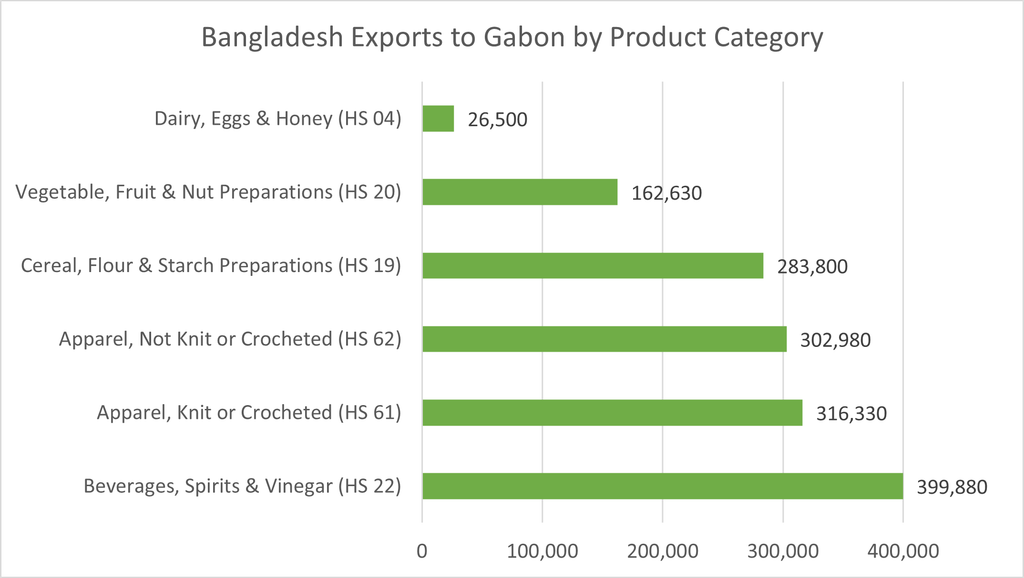
| Beverages, spirits and vinegar (HS 22) | 399,880 | ~25.3% | Retail, hospitality sector | UN Comtrade via Trading Economics[20] |
| Apparel, knit or crocheted (HS 61) | 316,330 | ~20.0% | Retail, personal consumption | UN Comtrade[20] |
| Apparel, not knit or crocheted (HS 62) | 302,980 | ~19.2% | Retail, personal consumption | UN Comtrade[20] |
| Cereal, flour, starch, milk preparations (HS 19) | 283,800 | ~18.0% | Retail, food processing | UN Comtrade[20] |
| Vegetable, fruit, nut preparations (HS 20) | 162,630 | ~10.3% | Retail, food processing | UN Comtrade[20] |
| Dairy, eggs, honey, edible products (HS 04) | 26,500 | ~1.7% | Retail, food service | UN Comtrade[20] |
| Fish, crustaceans, molluscs | Minor | ~0.5% | Retail, food service | UN Comtrade[20] |
| Total | ~1,580,000 | 100% | — | UN Comtrade[20] |
Product Mix Analysis: Bangladesh’s modest exports to Gabon are notably diversified across four categories — beverages/spirits (25%), knit apparel (20%), woven apparel (19%), and cereal/flour preparations (18%). This distribution reflects Gabon’s high food-import dependence (~60%) and consumer demand for imported processed goods and ready-made clothing[20][21].
Source: UN Comtrade via Trading Economics — Gabon Imports from Bangladesh (2023) https://tradingeconomics.com | U.S. International Trade Administration — Gabon Market Overview (2024)
What Gabon Exports to Bangladesh
Status: Gabon’s recorded exports to Bangladesh are effectively nil in available trade databases. No significant Gabonese commodity — crude oil, manganese, or timber — has Bangladesh as an established end market in documented trade flows[20].
Structural Explanation: Gabon’s export commodities (crude oil, manganese ore, processed timber) are directed overwhelmingly to China, India, Indonesia, and the EU — markets with established refining, smelting, and processing infrastructure. Bangladesh currently lacks the large-scale refinery or ferroalloy capacity that would create direct demand for Gabonese crude or manganese ore at commercial scale[13][20].
Trade Balance Summary
| Metric | Value | Interpretation |
|---|---|---|
| Bangladesh Exports to Gabon | ~US$1.58 million (2023) | Marginal absolute figure |
| Gabon Exports to Bangladesh | ~Negligible / Nil | No documented flows |
| Trade Balance (Bangladesh) | +US$1.58 million | Positive but immaterial |
| Share of Gabon’s Total Imports | <0.01% | Substantial untapped potential |
| Bilateral Trade Agreement | None identified | Foundational gap |
| Joint Economic Commission | None identified | Foundational gap |
Data Limitation Advisory: Verified, HS-code-level bilateral trade and trade-financing figures should be requested directly from the Export Promotion Bureau (EPB) of Bangladesh and Bangladesh Bank before finalising any investment or market-entry decisions. Bilateral figures for Gabon are not publicly disaggregated at the level of granularity required for commercial planning[22].
Banking and Financial Linkages
| Dimension | Status |
|---|---|
| Currency Regime | CFA Franc (XAF) — pegged to the Euro via French Treasury guarantee |
| Central Bank | BEAC (Bank of Central African States); policy rate raised to 4.75% in December 2025 |
| Correspondent Banking | Routed via French and international banks; no direct Bangladesh–Gabon corridor identified |
| Trade Finance Instruments | Advance payment and documentary collection dominate; LC usage minimal at current volumes |
| Remittances | Negligible — no significant Bangladeshi diaspora in Gabon identified |
Source: EPB Bangladesh; Bangladesh Bank — institutional context; bilateral figures require direct data request (not publicly available)
10. OPPORTUNITIES FOR BANGLADESHI CITIZENS IN GABON
| Opportunity Area | Status | Details | Source |
|---|---|---|---|
| Higher Education | Very limited | No dedicated Bangladesh–Gabon scholarship scheme identified; options rely on Gabon’s own schemes or French-language academic routes | Uploaded Country Profile Report[23] |
| Employment / Labour Migration | Niche only | Gabon’s labour force (~771,000) is dominated by oil, mining and services; no formal migration channel exists — openings likely limited to niche technical/construction roles on infrastructure projects | Uploaded Report[23] |
| Visa Facilities | Non-resident processing | With no resident Bangladesh mission in Libreville, processing routes through a regional mission or Gabon’s own consular arrangements — to be confirmed with the Ministry of Foreign Affairs | MoFA[23] |
| Export Opportunities | Most viable pathway | Apparel, processed foods, beverages and pharmaceuticals already have a small foothold and could grow given Gabon’s 60% food-import dependence | UN Comtrade / ITA[23] |
| Residency / Citizenship | No facility identified | No specific bilateral facility for Bangladeshi nationals was identified | Uploaded Report[23] |
Key Practical Constraint: Gabon’s French-language business and administrative environment, combined with the absence of a resident Bangladesh mission and the small domestic market (~2.6 million people), means Bangladeshi engagement is most realistically pursued through third-country intermediaries or regional hubs rather than through direct presence[23].
Source: Uploaded Gabon Country Profile Report — Opportunities for Bangladeshi Citizens in Gabon
11. OPPORTUNITIES FOR GABON FROM BANGLADESH
High-Potential Import Categories
| Product Category | Bangladesh’s Competitive Position | Gabon’s Need | Current Uptake | Source |
|---|---|---|---|---|
| Ready-Made Garments | World’s 2nd largest apparel exporter | All apparel imported; consumer demand | Already US$619,310 (HS 61+62, 2023) | UN Comtrade[20] |
| Processed Foods & Beverages | Established food processing sector | 60% food-import dependence | Already US$446,430 (HS 19+20, 2023) | UN Comtrade[20] |
| Pharmaceuticals | WHO-GMP certified, cost-competitive | Healthcare system needs affordable generics | Small foothold; UHC Index 48/100 | Uploaded Report / WHO[20] |
| Footwear | 3rd largest leather processor globally | All footwear imported | Minimal current uptake | Uploaded Report[23] |
| Light Consumer Goods | Broad manufacturing capacity | Import-dependent market | Marginal | Uploaded Report[23] |
| Beverages & Spirits | Established beverage sector | Strong hospitality demand | US$399,880 — largest single category (2023) | UN Comtrade[20] |
Estimated Near-Term Export Potential: Building on the existing modest trade base of ~US$1.58 million, targeted promotion could realistically grow bilateral trade toward US$5-15 million annually within three to five years, concentrated in apparel, processed foods, and pharmaceuticals[23].
Investment and Industrial Cooperation
| Cooperation Model | Bangladesh Sector | Alignment with Gabon’s Priorities | Source |
|---|---|---|---|
| Joint Ventures | Textiles, agro-processing, pharmaceuticals | Gabon’s push to diversify beyond raw commodities | Uploaded Report[23] |
| Light Manufacturing | Apparel assembly, consumer goods | Reduces import dependence; creates jobs | Uploaded Report[23] |
| Food Processing Collaboration | Agro-processing, packaged foods | Helps reduce Gabon’s high food-import dependence | Uploaded Report[23] |
| Shipping & Logistics Services | Maritime services (growing Bangladeshi expertise) | Supports Gabon’s port and trade-facilitation needs | Uploaded Report[23] |
Strategic Rationale: Gabon’s post-transition economic diversification agenda prioritises reducing commodity dependence — precisely the area where Bangladesh’s manufacturing, agro-processing, and pharmaceutical capabilities offer complementary expertise. Gabon’s deep-water port access at Libreville, Port-Gentil and Owendo provides the logistics foundation that many Central African markets lack[23].
Source: Uploaded Gabon Country Profile Report — Opportunities for Gabon from Bangladesh
12. TRADE ASSOCIATIONS AND FUTURE PROSPECTS
Key Trade Bodies
Gabonese Institutions:
- Chambre de Commerce, d’Agriculture, d’Industrie et des Mines du Gabon — primary private sector body
- Gabon’s Ministry of Commerce — trade policy and regulation
- ANPI-Gabon (Agence Nationale de Promotion des Investissements) — investment promotion agency
Bangladeshi Institutions:
- Federation of Bangladesh Chambers of Commerce & Industry (FBCCI): https://www.fbcci.org
- Bangladesh Garment Manufacturers & Exporters Association (BGMEA): https://www.bgmea.com.bd
- Bangladesh Knitwear Manufacturers & Exporters Association (BKMEA) — relevant given knit apparel’s prominence in current exports
- Export Promotion Bureau (EPB): https://www.epb.gov.bd
Institutional Gap
No documented cooperation between Bangladeshi trade bodies (FBCCI, BGMEA, BKMEA) and Gabonese counterparts was identified — consistent with the limited trade volume documented in the preceding section[24].
Future Prospects
Near-Term (2025-2027) — Foundation Building:
- Trade-Fair Participation: Targeted participation in Gabonese and CEMAC-regional trade fairs to build visibility[24]
- Honorary Consular Presence: Explore an honorary consulate or trade desk to lower transaction costs and improve visibility for Bangladeshi exporters[24]
- Direct EPB Engagement: Formal engagement with Gabon’s Ministry of Commerce and Chamber of Commerce
Medium-Term (2027-2030):
- Trade Delegation Exchange: Exploratory exchanges between EPB/FBCCI and Gabon’s Chamber of Commerce to assess demand and regulatory requirements[24]
- Priority Category Development: Build on the existing small base in apparel, processed food, beverages, and pharmaceuticals[24]
- Growth Trajectory: Steady growth in apparel, food and pharmaceutical categories with targeted promotion[24]
Country-Risk Monitoring:
- Track Gabon’s post-transition political and fiscal environment — including Fifth Republic reforms and the fiscal deficit path — as part of ongoing country-risk review[24]
Prospects Summary: Given Gabon’s small, import-dependent consumer market, near-term prospects remain modest but could grow steadily in apparel, food, and pharmaceutical categories with targeted promotion and foundational trade infrastructure[24].
Source: Uploaded Gabon Country Profile Report — Trade Associations and Future Prospects / Recommendations
13. RECOMMENDATIONS
For Bangladeshi Exporters and Entrepreneurs
- Request Verified Data First: Obtain HS-code-level trade and trade-financing figures directly from EPB and Bangladesh Bank before finalising investment decisions, given the data limitations in bilateral trade statistics[24].
- Prioritise Four Categories: Focus near-term effort on apparel, processed food, beverages, and pharmaceuticals — building on the existing small trade base where Bangladesh has already established a foothold[24].
- Establish Honorary Consulate or Trade Desk: Explore an honorary consular presence or trade desk to lower transaction costs and improve visibility for Bangladeshi exporters in Gabon’s import-dependent market[24].
- Pursue Trade-Delegation Exchange: Initiate exploratory trade-delegation exchanges between EPB/FBCCI and Gabon’s Chamber of Commerce to assess demand and regulatory requirements directly[24].
- Plan for French-Language Operations: Gabon’s commercial and administrative environment operates in French; partner with Francophone intermediaries or develop French-capable trade representation[23].
- Monitor Political and Fiscal Environment: Track Gabon’s post-transition reforms and fiscal trajectory — including the debt position above the CEMAC ceiling — as part of ongoing country-risk assessment[24].
For the Bangladeshi Government
- Honorary Consular Appointment: Move quickly to appoint an honorary consul in Libreville — the single lowest-cost intervention to reduce bilateral transaction friction[24].
- EPB Market Assessment: Commission a formal Export Promotion Bureau market assessment for Gabon within the CEMAC framework[24].
- Data Transparency: Direct Bangladesh Bank and EPB to publish disaggregated Gabon bilateral trade data to enable evidence-based commercial planning[22].
- CEMAC Engagement: Explore Bangladesh’s engagement with CEMAC as a regional bloc — a more efficient route to a 6-nation market than bilateral engagement with each member state[18].
For Gabonese Importers and Investors
- Source Bangladeshi Apparel and Food Directly: Reduce intermediary costs by establishing direct relationships with Bangladeshi apparel and processed food exporters — Bangladesh already supplies these categories[20].
- Pharmaceutical Sourcing: Explore WHO-GMP certified Bangladeshi generics to reduce healthcare procurement costs amid a Universal Health Coverage Index of 48/100[20].
- Joint Venture Industrial Cooperation: Engage Bangladeshi textile, agro-processing, and pharmaceutical firms for joint ventures aligned with Gabon’s diversification from raw commodities.
- Leverage Atlantic Port Advantage: Position Gabon’s deep-water ports as the CEMAC gateway for Bangladeshi goods entering the six-nation common-currency bloc[1].
REFERENCES
- World Bank, Gabon Country Overview (2025)
https://www.worldbank.org/ext/en/country/gabon - FAO, Global Forest Resources Assessment — Gabon
https://www.fao.org/forest-resources-assessment - World Bank Open Data — Gabon (Population, Urbanisation, GDP)
https://data.worldbank.org/country/gabon - Wikipedia — Politics of Gabon / Foreign Relations of Gabon (structural cross-reference)
https://en.wikipedia.org/wiki/Gabon - RioTimes Online, “Gabon economy faces oil decline as Oligui bets on mining” (2026)
https://www.riotimesonline.com/gabon-economy-after-bongo-2026/ - World Bank, Gabon Economic Update 2025: Building and Preserving Gabon’s Wealth for Better Livelihoods
https://www.worldbank.org/en/country/gabon/publication/gabon-economic-update-2025-building-and-preserving-gabon-wealth-for-better-livelihoods - African Development Bank, Gabon Economic Outlook (2026)
https://www.afdb.org - WITS, World Bank — Gabon Trade Summary / Country Snapshot (2023)
https://wits.worldbank.org/CountryProfile/en/Country/GAB - World Bank, Gabon Economic Update — Full Report (PDF)
https://documents1.worldbank.org/curated/en/099062325175013465/pdf/ - Coface — Gabon Country Risk Assessment
https://www.coface.com - FreightAmigo, “Gabon Exports & Economy 2026 — Logistics Guide”
https://www.freightamigo.com/en/blog/global-trade/gabon-exports-economy-logistics/ - World Bank, Gabon Economic Update — Wood and Agriculture Sector Analysis
https://documents1.worldbank.org/curated/en/099092524143030496/ - Lloyds Bank Trade — Foreign Trade Figures of Gabon
https://www.lloydsbanktrade.com - U.S. International Trade Administration — Gabon Market Opportunities/Overview (2024)
https://www.trade.gov - UNESCO Institute for Statistics — Gabon Literacy Rate (2022); CONFEMEN-PASEC via AllAfrica (2025)
https://uis.unesco.org - WHO — Gabon Country Statistics; Destatis Statistical Country Profile Gabon
https://www.who.int | https://www.destatis.de - UNDP HDI; Our World in Data (UN Health Indicators); UNICEF/WHO/World Bank Joint Child Malnutrition Estimates
https://hdr.undp.org | https://ourworldindata.org - Organisation of Islamic Cooperation — Member States List
https://www.oic-oci.org - Wikipedia — Foreign Relations of Gabon / Bangladesh (structural cross-reference only)
- UN Comtrade via Trading Economics — Gabon Imports from Bangladesh (2023)
https://tradingeconomics.com - World Bank — Gabon Food Import Dependence Analysis
- EPB Bangladesh; Bangladesh Bank — institutional context (bilateral figures require direct data request)
https://www.epb.gov.bd - Uploaded Gabon Country Profile Report — Opportunities Sections (Sections 8-9)
- Uploaded Gabon Country Profile Report — Trade Associations, Future Prospects and Recommendations (Sections 10-11)
For more information, contact us