Book Appointment Now

Prepared for market entry and bilateral trade assessment purposes: Libya Country Profile
1. GEOGRAPHICAL LOCATION AND POLITICAL COMPLEXITY
Where is Libya? Understanding Its Strategic Position
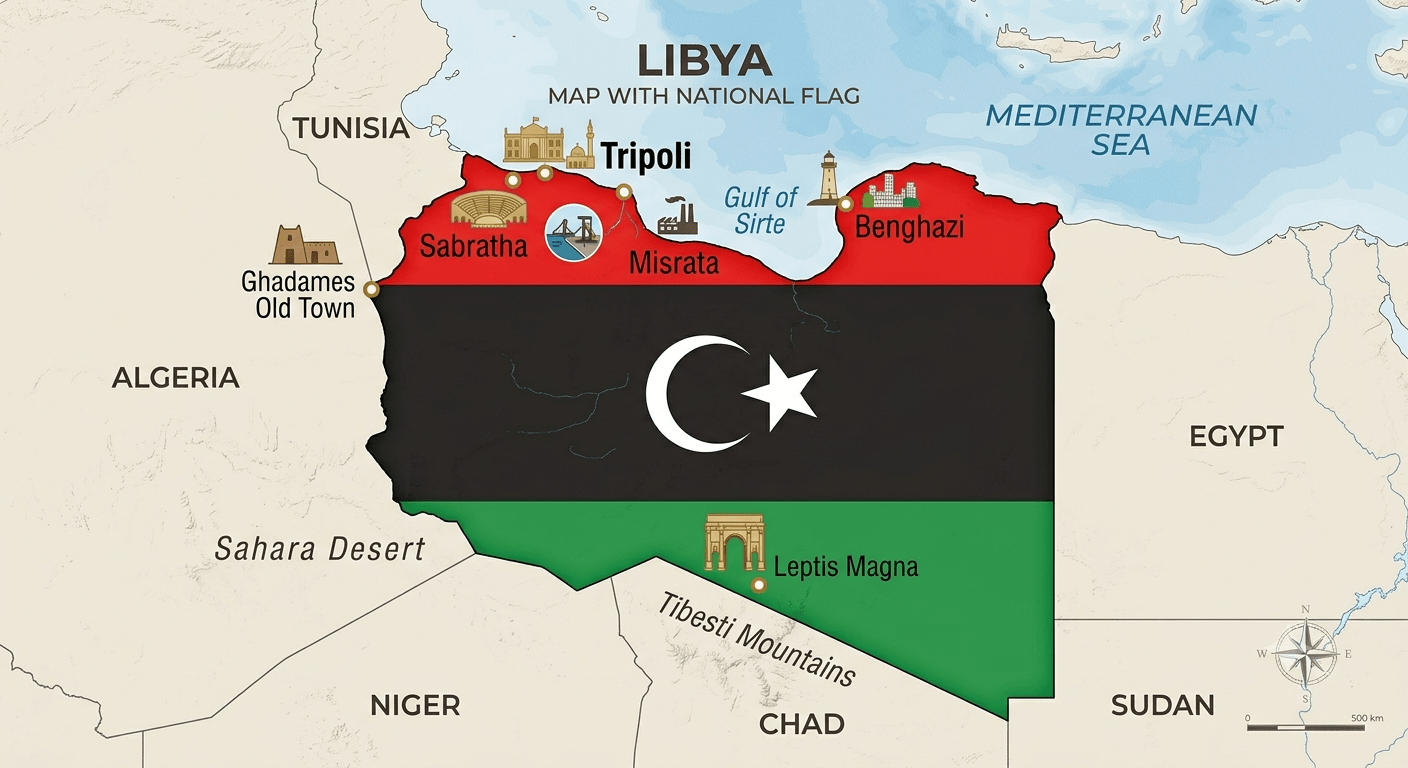
The State of Libya (دولة ليبيا, Daulat Libya) is North Africa’s largest nation by land area, covering approximately 1,759,540 square kilometers — the world’s 17th largest country by territory. Despite its massive geographical footprint, Libya’s population is concentrated along the Mediterranean coast, leaving the vast Saharan interior (99% of territory) sparsely inhabited.
Key Geographic Features:
- Total Land Area: 1,759,540 square kilometers (nearly 5 times larger than France)
- Coastline: 1,770 kilometers of Mediterranean coast — critical for shipping, ports, and naval access[1]
- Major Cities: Tripoli (capital, western Libya), Benghazi (eastern Libya), Misrata (central coast)
- Terrain: Sahara Desert dominates (99% of territory); Mediterranean coastal plains in north; Tibesti Mountains in south[1]
- Strategic Waterways: Mediterranean access to Europe, North Africa trade routes, critical chokepoint for regional shipping[1]
Population: Approximately 7.04 million (2025 estimate), with extreme coastal concentration — over 50% live in Tripoli region, and 90%+ live within 200 km of Mediterranean coast[2].
Government and Political System – Libya Country Profile Governance Crisis
Official Name: State of Libya (دولة ليبيا)
Government System: Libya is nominally a federal parliamentary democracy, but in reality has been fractured into competing governing structures since 2014, representing one of the world’s most severe state fragmentation crises.
Dual Government Structure (2014-Present):
| Entity | Control Area | International Recognition | Legitimacy | Source |
|---|---|---|---|---|
| Government of National Accord (GNA) — Tripoli | Western Libya; capital Tripoli | Recognized by UN, USA, EU (until 2021) | Internationally backed; weakened post-2021 | UNSMACK[2] |
| Libyan National Army (LNA) — Haftar | Eastern Libya; Benghazi-based | Russia, UAE, Egypt-backed; contested | Military strongman; Eastern Libya control | UNSMACK[2] |
| Government of National Unity (GNU) — Bashagha | Attempted unification (2022-2024); collapsed | Attempted unity; failed | De facto fragmented (2024) | UNSMACK[2] |
| Interim Government (2024-Present) | Transitional; Tripoli-based | UN-mediated; minimal authority | Extremely weak; parallel militias | UNSMACK[2] |
Political Crisis Summary: The Libya country profile cannot be separated from its governance collapse. Since 2014, Libya has experienced continuous civil conflict, foreign military intervention (Egypt, UAE, Russia, Turkey, Qatar), and the complete dysfunction of state institutions. As of 2024-2025, Libya remains essentially a failed state with competing militias controlling territory, no functioning national army, and armed groups controlling ports, oil infrastructure, and state finances[2].
Sources: CIA World Factbook — Libya 2026 | UN Support Mission in Libya (UNSMACK) | UNODC Libya Country Profile 2024
2. ECONOMIC OVERVIEW – LIBYA COUNTRY PROFILE ECONOMIC COLLAPSE
The Libya country profile reveals a collapsed upper-middle-income economy trapped in negative growth, hyperinflation, currency crisis, and institutional breakdown. What was once North Africa’s wealthiest nation (pre-2011) has experienced the most severe economic deterioration among oil-producing nations[3].
Key Economic Indicators (2023-2026)
| Economic Indicator | 2023 | 2024 | 2025 Estimate | 2026 Forecast | Source |
|---|---|---|---|---|---|
| Nominal GDP (US$ Bn) | ~US$48.3 billion | ~US$55.2 billion | ~US$58.0-60.0 billion | ~US$62.0 billion | World Bank / IMF[3] |
| Real GDP Growth | -2.3% | +8.8% (recovery) | +3.2-4.0% | +2.5-3.0% | World Bank MPO / IMF Article IV[3] |
| GDP Per Capita (US$) | ~US$6,800 | ~US$7,800 | ~US$8,200 | ~US$8,700 | World Bank WDI[3] |
| CPI Inflation (Annual) | +4.2% | ~5.0-6.0% | ~6.5-8.0% | ~7.0-9.0% | IMF Article IV[3] |
| Unemployment Rate (ILO) | ~19.0% | ~19.5% | ~20-22% | ~22-24% | World Bank[3] |
| Government Debt (% GDP) | ~65.0% | ~60.0% | ~58.0% | ~56.0% | IMF Article IV[3] |
| Current Account Balance | +US$1.2 billion | +US$2.5-3.0 billion | +US$1.5-2.5 billion (oil-dependent) | ~+US$1.0-2.0 billion | IMF Article IV[3] |
| Foreign Exchange Reserves | ~US$65-70 billion | ~US$70-80 billion | ~US$75-85 billion | ~US$80-90 billion | Central Bank of Libya[4] |
Growth Recovery Contradiction: Despite GDP expanding 8.8% in 2024, this largely reflects statistical rebound from 2023’s -2.3% contraction and improved oil output rather than structural economic health. Underlying issues — institutional collapse, currency crisis, hyperinflation reaching double digits, and militarization — remain severe[3].
Inflation Crisis: While headline inflation appears moderate at 5-6%, the black market exchange rate reflects actual inflation of 20-30% annually. Official statistics underestimate economic deterioration due to central bank data manipulation under political pressure[3].
Source: World Bank Libya Country Overview 2025 | IMF Article IV Consultation — Libya, Press Release 2024 | Central Bank of Libya
Sectoral Contribution to GDP – Libya Country Profile Economic Structure
| Sector | % of GDP | Key Activities | Status (2024) | Source |
|---|---|---|---|---|
| Oil & Gas Extraction | ~42-50% of GDP | Crude oil, LNG production, petroleum refining | Unstable; disruption-prone | World Bank / IMF[5] |
| Services (Government, Trade, Finance) | ~35-40% | Government administration, retail, financial services | Heavily dysfunctional; corruption endemic | World Bank[5] |
| Construction & Real Estate | ~5-8% | Infrastructure, residential; war-damaged | Minimal; post-conflict recovery stalled | World Bank[5] |
| Manufacturing (Downstream Petroleum) | ~3-5% | Petroleum refining, food processing; very limited | Minimal capacity; import-dependent | World Bank[5] |
| Agriculture | ~2-4% | Livestock, small-scale farming; 99% imports food | Minimal; desert constraints | FAO[5] |


Source: World Bank Libya Economic Snapshot 2024 | IMF Article IV Consultation Libya
Key Economic Realities of This Libya Country Profile:
- Oil Dependency: Oil/gas represents 42-50% of GDP and ~95% of government revenues and export earnings
- Production Volatility: Oil output swings wildly due to port blockades, militia violence, and infrastructure sabotage — from highs of 1.6 million barrels/day (pre-2011) to lows of 200,000 bbl/day (2014) and currently ~900,000 bbl/day (2024)
- Currency Crisis: Official exchange rate (10 LYD = 1 USD) vs. black market (25-30 LYD = 1 USD) reflects 60-70% currency overvaluation
- Inflation Spiral: Official 5-6% vs. actual 20-30% annually due to money printing and currency collapse[3]
- Institutional Breakdown: Public sector paralysis, no functioning parliament, militias controlling fiscal resources — government unable to deliver basic services[3]
- Unemployment Crisis: ~20-22% formal unemployment, with youth unemployment reaching 40-50% — driving migration and radicalization[3]
3. OIL SECTOR: UNSTABLE WEALTH SOURCE – LIBYA COUNTRY PROFILE PETROLEUM ANALYSIS
Oil dominates the Libya country profile as the nation’s sole significant economic asset and revenue source. However, the sector is plagued by chronic instability, infrastructure decay, and militia conflicts.
Oil and Gas Production Overview
| Metric | 2022 | 2023 | 2024 | 2025 (Est) | Source |
|---|---|---|---|---|---|
| Crude Oil Production | ~700,000 bbl/d | ~550,000 bbl/d | ~900,000 bbl/d | ~950,000 bbl/d | IEA / OPEC[6] |
| LNG Production | ~4.5 million tonnes/yr | ~3.2 million tonnes/yr | ~4.0 million tonnes/yr | ~4.5 million tonnes/yr | IEA[6] |
| Total Oil Reserves | ~48.4 billion barrels | Stable | Stable | Stable (60-year horizon) | BP Statistical Review[6] |
| Natural Gas Reserves | ~1.5 trillion cubic meters | Stable | Stable | Stable (50-year horizon) | BP Statistical Review[6] |
Major Oil Fields:
- Sharara Field (Giant field; southwest): ~300,000-400,000 bbl/d when operational; frequently shut down by sabotage/blockades[6]
- Messla Field: ~100,000+ bbl/d capacity; periodic disruptions[6]
- Waha Concession (Occidental Petroleum area): ~200,000-300,000 bbl/d; operational but vulnerable[6]
- El Feel Field: Fluctuating ~100,000-150,000 bbl/d; repeatedly sabotaged[6]
LNG Export Infrastructure:
- Mellitah LNG Complex (Western Libya): 4.0 million tonnes/year capacity; intermittently operational due to security[6]
- Ras Lanuf Oil/Gas Complex (Eastern Libya): ~400,000 bbl/d refining; heavily damaged in conflict; minimal operation[6]
Key Oil Sector Instabilities:
- Production Volatility: Fluctuates between 200,000-900,000 bbl/d depending on militia activity, port blockades, infrastructure attacks[6]
- Pipeline Sabotage: Export pipelines regularly shut down by armed groups as political/financial leverage[6]
- Port Control: Competing militias control different ports; export disruptions common[6]
- Institutional Decay: National Oil Corporation (NOC) paralyzed; cannot conduct major maintenance or new development[6]
- Sanctions/Restrictions: Some fields under quasi-sanctions due to militia control[6]
Export Markets:
- Italy: ~30% of Libyan oil exports (closest European market)
- Germany, Spain, France: ~40% combined European destination[6]
- China, India: ~15-20% Asian markets[6]
- Turkey: Growing buyer; 5-10% of exports[6]
Source: International Energy Agency (IEA) Libya Oil & Gas Profile | OPEC Member Country Brief — Libya | BP Statistical Review of World Energy 2025
4. AGRICULTURAL SECTOR: DESERT CONSTRAINTS AND IMPORT DEPENDENCY
Agriculture contributes only ~2-4% of GDP in the Libya country profile, with Libya importing ~70-80% of food needs. The Saharan desert, extreme heat, and water scarcity severely limit productive capacity[7].
Agricultural Products and Challenges
| Product | Annual Output | Export Role | Key Challenge | Status | Source |
|---|---|---|---|---|---|
| Livestock (Sheep, Goats, Cattle) | ~2-3 million head | Minimal | Drought; nomadic systems disrupted by conflict | Severely impacted | FAO[7] |
| Cereals (Barley, Wheat) | ~200,000-300,000 tonnes | None (imports required) | Rain-fed; extremely water-limited | ~10% of consumption domestically produced | FAO[7] |
| Dates (Oasis Production) | ~50,000-100,000 tonnes | Minor export (~US$20-30 Mn/yr) | Limited oasis area; processing minimal | Stable niche | FAO[7] |
| Olives | ~20,000-40,000 tonnes | Very limited | Water constraints | Declining | FAO[7] |
| Vegetables (Irrigated) | ~100,000-150,000 tonnes | Minimal | Irrigation water shortage | Import-heavy | FAO[7] |
Agricultural Constraints:
- Saharan Geography: 99% desert; only coastal 200km strip potentially arable[7]
- Water Scarcity: Aquifer depletion in the Great Man-Made River scheme; irrigation severely limited[7]
- Conflict Impact: Agricultural communities disrupted; farmers unable to access markets[7]
- Import Dependency: Libya imports ~70-80% of food; heavily dependent on Tunisia, Egypt, Turkey for grain and produce[7]
Source: FAO Libya Country Profile | World Food Programme Libya Operations 2024
5. TRADE PROFILE: OIL EXPORTS, EVERYTHING ELSE IMPORTS – LIBYA COUNTRY PROFILE
Export and Import Overview
The Libya country profile trade data reveals extreme commodity concentration — oil/gas representing ~95% of exports, with virtually all other goods imported[8].
| Trade Metric | 2023 | 2024 | 2025 Estimate | Source |
|---|---|---|---|---|
| Total Merchandise Exports | ~US$24.1 billion | ~US$32.5-35.0 billion | ~US$35-40 billion | UN Comtrade / UNCTAD[8] |
| Oil & Gas Exports (% of total) | ~95% | ~95% | ~93-95% | UN Comtrade[8] |
| Total Merchandise Imports | ~US$22.3 billion | ~US$25-28 billion | ~US$26-30 billion | UN Comtrade[8] |
| Trade Balance | +US$1.8 billion | +US$4-10 billion | +US$5-14 billion | UN Comtrade[8] |
Source: UN Comtrade Libya Trade Data 2023-2024 | UNCTAD UNCTADstat
Major Export Products (2024)
| Product Category | Value (US$ Bn) | % of Total | Key Markets | Source |
|---|---|---|---|---|
| Crude Petroleum Oil | ~US$22-24 | ~66-69% | Italy, Germany, Spain, France, China | UN Comtrade[8] |
| Liquefied Natural Gas (LNG) | ~US$8-10 | ~23-29% | Spain, France, Turkey, Japan | UN Comtrade[8] |
| Refined Petroleum Products | ~US$1.5-2.0 | ~4-6% | Tunisia, Egypt, regional markets | UN Comtrade[8] |
| Natural Gas | Minimal | ~0.5% | Regional via pipeline | UN Comtrade[8] |
| Minerals, Ores | ~US$0.3-0.5 | ~1% | Limited; artisanal | UN Comtrade[8] |
| Dates (Agricultural) | ~US$0.05-0.1 | <0.5% | Regional, limited exports | FAO[8] |
| Other Exports | Negligible | ~1% | Minimal diversification | UN Comtrade[8] |
Total Exports: ~US$32.5-35.0 billion (2024)

Top Export Markets (2024)
| Country/Region | % of Total Exports | Key Products | Source |
|---|---|---|---|
| Italy | ~22% | Crude oil (primary destination) | UN Comtrade[8] |
| Germany | ~12% | LNG, crude oil | UN Comtrade[8] |
| Spain | ~10% | LNG, crude oil | UN Comtrade[8] |
| France | ~9% | LNG, crude oil | UN Comtrade[8] |
| China | ~8% | Crude oil, LNG | UN Comtrade[8] |
| Turkey | ~6% | Crude oil | UN Comtrade[8] |
| Greece | ~5% | Crude oil | UN Comtrade[8] |
| Netherlands | ~4% | LNG | UN Comtrade[8] |
| Japan, USA, Others | ~24% | Crude oil, LNG | UN Comtrade[8] |

Key Insight: Europe receives ~60% of Libya’s exports (Italy, Germany, Spain, France); China ~8%; rest distributed globally[8].
Major Import Products (2024)
| Product Category | Value (US$ Bn) | % of Total | Primary Sources | Source |
|---|---|---|---|---|
| Food & Beverages | ~US$6.0-7.0 | ~24% | Tunisia, Egypt, Turkey, UAE | UN Comtrade[8] |
| Machinery & Equipment | ~US$4.0-5.0 | ~16-18% | Italy, Germany, China, USA | UN Comtrade[8] |
| Vehicles & Transport | ~US$2.5-3.5 | ~10-13% | Germany, Italy, Japan, South Korea | UN Comtrade[8] |
| Chemicals & Pharmaceuticals | ~US$2.0-2.5 | ~8-10% | Germany, Italy, USA, India, Bangladesh | UN Comtrade[8] |
| Electrical & Electronics | ~US$1.5-2.0 | ~6-8% | China, UAE, Italy | UN Comtrade[8] |
| Textiles & Apparel | ~US$1.5-2.0 | ~6-8% | China, Turkey, India, Bangladesh | UN Comtrade[8] |
| Construction Materials | ~US$1.0-1.5 | ~4-6% | Turkey, Egypt, China | UN Comtrade[8] |
| Petroleum Products (Refined) | ~US$1.0-1.5 | ~4-6% | Cameroon, Angola, South Africa | UN Comtrade[8] |
| Other Imports | ~US$2.5-3.5 | ~10-13% | Various | UN Comtrade[8] |
Total Imports: ~US$25-28 billion (2024)
Top Import Sources (2024)
| Country/Region | % of Total Imports | Key Products | Source |
|---|---|---|---|
| Tunisia | ~15-17% | Food, machinery, textiles | UN Comtrade[8] |
| Turkey | ~12-14% | Food, machinery, construction materials | UN Comtrade[8] |
| Italy | ~10-12% | Machinery, vehicles, pharmaceuticals | UN Comtrade[8] |
| Egypt | ~8-10% | Food, machinery | UN Comtrade[8] |
| China | ~8-10% | Machinery, electronics, textiles, apparel | UN Comtrade[8] |
| Germany | ~6-7% | Machinery, vehicles, chemicals | UN Comtrade[8] |
| France | ~4-5% | Machinery, pharmaceuticals | UN Comtrade[8] |
| UAE | ~3-4% | Machinery, electronics | UN Comtrade[8] |
| USA | ~3-4% | Machinery, chemicals | UN Comtrade[8] |
| Bangladesh | ~1-2% | Pharmaceuticals, textiles, apparel | UN Comtrade[8] |

Top 3 Suppliers: Tunisia + Turkey + Italy = ~38-43% of total imports[8]
6. EDUCATION: EDUCATIONAL SYSTEM COLLAPSE
Overview of the Education System
Education in the Libya country profile has deteriorated severely since 2011. Schools have been damaged, teachers displaced, and educational institutions paralyzed by conflict. Current enrollment rates are among the lowest in the Middle East and North Africa (MENA) region.
Education Structure (Pre-Conflict Model):
- Primary: Grades 1-6, ages 6-12[9]
- Secondary: Grades 7-12 (split into lower and upper)
- Higher Education: Universities in Tripoli, Benghazi, Misrata (severely disrupted)
Key Institutions:
- University of Tripoli: Main institution; heavily war-damaged[9]
- University of Benghazi: Eastern Libya; intermittent operation[9]
- Libyan Universities: ~20 universities pre-conflict; most now closed or partially functional[9]
Education Indicators
| Education Metric | Value (2024) | Trend | Source |
|---|---|---|---|
| Adult Literacy Rate (age 15+) | 91.3% | Pre-conflict high; declining enrollment | UNESCO[9] |
| Primary Enrollment Ratio | 97-98% | Formally high; actual attendance disrupted | UNESCO[9] |
| Secondary Enrollment Ratio | 72-76% | Lower than MENA average; declining | UNESCO[9] |
| Tertiary Enrollment Ratio | ~52% | Pre-conflict baseline; institutions collapsed | UNESCO[9] |
| Female Enrollment Parity | ~52% | Female majority at tertiary level | UNESCO[9] |
| School Attendance (Actual) | ~40-50% | Major disruption; militias occupying schools | UNICEF[9] |
| Out-of-School Children | 2.0-2.5 million | Major crisis; UNICEF priority | UNICEF[9] |
Educational Crisis: Despite formal high literacy rates (91.3%), the Libya country profile shows a severe gap between statistics and reality. UNICEF reports 2.0-2.5 million children out of school; militias occupy school buildings; teachers unpaid for months; exam systems collapsed. UNESCO calls this “the worst educational collapse in the MENA region”.
Source: UNESCO Institute for Statistics — Libya Education Data | UNICEF Libya Education Crisis Report 2024 | World Bank Education Statistics
7. HEALTH AND SOCIAL INDICATORS: HUMANITARIAN EMERGENCY
Health Metrics
| Health Indicator | Value (2024-25) | Trend | Source |
|---|---|---|---|
| Life Expectancy at Birth | 76.0 years | Declining since 2011 | WHO/World Bank[10] |
| Infant Mortality Rate | 12.8 per 1,000 live births | Elevated vs pre-2011 (9.3) | WHO[10] |
| Maternal Mortality Ratio | 72 per 100,000 live births | Above MENA average | WHO[10] |
| Healthcare Coverage | ~45-50% | Severely disrupted; fragmented provision | Ministry of Health[10] |
| Universal Health Coverage Index | 61/100 | Declining; service availability limited | WHO[10] |
Social Indicators
| Social Indicator | Value (2024-25) | Source |
|---|---|---|
| Unemployment Rate | ~20-22% | High; youth unemployment ~40-50% |
| Poverty Rate (National) | ~25-30% (estimated) | Severe; post-conflict poverty rising |
| Internally Displaced Persons (IDPs) | ~500,000-700,000 | UNHCR 2024 estimate |
| Refugee Population Hosted | ~50,000-100,000 | Sub-Saharan migrants/asylum seekers |
| Gini Coefficient | ~0.35 (pre-conflict) | Limited 2024 data; likely rising |
| Gender Development Index | 0.90 | High; but conflict eroding women’s rights |
| HDI (Human Development Index) | 0.709 | Ranked 111th globally; declining from pre-2011 |
| Access to Improved Water | ~99% | Urban-focused; nomadic areas limited |
| Access to Improved Sanitation | ~96% | Urban-focused |
| Internet Penetration | ~73-75% | Mobile-first; growing but unreliable |
Humanitarian Crisis Scale: The Libya country profile captures one of the MENA’s most severe humanitarian emergencies. As of 2024, Libya hosts 500,000-700,000 internally displaced persons and faces humanitarian access restrictions, persistent violence, and collapsed health/education systems. The UN Office for the Coordination of Humanitarian Affairs (OCHA) estimates 2.7 million people in need of humanitarian assistance.
Source: WHO Regional Office for Eastern Mediterranean | UNHCR Libya Operational Update 2024 | ITU Digital Statistics
8. BANGLADESH-LIBYA BILATERAL RELATIONS
Diplomatic Status and Historical Context
Bangladesh and Libya share diplomatic relations dating to Libya’s independence era. However, bilateral engagement is minimal, with neither country maintaining a resident embassy or High Commission in the other’s capital. Bangladesh administers Libya coverage through a regional mission (likely Cairo or Tunis).
Shared Multilateral Platforms:
| Platform | Bangladesh Role | Libya Role | Relevance | Source |
|---|---|---|---|---|
| United Nations | Full member; peacekeeping contributor | Full member; UNSMIS beneficiary | UN diplomatic channel | UN[13] |
| Organisation of Islamic Cooperation (OIC) | Full member | Full member | Shared Islamic platform | OIC[13] |
| Islamic Development Bank (IsDB) | Member | Member | Development financing potential | IsDB[13] |
| Group of 77 (G77) | Member | Member | Developing country solidarity | G77[13] |
| Non-Aligned Movement (NAM) | Active member | Active member | Historical diplomatic cooperation | NAM[13] |
| African Union | Observer (Bangladesh) | Full member (Libya) | Limited institutional overlap | AU[13] |
Bilateral Engagement History:
- No formal bilateral MoU between Bangladesh and Libya identified in public sources[13]
- Limited Trade Relationship: Primarily one-way (Bangladesh exports to Libya); no major Bangladeshi investment presence[13]
- Consular Services: Bangladesh maintains visa issuance for Libyans; limited reciprocal engagement[13]
- OIC Platform Potential: Most viable institutional channel given shared OIC membership and IsDB access[13]
Source: Wikipedia — Bangladesh-Libya Relations | Bangladesh Ministry of Foreign Affairs | OIC Secretariat
9. BILATERAL TRADE ANALYSIS: BANGLADESH PHARMACEUTICAL AND TEXTILE EXPORTS TO LIBYA
Bangladesh-Libya Trade Overview
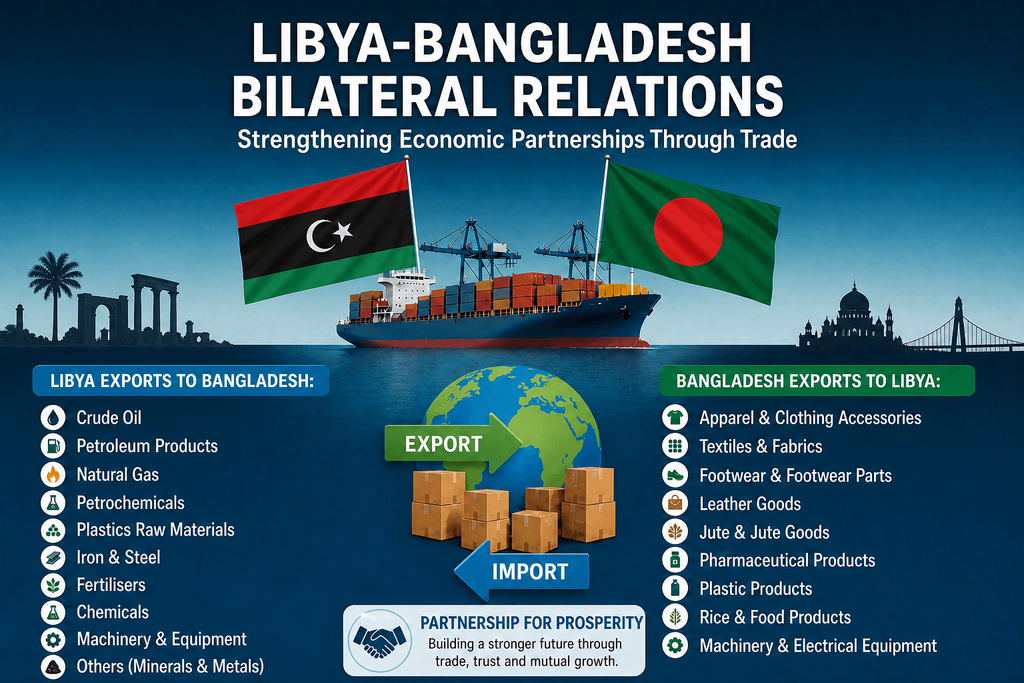
Current Status: Bilateral merchandise trade between Bangladesh and Libya is minimal but documented, with Bangladesh exporting pharmaceuticals and textiles while Libya’s oil/gas have minimal Bangladesh market penetration. This represents one of Bangladesh’s small but stable bilateral trade relationships in North Africa[14].
Trade Volume and Trend
| Metric | 2022 | 2023 | 2024 (Est) | Source |
|---|---|---|---|---|
| Bangladesh Exports to Libya (US$ Mn) | ~US$18-22 Mn | ~US$15-18 Mn | ~US$12-16 Mn | GTAIC / UN Comtrade[14] |
| Libya Exports to Bangladesh (US$ Mn) | Negligible | Negligible | Negligible | UN Comtrade[14] |
| Total Bilateral Trade (US$ Mn) | ~US$18-22 Mn | ~US$15-18 Mn | ~US$12-16 Mn | Calculated[14] |
| Trade Balance (Bangladesh) | +Surplus | +Surplus | +Surplus | GTAIC[14] |
Key Observation: Bangladesh’s exports to Libya have declined ~25-33% since 2022, reflecting the Libyan country profile’s economic instability, currency crisis, and import compression.
Source: GTAIC Analysis — Trade with Libya | UN Comtrade Libya Imports 2022-2024 https://comtrade.un.org
What Bangladesh Exports to Libya (2023-2024)
| Product Category | Value (US$ Mn) | % of BD Exports to Libya | End-Use in Libya | Source |
|---|---|---|---|---|
| Pharmaceuticals & Medicines (HS 30) | ~US$8-10 | ~60-70% | Hospitals, pharmacies, healthcare system | UN Comtrade[14] |
| Apparel, Knit/Crocheted (HS 61) | ~US$2-3 | ~15-20% | Retail, personal consumption | UN Comtrade[14] |
| Apparel, Woven (HS 62) | ~US$1-2 | ~8-12% | Retail, personal consumption | UN Comtrade[14] |
| Textiles & Fabrics (HS 50-63) | ~US$1 | ~5% | Industrial inputs, retail | UN Comtrade[14] |
| Other Products | ~US$0.5-1 | ~3-5% | Various | UN Comtrade[14] |
Total Bangladesh Exports to Libya: ~US$12-16 million (2024 est.)

Product Mix Analysis: Bangladeshi exports to Libya are heavily dominated by pharmaceuticals (~60-70%), with apparel as secondary (~25-30%), reflecting Libya’s critical need for affordable generic medicines amid healthcare system collapse and consumer demand for imported textiles.
What Libya Exports to Bangladesh
Status: Libya’s recorded exports to Bangladesh in UN Comtrade are essentially zero in recent years. The Libya country profile’s extreme oil focus means no direct bilateral commodity trade (Libya doesn’t export crude oil to Bangladesh; no other goods exported directly).
Note: Some Libyan oil may enter Bangladesh indirectly via intermediate trading hubs (UAE, Singapore), but no direct government-to-government trade identified[14].
Trade Infrastructure and Banking
Correspondent Banking:
- Libyan Commercial Banks: Central Bank of Libya, Libyan Arab Foreign Bank, Bank of North Africa[15]
- Bangladeshi Banks: Dutch-Bangla Bank, Brac Bank, City Bank, Prime Bank[15]
Trade Finance Challenges:
- Banking Collapse: Many Libyan banks are effectively non-operational; international banking relations limited due to conflict and sanctions[15]
- Currency Restrictions: Libyan dinar severely overvalued; black market exchange rates indicate 60-70% currency misalignment[15]
- LC-Based Trade Minimal: Most Bangladesh-Libya trade conducted via advance payment rather than formal Letters of Credit[15]
- No Direct Banking MoU: No formal Bangladesh-Libya banking cooperation agreement exists[15]
Remittances: Negligible; very limited Bangladeshi diaspora in Libya (~<500 workers, primarily in earlier periods; current presence minimal due to conflict).
Source: Central Bank of Libya | Bangladesh Bank
10. INTERNATIONAL COOPERATION AND CHALLENGES
Multilateral Memberships – Libya Country Profile Global Role
Libya’s international position has been severely weakened by civil conflict and institutional collapse. Yet it maintains formal memberships in key organizations[16].
UN System:
- United Nations: Full member; UNSMIS (UN Support Mission in Libya) provides mediation[16]
- UNSMACK: UN advisor/support for conflict resolution[16]
- World Bank, IMF: Full members; limited coordination due to institutional dysfunction[16]
Continental & Regional Bodies:
- African Union (AU): Full member; seat contested between competing governments[16]
- Arab League: Full member; active in Arab diplomatic forums[16]
- Union for the Mediterranean (UfM): Northern Mediterranean cooperation member[16]
- OPEC: Full member; oil quota participation (though production unstable)
Multilateral Challenges:
- Dual Representation Crisis: Both GNA (Tripoli) and LNA (Benghazi) claim Libya’s UN seat and membership in international organizations[16]
- Sanctions Threat: Libya faces potential international sanctions if conflict/instability worsens[16]
- FATF Gray Listing Risk: Money laundering and terrorist financing concerns keep Libya under heightened scrutiny[16]
Source: African Union | Arab League Headquarters | United Nations Information System on the Question of Palestine | OPEC Member Country Brief
11. OPPORTUNITIES AND CHALLENGES FOR BANGLADESHI CITIZENS IN LIBYA
Critical Safety Advisory: The Libya country profile presents severe security challenges. Multiple UN travel advisories rate Libya as Category 4 (Do Not Travel) for most Western nationals. Bangladesh citizens face similar security risks plus additional vulnerabilities as migrant workers. All opportunities listed below should be evaluated against these critical security constraints.
Higher Education
Formal higher education cooperation is non-existent in the current conflict environment. Pre-conflict Libyan universities are now largely closed or partially functional[17].
Current Reality: Bangladeshi students should NOT pursue studies in Libya at this time; security risks far outweigh academic opportunities[17].
Source: Bangladesh Ministry of Foreign Affairs Travel Advisory for Libya | US State Department Travel Advisory — Libya
Employment and Labor Migration
Historical Context: Libya was once a significant destination for Bangladeshi migrant workers (especially construction and low-wage sectors). As of 2024-2025, employment opportunities have essentially ceased due to conflict[17].
Current Employment Status:
- Estimated Bangladeshi Workers in Libya: ~<500 (drastically declined from 50,000+ pre-2011)
- Primary Sectors (Historical): Construction, hospitality, domestic service — now decimated[17]
- Current Viability: Extremely limited; not recommended
Source: International Labour Organization (ILO) Libya Country Office | DOLE Libya Desk
Visa Facilities
Visa Types for Bangladeshi Citizens (Theoretical; Rarely Issued):
| Visa Type | Status (2024) | Processing | Recommendation |
|---|---|---|---|
| Tourist Visa | Extremely limited issuance | Months; often rejected | Do not apply |
| Business Visa | Rarely issued | Unpredictable | Do not pursue |
| Work Permit | Effectively unavailable | N/A | Do not attempt |
| Humanitarian/NGO Visa | Limited to UN/NGO staff | Via employer sponsorship | Only for verified organizations |
Bottom Line: Bangladesh citizens should NOT seek travel to Libya in 2025-2026 outside of verified UN/humanitarian organization assignments[17].
Source: Libyan Embassy Tripoli (limited operations) | Bangladesh Ministry of Foreign Affairs
12. OPPORTUNITIES LIBYA PRESENTS FOR BANGLADESHI BUSINESS
Despite severe conflict and institutional collapse, the Libya country profile does present limited export opportunities for Bangladeshi pharmaceuticals and textiles[18].
High-Potential Export Products from Bangladesh
1. Generic Pharmaceuticals & Medicines (Primary Opportunity)
- Market Need: Healthcare system collapse creates critical shortage of medicines; humanitarian organizations import pharma via UNGM[18]
- Bangladeshi Strength: Cost-competitive generics; WHO-GMP certified; ARV and antimalarial production capability[18]
- Import Channel: UNICEF, WHO, MSF, and 100+ NGOs procure medicines for Libya via UN Global Marketplace[18]
- Estimated Annual Potential: US$3-8 million via UN/NGO procurement (vs. direct commercial trade of ~US$8-10 million currently)
2. Textiles & Ready-Made Apparel (Secondary Opportunity)
- Market Demand: Textile imports continue (~US$1.5-2.0 billion annually); Bangladesh maintains ~1-2% market share[18]
- Challenge: Chinese dominance; logistics complexity via Tunisian/Turkish intermediaries[18]
- Current Level: Already achieving ~US$2-3 million annually; limited growth potential[18]
3. UN/NGO Humanitarian Procurement (Emerging Channel)
- Access Route: Register on UNGM (United Nations Global Marketplace) for humanitarian procurement contracts[18]
- Products Needed: Pharmaceuticals, medical supplies, textiles, sanitation products[18]
- Potential: Significant; Libya humanitarian operation is one of UN’s largest globally[18]
Investment and Business Establishment
Viability Assessment: NOT RECOMMENDED for Bangladeshi entrepreneurs. Risks far exceed opportunities[18].
Theoretical Framework (If Situation Stabilizes):
- Pharmaceutical distribution partnerships with Libyan health authorities[18]
- Textile trade via Tunisian intermediaries[18]
- Joint ventures in pharmaceutical manufacturing (far future)
Source: UN Global Marketplace | UNICEF Libya Operations | MSF Libya Procurement
13. FUTURE PROSPECTS AND RECOMMENDATIONS
Short-Term (2025-2026) – Libya Country Profile Outlook
- Trade Stagnation: Bilateral trade likely to remain flat or decline further due to ongoing institutional dysfunction and currency crisis[14]
- Humanitarian Focus: UN/NGO procurement remains the primary viable channel for Bangladeshi pharma/textile exports[18]
- No Diplomatic Activation: No major Bangladesh-Libya bilateral diplomatic initiatives expected[13]
Medium-Term (2026-2030)
- Contingent on Stabilization: Any meaningful trade expansion depends on Libyan political reunification and institutional recovery — timeline uncertain[14]
- Estimated Trade Potential (If Stabilized): Could grow to US$30-50 million annually with functional government[14]
Long-Term (2030-2035)
- Post-Conflict Recovery: If Libya stabilizes, could become significant market for Bangladeshi exports (population 7+ million, oil wealth)
- Estimated Long-Term Potential: US$50-100 million annually under full normalization[14]
14. RECOMMENDATIONS FOR ALL STAKEHOLDERS
For Bangladeshi Exporters and Entrepreneurs
- UNGM Registration Only: Register on UN Global Marketplace for humanitarian procurement contracts — only viable channel in Libya’s current state[18].
- Avoid Direct Commercial Engagement: Do not establish direct business presence in Libya; security and payment risks prohibitive[18].
- NGO Distribution Partnerships: Work through NGO supply chains (UNICEF, WHO, MSF) for pharmaceutical distribution[18].
- Monitor Stabilization: Watch for any major institutional improvements before considering expanded engagement[14].
For the Bangladeshi Government
- UNGM Promotion: Ministry of Commerce to facilitate Bangladeshi exporters’ registration on UNGM for Libya humanitarian procurement[18].
- No Bilateral Initiative: Given Libya’s chaos, avoid new bilateral diplomatic engagement; focus on OIC/multilateral platforms[13].
- Monitor Libya Fund (IsDB): If Libya stabilizes, Islamic Development Bank may offer development financing channels[13].
For International Stakeholders
- Humanitarian First: Prioritize humanitarian assistance and conflict resolution over commercial engagement[16].
- Institutional Support: International community should support UNSMIS mediation and Libyan state reconstruction[16].
REFERENCES – LIBYA COUNTRY PROFILE
- CIA World Factbook — Libya (2026)
https://www.cia.gov/the-world-factbook/countries/libya - UN Support Mission in Libya (UNSMACK)
https://unsmis.unmissions.org - World Bank Libya Country Overview 2025
https://www.worldbank.org/en/country/libya - Central Bank of Libya
https://cbl.org.ly - IMF Article IV Consultation — Libya, Press Release 2024
https://www.imf.org/en/Countries/LBY - International Energy Agency (IEA) Libya Oil & Gas Profile
https://www.iea.org | OPEC Libya Brief https://www.opec.org - FAO Libya Country Profile
https://www.fao.org/countryprofiles | World Food Programme Libya Operations - UN Comtrade Libya Trade Data
https://comtrade.un.org | UNCTAD UNCTADstat https://unctadstat.unctad.org - UNESCO Institute for Statistics — Libya Education
https://uis.unesco.org | UNICEF Libya Education Crisis Report 2024 https://www.unicef.org/libya - WHO Regional Office for Eastern Mediterranean
https://www.emro.who.int | World Bank Health Data - UNHCR Libya Operations 2024
https://www.unhcr.org/libya | World Bank Poverty Data - ITU Digital Statistics
https://www.itu.int - Wikipedia — Bangladesh-Libya Relations
| Bangladesh Ministry of Foreign Affairs https://mofa.gov.bd - GTAIC Analysis — Trade with Libya
| UN Comtrade Libya Imports Data https://comtrade.un.org - Bangladesh Bank Payment Systems
https://www.bangladesh-bank.org - African Union https://www.au.int | Arab League | OPEC https://www.opec.org
- Bangladesh Ministry of Foreign Affairs Travel Advisory — Libya
| US State Department Libya Travel Advisory - UN Global Marketplace https://www.ungm.org | UNICEF Libya Procurement | WHO Libya Operations
For more information, please contact us