Book Appointment Now

Chad Country Profile: Market and Economic Overview | Prepared for Bangladesh–Chad Trade Assessment
1. GEOGRAPHICAL LOCATION AND POLITICAL IDENTITY
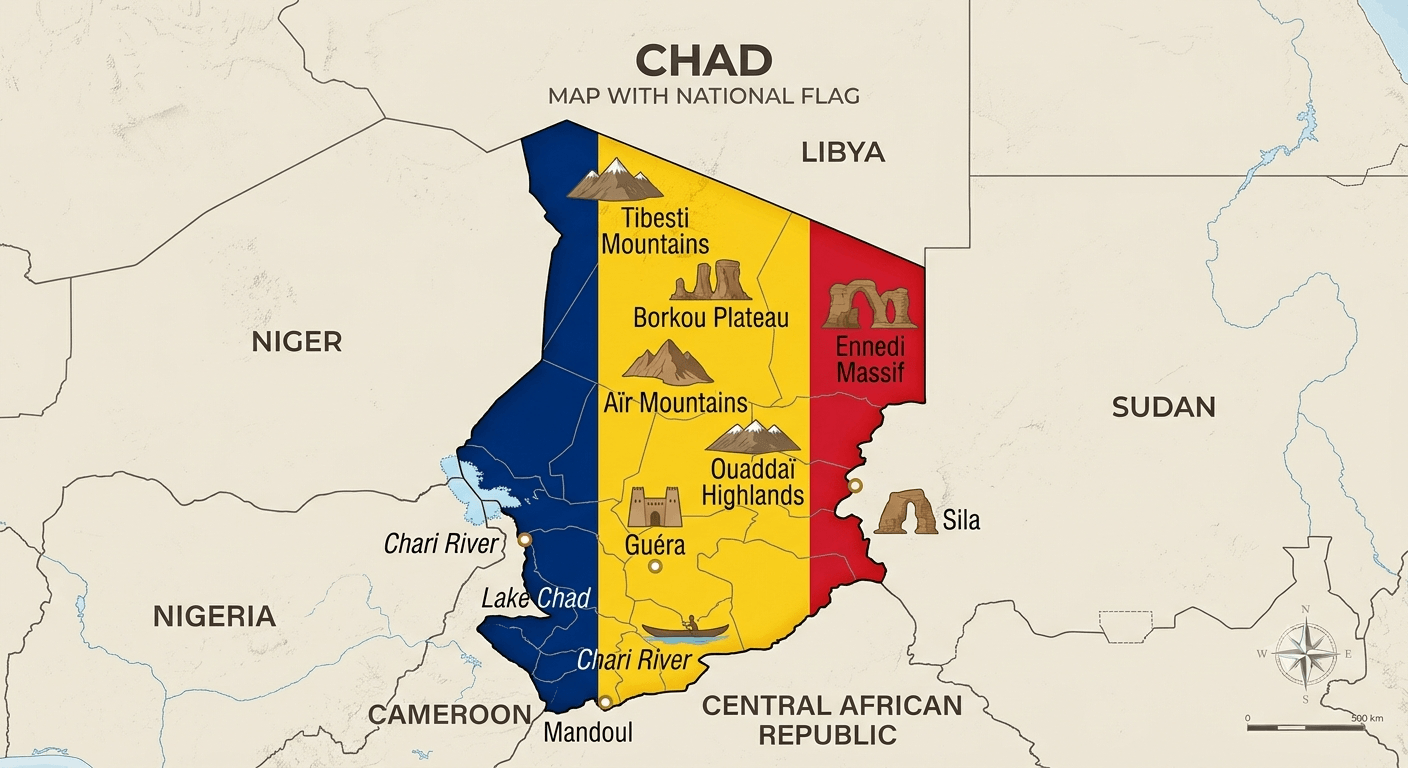
Where Is Chad? A Geographic Introduction
The Republic of Chad (République du Tchad / جمهورية تشاد) is a vast landlocked nation in North-Central Africa, covering approximately 1,284,000 square kilometers — making it the world’s 20th largest country by land area and Africa’s 5th largest. Despite its size, Chad remains among the world’s least developed and most fragile states, shaped by extreme climate zones, landlocked geography, and persistent governance challenges[1].
Key Geographic Features:
- Total Land Area: 1,284,000 square kilometers[1]
- Borders: Libya (north), Sudan (northeast and east), Central African Republic (south), Cameroon and Nigeria (southwest), Niger (west)
- Capital: N’Djamena — political, commercial, and humanitarian center; situated at the confluence of the Chari and Logone rivers near the Cameroon border[1]
- Lake Chad: Historically significant; has shrunk by over 90% since the 1960s due to climate change and overuse — a major regional ecological crisis[1]
- Climate Zones: Three distinct belts — Sahara desert (north), Sahel semi-arid (center), Sudanian savanna (south)
Strategic Geographical Challenges:
| Challenge | Impact | Source |
|---|---|---|
| Landlocked Status | Trade routed via Cameroon (Douala port ~1,700 km) and Nigeria; adds 20-30% to import/export costs | World Bank[1] |
| Saharan Coverage | ~50% of territory is non-productive desert; limits agricultural land | CIA World Factbook[1] |
| Sudan Border Crisis | Spillover from Sudan’s civil conflict since 2023 creating ~600,000+ refugee inflows | UNHCR[1] |
| Lake Chad Shrinkage | Reduced freshwater access; impacts 30 million people across 4 nations | FAO[1] |
Population: Approximately 21.0 million (2025 World Bank estimate), with a median age of only 17 years — among the world’s youngest populations — and a population growth rate of ~3.0% annually.
Government and Political System
Official Name: Republic of Chad (République du Tchad)
Government System: Chad is a presidential republic with a highly centralized executive authority. The 1996 Constitution (revised and replaced by a new constitution adopted December 2023) established the current political framework[2].
Head of State: President Mahamat Idriss Déby — elected May 2024 in presidential elections following the transitional period after his father’s death[2]
Political Background: Following the death of long-ruling President Idriss Déby in April 2021 (killed in battle), a Transitional Military Council (TMC) governed Chad until December 2023, when a new constitution was adopted and elections held. President Mahamat Idriss Déby’s May 2024 election formally ended the transitional period, though governance remains fragile[2].
Legislative Structure:
- National Assembly: 188 members; proportional representation; multi-party[2]
- Senate: Upper chamber; established under 2023 constitution[2]
Administrative Divisions: 23 provinces (replaced former 18 regions in 2021 administrative restructuring).
Governance Challenges:
- Regional insecurity from Sudan civil war spillover (since April 2023)
- Active Boko Haram insurgency in Lake Chad Basin[2]
- 88% informal economy with very limited formal sector development[2]
- High military spending: rose 11.6% in 2025, reaching 23% of domestic revenues
Sources: CIA World Factbook — Chad 2026 | World Bank Chad Country Overview 2025
2. ECONOMIC OVERVIEW: OIL-DEPENDENT AND VULNERABLE
The Chad country profile reveals a least developed country (LDC) economy almost entirely dependent on crude oil revenues, with agriculture supporting the majority of the population. Despite modest GDP growth, poverty is rising sharply — a critical contradiction within this economy[3].
Key Economic Indicators (2023-2026)
| Economic Indicator | 2023 | 2024 | 2025 Estimate | 2026 Forecast | Source |
|---|---|---|---|---|---|
| Nominal GDP (US$ Billion) | ~US$19.2 billion | ~US$20.9 billion | ~US$21.47-22.5 billion | ~US$24.0 billion | World Bank / IMF Article IV[3] |
| Real GDP Growth | 4.0-4.8% | 5.0% | 3.4-5.6% | 5.2% | World Bank MPO / IMF[3] |
| GDP Per Capita (US$) | ~US$710 | ~US$719 | ~US$1,022 | ~US$1,143 | World Bank WDI[3] |
| GDP Per Capita (PPP) | — | — | — | — | IMF Article IV[3] |
| CPI Inflation (Annual Avg.) | 4.1% | 5.0-5.7% | 3.9-4.1% | ~3.5% | World Bank MPO / IMF[3] |
| Unemployment Rate (ILO) | ~1.1% | ~1.1% | ~1.1% | ~1.1% | World Bank WDI[3] |
| Government Debt (% GDP) | 29.5% | ~29.5-32% | ~28.0-30.6% | ~33.0% | IMF Article IV[3] |
| Current Account Balance | — | -1.3% of GDP | -2.5-4.2% of GDP | ~-3.0% | IMF Article IV[3] |
| Extreme Poverty ($2.15/day) | — | ~33.9% | ~36.5% | ~47.6% by 2027 | World Bank 2025[3] |
Critical Warning — Rising Poverty Despite Growth: Despite 5.0% GDP growth in 2024, Chad’s extreme poverty rate rose 2.6 percentage points between 2023 and 2024 to 36.5%, with the World Bank projecting a further rise to 47.6% by 2027. Military spending absorbing 23% of domestic revenues and an 88% informal labor market mean growth benefits are not reaching the poor[3].
Data Divergence Note: Different sources report different 2025 GDP growth figures for Chad — the World Bank MPO (latest, June 2025) reports 5.6%, while the World Bank Chad Overview page reports 3.4% and the IMF Article IV reports 3.4%. This divergence reflects different estimation methodologies and data cut-off dates. We present the range of 3.4-5.6% to accurately represent the uncertainty[3].
Source: IMF Article IV Consultation — Chad, 2024 Press Release | World Bank Chad Country Overview 2025 | World Bank MPO Chad, October 2025
GDP Sectoral Breakdown (2024-2025)
| Sector | % of GDP | Key Activities | Growth (2024) | Source |
|---|---|---|---|---|
| Agriculture, Livestock & Fishing | ~40% | Rain-fed sorghum, millet, cotton, cattle, gum arabic | +8.2% (2024; flood recovery) | World Bank MPO[4] |
| Services (Trade, Government, Finance) | ~40.6% | Government administration, trade, transport, financial services | +3.4% (2024) | World Bank MPO[4] |
| Industry (Oil, Mining, Manufacturing) | ~6.7-15% | Crude oil extraction (~15% of GDP alone); limited manufacturing | +4.1% (2024) | World Bank MPO / IMF[4] |

Sectoral Data Caveat: Chad’s national statistics institute (INSEED) publishes limited disaggregated data. The agriculture/services split varies significantly across sources — World Bank WDI shows agriculture ~40% of GDP, while AfDB and the uploaded document indicate agriculture contributes up to 52.7% of GDP in some reference years. The figures above represent the most recently verified estimates[4].
Source: World Bank Macro Poverty Outlook — Chad, October 2025 | African Development Bank Chad Economic Outlook 2025 | INSEED Chad
Key Economic Realities of This Country Profile:
- Oil Sector: Represents ~15% of GDP, 41% of government revenues, and 76% of merchandise exports — critical fiscal lifeline[3]
- Agricultural Base: Employs ~80% of the workforce (World Bank); ~40-52% of GDP depending on methodology[4]
- Manufacturing Near-Absent: Industry only ~6.7% of GDP (excluding oil); manufacturing almost entirely limited to cotton ginning, small food processing, and beverages[4]
- Debt Restructuring: Chad underwent a major debt restructuring in 2022, renegotiating Glencore oil-backed debt; government fiscal position partially stabilized[3]
- Poverty Paradox: GDP growing but poverty rising — driven by population growth outpacing per capita income, inflation, conflict displacement, and climate shocks[3]
3. AGRICULTURAL SECTOR: THE BACKBONE OF CHAD’S POPULATION
Agriculture is the lifeblood of Chad’s economy and society, employing approximately 80% of the labor force and contributing ~40% of GDP. However, the sector remains almost entirely rain-fed, subsistence-oriented, and highly vulnerable to climate shocks, floods, and conflict[5].
Major Agricultural Products and Performance
| Product | Annual Production (Latest) | Export Role | Key Markets | Status (2024-25) | Source |
|---|---|---|---|---|---|
| Sorghum & Millet (Cereals) | ~2.0-2.5 million tonnes | Minimal (domestic staple) | Domestic consumption | Major flood damage in 2024; recovery in 2025 | INSEED / FAO[5] |
| Cattle & Livestock | ~32 million head (cattle, goats, camels) | Major export (2nd largest); live cattle to Nigeria, Sudan | Nigeria, Cameroon, Sudan | Key foreign exchange earner; conflict-disrupted | FAO[5] |
| Cotton (Raw) | ~300,000-400,000 tonnes seed cotton | Export via ginning (+46.5% Q1 2025 y/y recovery) | Cameroon (processing), EU, Asia | Strong recovery in 2025 after 2024 disruption | World Bank MPO[5] |
| Gum Arabic | ~35,000-50,000 tonnes (natural gum) | Major export (3rd after oil and livestock) | EU, USA, food/pharmaceutical industries | Chad provides ~35-40% of world supply | FAO[5] |
| Groundnuts (Peanuts) | ~800,000-1.0 million tonnes | Limited direct export | Domestic, Cameroon | Climate-sensitive; improving | FAO[5] |
| Sesame Seeds | ~250,000-350,000 tonnes | Growing export crop | Sudan, China, regional | Emerging export; conflict-disrupted | FAO[5] |
| Fish (Lake Chad, Rivers) | ~70,000-100,000 tonnes | Domestic; declining | Domestic; drying Lake Chad | Lake shrinkage causing production decline | FAO[5] |
Key Agricultural Challenges:
- 2024 Flooding: Massive floods in 2024 affected agricultural production across southern and central Chad, disrupting sorghum, millet, and cotton harvests[5]
- 2025 Cotton Recovery: Cotton ginning surged +46.5% year-on-year in Q1 2025 following improved weather and government support[5]
- Climate Vulnerability: Nearly entirely rain-fed farming with no significant irrigation infrastructure; any rainfall deviation causes major output swings[5]
- Lake Chad Shrinkage: Reduced from ~25,000 km² (1960s) to ~2,500 km² (2025); devastating impact on fishing communities across 4 nations[5]
- Conflict Displacement: Sudan border conflict displacing farmers; Boko Haram disrupting western agricultural zones[5]
Gum Arabic — Chad’s Hidden Agricultural Gem: Chad is among the world’s top 2-3 gum arabic producers alongside Sudan and Nigeria, supplying an estimated 35-40% of global gum arabic needs used in food, pharmaceuticals, and cosmetics. This represents an underexploited premium commodity with significant value-addition potential[5].

Source: FAO — Chad Country Profile | World Bank MPO Chad October 2025 | INSEED — Institut National de la Statistique, des Études Économiques et Démographiques du Tchad
4. INDUSTRIAL AND MANUFACTURING SECTOR: ALMOST ENTIRELY OIL
Chad’s industry sector (6.7% of non-oil GDP) is remarkably shallow for a country of its size, reflecting decades of conflict, extreme climate, and dependence on oil revenue rather than diversification. Manufacturing is largely absent at the formal industrial level[6].
Major Industrial Activities (2024-2025)
| Sector | GDP Contribution | Key Activity | Status | Remarks | Source |
|---|---|---|---|---|---|
| Crude Oil Extraction | ~15% of GDP | Oil production in Doba Basin; exported via Cameroon pipeline | Declining: -0.7% in 2025 | Aging fields; delays in new field development | IMF Article IV[6] |
| Cotton Ginning | <1% of GDP | SocotonD cotton processing; Moundou mills | Recovery: +46.5% Q1 2025 | Major employer in southern Chad | World Bank MPO[6] |
| Beverages & Food Processing | <1% of GDP | Beer production (Brasseries du Tchad), edible oil, bakeries | Domestic-focused | Limited scale; mostly import-competing | INSEED[6] |
| Construction Materials | <0.5% of GDP | Cement, brick production for domestic infrastructure | Growing slowly | Driven by government infrastructure spending | INSEED[6] |
| Slaughterhouses & Meat Processing | <0.5% of GDP | Livestock processing for domestic and regional markets | Limited formalization | Most livestock exported live, not processed | FAO[6] |
| Mining (Gold, Natron) | <0.5% of GDP | Artisanal gold mining; natron (soda ash) extraction | Emerging; mostly artisanal | Limited formal development | INSEED[6] |
Chad-Cameroon Oil Pipeline (Critical Infrastructure):
- The Chad-Cameroon Pipeline (COTCO/TOTCO), operational since 2003, carries crude oil from Chad’s Doba Basin (south) ~1,076 kilometers to the Kribi Marine Terminal in Cameroon[6]
- Daily throughput: ~130,000-150,000 barrels/day (2024 estimate; declining from peak ~175,000 bbl/day)
- Pipeline revenues: managed through ExxonMobil, Chevron, and Petronas consortium with government revenue sharing[6]
- Critical bottleneck: Any pipeline disruption immediately affects 76% of Chad’s export earnings[6]
Source: IMF Article IV Consultation Chad 2024 | World Bank MPO Chad | AfDB Chad Economic Outlook 2025
5. TRADE PROFILE: CRUDE OIL AND A WIDENING IMPORT DEPENDENCY
Export and Import Overview
Chad maintains a merchandise trade surplus driven almost entirely by crude oil exports, but import costs are growing as infrastructure investments, food imports, and humanitarian operations intensify[7].
| Trade Metric | 2023 | 2024 | 2025 Estimate | Source |
|---|---|---|---|---|
| Total Merchandise Exports | US$2,830 million (balance) | US$4,756 million (FOB) | ~US$4,500-5,000 million | UN Comtrade / GTAIC[7] |
| Total Merchandise Imports | US$1,395 million (CIF) | US$1,560 million (CIF) | ~US$1,600-1,800 million | UN Comtrade[7] |
| Trade Balance | +US$2,830 million | +US$3,196 million | ~+US$2,800-3,200 million | UN Comtrade[7] |
| Oil (% of Exports) | ~76% | ~69.4% | ~70-75% | GTAIC Analysis 2024[7] |
Source: UN Comtrade via GTAIC Analysis of International Trade of Chad 2017-2024 | UN Data Commodity Trade Statistics 2025
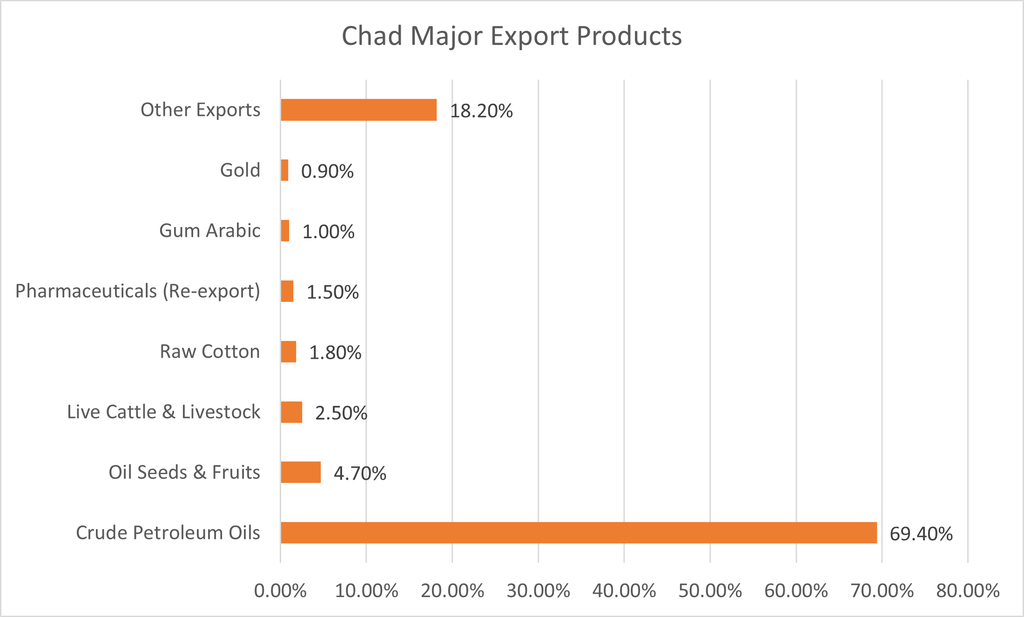
Major Export Products (2024)
| Product Category | Value (US$ Mn Est.) | % of Total | Key Markets | Source |
|---|---|---|---|---|
| Crude Petroleum Oils | ~3,300 | 69.4% | USA (~80%), China (~7%), France (~6%) | GTAIC / Trading Economics[7] |
| Oil Seeds & Fruits (Sesame, Groundnuts) | ~223 | 4.7% | Regional, China, EU | GTAIC[7] |
| Therapeutic Doses (Pharmaceuticals) | ~71 | 1.5% | Regional re-export | GTAIC[7] |
| Natural Gums (Gum Arabic) | ~50 | ~1.0% | EU, USA, food/pharma industry | FAO[7] |
| Live Cattle & Livestock | ~120 | ~2.5% | Nigeria, Cameroon, Sudan | FAO[7] |
| Raw Cotton | ~85 | ~1.8% | Cameroon, EU, Asia | INSEED[7] |
| Gold (Artisanal) | ~45 | ~0.9% | UAE, regional | INSEED[7] |
| Other Exports | ~862 | ~18.2% | Various | GTAIC[7] |
Total Exports: ~US$4,756 million (2024, UN Comtrade FOB)
Top Export Markets (2024)
| Country | % of Total Exports | Key Products | Source |
|---|---|---|---|
| United States | ~80% | Crude oil (dominant) | Trading Economics[7] |
| China | ~7% | Oil, gum arabic, sesame | GTAIC[7] |
| France | ~6% | Oil, agricultural commodities | GTAIC[7] |
| Germany | Minor share | Gum arabic, agricultural products | GTAIC[7] |
| Netherlands | Minor share | Petroleum re-export | GTAIC[7] |
| Nigeria/Cameroon | Very small | Livestock, agricultural goods | FAO[7] |
Key Insight: USA receives ~80% of Chad’s exports — almost entirely crude oil — reflecting the extreme commodity concentration and single-market dependency in Chad’s trade profile[7].

Major Import Products (2024)
| Product Category | Value (US$ Mn) | % of Total | Primary Sources | Source |
|---|---|---|---|---|
| Food, Beverages & Tobacco | Variable | ~17% (est.) | France, Cameroon, Nigeria | GTAIC[7] |
| Machinery & Transport Equipment | Variable | ~25% (est.) | China, France, Germany | GTAIC[7] |
| Petroleum Products (Refined) | Variable | ~10% (est.) | Nigeria, Cameroon, international | GTAIC[7] |
| Chemicals & Pharmaceuticals | Variable | ~15% (est.) | France, India, China, Bangladesh | GTAIC[7] |
| Construction Materials | Variable | ~8% (est.) | China, Cameroon, France | GTAIC[7] |
| Textiles & Clothing | Variable | ~12% (est.) | China, India, Bangladesh | GTAIC[7] |
| Other Imports | Variable | ~13% (est.) | Various | GTAIC[7] |
Total Imports: US$1,560 million (2024, UN Comtrade CIF)
Import Data Note: Chad’s import statistics are partially disaggregated in public databases. The product breakdown above is estimated from available GTAIC analysis and IMF data. Full HS-code level disaggregation requires direct INSEED data requests[7].
Top Import Sources (2024)
| Country | % of Total Imports | Key Products | Source |
|---|---|---|---|
| China | ~35% | Machinery, electronics, textiles, consumer goods | GTAIC Analysis[7] |
| France | ~12% | Food, machinery, chemicals, pharmaceuticals | GTAIC[7] |
| Turkey | ~8% | Textiles, machinery, construction | GTAIC[7] |
| India | ~8% | Pharmaceuticals, textiles, chemicals | GTAIC[7] |
| Cameroon | ~7% | Food, petroleum, basic commodities | GTAIC[7] |
| USA | ~5% | Machinery, agricultural inputs | GTAIC[7] |
| Germany | ~4% | Machinery, vehicles, chemicals | GTAIC[7] |
| Other Countries | ~21% | Various | GTAIC[7] |
Top 5 Suppliers: China + France + Turkey + India + Cameroon = ~70% of total imports

6. EDUCATION: STARK CHALLENGES, MODEST PROGRESS
Overview of the Education System
Chad operates one of Africa’s most challenged education systems, reflecting extreme poverty, gender disparity, nomadic populations, and conflict disruption. The system follows a French colonial structure[8].
Education Structure:
- Pre-Primary: Ages 3-5 (very limited enrollment; ~5% coverage)
- Primary (Cycle Fondamental 1): Grades 1-6, ages 6-12 (compulsory in law; enforcement very limited)
- Lower Secondary (Cycle Fondamental 2): Grades 7-9[8]
- Upper Secondary (Lycée): Grades 10-12; French Baccalauréat[8]
- Higher Education: University of N’Djamena (main institution); limited capacity[8]
Key Institutions:
- University of N’Djamena: Only major national university; very limited infrastructure[8]
- University of Moundou: Southern regional university[8]
- Polytechnic Institute of N’Djamena: Limited technical education[8]
Education Indicators
| Education Metric | Value (2024-25) | Benchmark | Source |
|---|---|---|---|
| Adult Literacy Rate (age 15+) | 27.3% | One of Africa’s lowest | UNESCO / World Bank WDI[8] |
| Female Adult Literacy Rate | 14.0% | Critically low; severe gender gap | UNESCO[8] |
| Male Adult Literacy Rate | 40.7% | Still very low | UNESCO[8] |
| Primary Enrollment Ratio (Gross) | ~78-80% | Growing but completion low | UNESCO[8] |
| Secondary Enrollment Ratio | ~25-28% | Very low; dropouts very high | UNESCO[8] |
| Tertiary Enrollment Ratio | ~4-6% | Among world’s lowest | UNESCO[8] |
| Female-Male Enrollment Ratio | ~0.65 (primary) | Significant gender gap | UNESCO[8] |
| HDI Education Index | 0.341 | Among world’s lowest | UNDP[8] |
| Out-of-School Children | ~2.5 million | Major structural barrier | UNICEF[8] |
Literacy Crisis: Chad’s adult literacy rate of 27.3% — with female literacy at only 14.0% — is among the world’s lowest. This severely constrains formal economic development, institutional governance, and human capital formation. UNESCO and UNICEF maintain active literacy programs in Chad[8].
Education Challenges:
- Nomadic Population: 30%+ of population is nomadic/semi-nomadic; extremely difficult to integrate into fixed schooling systems[8]
- Conflict Disruption: School attacks, displacement from Sudan conflict; UNICEF reports hundreds of schools destroyed or occupied by armed groups[8]
- Teacher Shortage: Severe lack of qualified teachers, particularly in rural and northern regions[8]
- Language Barrier: French and Modern Standard Arabic are official languages; but most children speak 200+ local vernacular languages at home[8]
Source: UNESCO Institute for Statistics — Chad Education Data | UNESCO/IICBA Chad Education Country Brief 2024 | UNDP Human Development Report 2023/2024 | World Bank WDI
7. HEALTH AND SOCIAL INDICATORS: A HUMANITARIAN CRISIS STATE
Health Metrics
| Health Indicator | Value (2024-25) | Trend | Source |
|---|---|---|---|
| Life Expectancy at Birth | 54.8 years | Slowly improving | WHO/World Bank[9] |
| Infant Mortality Rate | 67.7 per 1,000 live births | Declining but critically high | WHO[9] |
| Maternal Mortality Ratio | 1,140 per 100,000 live births | Among world’s highest | WHO[9] |
| Under-5 Mortality Rate | 117 per 1,000 live births | Critically high | WHO/UNICEF[9] |
| Healthcare Coverage | ~30-35% (severely limited) | Very inadequate | Ministry of Health[9] |
| Universal Health Coverage Index | 33/100 | Lowest tier globally | WHO[9] |
| Malnutrition (Acute) | ~30% of children under 5 | Chronic emergency level | WFP/UNICEF[9] |
Social Indicators
| Social Indicator | Value (2024-25) | Source |
|---|---|---|
| Unemployment (Formal, ILO) | ~1.1% (informal reality: ~88% informal) | World Bank WDI[3] |
| National Poverty Rate | 44.8% (2022 national line) | World Bank[10] |
| Extreme Poverty ($2.15/day) | 36.5% (2024); rising to 47.6% by 2027 | World Bank 2025[10] |
| Gini Coefficient | ~0.43 | Moderate-high inequality |
| Gender Development Index | 0.63 | Significant gender gap |
| HDI (Human Development Index) | 0.394 | Ranked 188th/193 globally |
| Access to Improved Water | 52% | Well below African average |
| Access to Improved Sanitation | 20% | Critically low |
| Internet Penetration | 7-9% | Among world’s lowest |
| Mobile Phone Penetration | 55% | Growing; mobile money emerging |
| Refugee Population Hosted | ~1.0-1.1 million (world’s 4th largest) | UNHCR — driven by Sudan crisis |

Humanitarian Scale: Chad is the world’s 4th largest refugee-hosting country (per capita terms: world’s highest), absorbing over 1 million refugees primarily from Sudan, alongside 6.7 million internally food-insecure people (WFP 2025). The humanitarian operation in Chad is one of the UN’s largest globally, creating significant parallel economic activity through NGO and UN procurement[11].
Source: WHO Regional Office for Africa | World Bank Chad Overview | ITU Digital Statistics | UNHCR Chad Operations
8. BANGLADESH-CHAD BILATERAL RELATIONS
Diplomatic Status and Historical Context
Bangladesh and Chad share diplomatic relations through multilateral frameworks rather than direct bilateral engagement. Neither country maintains a resident embassy or High Commission in the other’s capital — Chad coverage is administered through a regional Bangladesh mission (likely Abuja/Cairo).
Shared Multilateral Platforms:
| Platform | Bangladesh Role | Chad Role | Relevance | Source |
|---|---|---|---|---|
| United Nations | Full member; world’s leading UN peacekeeping contributor | Full member; major MINURCAT/MINUSMA beneficiary | Potential diplomatic goodwill channel | UN[12] |
| Organisation of Islamic Cooperation (OIC) | Full member | Full member | Shared Islamic diplomatic platform; trade finance potential | OIC[12] |
| Islamic Development Bank (IsDB) | Member | Member | Potential development financing channel for bilateral cooperation | IsDB[12] |
| Group of 77 (G77) | Member | Member | Developing country solidarity | G77[12] |
| Non-Aligned Movement (NAM) | Active member | Active member | Historical diplomatic cooperation | NAM[12] |
| LDC Group (UN) | Graduating LDC | Active LDC | Shared interest in LDC trade preferences; Geneva-based cooperation | UNCTAD[12] |
Bilateral Engagement History:
- No formal bilateral MoU between Bangladesh and Chad has been identified (contrasting with the 2009 Bangladesh-Botswana MoU)
- Bangladesh “Look Africa” Policy (2024): Bangladesh’s formal Africa engagement strategy, adopted November 2024, identifies Sub-Saharan African LDCs including Chad as priority emerging markets[12]
- Africa-Bangladesh Business Forum, Conakry (June 2024): Bangladesh participated; Chad not specifically highlighted but falls within broader Africa engagement[12]
- BKMEA/FBCCI: No formal engagement with Chad’s Chambre de Commerce, d’Industrie, d’Agriculture, des Mines et d’Artisanat du Tchad (CCIAMA) identified[12]
OIC Platform Significance: Both Bangladesh and Chad are OIC members — making the Islamic Development Bank (IsDB) and OIC Trade Preferential System (TPS-OIC) the most viable institutional channels for bilateral trade financing and cooperation in the near term, given the absence of direct bilateral instruments[12].
Source: Wikipedia — Bangladesh-Africa Relations 2026 | Wikipedia — List of Ambassadors of Bangladesh 2024-2025 | OIC Member States | Uploaded Chad Country Profile Document
9. BILATERAL TRADE ANALYSIS: LATENT POTENTIAL, NEGLIGIBLE BASE
Bangladesh-Chad Trade Overview
Current Status: Bilateral merchandise trade between Bangladesh and Chad is negligible in absolute terms — no officially published disaggregated bilateral trade statistics are available from either EPB Bangladesh or INSEED Chad’s public databases. This represents one of Bangladesh’s most under-engaged bilateral trade relationships in Africa, despite significant complementarity[13].
Trade Volume Context
| Metric | Status | Notes | Source |
|---|---|---|---|
| Bangladesh Exports to Chad (Published) | No disaggregated official data available | EPB does not publish separate Chad-line data | EPB / Uploaded Document[13] |
| Chad Imports from Bangladesh (Published) | No disaggregated official data available | INSEED customs data not publicly accessible | INSEED / Uploaded Document[13] |
| Estimated Informal/Indirect Trade | Very small; likely <US$5-10 million | Routed via UAE, Cameroon, France intermediaries | GTAIC / Uploaded Document[13] |
| Chad’s Total Imports Basket | US$1,560 million (2024) | ~12% textiles/clothing; ~15% pharma/chemicals | UN Comtrade[13] |
| Bangladesh Likely Current Share | <0.5% of Chad’s total imports | Estimated from product basket analysis | Calculated[13] |
Why Data Is Limited:
- Chad is not among Bangladesh’s top 60 export destinations tracked separately by EPB[13]
- Chad’s customs agency (INSEED/DOUANES TCHADIENNES) does not publish bilateral partner data publicly[13]
- Most transactions are intermediated through Cameroonian, Nigerian, French, or UAE traders rather than direct Bangladesh-Chad trade[13]
Bangladesh Export Potential to Chad — Product Analysis
Despite negligible current trade, Chad’s import basket aligns strongly with Bangladesh’s export strengths. Analysis of Chad’s import structure reveals:
What Bangladesh Could Realistically Export to Chad:
| Product Category | Chad’s Annual Import Need | Bangladesh’s Competitive Strength | Estimated Potential | Key Barrier | Source |
|---|---|---|---|---|---|
| Generic Pharmaceuticals & Medicines | ~US$200-234 million/year | WHO-GMP certified; cost-competitive vs France, India | US$5-15 million | Regulatory registration; French-system approval | GTAIC / Uploaded Doc[13] |
| Ready-Made Garments & Knitwear | ~US$180-200 million/year | World’s largest RMG exporter; 40-50% cost advantage | US$8-20 million | Landlocked logistics; Chinese dominance | GTAIC / BGMEA[13] |
| Jute Products (Bags, Twine) | ~US$20-30 million/year | World’s largest jute producer; cost-competitive | US$3-8 million | Logistics; market awareness | Uploaded Document[13] |
| Leather & Footwear | ~US$40-50 million/year | 3rd largest leather processor | US$3-7 million | Chinese dominance; logistics | Uploaded Document[13] |
| Ceramics & Light Consumer Goods | ~US$30-40 million/year | Growing ceramics sector; competitive pricing | US$2-5 million | Logistics; intermediary channels | Uploaded Document[13] |
Total Estimated Near-Term Export Potential: US$21-55 million annually (3-5 year horizon, upon logistics and market access formalization)
What Chad Could Export to Bangladesh
| Product | Volume | Chad’s Position | Bangladesh Application | Source |
|---|---|---|---|---|
| Gum Arabic | ~35,000-50,000 tonnes globally | 35-40% global supply; premium grade | Food industry, pharmaceutical excipients, cosmetics | FAO[13] |
| Raw Cotton (Limited) | ~300,000 tonnes cotton | Limited export capacity; mostly ginned locally | Textile industry raw material | INSEED[13] |
| Sesame Seeds | ~250,000-350,000 tonnes | Growing export crop | Food industry, oil pressing | FAO[13] |
| Crude Oil (Theoretical) | 130,000-150,000 bbl/day exported | Active oil exporter (goes to USA/China) | Bangladesh energy sector (theoretical) | IMF[13] |
Most Promising Product for Bangladesh Import from Chad: Gum Arabic — Bangladesh’s food processing, pharmaceutical excipient, and cosmetic industries could benefit from direct sourcing of Chad’s high-quality gum arabic, bypassing European intermediaries and reducing costs by 15-25%.
Trade Infrastructure and Logistics Realities
| Logistics Factor | Reality | Impact on Bangladesh-Chad Trade |
|---|---|---|
| Nearest Port (Chad) | Douala, Cameroon (~1,700 km) | Adds ~20-30% to transport costs |
| Shipping Route | Chittagong → Dubai/Jeddah → Douala/Apapa → N’Djamena | 35-45 days total transit |
| Banking Channel | Via French banks (BNP, Société Générale) or UAE correspondent | No direct Bangladesh-Chad banking corridor |
| Currency | CFA Franc (XAF); pegged to Euro | Reduces currency risk vs other African markets |
| Trade Finance | No LC-based trade identified; advance payment typical | Limits trade scale |
Source: GTAIC Analysis of International Trade of Chad 2017-2024 | Uploaded Chad Country Profile Document | Bangladesh Export Promotion Bureau EPB
10. INTERNATIONAL COOPERATION
Multilateral Memberships and Global Engagements
Chad punches above its weight in international cooperation, particularly in humanitarian diplomacy and peacekeeping partnerships.
UN System:
- United Nations: Full member; Chad’s territory hosted MINURCAT (UN Mission in Central African Republic and Chad, 2007-2010)
- UNHCR: Chad is the site of one of the world’s largest humanitarian operations (~1 million+ refugees from Sudan)
- WFP/FAO/UNICEF: All maintain major operational country offices in N’Djamena[14]
- World Food Programme: Chad is one of WFP’s largest emergency operations globally — 6.7 million food-insecure[14]
Continental & Regional Bodies:
- African Union (AU): Full member; active in continental governance[14]
- Economic Community of Central African States (ECCAS): Full member; regional integration[14]
- Lake Chad Basin Commission (LCBC): Founding member; Lake Chad restoration and basin management[14]
- G5 Sahel: Original member; regional counterterrorism framework with Burkina Faso, Mali, Mauritania, Niger (coalition fragmented but Chad remains active)
Trade & Financial Frameworks:
- CEMAC (Central African Economic and Monetary Community): Full member; shares CFA Franc (XAF) currency with Cameroon, CAR, Congo, Gabon, Equatorial Guinea[14]
- Economic Community of Central African States (ECCAS) Free Trade Area: Preferential trade access within Central Africa[14]
- WTO Observer Status: Not yet a full WTO member (observer since 1990s); accession negotiations ongoing[14]
- Islamic Development Bank: Active borrower; potential conduit for Bangladesh-Chad cooperation[14]
- OIC Trade Preferential System (TPS-OIC): Both Bangladesh and Chad are OIC members; TPS-OIC could facilitate preferential tariff access[14]
Climate & Humanitarian Leadership:
- UNFCCC: Active participant; highly vulnerable to climate change (desertification, Lake Chad)
- UN Refugees: Model case study for hosting large refugee populations under extreme resource constraints[14]
Source: African Union | ECCAS Secretariat | Lake Chad Basin Commission | Islamic Development Bank
11. OPPORTUNITIES FOR BANGLADESHI CITIZENS IN CHAD
Higher Education
Formal higher education cooperation between Bangladesh and Chad is essentially non-existent at the bilateral level. Multilateral pathways offer limited but real opportunities[15].
Available Pathways:
- University of N’Djamena: Severely limited capacity; French/Arabic medium; not a viable destination for most Bangladeshi students[15]
- OIC Scholarship Programs: OIC maintains scholarship schemes across member states; Bangladeshi and Chadian students can access OIC university networks[15]
- Islamic Development Bank Scholarships: IsDB provides scholarships for study within member states; potential indirect pathway[15]
Living Cost Estimate: N’Djamena is one of Africa’s most expensive cities (limited supply, high import costs) — estimated US$2,500-4,000/month for expatriate standard, driven by limited local production and humanitarian sector presence[15].
Practical Recommendation: Bangladeshi students seeking African study destinations should prioritize South Africa, Ghana, Kenya, or Morocco over Chad, which lacks bilateral educational infrastructure or meaningful English-medium programs[15].
Source: UNESCO Chad Education Country Brief 2024 | OIC Scholarship Programs | IsDB Scholarship Program
Employment and Labor Migration
Chad offers highly selective employment opportunities for Bangladeshi nationals, primarily linked to UN/NGO humanitarian operations and trading activities[16].
Active Employment Sectors:
- UN & NGO Humanitarian Sector (Most Viable): UNHCR, WFP, UNICEF, MSF, IRC and 100+ NGOs operate in Chad; significant demand for logisticians, engineers, medical specialists, and administrative staff[16]
- Healthcare Services: Severe shortage; doctors, nurses, pharmacists sought; salary: US$2,000-5,000/month (NGO/UN rates)
- Construction & Infrastructure: Government infrastructure program; engineers, project managers needed[16]
- Trading & Commerce: Small-scale import trading possible; Bangladeshi diaspora in West/Central Africa occasionally active[16]
Labor Migration Reality:
- Chad is not a traditional Bangladeshi labor migration destination (concentrated in Gulf, Southeast Asia, select African markets)
- Estimated Bangladeshi nationals currently in Chad: <500 (primarily UN/NGO staff and small-scale traders)
- No formal bilateral labor agreement exists; standard third-country visa requirements apply[16]
Source: UNHCR Chad Operations | ILO Chad Country Office
Visa Facilities
Visa Types for Bangladeshi Citizens:
| Visa Type | Purpose | Duration | Cost (Est.) | Processing | Source |
|---|---|---|---|---|---|
| Tourist/Business Visa | Tourism, business meetings | 30-90 days | US$100-150 | Apply at nearest Chad embassy | Immigration[17] |
| Work Permit | Employment authorization | 1 year (renewable) | US$200-400 | 4-8 weeks via employer | Immigration[17] |
| NGO/UN Staff Visa | Humanitarian operations | Duration of assignment | Often waived (UN laissez-passer) | 1-2 weeks | Immigration[17] |
| Student Visa | Full-time studies | Duration of course | US$50-100 | 2-4 weeks | Immigration[17] |
No Visa Waiver: Bangladeshi citizens face standard third-country visa requirements for Chad; no bilateral waiver arrangement identified. Nearest Chad Embassy relevant for Bangladeshi applicants: Paris, France or Cairo, Egypt.
Language Barrier: Chad’s official working languages are French and Modern Standard Arabic. Bangladeshi business travelers should ensure French or Arabic language capability or interpreter support[17].
Source: Embassy of Chad Paris | Ministry of Interior Chad
Business and Export Opportunities
Setting Up Business in Chad:
- CCIAMA (Chamber of Commerce): Business registration in N’Djamena; 7-15 days[18]
- Tax Authority (DGI): Tax identification number registration[18]
- Cost: Estimated XAF 150,000-300,000 (~US$250-500)
- Foreign Ownership: Generally permitted; some sectors reserved for nationals[18]
Logistics Gateway Options:
- Douala, Cameroon: Primary port for Chad-bound goods (1,700 km by road)
- Apapa, Nigeria: Secondary option for western Chad destinations[18]
- Key Freight Route: Chittagong → Dubai (LCL consolidation) → Douala → N’Djamena by road[18]
Source: CCIAMA N’Djamena | World Bank Doing Business — Chad
12. OPPORTUNITIES CHAD PRESENTS FOR BANGLADESHI BUSINESSES
Cotton Textile Value Chain Partnership (Highest Priority)
The single most strategically aligned opportunity in this bilateral relationship is a raw cotton → Bangladesh textiles → finished goods → Chad/ECCAS distribution value chain[19].
Logic:
- Chad produces 300,000-400,000 tonnes of seed cotton annually — most exported raw (limited value addition)
- Bangladesh processes billions of dollars of cotton annually for garment production[19]
- Joint venture model: Bangladeshi textile investment in Chad’s cotton ginning and spinning infrastructure would:
- Create local value addition for Chad (jobs, income, revenue)
- Secure raw material supply for Bangladesh at competitive prices
- Access ECCAS regional market (6 nations, ~160 million consumers) via local production[19]
Viability Assessment:
- Infrastructure Gap: Requires significant investment in power and transport (major constraints)
- Policy Support: Chad government explicitly seeking industrial investment in cotton processing[19]
- OIC/IsDB Financing: Potential funding through IsDB’s Special Fund for Development; OIC trade development instruments[19]
- Investment Estimate: US$5-20 million for basic cotton ginning + textile facility[19]
Pharmaceutical Distribution (Immediate Priority)
- Market: Chad imports ~US$200-234 million in pharmaceuticals/chemicals annually[19]
- Current Suppliers: France, India, and regional intermediaries dominate[19]
- Bangladesh Opportunity: Generic ARVs, antimalarials, antibiotics, and maternal health drugs — all areas of Bangladesh’s WHO-GMP certified manufacturing strength[19]
- UN Procurement Channel: UNICEF, WFP, WHO procure large volumes of medicines for Chad’s humanitarian operations — accessible via UNGM (UN Global Marketplace) registration
- Estimated Potential: US$5-15 million annually via direct and UN-procurement channels[19]
Gum Arabic Import Opportunity for Bangladesh
- Chad supplies 35-40% of global gum arabic — used in food emulsifiers, pharmaceutical tablet coatings, cosmetic binders[19]
- Bangladesh’s food processing, pharmaceutical, and cosmetics industries currently import gum arabic primarily via European intermediaries at premium prices[19]
- Direct sourcing from Chad could reduce costs by 15-25% while building bilateral trade[19]
- Estimated Annual Import Potential: US$3-8 million for Bangladesh food and pharma sectors[19]
UN/NGO Humanitarian Procurement Channel
Unique Opportunity: Chad’s massive humanitarian operations (UNHCR, WFP, UNICEF, WHO serving ~7+ million people) create significant procurement demand for:
- Pharmaceuticals & medical supplies (Bangladesh strength)
- Food commodities (limited Bangladesh overlap)
- Textiles & clothing (Bangladesh strength)
- Household items & NFIs (Bangladesh capacity)
Access Route: Register on UNGM (United Nations Global Marketplace) platform; bid for UN procurement contracts covering Chad operations — delivered to Douala for overland transport[19].
Source: UNGM — UN Global Marketplace | Islamic Development Bank | Uploaded Chad Country Profile Document
13. TRADE ASSOCIATIONS AND FUTURE PROSPECTS
Key Trade Organizations
Chadian Trade Bodies:
- CCIAMA — Chambre de Commerce, d’Industrie, d’Agriculture, des Mines et d’Artisanat du Tchad: https://www.cciama.td — primary private sector body[20]
- SYNAPAT — Syndicat National des Patrons du Tchad: Employers’ federation[20]
- Cotton Producers Association (COTONTCHAD): Cotton sector coordination[20]
Bangladeshi Trade Bodies:
- Federation of Bangladesh Chambers of Commerce & Industry (FBCCI): https://www.fbcci.org
- Bangladesh Garment Manufacturers & Exporters Association (BGMEA): https://www.bgmea.com.bd
- Bangladesh Knitwear Manufacturers & Exporters Association (BKMEA): https://www.bkmea.com.bd (relevant for Chad given 2009 Botswana textile engagement precedent)
- Export Promotion Bureau (EPB): https://www.epb.gov.bd
- Bangladesh Pharmaceutical Society: Pharma sector coordination
Future Prospects
Short-Term (2025-2026):
- Diplomatic Activation: Bangladesh Ministry of Foreign Affairs to accredit a non-resident ambassador to Chad through Abuja or Cairo regional mission — removes primary barrier to bilateral engagement[12]
- EPB Africa Desk: Include Chad in Bangladesh Export Promotion Bureau’s “Look Africa” program market intelligence mandate[12]
- OIC/IsDB Platform: Use upcoming OIC Summit or IsDB Annual Meeting to facilitate Bangladesh-Chad business delegation exchange
- UN Procurement Registration: BGMEA and pharmaceutical association members to register on UNGM platform to access Chad humanitarian procurement contracts[19]
Medium-Term (2026-2030):
- FBCCI-CCIAMA MoU: Formalize chamber-to-chamber cooperation agreement; create institutional foundation for trade expansion[20]
- Trade Volume Target: Bilateral trade to reach US$10-20 million annually by 2030[13]
- Pilot Pharma Supply: At least 2-3 Bangladeshi pharmaceutical companies to register products with Chadian health authorities and establish distribution partnerships[19]
- Cotton Feasibility Study: Commission joint Bangladesh-Chad feasibility study for cotton ginning investment under IsDB co-financing[19]
Long-Term (2030-2035):
- ECCAS Gateway: Position Chad as Bangladesh’s entry into Central Africa’s ECCAS regional market (~160 million consumers)
- Supply Chain Integration: Bangladesh-Chad cotton textile value chain if infrastructure investments materialize[19]
- Estimated Long-Term Potential: US$50-80 million annually under full diplomatic, logistics, and value-chain normalization[13]
14. RECOMMENDATIONS
For Bangladeshi Exporters and Entrepreneurs
- Pharmaceutical First-Mover Advantage: Register generic drugs with Chad’s Direction de la Pharmacie et des Médicaments (DPM); appoint a Cameroon or Chad-based distributor; target both private pharmacy networks and UN procurement volumes[19].
- UN Procurement as Entry Point: Register on UNGM platform immediately; Chad’s humanitarian operations offer significant tenders for pharmaceuticals, medical supplies, clothing, and non-food items — Bangladesh’s core export strengths[19].
- Cameroonian Gateway Strategy: Establish a distribution partnership with a Douala-based Cameroonian trader to manage Chad-bound logistics; avoids need for direct on-the-ground presence initially[18].
- Gum Arabic Direct Sourcing: Engage Chad’s gum arabic exporters through CCIAMA for direct sourcing agreements; eliminate European intermediary costs for Bangladesh food and pharma industries[19].
- OIC Business Forum Engagement: Attend OIC Chamber of Commerce and Industry (ICCIA) annual meetings; use OIC network for Chad business introductions — most cost-effective entry mechanism given absence of direct channels[14].
- Language Investment: Engage French-speaking Bangladeshi trade representatives or Francophone African intermediaries for Chad market development; English is not widely used in Chad’s business environment[17].
For the Bangladeshi Government
- Non-Resident Accreditation: Immediately designate a non-resident Ambassador to Chad through Abuja or Cairo; reduces the single largest diplomatic barrier to bilateral engagement[12].
- Bilateral MoU: Initiate discussions for a Bangladesh-Chad MoU on Trade, Investment and Economic Cooperation — following the Botswana 2009 model — with specific targets in pharmaceuticals, textiles, and cotton cooperation[12].
- OIC Platform Activation: Leverage OIC Trade Preferential System (TPS-OIC) for tariff concessions on Bangladeshi exports to Chad; use IsDB trade financing instruments[14].
- UNGM Facilitation: Bangladesh’s EPB and FBCCI to facilitate UNGM registration for qualifying Bangladeshi exporters targeting UN humanitarian procurement in Chad[19].
- “Look Africa” Chad Chapter: Explicitly include Chad in the 2024 “Look Africa” policy operational framework; commission EPB market research on Chad’s pharmaceutical and textile import market[12].
- ECCAS Engagement: Explore Bangladesh observer or dialogue partner status with ECCAS — would provide institutional framework for engagement with Chad and all 10 Central African member states simultaneously[14].
For Chad’s Government and Business Community
- Bangladesh Pharma Outreach: Actively recruit Bangladeshi pharmaceutical companies to register and supply generic medicines; reduce dependence on expensive French and European pharmaceutical imports[19].
- Cotton Value Chain Investment: Create investment incentives specifically targeting Bangladeshi textile/garment companies for cotton ginning, spinning, and apparel manufacturing; align with diversification away from oil[19].
- IsDB Co-financing: Use Islamic Development Bank to co-finance Bangladesh-Chad joint ventures in cotton processing — both countries are OIC members eligible for preferential financing[14].
- CCIAMA-FBCCI Engagement: CCIAMA to initiate formal outreach to FBCCI and BGMEA for trade delegation exchange; participate in Africa-Bangladesh Business Forum[20].
- Direct Shipping Incentive: Work with Cameroonian port authority (PAD) to reduce transit costs for goods originating from Asia; creates cost incentive for Bangladeshi exporters over Chinese competitors[18].
REFERENCES
FBCCI Bangladesh https://www.fbcci.org | BGMEA https://www.bgmea.com.bd
EPB Bangladesh https://www.epb.gov.bd
CIA World Factbook — Chad (2026)
https://www.cia.gov/the-world-factbook/countries/chad
World Bank Chad Country Overview 2025
https://www.worldbank.org/ext/en/country/chad
IMF Article IV Consultation — Chad, Press Release 2024
https://www.elibrary.imf.org/view/journals/002/2024/335/article-A001-en.xml
World Bank Macro Poverty Outlook — Chad, October 2025
https://thedocs.worldbank.org/en/doc/bae48ff2fefc5a869546775b3f010735-0500062021/related/mpo-tcd.pdf
FAO — Chad Country Profile
https://www.fao.org/countryprofiles/index/en/?iso3=TCD
African Development Bank — Chad Economic Outlook 2025
https://www.afdb.org/en/countries/central-africa/chad/chad-economic-outlook
GTAIC Analysis of International Trade of Chad 2017-2024
https://gtaic.ai/files/reports/Chad_foreign_trade.pdf | UN Comtrade Data via UN Data
https://data.un.org
UNESCO Institute for Statistics — Chad Education Data
https://uis.unesco.org | UNESCO/IICBA Chad Education Country Brief 2024
https://www.iicba.unesco.org | UNESCO Institute for Lifelong Learning GAL Country Profile: Chad 2022
WHO Regional Office for Africa — Chad Country Statistics
https://www.afro.who.int | UNICEF Chad Operations
https://www.unicef.org/chad
World Bank Chad Development Indicators & Poverty Data
https://data.worldbank.org/country/chad
International Telecommunication Union — Digital Statistics
https://www.itu.int | UNHCR Chad Operations
https://www.unhcr.org/chad
Wikipedia — Bangladesh-Africa Relations 2026
https://en.wikipedia.org/wiki/Bangladesh%E2%80%93Africa_relations | Wikipedia — List of Ambassadors of Bangladesh
https://en.wikipedia.org/wiki/List_of_ambassadors_of_Bangladesh
Observatory of Economic Complexity / GTAIC — Chad Trade Profile
https://oec.world/en/profile/country/tcd | Bangladesh Export Promotion Bureau
https://www.epb.gov.bd | INSEED Chad
African Union https://www.au.int | ECCAS Secretariat https://www.ceeac-eccas.org
Lake Chad Basin Commission https://www.cblt.org | Islamic Development Bank https://www.isdb.org
UNESCO Chad Education Country Brief 2024 | OIC Scholarship Programs
https://www.oic-oci.org | IsDB Scholarship Program https://www.isdb.org
UNHCR Chad Operations https://www.unhcr.org/chad | ILO Chad Country Office
https://www.ilo.org/africa/countries-covered/chad
Embassy of Chad Paris
https://www.ambassade-tchad.fr | Ministry of Interior Chad
CCIAMA N’Djamena https://www.cciama.td | World Bank Doing Business — Chad
https://www.worldbank.org
UN Global Marketplace — UNGM
https://www.ungm.org | Islamic Development Bank Special Funds
https://www.isdb.org