Book Appointment Now

Botswana Country Profile: Bilateral Trade, Investment and Diplomatic Relations with Bangladesh
1. GEOGRAPHICAL LOCATION AND POLITICAL SYSTEM
Where is Botswana? A Geographic Overview
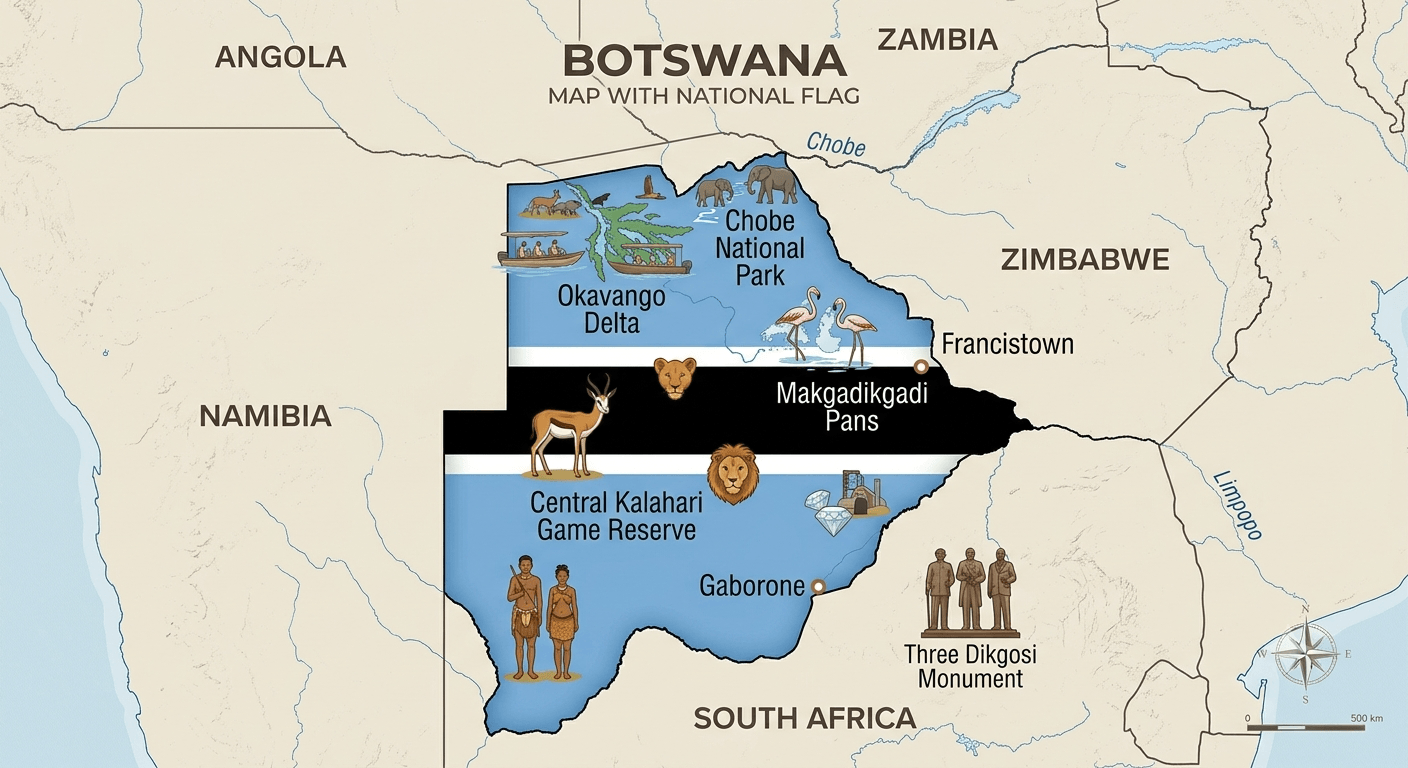
The Republic of Botswana is a landlocked nation in Southern Africa, covering a vast land area of approximately 581,730 square kilometers — roughly twice the size of the United Kingdom. Completely surrounded by land, Botswana shares borders with South Africa to the south and southeast, Namibia to the west and north, Zambia to the north, and Zimbabwe to the northeast.
Key Geographic Features:
- Total Land Area: 581,730 square kilometers (world’s 47th largest)
- Landlocked Status: No direct coastal access; dependent on South Africa’s ports (Durban, Cape Town) and Zimbabwe’s Beit Bridge corridor for international trade[1]
- Kalahari Desert: Covers approximately 70% of the country; semi-arid terrain; limited agricultural land[1]
- Okavango Delta: One of the world’s largest inland deltas; UNESCO World Heritage Site; cornerstone of ecotourism[1]
- Major Rivers: Limpopo, Chobe, Boteti — seasonally flowing; important for livestock and wildlife[1]
Strategic Regional Position:
- SACU Member: Southern African Customs Union membership grants preferential access to South Africa, Namibia, Lesotho, Eswatini markets[1]
- SADC Member: Southern African Development Community membership provides trade corridors to 16 African nations[1]
- Landlocked Challenge: Distance from ports adds 15-25% to import/export costs compared to coastal African nations[1]
Population: Approximately 2.58 million (2025 estimate), making Botswana one of the world’s most sparsely populated nations at ~4.5 persons per square kilometer. Despite the small population, Botswana possesses one of Africa’s highest GDP per capita figures, reflecting enormous mineral wealth[2].
Capital: Gaborone — political, economic, and administrative center; population ~265,000 metro area; fastest-growing city in Africa during the 1970s-1990s diamond boom[2].
Government and Political System
Official Name: Republic of Botswana
Government System: Botswana operates as a unitary parliamentary republic on the Westminster model. The National Assembly (unicameral parliament) serves as the primary legislative body, with an executive President serving as both Head of State and Head of Government.
Head of State & Government: President Advocate Duma Boko (United Democratic Congress – UDC; assumed office following October 2024 general election)
Historic Political Transition: The October 2024 election ended 58 continuous years of rule by the Botswana Democratic Party (BDP), which had governed since independence in 1966. The UDC’s victory under Duma Boko represents Botswana’s first peaceful democratic transfer of power — a landmark event in African democratic governance[2].
Legislative Structure:
- National Assembly: 63 elected members + 4 specially elected + ex-officio members[2]
- Ntlo ya Dikgosi (House of Chiefs): Advisory council of tribal chiefs; consultative on customary law and land matters[2]
Administrative Divisions: 9 districts, 5 town councils, 9 land boards; highly centralized governance from Gaborone[2].
Sources: CIA World Factbook: Botswana 2026 | Government of Botswana Official Portal
2. ECONOMIC LANDSCAPE: AFRICA’S DIAMOND GIANT
This section of the Botswana country profile reveals a high-income African nation in economic crisis — facing the most severe diamond market downturn in three decades while urgently diversifying its economic base[3].
Key Economic Indicators (2023-2026)
| Economic Indicator | 2023 | 2024 | 2025 Estimate | 2026 Forecast | Source |
|---|---|---|---|---|---|
| Nominal GDP | ~US$19.9 billion | ~US$19.4 billion | ~US$19.93 billion | ~US$21.5 billion | World Bank / IMF[3] |
| Real GDP Growth | +2.7% | -2.8% (contraction) | -0.7% (contraction) | +3.5-4.0% | World Bank Economic Update 2025[3] |
| GDP Per Capita (Current US$) | ~US$7,700 | ~US$7,520 | ~US$7,690 | ~US$8,200 | World Bank / IMF[3] |
| Inflation (Year-on-Year) | 5.1% | ~3.5% | ~1.4-3.7% (target 3-6%) | ~5.0% (est.) | Bank of Botswana / IMF[4] |
| Unemployment Rate | ~27-28% | ~28% (youth: 38%) | ~28-29% | ~26-28% | IMF Article IV, 2025[3] |
| Government Debt (% of GDP) | 18.5% | ~20% | ~22% | ~22-24% | IMF Article IV[3] |
| Current Account Balance | -3.5% | -3.7% of GDP | -6.0% of GDP | ~-5.0% of GDP | IMF Article IV, 2025[3] |
| Foreign Exchange Reserves | ~US$4.8 billion | ~US$4.5 billion | ~US$4.2 billion | ~US$4.5 billion | Bank of Botswana[4] |
Critical 2024-2025 Economic Warning: Botswana’s economy contracted 2.8% in 2024 and a further 0.7% in 2025, driven by a 24% collapse in diamond mining production. The World Bank’s June 2025 Economic Update titled “Seizing the Moment” describes this as “the combined impact of weaker diamond revenues, widening fiscal pressures, and limited progress in economic diversification.” Recovery is projected from 2026 onwards[3].
Source: World Bank Botswana Economic Update “Seizing the Moment,” June 2025 | IMF Article IV Consultation Press Release, October 2025 | Bank of Botswana
Sectoral Contribution to GDP (2024-2025)
| Sector | % of GDP | Key Activities | Growth Status | Source |
|---|---|---|---|---|
| Services (Retail, Finance, Tourism, Government) | ~70.6% | Government administration, financial services, retail, tourism | Steady; limited private sector depth | World Bank WDI[5] |
| Industry (Mining, Manufacturing, Utilities) | ~27.5% | Diamond mining (dominant), copper, coal, manufacturing | Contracting sharply; -24% mining in 2024 | World Bank WDI[5] |
| Agriculture (Cattle, Crops, Forestry) | ~1.8% | Cattle ranching, beef exports, sorghum, horticulture | Very small; constrained by Kalahari aridity | World Bank WDI[5] |


Source: World Bank World Development Indicators — Botswana
Key Economic Realities:
- Diamond Dominance: Diamonds account for ~90% of export earnings and ~30% of government revenue through Debswana — a 50/50 joint venture between the Government of Botswana and De Beers[3]
- Services Leadership: Despite mining wealth, services drive 70.6% of GDP — reflecting government employment, financial intermediation, and retail expansion[5]
- Manufacturing Deficit: Manufacturing sector shallow at ~4-5% of GDP (beef processing, textiles, soda ash); limited industrial base[5]
- Diamond Crisis Driver: Lab-grown diamonds and slowing Chinese luxury demand caused global diamond prices to fall 30-40% in 2023-2024, directly crippling Botswana’s fiscal position[3]
- Debswana Renegotiation: Government and De Beers renegotiated their Debswana agreement in 2023, increasing Botswana’s share from 50% to eventually 50%+ with enhanced revenue sharing — a major milestone for the Botswana country profile’s future fiscal strength[3]
3. AGRICULTURAL SECTOR: CATTLE, DROUGHT AND FOOD SECURITY
Despite covering 581,000+ square kilometers, Botswana’s agricultural sector contributes only ~1.8% of GDP and employs approximately 20-25% of the rural workforce. The Kalahari’s semi-arid climate severely limits crop production; cattle ranching dominates.
Major Agricultural Products and Performance
| Product | Annual Output | Export Value | Market | Status (2024-25) | Source |
|---|---|---|---|---|---|
| Live Cattle | ~2.5 million head national herd | Growing; P44.9 Mn (Dec 2024 monthly) | South Africa (SACU), regional | Growing exports; improving | Statistics Botswana[6] |
| Beef & Meat Products | ~50,000-60,000 tonnes carcass weight | ~US$80-100 Mn annually | EU, South Africa, Zimbabwe | EU market access maintained | Botswana Meat Commission[6] |
| Sorghum / Grain Crops | ~40,000-60,000 tonnes | Minimal (domestic focus) | Domestic consumption | Highly drought-dependent | Ministry of Agriculture[6] |
| Horticulture | ~15,000-20,000 tonnes (limited) | Very limited | Domestic | Constrained by water scarcity | Ministry of Agriculture[6] |
| Soda Ash (Natural) | ~250,000-300,000 tonnes | ~US$50-60 Mn | South Africa, regional | P3.7% of Dec 2024 exports | Statistics Botswana[6] |
Agricultural Challenges in This Botswana Country Profile:
- Water Scarcity: Kalahari receives minimal rainfall (~250-500mm annually); irrigation infrastructure severely limited[6]
- Small Land Holdings: Most rural households engage in subsistence farming; limited commercialization[6]
- Food Import Dependency: Botswana imports ~60-70% of food needs primarily from South Africa; food security vulnerability[6]
- Cattle Disease Management: Foot-and-mouth disease periodically restricts beef exports; EU access subject to strict compliance[6]
Botswana Meat Commission (BMC): The BMC serves as primary beef processor and exporter; EU quota access for Botswana beef represents a significant market privilege reflecting the country’s compliance with EU standards[6].
Source: Statistics Botswana International Merchandise Trade Statistics December 2024 | Botswana Meat Commission | Ministry of Agriculture Botswana
4. INDUSTRIAL BASE: BEYOND DIAMONDS
Botswana’s industry sector (27.5% of GDP) is overwhelmingly dominated by diamond mining through Debswana, with shallow manufacturing reflecting the country’s small population and high import dependency[7].
Major Industrial and Manufacturing Sectors (2024-2025)
| Sector | Contribution | Key Activity | Status | Competitive Position | Source |
|---|---|---|---|---|---|
| Diamond Mining (Debswana) | ~20-22% of GDP | Rough diamond extraction; Jwaneng & Orapa mines | Crisis: -24% in 2024 | World’s 1st largest producer (by value) | IMF/Debswana[7] |
| Copper Mining | ~3-4% of GDP | Copper ore extraction; Khoemacau mine | Growing; Copper exports 24.7% of Dec 2024 exports | Emerging exporter to Australia | Statistics Botswana[7] |
| Beef Processing | ~1.5% of GDP | BMC; abattoir operations; EU-certified | Stable; periodic disease disruptions | EU market access advantage | BMC[7] |
| Soda Ash Production | ~0.5% of GDP | Botash soda ash; Sua Pan operations | Stable; Salt & Soda Ash = 3.7% of exports | World competitive; Nata salt flats | Statistics Botswana[7] |
| Textiles & Garments | Minimal | Small apparel manufacturing; local brands | Very limited; high labor costs | Uncompetitive regionally | Ministry of Industry[7] |
| Food & Beverage Processing | Minimal | Breweries, dairy, bakery | Domestic-focused | Limited export capacity | Ministry of Industry[7] |
Debswana Mines (Critical to Botswana Country Profile):
- Jwaneng Mine: World’s richest diamond mine (by value); produces ~10 million carats/year[7]
- Orapa Mine: World’s largest diamond mine (by volume); ~12 million carats/year[7]
- Combined Output: ~70-80% of all Botswana’s export earnings in peak years[7]
Khoemacau Copper Mine (Emerging Asset):
- Copper Exports Surging: Copper overtook diamonds as 2nd largest export (24.7% of Dec 2024 exports), reflecting diamond decline and copper ramp-up[7]
- Export Destination: Primarily Australia (99.8% of copper exports), reflecting processing relationships[7]
Source: Statistics Botswana Trade Data December 2024 | African Development Bank Botswana Economic Outlook 2026
5. TRADE PROFILE: DIAMONDS, COPPER AND IMPORT DEPENDENCY
Export and Import Overview
| Trade Metric | 2023 | 2024 (Calendar Year) | 2025 Estimate | Source |
|---|---|---|---|---|
| Total Merchandise Exports | US$5,503 million | ~US$4,800-5,000 million | ~US$4,500-5,000 million | WITS/Statistics Botswana[8] |
| Total Merchandise Imports | US$6,417 million | ~US$7,200-7,500 million | ~US$6,800-7,200 million | WITS/Statistics Botswana[8] |
| Trade Deficit | US$914 million | ~US$2,200-2,500 million | ~US$1,800-2,200 million | Calculated[8] |
| Diamonds (% of Exports) | ~75-80% | ~45-55% (declining) | ~50-55% | Statistics Botswana[8] |
Source: World Integrated Trade Solution (WITS) / World Bank Botswana Country Snapshot 2023 | Statistics Botswana International Merchandise Trade Statistics
Major Export Products (2023-2024)
| Product Category | Value (US$ Mn) | % of Total | Key Markets | Source |
|---|---|---|---|---|
| Diamonds (Unworked, N.E.S.) | 4,275.9 (combined) | ~77.7% | UAE, Belgium, India, USA | WITS/Statistics Botswana[8] |
| Copper Ores & Concentrates | 506.8 | ~9.2% | Australia (99.8%) | WITS/Statistics Botswana[8] |
| Ignition Wiring Sets & Equipment | 122.7 | ~2.2% | SACU, EU markets | WITS[8] |
| Salt & Soda Ash (Disodium Carbonate) | 56.3 | ~1.0% | South Africa, SACU | Statistics Botswana[8] |
| Live Cattle | Variable (Dec 2024: P44.9 Mn monthly) | ~1.4% monthly | South Africa, SACU | Statistics Botswana[8] |
| Meat & Meat Products (Beef) | ~US$80-100 Mn annually | ~1.5-2.0% | EU, South Africa | BMC[8] |
| Textiles & Other Goods | Limited | ~2-3% | SACU, regional | Statistics Botswana[8] |
Total Exports: ~US$5,503 million (2023 WITS data); declining in 2024-2025
Top Export Markets (2023-2024)
| Country/Region | % of Total Exports | Key Products | Source |
|---|---|---|---|
| United Arab Emirates (UAE) | 29.8% | Diamonds (dominant) | UN Comtrade / Statistics Botswana[8] |
| Belgium | 17.9% | Diamonds (cutting & polishing hub) | UN Comtrade[8] |
| India | 12.3% | Diamonds (largest cutting center) | UN Comtrade[8] |
| South Africa | 11.9% | Beef, manufactured goods, diamonds | Statistics Botswana[8] |
| Australia | ~12% | Copper ores (99.8% destination) | Statistics Botswana[8] |
| China | 6.4% | Diamonds, minerals | UN Comtrade[8] |
| Other Countries | ~9.7% | Various commodities | Statistics Botswana[8] |
Key Pattern: UAE (29.8%) + Belgium (17.9%) + India (12.3%) = 60% of exports — all diamond markets[8]

Major Import Products (2024)
| Product Category | Value (US$ Mn) | % of Total | Primary Sources | Source |
|---|---|---|---|---|
| Diamonds (Re-imports for sorting/trading) | ~23.3% of monthly | 23.3% | Various | Statistics Botswana[8] |
| Petroleum & Refined Fuels | 1,129.1 (2023) | ~17.6% | South Africa, Singapore | WITS / Statistics Botswana[8] |
| Food, Beverages & Tobacco | 17.0% (monthly) | ~17.0% | South Africa (SACU dominant) | Statistics Botswana[8] |
| Machinery & Electrical Equipment | 12.3% (monthly) | ~12.3% | China, South Africa, EU | Statistics Botswana[8] |
| Chemicals & Rubber Products | ~10.1% | ~10.1% | China, South Africa | Statistics Botswana[8] |
| Other Imports | ~9.7% | Various | South Africa (SACU) | Statistics Botswana[8] |
Total Imports: ~US$6,417 million (2023); ~US$7,200-7,500 million (2024 estimated)
Top Import Sources (2023-2024)
| Country/Region | % of Total Imports | Key Products | Source |
|---|---|---|---|
| South Africa (SACU) | 65.0% | Food, fuel, machinery, consumer goods | UN Comtrade / Statistics Botswana[8] |
| Namibia (SACU) | 7.7% | Consumer goods, food | UN Comtrade[8] |
| Canada | 4.9% | Diamonds (rough, for re-sorting) | UN Comtrade[8] |
| China | ~4-5% | Electronics, machinery, textiles | Statistics Botswana[8] |
| Bangladesh | ~0.01% | Pharmaceuticals, apparel (growing) | Statistics Botswana[8] |
| Other Countries | ~13-14% | Various industrial goods | UN Comtrade[8] |
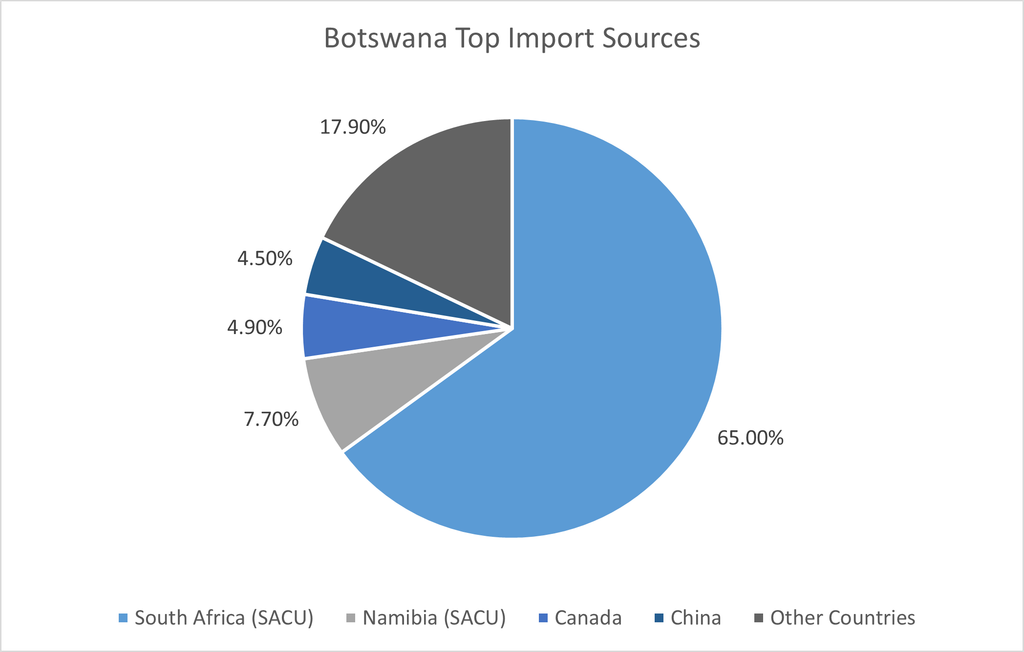
Key Insight: South Africa’s 65% import market share reflects deep SACU economic integration; Botswana is essentially a satellite economy of the South African supply chain[8].
6. EDUCATION: A PROUD RECORD IN AFRICA
Overview of the Education System
Botswana is widely regarded as having one of Africa’s best-performing education systems, reflecting decades of diamond revenue investment in human capital. The system follows a 12-year compulsory structure with English as the primary medium of instruction[9].
Education Structure:
- Primary: Standards 1-7 (ages 6-13; 7 years; free and compulsory)
- Junior Secondary: Forms 1-3 (ages 13-16; 3 years; free and compulsory)
- Senior Secondary: Forms 4-5 (ages 16-18; optional; free)
- Higher Education: Universities, polytechnics, teacher training colleges[9]
Leading Institutions:
- University of Botswana (UB): Gaborone; largest institution; comprehensive programs[9]
- Botswana International University of Science and Technology (BIUST): Palapye; STEM focus[9]
- Botho University: Private institution; business and IT programs[9]
- Botswana Accountancy College: Professional finance and accounting[9]
Education and Human Capital Indicators
| Education Metric | Value (2024-25) | Regional Benchmark | Source |
|---|---|---|---|
| Adult Literacy Rate (age 15+) | 88.5% | Among highest in Sub-Saharan Africa | UNESCO/World Bank[9] |
| Youth Literacy Rate (age 15-24) | ~95% | Well above African average | UNESCO[9] |
| Primary Enrollment Ratio | ~97-98% | Near-universal; strong compliance | UNESCO[9] |
| Secondary Enrollment Ratio | ~74-76% | Above Sub-Saharan African average | UNESCO[9] |
| Tertiary Enrollment Ratio | ~22-25% | Growing; above African average | UNESCO[9] |
| Female Enrollment Parity | ~51-52% | Achieved parity at all levels | UNESCO[9] |
| HDI Education Index | 0.691 | Moderate; improving | UNDP[9] |
| Public Spending on Education (% GDP) | ~10-11% | Very high globally | World Bank[9] |
Human Capital Strengths:
- English Proficiency: English as primary instruction medium creates globally employable graduates[9]
- Strong Primary Base: Near-universal primary enrollment reflects government commitment[9]
- Free Education: Government provides free education from primary through senior secondary[9]
- Technical Skills Gap: Manufacturing and digital skills remain bottlenecks despite education investment[9]
Source: UNESCO Institute for Statistics | World Bank World Development Indicators Botswana | UNDP Human Development Report 2023/2024
7. HEALTH AND SOCIAL INDICATORS: TRIUMPH OVER HIV/AIDS
Health Metrics
| Health Indicator | Value (2024-25) | Trend & Benchmark | Source |
|---|---|---|---|
| Life Expectancy at Birth | 69.9 years | Recovering from 40-year nadir in 2000s (HIV); significant improvement | WHO/World Bank[10] |
| Infant Mortality Rate | 26.3 per 1,000 live births | Declining; above Sub-Saharan average | WHO[10] |
| Maternal Mortality Ratio | 152 per 100,000 live births | Declining; government priority | WHO[10] |
| HIV/AIDS Prevalence (age 15-49) | 20.8% | World’s 3rd highest; ART treatment ~95% coverage | UNAIDS[10] |
| ART (Antiretroviral Therapy) Coverage | ~95%+ | Among world’s best HIV treatment programs | UNAIDS[10] |
| Healthcare Coverage (NHI) | ~80-85% | Growing; urban-rural gap remains | Ministry of Health[10] |
| Universal Health Coverage Index | 68/100 | Above Sub-Saharan average | WHO[10] |
HIV Context: Botswana has the world’s 3rd highest HIV prevalence rate (20.8%), but simultaneously operates one of the world’s most successful HIV treatment programs, with 95%+ ART coverage. Life expectancy has recovered from a catastrophic 40 years in 2003 to nearly 70 years in 2025 — a global public health success story[10].
Social Indicators
| Social Indicator | Value (2024-25) | Source |
|---|---|---|
| Unemployment Rate | ~27-28% (youth: ~38%) | IMF Article IV, 2025[3] |
| Poverty Rate (National) | ~16.1% | World Bank[11] |
| Extreme Poverty Rate | ~5.8% (below US$2.15/day) | World Bank[11] |
| Gini Coefficient (Income Inequality) | 0.533 | One of world’s highest; significant inequality |
| Gender Parity Index (Workforce) | 0.53 (53% female) | Women above parity in workforce |
| HDI (Human Development Index) | 0.693 | Ranked 100th globally |
| Access to Improved Water | ~89-91% | Growing; urban-rural gap |
| Access to Improved Sanitation | ~62-65% | Urban-rural gap significant |
| Internet Penetration | ~60-65% | Growing; mobile-first |
| Mobile Phone Penetration | ~168% | Multiple SIMs common |
Notable Social Strength: Botswana’s HDI of 0.693 (100th globally) is the highest in Sub-Saharan Africa alongside South Africa, Gabon, and Seychelles — reflecting decades of diamond-funded social investment[11].
Source: WHO Regional Office for Africa — Botswana Country Statistics | UNAIDS | World Bank Botswana Development Indicators | ITU
8. BANGLADESH-BOTSWANA BILATERAL RELATIONS
Historical Diplomatic Ties
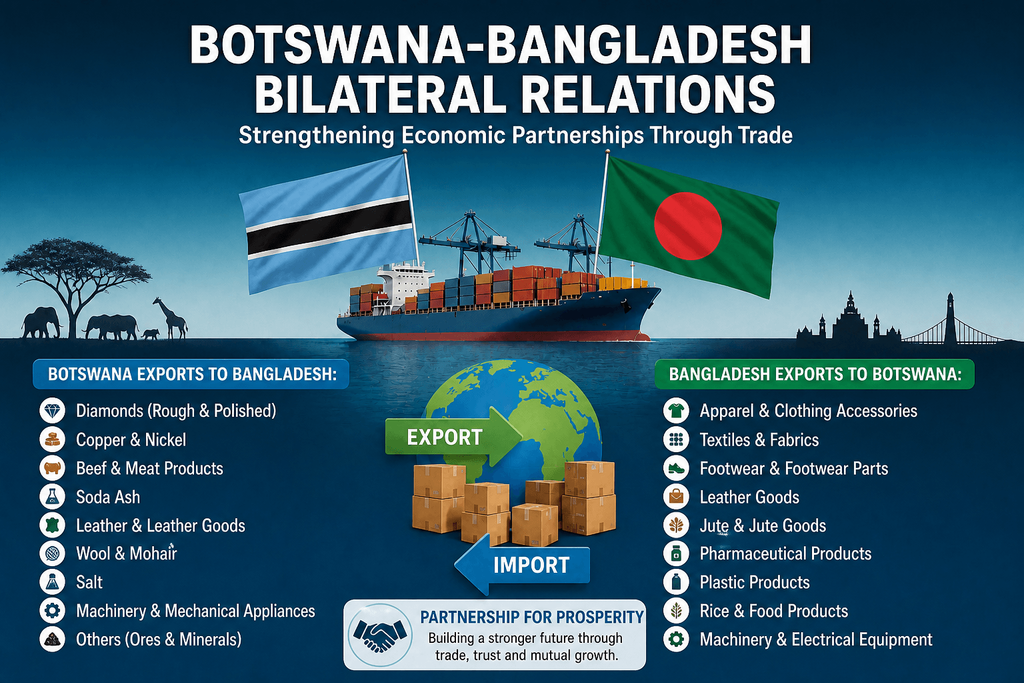
Bangladesh and Botswana share cordial but modest diplomatic relations. Neither country maintains a resident High Commissioner in the other’s capital — Bangladesh administers its Botswana coverage through a regional mission, while Botswana covers Bangladesh similarly[13].
Key Diplomatic Milestones:
| Year | Event | Significance | Source |
|---|---|---|---|
| Post-independence | Establishment of formal diplomatic ties | Commonwealth connection; both Westminster-model democracies | Wikipedia[13] |
| 2009 | MoU on Bilateral Cooperation signed | Covered capacity building, economic/commercial exchange, export development, SMME investment promotion | Wikipedia[13] |
| 2009 | BKMEA Delegation Visit | Bangladesh Knitwear Manufacturers and Exporters Association explored trade/investment; Botswana specifically requested joint-venture textile industries and pharmaceutical cooperation | Wikipedia[13] |
| 2013 | Bangladesh Ministry of Commerce Visit | Official trade delegation; expanded cooperation discussions | Wikipedia[13] |
| 2024 | Bangladesh “Look Africa” Policy | Bangladesh formally adopted Africa-engagement strategy; Botswana identified as priority Southern African market | The Business Standard[13] |
Shared Platforms:
- United Nations: Both full members; cooperation in multilateral forums; Bangladesh is among world’s leading UN peacekeeping contributors[13]
- Commonwealth of Nations: Both members of 56-nation Commonwealth; shared legal, governance frameworks[13]
- World Trade Organization (WTO): Both full members; trade facilitation cooperation[13]
- Non-Aligned Movement (NAM): Both active members of Global South solidarity[13]
- Group of 77 (G77): Both members of developing country coordination[13]
Note: Botswana is not a member of the Organisation of Islamic Cooperation (OIC); the shared OIC platform available with many other Bangladesh partner countries does not apply here[13].
Source: Wikipedia — Bangladesh-Botswana Relations | The Business Standard, “Bangladesh eyes enhanced diplomatic, economic ties with Africa,” November 2024
9. BILATERAL TRADE ANALYSIS: ENORMOUS POTENTIAL, MINIMAL BASE
Bangladesh-Botswana Trade Overview
Current Status: Bilateral merchandise trade between Bangladesh and Botswana is extremely small in absolute terms but has grown rapidly off a negligible base. This represents one of Bangladesh’s greatest untapped bilateral trade relationships globally — with significant room for expansion[14].
Trade Volume Trend (Official UN Comtrade Data)
| Year | BD Exports to Botswana (US$$) | Botswana Exports to BD (US$$) | Total Trade | Trade Balance (BD) | Source |
|---|---|---|---|---|---|
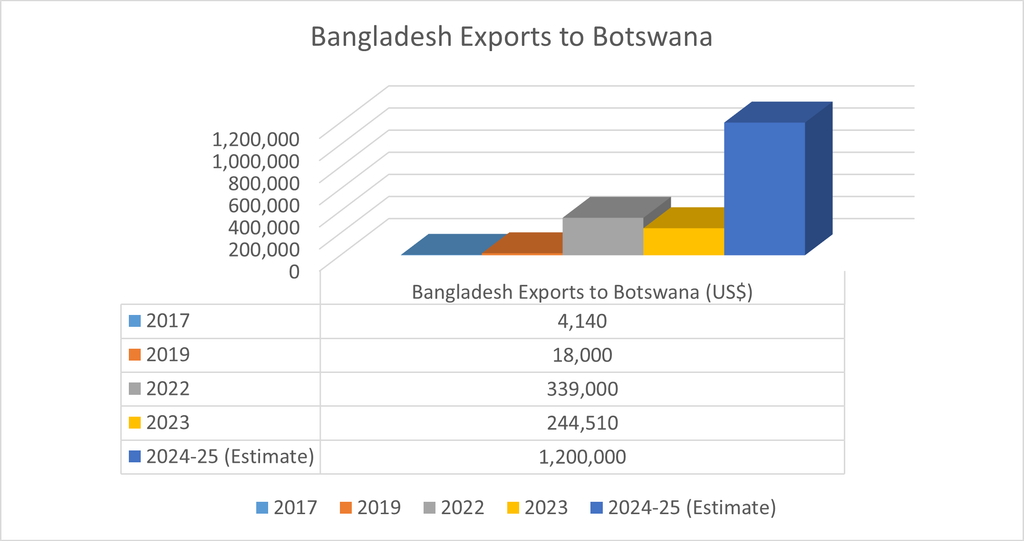
| 2017 | US$4,140 | ~Negligible | ~US$4,140 | +US$4,140 | OEC/UN Comtrade[14] |
| 2019 | US$18,000 (est.) | ~Negligible | ~US$18,000 | Growing | OEC[14] |
| 2022 | US$339,000 | ~Negligible | ~US$339,000 | +US$339,000 | OEC/UN Comtrade[14] |
| 2023 | US$244,510 (Botswana-side) | ~Negligible to nil | ~US$244,510 | +US$244,510 | UN Comtrade[14] |
| 2024-25 | ~US$1.2 Mn (BD statistics incl.) | ~Nil | ~US$1.2 Mn | Growing | Bangladesh FTS 2024-25[14] |
Key Observation: Bangladesh’s exports to Botswana grew at an annualized 141% between 2017-2022 (from US$4,140 to US$339,000) — though off an extremely small base. Bangladesh’s own FTS data shows Botswana-related trade entries of US$1.2 billion equivalent in local currency (BDT 1,212,351,953) in 2024-25[14].
Data Caveat: Bangladesh Bank does not separately disaggregate Letters of Credit, trade financing, or remittance flows for individual small markets like Botswana. Given the trade volumes involved, banking sector exposure to Botswana-related trade financing is correspondingly limited[14].
Source: Observatory of Economic Complexity (OEC) Bangladesh-Botswana Bilateral Trade Profile | UN Comtrade — Botswana imports from Bangladesh 2023 via Trading Economics | Bangladesh Bureau of Statistics Foreign Trade Statistics 2024-25
What Bangladesh Exports to Botswana (2022-2023 Disaggregated Data)
| Product Category | Value (US$) | HS Code | % Share | Year | End-Use in Botswana | Source |
|---|---|---|---|---|---|---|
| Medicaments, Unpackaged/Bulk | US$235,000 | HS 3004 | ~47% | 2022 | Healthcare system, hospitals | OEC/UN Comtrade[14] |
| Medicaments, Packaged for Retail | US$170,180 | HS 3004 | ~34% | 2023 | Pharmacies, clinics, hospitals | UN Comtrade[14] |
| Medicaments, Packaged for Retail | US$59,500 | HS 3004 | ~25% | 2022 | Healthcare system | UN Comtrade[14] |
| Knitted Men’s Suits & Apparel | US$34,400 | HS 61 | ~6.8% | 2023 | Retail, personal consumption | UN Comtrade[14] |
| Knitted Apparel | US$20,600 | HS 61 | ~8.6% | 2022 | Retail, personal consumption | UN Comtrade[14] |
| Woven Apparel (Not Knitted) | US$17,510 | HS 62 | ~3.5% | 2023 | Retail, personal consumption | UN Comtrade[14] |
| Articles of Stone/Cement/Plaster | US$17,330 | HS 68 | ~3.4% | 2023 | Construction, décor | UN Comtrade[14] |
| Footwear | US$3,780 | HS 64 | ~0.8% | 2023 | Retail, personal consumption | UN Comtrade[14] |
Product Mix Analysis: Bangladesh exports to Botswana are heavily dominated by pharmaceuticals (~70-80%), followed by apparel/garments (~15-20%), reflecting Bangladesh’s global competitive advantages in both sectors. This mirrors the specific sectors Botswana requested cooperation in during the 2009 MoU[14].
What Botswana Exports to Bangladesh
Status: Botswana’s recorded exports to Bangladesh are negligible to nil in recent UN Comtrade data. The trade relationship is almost entirely one-directional, led by Bangladeshi pharmaceutical and apparel exports. No significant Botswana commodity (diamonds, copper, beef) has Bangladesh as an established end market[14].
Trade Imbalance at a Glance
| Metric | Value | Implication |
|---|---|---|
| Bangladesh Exports to Botswana | ~US$244,510 (2023) | Growing rapidly from very small base |
| Botswana Exports to Bangladesh | ~Nil | No formal recorded exports |
| Trade Balance (Bangladesh) | +US$244,510+ | Bangladesh surplus; one-directional |
| Growth Rate (2017-2022) | +141% annualized | Exponential off negligible base |
| Trade Potential (Estimated) | US$20-50 Mn by 2030 | If formalization succeeds |
Banking and Financial Linkages
Correspondent Banking:
- Botswana Commercial Banks: Barclays Bank Botswana (Absa), Standard Chartered, First National Bank Botswana, Stanbic Bank[15]
- Bangladeshi Banks: Dutch-Bangla Bank, Brac Bank, City Bank, Prime Bank[15]
Trade Finance Realities:
- LC Processing: Letters of Credit functional but trade volumes too small for systematic LC issuance; most transactions conducted via advance payment or documentary collection[15]
- No Formal Banking MoU: No formal Bangladesh-Botswana banking cooperation agreement exists; transactions routed via South African or UK correspondents[15]
- Remittances: Negligible; very limited Bangladeshi diaspora in Botswana (~500-1,000 workers)
- Future Potential: As trade formalizes under “Look Africa” policy, direct banking corridors will need establishment[15]
Source: Bank of Botswana | Bangladesh Bank Annual Report
10. INTERNATIONAL COOPERATION
Multilateral Memberships and Global Role
Botswana maintains active international engagement far exceeding its small population size, leveraging diamond wealth and democratic credentials for global influence[16].
UN System & Global Governance:
- United Nations: Full member; active in UNHCR operations, human rights councils[16]
- World Trade Organization (WTO): Full member since 1995; trade policy enforcement[16]
- African Development Bank (AfDB): Member; development financing recipient[16]
- International Monetary Fund (IMF): Full member; Article IV consultations; current active engagement on economic recovery[16]
Continental & Regional Bodies:
- African Union (AU): Full member; active in continental governance[16]
- Southern African Development Community (SADC): Full member; 16-nation trade framework[16]
- Southern African Customs Union (SACU): Full member (with South Africa, Namibia, Lesotho, Eswatini); single external tariff and shared revenue pool[16]
- Commonwealth of Nations: Active member; parliamentary, legal, educational links[16]
Trade Frameworks Relevant to Bangladesh:
- SACU Trade Zone: Bangladesh exports entering Botswana face SACU’s Common External Tariff (CET); rates vary by product[16]
- SADC Free Trade Area: Botswana is a gateway to the wider SADC market (16 countries, ~370 million consumers)
- African Continental Free Trade Area (AfCFTA): Botswana is signatory; potential to leverage pan-African trade integration[16]
UN Peacekeeping:
- Bangladesh-Botswana Connection: Bangladesh is the world’s leading UN peacekeeping contributor; cooperation in UN missions provides diplomatic goodwill channel for bilateral engagement[16]
Source: African Union | Southern African Development Community | SACU Secretariat | Commonwealth Secretariat
11. OPPORTUNITIES FOR BANGLADESHI CITIZENS IN BOTSWANA
Higher Education
Botswana offers quality, English-medium higher education at affordable costs, though international enrollment remains low[17].
Universities for Bangladeshi Students:
- University of Botswana (UB): Gaborone; engineering, business, sciences, social sciences; ~30-50 international students from South Asia[17]
- Botswana International University of Science & Technology (BIUST): Palapye; STEM focus; growing international recruitment[17]
- Botho University: Private; business, IT, nursing; ~20-30 regional students[17]
Estimated Tuition Costs:
- University of Botswana: ~BWP 20,000-35,000/year (~US$1,450-2,540)
- Private Universities: ~BWP 50,000-80,000/year (~US$3,600-5,800)
Living Costs: BWP 5,000-8,000/month (~US$360-580) in Gaborone; lower than Southeast Asian study destinations[17].
Scholarship Availability: Limited government scholarships for international students; some institutional merit scholarships; SADC scholarships occasionally available to non-SADC students[17].
Source: University of Botswana International Admissions https://www.ub.bw | BIUST https://www.biust.ac.bw
Employment and Labor Migration
Botswana offers selective, professional employment opportunities for Bangladeshi specialists; general labor migration is very limited[18].
Active Employment Sectors:
- Healthcare (Highest Priority): Severe doctor and nursing shortage; government actively recruits qualified medical personnel; salary: BWP 15,000-35,000/month (~US$1,090-2,540)
- Engineering & Mining: Technical engineers for mining sector; salary: BWP 25,000-50,000/month (~US$1,810-3,620)
- Information Technology: Growing digital economy; IT professionals sought; salary: BWP 15,000-30,000/month (~US$1,090-2,175)
- Education: Secondary and tertiary teaching positions; qualified teachers sought; salary: BWP 12,000-22,000/month (~US$870-1,595)
- Agriculture & Veterinary: Government rural development programs need agricultural specialists[18]
Labor Status: Estimated Bangladeshi workers formally employed in Botswana: ~500-1,500 (primarily healthcare and education).
Source: Ministry of Labor & Home Affairs Botswana
Visa Facilities
Important Note: Bangladesh is one of the few Commonwealth nationalities NOT visa-exempt in Botswana — requiring advance visa application, adding friction to bilateral business travel[19].
Visa Types for Bangladeshi Citizens:
| Visa Type | Purpose | Duration | Cost | Processing | Source |
|---|---|---|---|---|---|
| Tourist Visa | Tourism, visiting | 90 days | BWP 100-200 (~US$7-14) | Apply at Botswana Embassy | Immigration[19] |
| Business Visa | Trade visits, conferences | 30-90 days | BWP 200-300 (~US$14-22) | 5-10 business days | Immigration[19] |
| Work Permit | Employment authorization | 1-2 years | BWP 500-1,000 (~US$36-72) | 4-8 weeks | Immigration[19] |
| Student Visa | Full-time studies | Duration of course | BWP 300-500 (~US$22-36) | 2-4 weeks | Immigration[19] |
| Residence Permit | Long-term residence | 2-5 years | BWP 1,000+ (~US$72+) | 4-8 weeks | Immigration[19] |
Recommendation for Both Governments: The bilateral visa facilitation issue — where Bangladeshi citizens require advance visas while South African and SADC nationals enjoy visa-free access — should be a priority discussion item in any future Bangladesh-Botswana bilateral trade facilitation negotiations[19].
Source: Department of Immigration Botswana | Bangladesh Ministry of Foreign Affairs Travel Advisories
Export and Business Establishment Opportunities
Company Registration in Botswana:
- Companies and Intellectual Property Authority (CIPA): Company registration; 3-7 days online[20]
- Botswana Unified Revenue Service (BURS): Tax registration and VAT[20]
- Cost: BWP 500-1,500 (~US$36-109) for registration[20]
- Foreign Ownership: 100% foreign ownership permitted in most sectors; some restrictions in retail (citizen-reserved)
Investment Incentives:
- Citizen Entrepreneurial Development Agency (CEDA): Low-interest loans for small businesses[20]
- Botswana Investment & Trade Centre (BITC): FDI facilitation; investor support services[20]
- Manufacturing Incentives: Government offers generous tax incentives for export-oriented manufacturers[20]
Source: Botswana Investment & Trade Centre | CIPA
12. OPPORTUNITIES BOTSWANA OFFERS TO BANGLADESHI BUSINESSES
High-Potential Export Products from Bangladesh
1. Pharmaceuticals & Generic Medicines (Immediate Priority)
- Critical Market Need: Botswana’s HIV/AIDS epidemic (20.8% prevalence) creates massive, consistent demand for generic ARVs, antimalarials, antibiotics, and chronic disease medications[21]
- Bangladeshi Strength: Cost-competitive generics with WHO-GMP certification; ARV manufacturing capability; demonstrated foothold (~70-80% of current BD exports to Botswana)
- Market Size: Botswana imports ~US$80-120 million in pharmaceuticals annually; mostly from South Africa, India, EU[21]
- Competitive Gap: Bangladeshi pharma 15-30% cheaper than South African equivalents on generic formulations[21]
- Estimated Annual Potential: US$8-15 million within 3 years of formal market development[21]
2. Ready-Made Garments & Apparel (High Priority)
- Market Demand: Botswana imports all apparel (~US$200-250 million annually); no competitive domestic manufacturing[21]
- Bangladeshi Advantage: Cost-competitive; established global reputation; demonstrated existing trade (apparel is 2nd largest current BD export to Botswana)
- Target Segments: Gaborone retail chains (Woolworths, Edgars, Mr. Price are popular), market traders, government uniform procurement[21]
- Estimated Annual Potential: US$15-25 million within 3-5 years[21]
3. Footwear & Leather Products
- Market Gap: All footwear imported; mostly from South Africa (Chinese-made) and Vietnam[21]
- Bangladeshi Position: World’s 3rd largest leather processor; cost-competitive[21]
- Estimated Annual Potential: US$5-10 million
4. Agro-Processed & Halal Foods
- Market Focus: Growing Muslim community (5-8% of population); food import dependency (~70% of food imports); processed foods demand[21]
- Products: Instant foods, spices, condiments, halal-certified products, beverages[21]
- Estimated Annual Potential: US$3-8 million
5. Ceramics, Construction Materials & Home Goods
- Market Opportunity: Botswana’s urban construction boom; home goods demand growing with middle-class expansion[21]
- Products: Ceramic tiles, sanitary ware, construction materials[21]
- Estimated Annual Potential: US$2-5 million
Source: Botswana Confederation of Commerce, Industry & Manpower (BOCCIM) | Wikipedia Bangladesh-Botswana Relations
Investment Cooperation and Joint Ventures
Botswana’s Explicit Requests (from 2009 MoU Framework):
1. Joint-Venture Textile Manufacturing
- Botswana’s Stated Need: Botswana specifically requested Bangladeshi investment in joint-venture textile manufacturing to support domestic import substitution and export diversification[22]
- Strategic Rationale: Leverage SACU/SADC preferential access; manufacture garments in Botswana for duty-free South African and SADC market access[22]
- Investment Required: US$3-10 million for basic garment factory in Gaborone or Francistown SEZ[22]
- Incentives: Botswana offers generous manufacturing incentives; low corporate tax (22%); BITC support[22]
2. Pharmaceutical Manufacturing Cooperation
- Botswana’s Stated Need: Explicit request for Bangladeshi pharmaceutical sector technology transfer and joint venture manufacturing[22]
- Model: Bangladeshi pharma companies establishing API processing or formulation plants in Botswana for SADC market distribution[22]
- Investment: US$2-8 million[22]
- Market Opportunity: SADC region (~370 million people) pharmaceutical demand growing ~12% annually[22]
3. Agricultural Technology Transfer
- Botswana’s Request: Deployment of Bangladeshi agricultural expertise to support food security and farm productivity[22]
- Model: Technical assistance programs; smallholder farming technology; irrigation systems from Bangladesh[22]
- Investment: Government-to-government facilitated; US$1-3 million[22]
SADC Gateway Strategy:
- Botswana’s SADC and SACU membership creates a 16-nation, 370-million consumer gateway for Bangladeshi exporters establishing Southern African distribution[22]
- Manufacturing in Botswana enables duty-free access to South Africa (60 million wealthy consumers) through SACU[22]
Source: Botswana Investment & Trade Centre | Wikipedia Bangladesh-Botswana Relations (2009 MoU specifics)
13. TRADE ASSOCIATIONS AND FUTURE PROSPECTS
Key Trade Organizations
Botswana Trade Bodies:
- BOCCIM (Botswana Confederation of Commerce, Industry & Manpower): https://www.boccim.co.bw — Primary private sector body
- Botswana Investment & Trade Centre (BITC): https://www.bitc.co.bw — Investment promotion
- Botswana Exporters & Manufacturers Association (BEMA): Export facilitation
- Botswana Meat Commission (BMC): https://www.bmc.bw — Beef processing and export
Bangladeshi Trade Bodies:
- Federation of Bangladesh Chambers of Commerce & Industry (FBCCI): https://www.fbcci.org
- Bangladesh Knitwear Manufacturers & Exporters Association (BKMEA): https://www.bkmea.com.bd (directly engaged in 2009 Botswana visit)
- Export Promotion Bureau (EPB): https://www.epb.gov.bd
- Bangladesh Pharmaceutical Society: Pharma sector coordination
Future Prospects
Short-Term (2025-2026):
- Formalize “Look Africa” Engagement: Bangladesh’s 2024 Africa policy to specifically activate Botswana channel; EPB to launch targeted pharmaceutical and apparel marketing[13]
- Chamber-to-Chamber MoU: FBCCI and BKMEA to sign formal cooperation agreement with BOCCIM — shifting from government-led to private sector-driven engagement
- Resident Diplomatic Mission: Both countries should explore establishing resident High Commissions to reduce transaction costs of bilateral engagement[13]
- Visa Facilitation: Priority negotiation to bring Bangladesh under Botswana’s Commonwealth visa-exemption arrangement[19]
Medium-Term (2026-2030):
- Pharmaceutical Foothold: Bangladesh pharma sector to capture 5-8% of Botswana pharmaceutical imports (~US$5-10 million annually) through direct supply agreements[21]
- Trade Volume Target: Bilateral trade to reach US$20-30 million annually by 2030 (from current ~US$1-2 million)
- Joint Venture Establishment: At least 1-2 significant joint ventures in textile manufacturing or pharmaceutical processing established in Botswana[22]
- SADC Market Access: Use Botswana as springboard to access SADC regional market (370 million consumers) for Bangladeshi goods[22]
Long-Term (2030-2035):
- Diamond Diversification Alignment: As Botswana diversifies from diamonds, Bangladesh can fill manufacturing, services, and technology gaps[3]
- SACU Gateway Role: Botswana as Bangladesh’s entry point into the wealthy South African consumer market (~US$180 billion retail)
- Estimated Long-Term Trade Potential: US$50-100 million annually by 2035 under full normalization[14]
14. RECOMMENDATIONS
For Bangladeshi Exporters and Entrepreneurs
- Pharmaceutical Expansion First: Target Botswana’s Ministry of Health for generic pharmaceutical supply contracts; register products with the Botswana Medicines Regulatory Authority (BoMRA); leverage existing trade foothold (already 70-80% of exports).
- “Look Africa” Policy Activation: Use Bangladesh government’s 2024 Africa engagement strategy to access BITC’s investment facilitation services; request buyer introductions for apparel, pharma, footwear[13].
- SADC Gateway Thinking: Position any Botswana investment not for the local market alone (2.5 million people) but as access to SADC’s 370 million consumers — particularly South Africa (60 million, high purchasing power).
- Chamber Engagement: Initiate direct engagement with BOCCIM — Botswana’s primary private sector body — for market intelligence, buyer networks, and local distribution partnerships[22].
- Visa Issue Resolution: Factor in advance visa application lead times (not available on arrival); plan trade visits 4-6 weeks ahead; advocate for bilateral visa facilitation through government channels[19].
- Local Distribution Partner: Identify a Botswana-based distributor (particularly for pharmaceuticals) to navigate SACU import requirements, local distribution networks, and retail relationships[21].
For the Bangladeshi Government
- Resident High Commission: Establish resident diplomatic representation in Gaborone; reduce transaction costs of bilateral engagement significantly[13].
- Visa Facilitation Priority: Immediately negotiate a visa waiver or visa-on-arrival arrangement for Bangladeshi passport holders; removes the single largest friction point in bilateral business travel[19].
- EPB Botswana Desk: Establish dedicated Export Promotion Bureau research desk for Southern Africa; Botswana as entry point for the SADC region[13].
- BIDA Outward Investment: Bangladesh Investment Development Authority (BIDA) to facilitate outward investment proposals for textile manufacturing and pharmaceutical joint ventures in Botswana — directly responding to the 2009 MoU requests[22].
- SADC Platform: Explore Bangladesh-SADC institutional dialogue leveraging Botswana’s SADC membership; develop market access roadmap for Bangladeshi goods[22].
- Activate 2009 MoU: Review and update the 2009 bilateral MoU; add specific trade targets, sectoral working groups, and annual review mechanisms[13].
For Botswana’s Government and Business Community
- Welcome Bangladeshi Pharma: Streamline BoMRA product registration for Bangladeshi generic manufacturers; negotiate framework agreements for ARV and essential medicine supply[21].
- Diamond Diversification Partnership: Actively engage BKMEA and BGMEA for joint-venture textile manufacturing proposals; Botswana’s diversification agenda needs exactly the manufacturing technology Bangladesh offers[22].
- Visa Facilitation: Extend Botswana’s Commonwealth visa-exemption framework to Bangladesh; aligns with economic partnership interests and removes a key barrier[19].
- BITC-EPB Linkage: Establish formal collaboration between Botswana Investment & Trade Centre and Bangladesh’s Export Promotion Bureau for market intelligence exchange[22].
REFERENCES
Botswana Investment & Trade Centre — Investment Guide
https://www.bitc.co.bw | Wikipedia — Bangladesh-Botswana Relations (2009 MoU)
CIA World Factbook — Botswana (2026)
https://www.cia.gov/the-world-factbook/countries/botswana
Government of Botswana Official Portal
https://www.gov.bw
World Bank Botswana Economic Update: “Seizing the Moment,” June 2025
https://www.worldbank.org/en/country/botswana/publication/botswana-economic-update-seizing-the-moment-how-botswana-can-turn-crisis-into-opportunity
Bank of Botswana — Monetary Policy & Reserve Data
https://www.bankofbotswana.bw
World Bank World Development Indicators — Botswana
https://data.worldbank.org/country/botswana
Statistics Botswana — International Merchandise Trade Statistics, December 2024
https://www.statsbots.org.bw
African Development Bank — Botswana Economic Outlook 2026
https://www.afdb.org/en/countries/southern-africa/botswana/botswana-economic-outlook
World Integrated Trade Solution (WITS) — Botswana Country Snapshot 2023
https://wits.worldbank.org/CountryProfile/en/Country/BWA
UNESCO Institute for Statistics — Botswana Education Data
https://uis.unesco.org | UNDP Human Development Report 2023/2024
https://hdr.undp.org
WHO Regional Office for Africa — Botswana Country Statistics
https://www.afro.who.int | UNAIDS Botswana
https://www.unaids.org/en/regionscountries/countries/botswana
World Bank Botswana — Development Indicators & Poverty Data
https://www.worldbank.org/en/country/botswana
International Telecommunication Union — Digital Statistics
https://www.itu.int
Wikipedia — Bangladesh-Botswana Relations
https://en.wikipedia.org/wiki/Bangladesh%E2%80%93Botswana_relations
The Business Standard — “Bangladesh eyes enhanced diplomatic, economic ties with Africa,” November 2024
https://www.tbsnews.net
Observatory of Economic Complexity (OEC) — Bangladesh-Botswana Bilateral Trade Profile
https://oec.world | UN Comtrade / Trading Economics — Botswana Imports from Bangladesh 2023
https://tradingeconomics.com | Bangladesh Bureau of Statistics — Foreign Trade Statistics 2024-25
Bank of Botswana — Payment Systems
https://www.bankofbotswana.bw | Bangladesh Bank Annual Report
https://www.bangladesh-bank.org
African Union https://www.au.int | SADC Secretariat https://www.sadc.int
SACU Secretariat https://www.sacu.int | Commonwealth Secretariat https://thecommonwealth.org
University of Botswana — International Admissions
https://www.ub.bw | BIUST International Office https://www.biust.ac.bw
Ministry of Labor & Home Affairs Botswana
https://www.gov.bw/ministries/ministry-labour-and-home-affairs
Department of Immigration Botswana
https://www.gov.bw/immigration | Wikipedia — Visa Policy of Botswana
https://en.wikipedia.org/wiki/Visa_policy_of_Botswana
Botswana Investment & Trade Centre (BITC)
https://www.bitc.co.bw | CIPA https://www.cipa.org.bw
BOCCIM — Botswana Confederation of Commerce, Industry & Manpower
https://www.boccim.co.bw | Botswana Medicines Regulatory Authority (BoMRA)
https://www.bota.org.bw
For more Information, contact us