Book Appointment Now

Gateway to Africa: A Complete Economic and Investment Guide to Morocco Country Profile 2026
1. GEOGRAPHICAL LOCATION AND POLITICAL SYSTEM OF MOROCCO
Strategic Geographic Position of Morocco
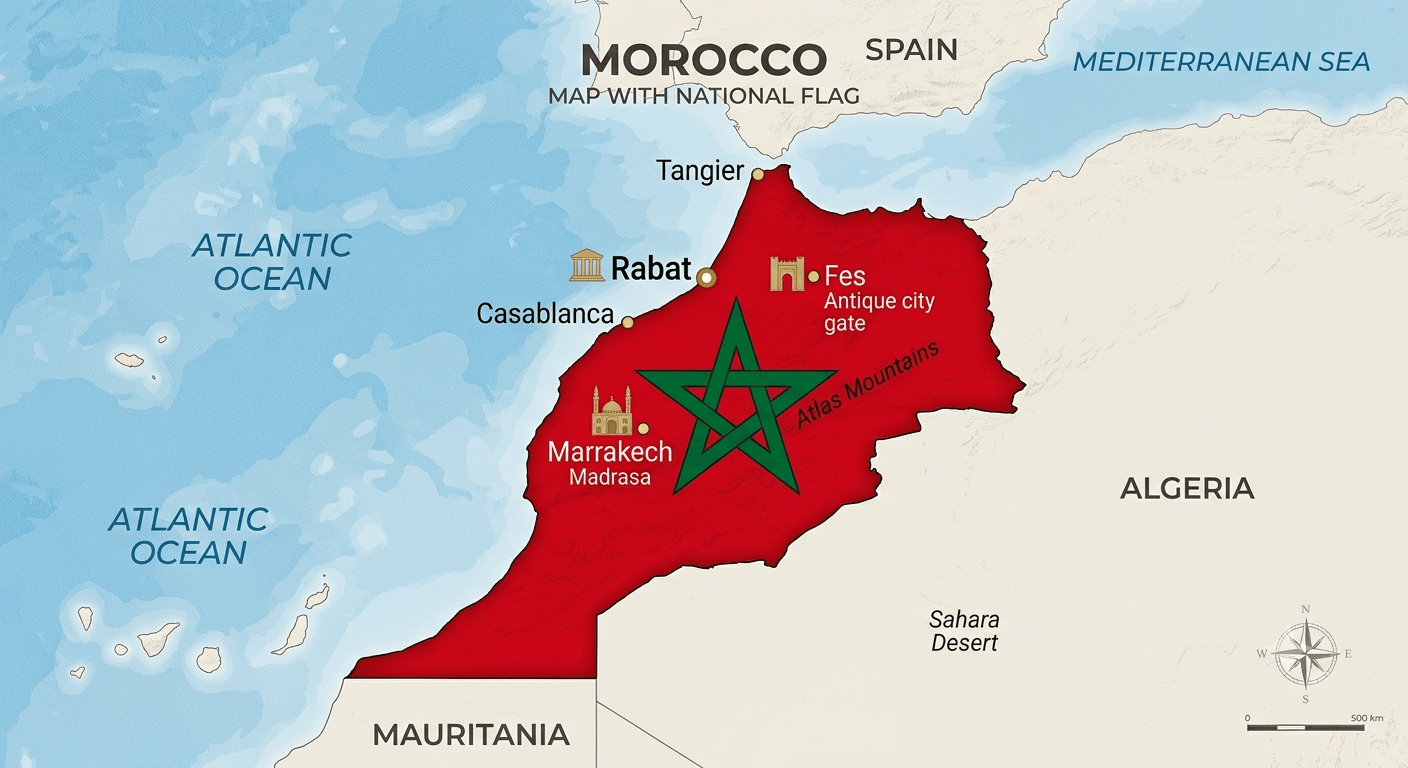
The Kingdom of Morocco (المملكة المغربية, Royaume du Maroc) occupies a pivotal strategic position at the northwestern tip of Africa, standing as the closest African nation to Europe. This geographical advantage has historically made Morocco a crucial Mediterranean cornerstone for trade and cultural exchange between Africa, Europe, and the Middle East[1].
Key Geographic Features:
- Total Land Area: 446,550 square kilometers including Western Sahara, making Morocco the 25th largest country in Africa
- Coastlines: Atlantic coast (2,094 km) and Mediterranean coast (512 km) — dual ocean access
- Major Geographic Regions: Atlas Mountains, Rif Mountains, fertile coastal plains, Sahara Desert
- Neighboring Countries: Algeria (east), Mauritania (south), Spain (north across the Strait of Gibraltar)
- Climate Zones: Mediterranean climate (coastal plains), semi-arid (interior), desert (southern Sahara regions)
Population: Approximately 38.2 million (2025 estimate), with significant growth moderated by reduced birth rates. Morocco’s population is predominantly young, with a median age of 30.5 years, representing a significant demographic advantage[2].
Capital: Rabat (political capital) — hosts royal, government, and administrative institutions. Casablanca serves as the economic capital and largest city[2].
Strategic Geographical Significance:
- Strait of Gibraltar Control: Morocco controls the southern side of the Strait of Gibraltar, one of the world’s busiest maritime chokepoints (100,000+ ships/year)
- Mediterranean-Atlantic Bridge: Only African nation with both Mediterranean and Atlantic access
- Gateway to West Africa: Traditional hub connecting Europe/Mediterranean to Sub-Saharan African markets
- EU Trade Proximity: 13 kilometers separat Morocco from Spain at the shortest point — critical for land-sea-air trade logistics[1]
Sources: CIA World Factbook: Morocco 2026 | World Bank Morocco Open Data
Morocco Government and Political System
Official Name: Kingdom of Morocco (المملكة المغربية, Royaume du Maroc)
Government System: Morocco operates as a constitutional monarchy with an elected parliamentary system. The 1996 Constitution (amended 2011 following Arab Spring protests) established a balance of power where the King retains significant executive authority while a Prime Minister and Parliament handle day-to-day governance[3].
Head of State: King Mohammed VI (reigning since 1999), who serves as both political leader and “Commander of the Faithful” (Amir al-Mu’minin) — a religious role unique among Arab monarchs[3]
Head of Government: Prime Minister Aziz Akhannouch (National Rally of Independents party; elected 2021, serving term)
Legislative Structure:
- House of Representatives: Elected body with significant legislative powers; expected 525 seats under new constitutional revisions[3]
- House of Councillors: Appointed/indirectly elected upper chamber; regional representation[3]
Administrative Reforms (2021-2026):
- Regionalization Process: Morocco established 12 administrative regions with enhanced devolved powers
- Advanced Regionalization: The 2020-2030 regionalization agenda granting regions significant autonomy over economic development[3]
Key Political Characteristics:
- Monarchical Stability: The Alaouite dynasty (ruling since 1666) provides continuity amidst regional instability
- Democratic Evolution: Morocco has gradually transferred more powers to elected governments while maintaining royal prerogatives in foreign policy, security, and religious affairs
- Multi-Party System: Active multi-party democracy with competitive elections[3]
Strategic International Alignment: Morocco normalized relations with Israel in 2020 (Abrahms Accord), positioning itself as a diplomatic bridge between Arab nations, Israel, and Africa. Morocco also maintains special partnership status with the EU and leading role in the African Union.
Source: Government of Morocco Official Portal
2. MOROCCO COUNTRY PROFILE ECONOMIC OVERVIEW: NORTH AFRICA’S ECONOMIC ENGINE
The Morocco country profile reveals one of Africa’s most diversified and resilient economies, achieving consistent 3-4% annual growth rates even amid regional turbulence. Unlike many resource-dependent African economies, Morocco has built competitive advantages in agriculture, manufacturing, tourism, and renewable energy.
Morocco Key Economic Indicators (2024-2026)
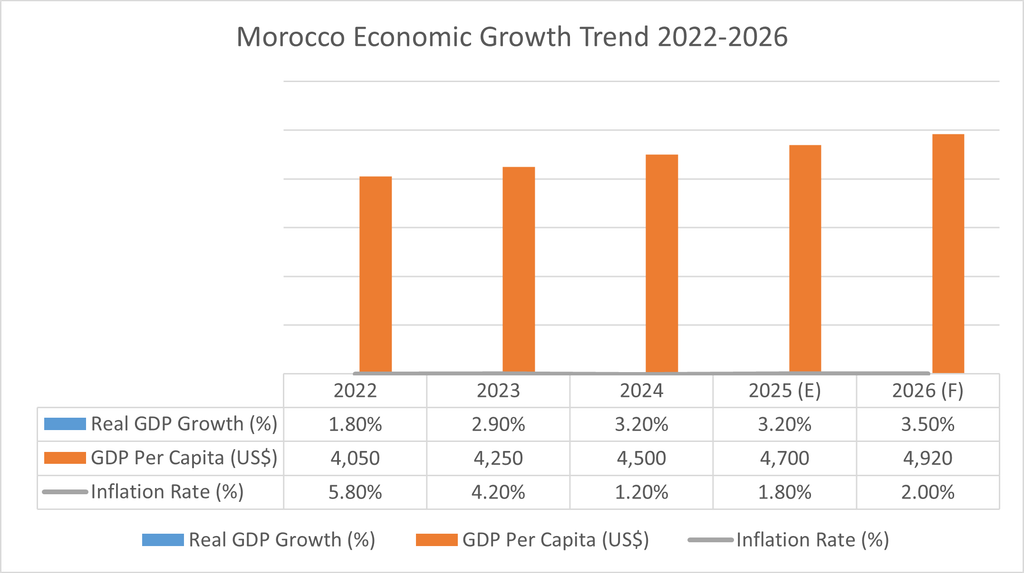
The Morocco country profile economic analysis shows stable, moderate growth with manageable debt levels compared to regional peers.
| Economic Indicator | 2024 | 2025 Estimate | 2026 Forecast | Source |
|---|---|---|---|---|
| Nominal GDP | ~US$173.8 billion | ~US$179.5 billion | ~US$188.5 billion | Ministry of Economy and Finance[5] |
| Real GDP Growth | 3.2% | 3.0-3.2% | 3.1-3.5% | World Bank/IMF[5] |
| GDP Per Capita (US$) | ~US$4,500 | ~US$4,700 | ~US$4,920 | World Bank[5] |
| Inflation Rate | ~1.2% | ~1.8% | ~1.5-2.0% | Bank Al-Maghrib[6] |
| Unemployment Rate | ~10.9% | ~9.5% (Q3 2025) | ~8.9% (target) | HCP Official Statistics[5] |
| Youth Unemployment (15-24) | 19.5% | 17.8% | ~16.0% (target) | HCP[5] |
| Current Account Balance | -5.30% of GDP | -4.80% of GDP | -4.50% of GDP | IMF[5] |
| Foreign Exchange Reserves | ~US$39.5 billion | ~US$42.2 billion | ~US$45.0+ billion | Bank Al-Maghrib[6] |
| Government Debt (% GDP) | 67.0% (below legal limit) | ~67.5% | ~66.0-68.0% | IMF Article IV[5] |
| Public External Debt | 112 (ranked 109 globally) | Stable outlook | — | ICRG/PRSG[5] |
Economic Imbalance Note: While the Morocco country profile shows stable growth, a persistent current account deficit (-4.8% of GDP) reflects reliance on remittances, tourism, and FDI to offset trade gaps. Import growth continues to outpace export growth, pressuring external balances[5].
Source: Ministry of Economy and Finance Morocco 2025 Budget Report | World Bank Morocco Economic Update July 2025 | International Monetary Fund Article IV Consultation Press Release November 2025 | Bank Al-Maghrib
Morocco Sectoral Contribution to GDP (2024-2025)
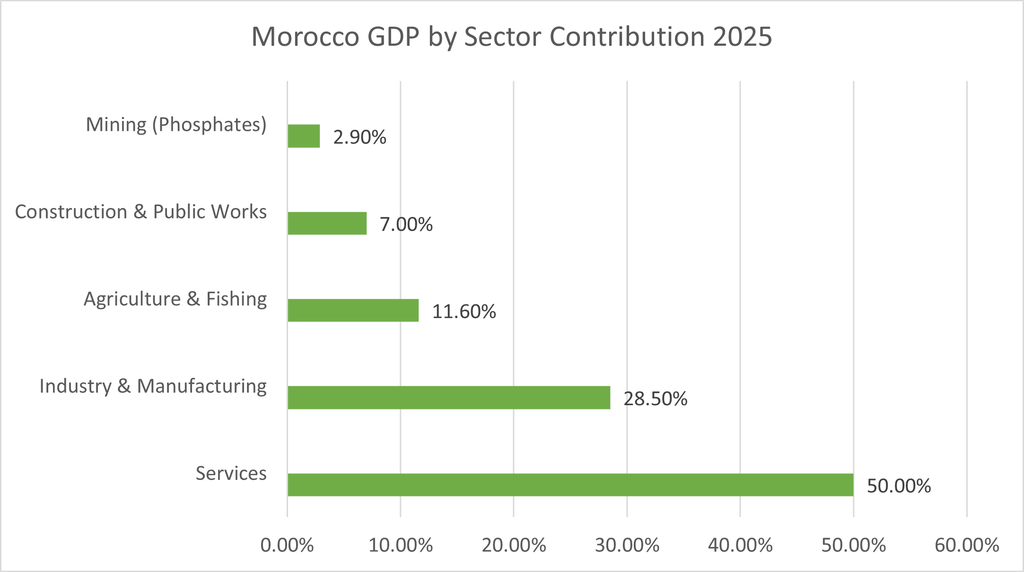
The Morocco country profile demonstrates remarkable economic diversification, with no single sector dominating economic output — a rare achievement among African economies.
| Sector | % of GDP | Key Activities | Growth Trend | Morocco Country Profile Competitive Advantage |
|---|---|---|---|---|
| Services (Tourism, Finance, Telecom) | 50.0% | Tourism, banking, retail, insurance, telecommunications | Strong + tourism recovery | Strategic location, multilingual workforce, EU market proximity |
| Industry & Manufacturing | 28.5% | Automotive (largest), aerospace, textiles, phosphates processing | Automotive export leader in Africa | Free trade zones, skilled labor, export logistics |
| Agriculture & Fishing | 11.6% | Citrus fruits, vegetables, cereals, olive oil, fish processing | Climate-dependent significant volatility | EU market access, quality irrigation, premium product reputation |
| Construction & Public Works | 7.0% | Infrastructure, housing, industrial zones | Government-led infrastructure push | Major public investment program (2021-2026) |
| Mining (Phosphates) | 2.9% | Phosphate rock extraction, fertilizers, chemicals | Global price-sensitive phosphate monopoly | World’s largest phosphate reserves holder |
Total GDP at Current Prices: ~Dh 1,607 billion (~US$179.5 billion at Dh 8.95 per USD)
Key Economic Strengths in Morocco Country Profile:
- Manufacturing Leadership: Automotive sector surpassed phosphates as top export category (31.6% of total exports in 2024); aerospace emerging as secondary niche[7]
- Agricultural Competitiveness: World’s largest exporter of phosphate fertilizers and top producer of argan oil; substantial fresh produce exports to EU[8]
- Tourism Recovery: 14+ million international visitors in 2024, recovering to pre-pandemic levels; tourism revenues ~7% of GDP[9]
- Financial Hub: Casablanca Finance Center emerging as African financial services hub; region’s 5th largest stock exchange[10]
- Renewable Energy Pioneer: 44% renewable energy target by 2030 and 10-14% export capacity in Europe[11]
Automotive Sector Insight: Morocco’s automotive sector exported ~US$8.6 billion in 2024 — making it Africa’s undisputed leader, attracting Renault, Peugeot, Stellantis, and 250+ suppliers. The country has positioned itself as Europe’s “extended factory floor” in Africa[7].
Source: Moroccan Exports Automotive Sector Dashboard 2025 | OCP Group World’s Largest Phosphate Producer | Ministry of Tourism Morocco | Casablanca Finance City Authority | Ministry of Energy Transition Morocco
3. MOROCCO COMMERCIAL AND INVESTMENT OPPORTUNITY ANALYSIS
Morocco Export Performance (2024)
| Product Category | Export Value | % Moroccan Exports | Key Markets | Morocco Country Profile Export Strategy |
|---|---|---|---|---|
| Automotive & Parts | US$8.6 billion | 31.6% | France, Spain, Germany, UK | Positioning as African automotive export hub |
| Agricultural Products | US$5.3 billion | 19.5% | EU, Canada, Russia, West Africa | Premium quality strategy for EU produce |
| Phosphates & Fertilizers | US$4.9 billion | 18.0% | Brazil, India, Europe, USA | World’s largest exporter strategy |
| Textiles & Clothing | US$2.9 billion | 10.6% | Spain, France, UK, Belgium | Quick turnaround for EU fashion seasons |
| Electrical Equipment | US$1.4 billion | 5.1% | France, Germany, West Africa | Emerging electronics manufacturing |
| Seafood & Fish Products | US$1.2 billion | 4.4% | EU, Japan, Russia | Sustainable fisheries management |
| Aerospace Components | US$950 million | 3.5% | France, USA, Spain | Niche precision manufacturing |
| Other Products | US$1.1 billion | 4.0% | Various markets | Diversification initiatives |
Source: Moroccan Customs Administration 2024 Year-End Report
Top Export Markets for Morocco (2024)
| Country/Region | Moroccan Export Value | % Total | Key Products |
|---|---|---|---|
| France | US$6.5 billion | 23.8% | Automotive, textiles, electronics, agricultural |
| Spain | US$5.2 billion | 19.1% | Automotive, textiles, seafood, agricultural |
| Brazil | US$2.8 billion | 10.2% | Fertilizers, phosphates |
| Germany | US$1.6 billion | 5.9% | Automotive, textiles, electrical |
| Italy | US$1.5 billion | 5.4% | Textiles, agricultural, seafood |
| United Kingdom | US$1.3 billion | 4.8% | Automotive, textiles, agricultural |
| United States | US$1.2 billion | 4.4% | Fertilizers, phosphates, textiles |
| Turkey | US$900 million | 3.3% | Automotive, textiles, fertilizers |
| Netherlands | US$800 million | 2.9% | Agricultural products, fertilizers |
| India | US$750 million | 2.7% | Fertilizers, phosphates |
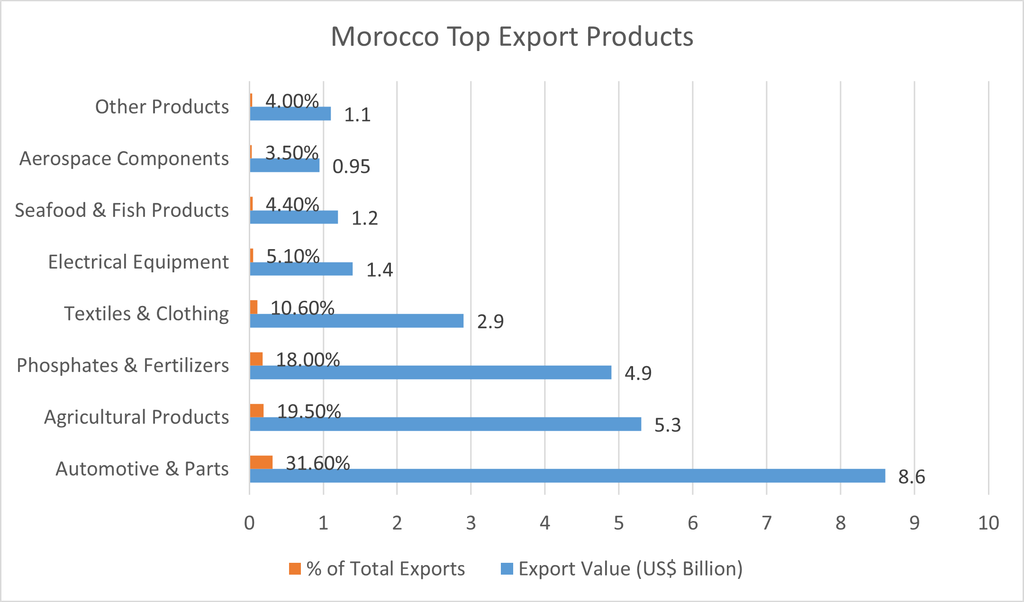
Morocco Country Profile Export Strategy: 42% of exports go to France & Spain alone, leveraging historical ties and geographical proximity. Morocco has strategically targeted automotive as its industrial export champion, overtaking traditional agricultural and phosphate exports[7].
Morocco Import Profile (2024)
| Product Category | Import Value | % Total | Primary Sources |
|---|---|---|---|
| Mineral Fuels & Oils | US$11.3 billion | 19.5% | Saudi Arabia, Nigeria, USA, Russia |
| Machinery & Mechanical Equipment | US$9.8 billion | 17.0% | France, Germany, China, Spain |
| Electrical Equipment | US$8.2 billion | 14.2% | China, Germany, Spain, France |
| Vehicles & Auto Parts | US$5.6 billion | 9.7% | France, Spain, Germany, China |
| Plastics & Rubber | US$2.8 billion | 4.9% | Saudi Arabia, USA, France |
| Pharmaceuticals | US$2.4 billion | 4.1% | France, Germany, Switzerland |
| Cereals & Grains | US$2.3 billion | 4.0% | France, Ukraine, Canada, USA |
| Iron & Steel | US$2.2 billion | 3.8% | China, France, Spain |
| Chemicals | US$2.0 billion | 3.5% | France, Germany, Belgium |
| Textile Yarns & Fabrics | US$1.6 billion | 2.8% | China, Turkey, Spain, France |
Morocco Country Profile Import Strategy: Heavy dependence on energy imports (19.5%) and manufacturing inputs (machinery, electrical, vehicles combined 41%) reflects Morocco’s industrial supply-chain strategy. 40% of pharmaceutical needs imported represent opportunity for substitutes[12].
Source: Moroccan Customs Administration Import Data 2024
4. MOROCCO COUNTRY PROFILE EDUCATION SYSTEM: FOUNDATION FOR ECONOMIC DEVELOPMENT
The Morocco country profile education system has undergone significant reforms since the 2015-2030 Vision educational reform program, producing notable improvements in enrollment and literacy.
Morocco Education Structure
- Primary Education: 6 years (compulsory, ages 6-12)
- Middle School: 3 years (collège, ages 12-15)
- High School: 3 years (lycée, ages 15-18)
- Higher Education: Universities, Grandes écoles (engineering/business), vocational institutes
- Language of Instruction: Arabic (primary), French (secondary and higher education), with increasing English[13]
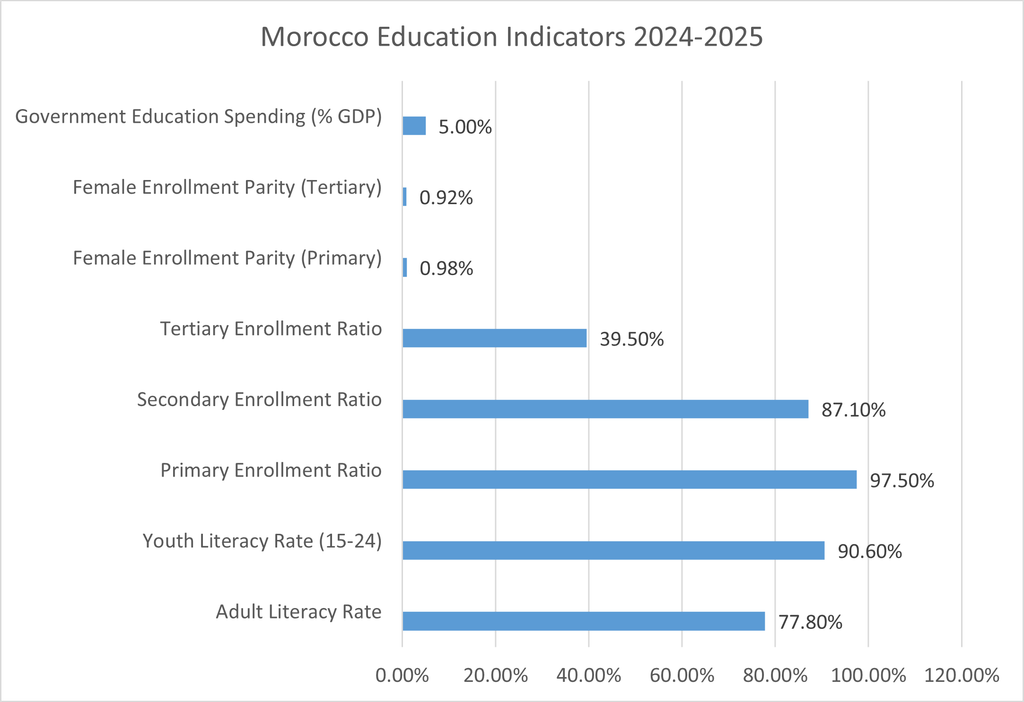
Morocco Education and Literacy Indicators
| Education Metric | Value (2024-25) | Trend | Morocco Country Profile Benchmark |
|---|---|---|---|
| Adult Literacy Rate | 77.8% (2023) | Steadily improving | Above MENA average (73.4%) |
| Youth Literacy Rate (15-24) | 90.6% (2023) | Strong improvement | Higher than adult rate reflects investment |
| Primary Enrollment Ratio | 97.5% (2024) | Near-universal access | Gender parity achieved |
| Secondary Enrollment Ratio | 87.1% (2024) | Improving | Lower than primary but growing |
| Tertiary Enrollment Ratio | 39.5% (2024) | Growing | Among highest in Africa |
| Female Enrollment Parity Index | 0.98 (primary) | Near parity | Progressive gender balance |
| 0.92 (tertiary) | Strong progress | Particularly in STEM | |
| Government Education Spending | 5.0-5.5% of GDP | Among highest in MENA | Major reform priority |
| Public Universities | 85+ institutions | Expanding access | Geographically distributed |
| Technical/Vocational Schools | 400+ | Focus on skills alignment | Employment linkage priority |
Morocco Country Profile Education Strengths:
- University System: Mohammed V University (Rabat), Cadi Ayyad University (Marrakech), Hassan II University (Casablanca) rank among Africa’s top 100
- Languages: Trilingual/bilingual population (Arabic, French, growing English) creates workforce adaptability
- Reform Momentum: 2015-2030 Vision for Education continues with decentralized management and curriculum modernization[13]
Sources: Ministry of Education Morocco Strategic Plan 2025-2030 | UNESCO Institute for Statistics | World Bank Education Sector Review
5. MOROCCO HEALTH AND SOCIAL INDICATORS
Morocco Key Health Metrics
| Health Indicator | Value (2024-25) | Trend | Morocco Country Profile Benchmark |
|---|---|---|---|
| Life Expectancy at Birth | 76.9 years | Improvement since 2010 | Above MENA average (73.4 years) |
| Infant Mortality Rate | 16.2 per 1,000 | Significant decline | Below MENA average (19.5) |
| Maternal Mortality Ratio | 72 per 100,000 | Reduction target on track | Lagging vs some peers |
| Healthcare Coverage | ~75-80% | Expanding through RAMED | Universal coverage target |
| Universal Health Coverage Index | 67/100 | Improving steadily | Above African average (55) |
| Health Expenditure per Capita | US$420 (current) | Growing | Higher than AfDB low-income benchmark |
| Physicians per 10,000 | 7.4 (2023) | Improving but uneven | Urban concentration persists |
| Child Malnutrition (Stunting) | 15.1% (2024) | Persistently high | Priority concern in rural areas |
| Fully Immunized Children | 95% (2024) | High achievement | Exceeds WHO 90% target |
Morocco Social Development Indicators
| Social Indicator | Value (2024-25) | Policy Context |
|---|---|---|
| Human Development Index (HDI) | 0.683 (2023) | “Medium human development” category |
| HDI Global Rank | 123rd of 193 countries (2023) | Lower than economic ranking suggests |
| Gini Coefficient (Inequality) | 39.5 (2020) | Moderate inequality; rural-urban divides |
| Poverty Rate (National) | 4.8% (2024) | Significant reduction from double digits (2015) |
| Extreme Poverty | ~0.4% (2024) | Almost eliminated |
| Youth Unemployment (15-24) | 17.8% (2025) | Priority national challenge |
| Women in Parliament | 24.3% (2025) | Above regional average; legal quota |
| Internet Penetration | 88.4% (2025) | High connectivity, 4G/5G expanding |
| Mobile Phone Penetration | 130.2% (2025) | Multiple SIMs typical |
| Access to Electricity | 100% (urban), 99.5% (rural) | Near-universal access achievement |
| Access to Clean Water | 98% (urban), 85% (rural) | Rural access gaps being addressed |
Morocco Country Profile Health Care System Evolution:
- RAMED (Régime d’Assistance Médicale): Government-funded health coverage for low-income citizens
- AMO (Assurance Maladie Obligatoire): Compulsory health insurance for formal sector workers
- Private Sector Expansion: Growing private clinics and hospitals serving middle/upper classes[14]
Source: Ministry of Health Morocco 2025 Statistical Report | World Health Organization Eastern Mediterranean Regional Office
6. BANGLADESH-MOROCCO RELATIONS IN THE MOROCCO COUNTRY PROFILE CONTEXT
Diplomatic Framework and Institutional Cooperation
The Morocco country profile includes established diplomatic relations with Bangladesh, dating to the post-independence period. The relationship is operationalized primarily through the Moroccan Embassy in Dhaka (established in 2018) and Bangladesh’s diplomatic presence in Rabat[15].
Key Historical Milestones:
- Early Diplomatic Recognition: Morocco recognized Bangladesh in the early 1970s
- Embassy Opening (Dhaka 2018): Establishment of Moroccan Embassy in Dhaka signaled deeper engagement
- Trade Delegations: Regular Bangladesh business delegations to Morocco organized by FBCCI and export promotion agencies
- Private Sector Engagement: Moroccan companies exploring Bangladeshi pharma, textile, and leather imports
Bilateral Cooperation Platforms
| Platform | Bangladesh Role | Morocco Role | Morocco Country Profile Relevance |
|---|---|---|---|
| Moroccan Embassy in Dhaka (Opened 2018) | Hosting embassy, issuing visas | Active commercial section promoting bilateral trade | Physical institutional presence lowers transaction costs |
| United Nations | Both full members, cooperation in multilateral forums | — | Routine diplomatic contact |
| Organisation of Islamic Cooperation (OIC) | Both full members | Morocco holds significant influence in OIC | Potential channel for trade financing through IsDB |
| WTO & UNCTAD | Both full members | — | Legal framework for trade disputes/cooperation |
| South-South Cooperation | Both active | Morocco positions as African leader | Aligns with Bangladesh’s “Look Africa” strategy |
| African Union | Observer status sought | Full member, influential | Potential AU platform for engagement |
Current Engagement Characteristics:
- Diplomatic: Consular services and public diplomacy handled by Moroccan Embassy Dhaka
- Commercial: Embassy commercial section facilitates trade and investment matchmaking
- Educational: Limited scholarship opportunities available for Bangladeshi students
- Cultural: Limited exchange; mostly consular-cultural events[15]
Source: Moroccan Embassy Dhaka Official Website | Bangladesh Ministry of Foreign Affairs Bilateral Relations Database
7. BANGLADESH-MOROCCO TRADE ANALYSIS WITHIN MOROCCO COUNTRY PROFILE
Bilateral Trade Overview
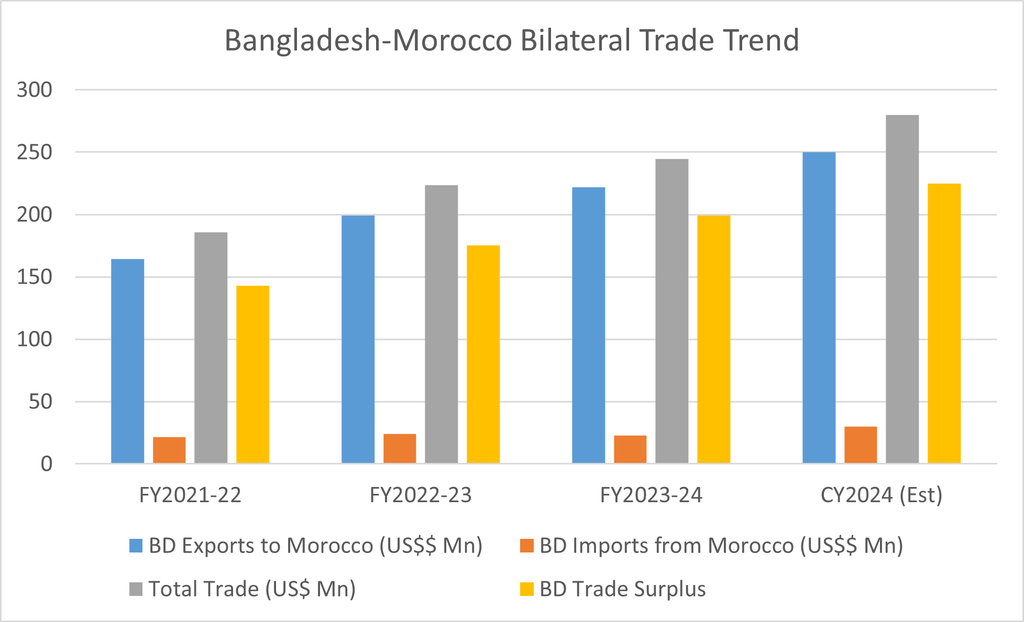
| Period | Bangladesh Exports to Morocco (US$$ Mn) | Bangladesh Imports from Morocco (US$$ Mn) | Total Trade (US$ Mn) | Trade Balance (BD) | Source |
|---|---|---|---|---|---|
| FY2021-22 | 164.32 | 21.31 | 185.63 | +143.01 | EPB/DCCI |
| FY2022-23 | 199.32 | 24.18 | 223.50 | +175.14 | EPB/DCCI |
| FY2023-24 | 221.87 | 22.64 | 244.51 | +199.23 | EPB Report |
| CY2024 (Estimate) | ~230-250 | ~25-30 | ~255-280 | +200-225 | Calculated |
Current Bilateral Trade Characteristics:
- Magnitude: ~US$250-280 million total bilateral trade (small relative to Morocco’s ~US$58 billion total trade)
- Imbalance: Consistent 8:1 surplus in Bangladesh’s favor
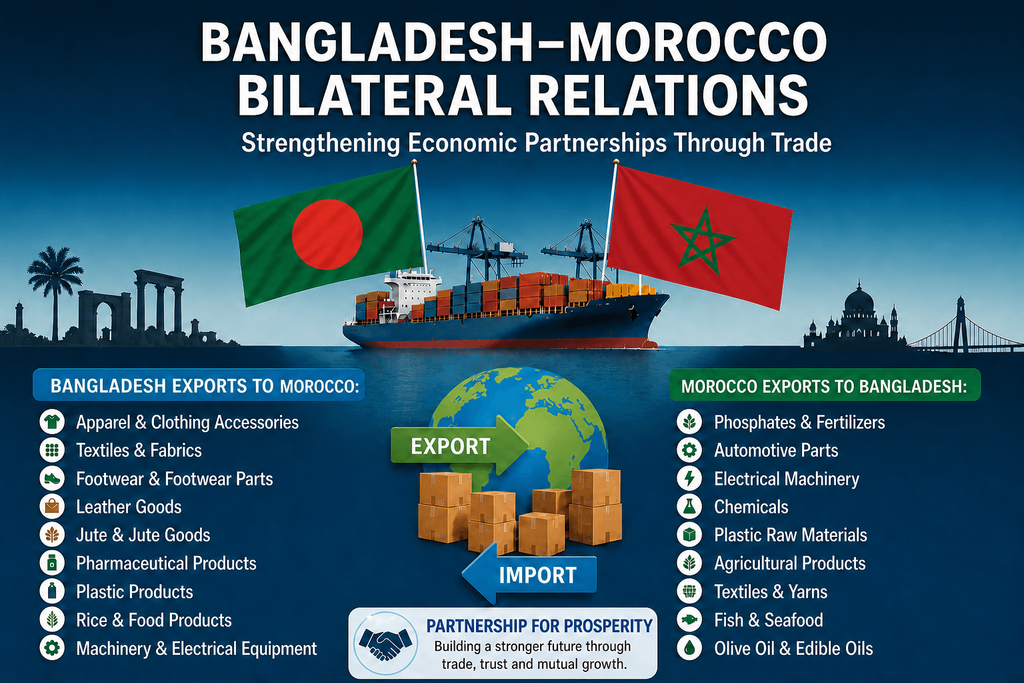
- Product Structure: Bangladesh exports apparel/textiles; Morocco exports fertilizers, phosphates, agricultural products
- Growth Pattern: 35% bilateral trade growth over three years (2021-2024)
What Bangladesh Exports to Morocco (Top Products)
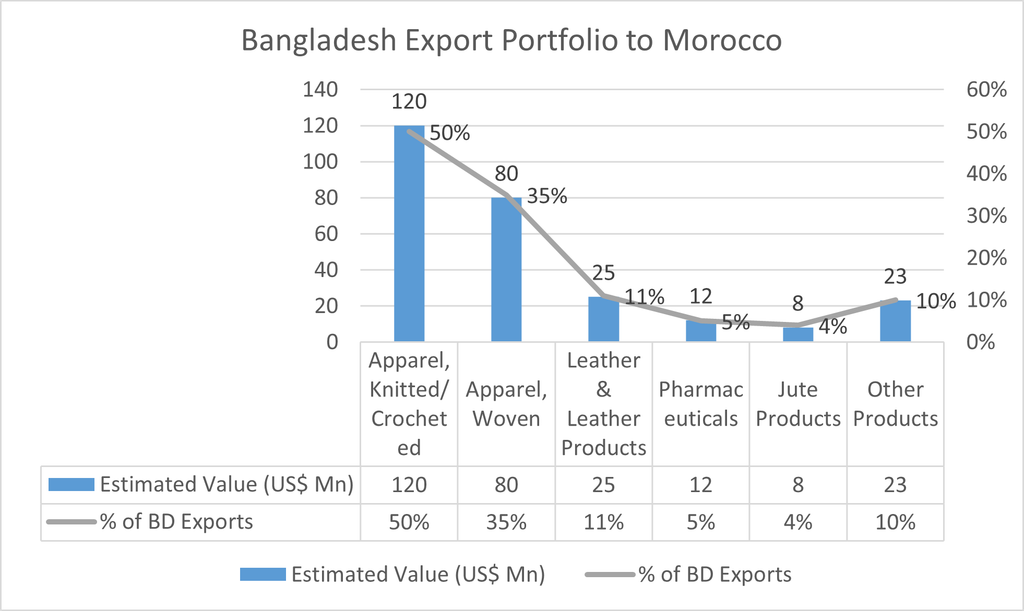
| Product Category | Estimated Value (US$ Mn) | % of BD Exports to Morocco | HS Code | End Use |
|---|---|---|---|---|
| Apparel, Knitted/Crocheted | ~100-120 | 45-50% | HS61 | Retail, clothing market |
| Apparel, Woven | ~70-80 | 30-35% | HS62 | Retail, clothing market |
| Leather & Leather Products | ~20-25 | 9-11% | HS41-43 | Shoes, accessories |
| Pharmaceuticals | ~8-12 | 3-5% | HS30 | Healthcare sector |
| Jute Products | ~5-8 | 2-4% | HS53 | Packaging, handicrafts |
| Other Products | ~18-23 | 8-10% | Mixed | Various |
Key Export Insights:
- Apparel Dominance: 75-85% of Bangladesh’s exports to Morocco are RMG products, reflecting core competitive advantage
- Pharmaceutical Niche: Growing foothold (US$8-12 Mn) in higher-value sector
- Jute Potential: US$5-8 million jute exports suggests packaging/sustainability appeal
What Morocco Exports to Bangladesh (Top Products)
| Product Category | Estimated Value (US$ Mn) | % of Morocco’s Exports to BD | HS Code | Origin in Bangladesh |
|---|---|---|---|---|
| Fertilizers & Chemicals | ~15-18 | 60-70% | HS31 | Agriculture sector |
| Inorganic Chemicals | ~3-5 | 12-20% | HS28 | Industrial use |
| Fresh Fruit & Vegetables | ~2-4 | 8-15% | HS07-08 | Retail, processing |
| Other Products | ~1-3 | 5-10% | Mixed | Various |
Morocco’s Export Strategy to Bangladesh:
- Phosphate Leadership: Leverages world’s largest phosphate reserves for fertilizer exports to Bangladesh’s agricultural sector
- Fertilizer-Food Chain: Bangladesh’s agricultural demand aligns with Morocco’s fertilizer export capacity
- Limited Product Range: Focused almost entirely on fertilizers and basic chemicals
Key Findings in Morocco Country Profile Trade Analysis:
- Structural Complementarity: Bangladesh’s labor-intensive manufacturing vs Morocco’s resource-based exports creates natural trade pattern
- Growth Potential: Current trade is <0.5% of Morocco’s total trade — significant expansion possible
- Apparel Market Opportunity: Morocco’s trade deficit suggests potential for further Bangladesh RMG market penetration
- Geographical Logic: Morocco’s EU market access could make it a re-export hub for Bangladeshi goods to North Africa/Europe[16]
Source: Bangladesh Export Promotion Bureau Bilateral Trade Statistics 2024 | Moroccan Customs Administration
8. INVESTMENT AND BUSINESS OPPORTUNITIES IN MOROCCO COUNTRY PROFILE
For Bangladeshi Exporters and Entrepreneurs
Primary Sectors with Maximized Potential:
| Sector | Bangladeshi Competitive Edge | Moroccan Market Need | Estimated Annual Potential |
|---|---|---|---|
| Ready-Made Garments | World’s second largest RMG exporter; cost advantage | Textile import dependence; fashion-conscious market | US$50-100 Mn additional within 3-5 years |
| Pharmaceuticals | WHO-GMP certified; affordable generics | High pharmaceutical import bill (US$2.4 Bn); universal health coverage expansion | US$15-25 Mn within 3 years |
| Leather & Footwear | Third largest leather processor globally | Footwear/leather goods imports; fashion market growing | US$10-20 Mn within 3 years |
| Jute Products | World’s largest jute producer; sustainability appeal | EU-related sustainability pressures; packaging demand | US$5-10 Mn within 3 years |
| Processed Foods | Established food processing sector; halal certification | High food import dependence; growing middle class | US$8-15 Mn within 3 years |
Market Entry Strategy for Morocco:
- Direct Distribution: Partner with Moroccan importers/distributors in Casablanca and Tangier Free Zone
- Showroom Presence: Establish showrooms in Casablanca’s commercial districts
- Digital Commerce: Leverage Morocco’s high internet penetration for e-commerce strategy
- Trade Fair Participation: Participate in Casablanca International Fair and textile/apparel expos
- Re-Export Hub: Use Morocco’s EU trade agreements for Made in Bangladesh goods to Europe[17]
Source: Moroccan Investment Development Agency (AMDIE) Investment Guide 2025
For Moroccan Investors and Importers
Why Source from Bangladesh:
| Product Category | Bangladeshi Advantage | Morocco Import Substitution Potential |
|---|---|---|
| Apparel/Textiles | 40-50% cost advantage vs Chinese/Vietnamese competitors | Current imports from Turkey/China expensive |
| Pharmaceuticals | 30-40% cheaper than European generics | Healthcare cost pressures demand affordable alternatives |
| Leather Goods | 25-35% cost advantage with quality comparable | High-end fashion production could leverage Bangladeshi inputs |
| Jute Products | Unmatched scale and price for eco-friendly packaging | EU sustainability standards create demand for non-plastic alternatives |
| Processed Foods | Halal-certified at competitive rates | Growing Muslim consumer market with disposable income |
Strategic Sourcing Rationale:
- Cost Reduction: Significant savings across multiple import categories
- Quality Standard: Bangladesh products meet international standards (ISO, OEKO-TEX, WHO-GMP)
- Geographical Complementarity: Seasonal product alignment possible (e.g., winter clothing)
- Diversification: Reduce dependence on traditional suppliers (China, Turkey, Europe)
9. PRACTICAL GUIDANCE FOR BUSINESS ENGAGEMENT
Establishing Business Presence in Morocco
| Step | Description | Requirements | Timeline |
|---|---|---|---|
| 1. Market Research | Understand consumer preferences in Casablanca, Rabat, Marrakech | Local market intelligence; consumer surveys | 2-3 months |
| 2. Partner Identification | Identify Moroccan importer/distributor | Business registry checks; Chamber of Commerce referrals | 1-2 months |
| 3. Product Registration | Register products with regulatory authorities | Technical specifications; certificates of analysis | 1-3 months |
| 4. Sample Testing | Test products for local market acceptance | Small sample shipments; focus groups | 1 month |
| 5. Distribution Setup | Establish logistics and distribution | Warehouse space; delivery arrangements | 1-2 months |
| 6. Marketing Launch | Launch marketing campaign | Digital marketing; trade show participation | 1 month |
Key Institutions for Market Entry:
- Moroccan Investment Development Agency (AMDIE): Primary investment facilitation
- Casablanca Finance City Authority: Financial services hub registration
- Chamber of Commerce and Industry: Business matchmaking and registration
- Tangier Free Zone: Export processing zone benefits[18]
Source: Ministry of Investment, Convergence and Evaluation of Public Policies — Investment Procedures Guide
Regulatory Environment Essentials
| Regulatory Area | Moroccan Requirements | Notes for Bangladeshi Businesses |
|---|---|---|
| Company Registration | Minimum capital requirements; business plan submission | Consider local partner or legal advisory |
| Product Standards | Moroccan standards (normes marocaines) apply | EU standards often accepted as equivalent |
| Customs Procedures | E-customs system; documentation requirements | Work with experienced customs broker |
| Taxation | Corporate tax 31%; VAT 20% standard rate | Tax incentives available in specific zones/sectors |
| Labor Regulations | Labor code compliance; social security contributions | Local labor contracts required for local hires |
| Intellectual Property | IP protection through OMPIC | Register trademarks and patents proactively |
| Environmental Compliance | Environmental impact assessments for certain sectors | Sustainability increasingly important for market access |
Accessing Financing Support
| Instrument | Moroccan Source | Bangladeshi Source | Purpose |
|---|---|---|---|
| Trade Finance | Attijariwafa Bank, BMCE Bank, Banque Populaire | Bangladesh Bank’s export development fund | Export-import financing |
| Investment Loans | AMDIE financing programs | BIDA outward investment support | Joint ventures |
| Guarantee Facilities | Caisse Centrale de Garantie | Bangladesh Export Development Fund | Risk mitigation |
| Currency Hedging | Moroccan commercial banks | Bangladeshi commercial banks | Exchange rate risk management |
10. CONCLUSIONS AND RECOMMENDATIONS FOR MOROCCO COUNTRY PROFILE ENGAGEMENT
Strategic Recommendations for Bangladesh
Immediate Actions (0-6 months):
- Launch Bangladesh-Morocco Business Council: Formal institutional framework between FBCCI and Moroccan counterpart
- Bangladesh Trade Desk in Casablanca: Physical presence to facilitate market entry
- Targeted Trade Mission: Sector-specific delegation focusing on apparel, pharmaceuticals, leather
- Digital Market Intelligence Platform: Real-time Moroccan market data for Bangladeshi exporters
Medium-Term Initiatives (6-24 months):
- Bilateral Preferential Trade Agreement: Negotiate tariff reductions for key product categories
- Joint Venture Facilitation Fund: Co-financing for Bangladeshi-Moroccan manufacturing joint ventures
- Re-Export Logistics Hub: Utilize Morocco’s EU trade agreements for Bangladesh-made goods
- Educational Exchange Program: Moroccan students in Bangladesh for technical/vocational training
Long-Term Vision (2-5 years):
- US$500 Million Bilateral Trade Target: Ambitious but achievable growth trajectory
- Supply Chain Integration: Bangladesh textile inputs for Moroccan fashion industry
- Regional Hub Strategy: Morocco as gateway for Bangladeshi products to North/West Africa
- Knowledge Exchange: Moroccan agricultural technology with Bangladeshi manufacturing expertise
Areas for Further Research
- Detailed Consumer Preferences: Granular understanding of Moroccan consumer behavior by region
- Regulatory Harmonization: Comprehensive analysis of Moroccan vs. Bangladeshi standards
- Logistics Cost Optimization: Route analysis for Bangladesh-Morocco shipping efficiency
- Competitor Analysis: Systematic study of Chinese, Turkish, and European suppliers in Morocco
- Policy Dialogue Mechanisms: Identification of institutional channels for trade facilitation
The Morocco country profile presents a compelling case for enhanced bilateral engagement. Strategic investment in this relationship could yield substantial dividends for both economies.
REFERENCES
Ministry of Investment, Convergence and Evaluation of Public Policies
https://www.investissement.gov.ma
CIA World Factbook: Morocco
https://www.cia.gov/the-world-factbook/countries/morocco/
World Bank Morocco Open Data
https://data.worldbank.org/country/morocco
Government of Morocco Official Portal
https://www.maroc.ma/en
World Bank Morocco Economic Update July 2025
https://www.worldbank.org/en/country/morocco/publication/morocco-economic-update
Moroccan Ministry of Economy and Finance 2025 Budget Report
https://www.finances.gov.ma
Bank Al-Maghrib Economic Reports
https://www.bkam.ma
Moroccan Automotive Industry Association Reports
https://www.amica.ma
OCP Group Corporate Reports
https://www.ocpgroup.ma
Moroccan Ministry of Tourism Statistics
https://www.visitmorocco.com
Casablanca Finance City Authority
https://www.cfc.ma
Moroccan Ministry of Energy Transition
https://www.mem.gov.ma
Moroccan Customs Administration Annual Report 2024
https://www.douane.gov.ma
Moroccan Ministry of Education Strategic Plan
https://www.men.gov.ma
Moroccan Ministry of Health Statistical Reports
https://www.sante.gov.ma
Moroccan Embassy Dhaka Official Website
https://www.mae.gov.ma
Bangladesh Export Promotion Bureau Bilateral Trade Statistics
https://www.epb.gov.bd
Moroccan Investment Development Agency (AMDIE) Investment Guide
https://www.invest.gov.ma
For more information, contact us