Book Appointment Now

Nigeria: With a Focus on Bangladesh–Nigeria Bilateral Relations
1. Country Profile
1.1 Geographical Location and Political Structure
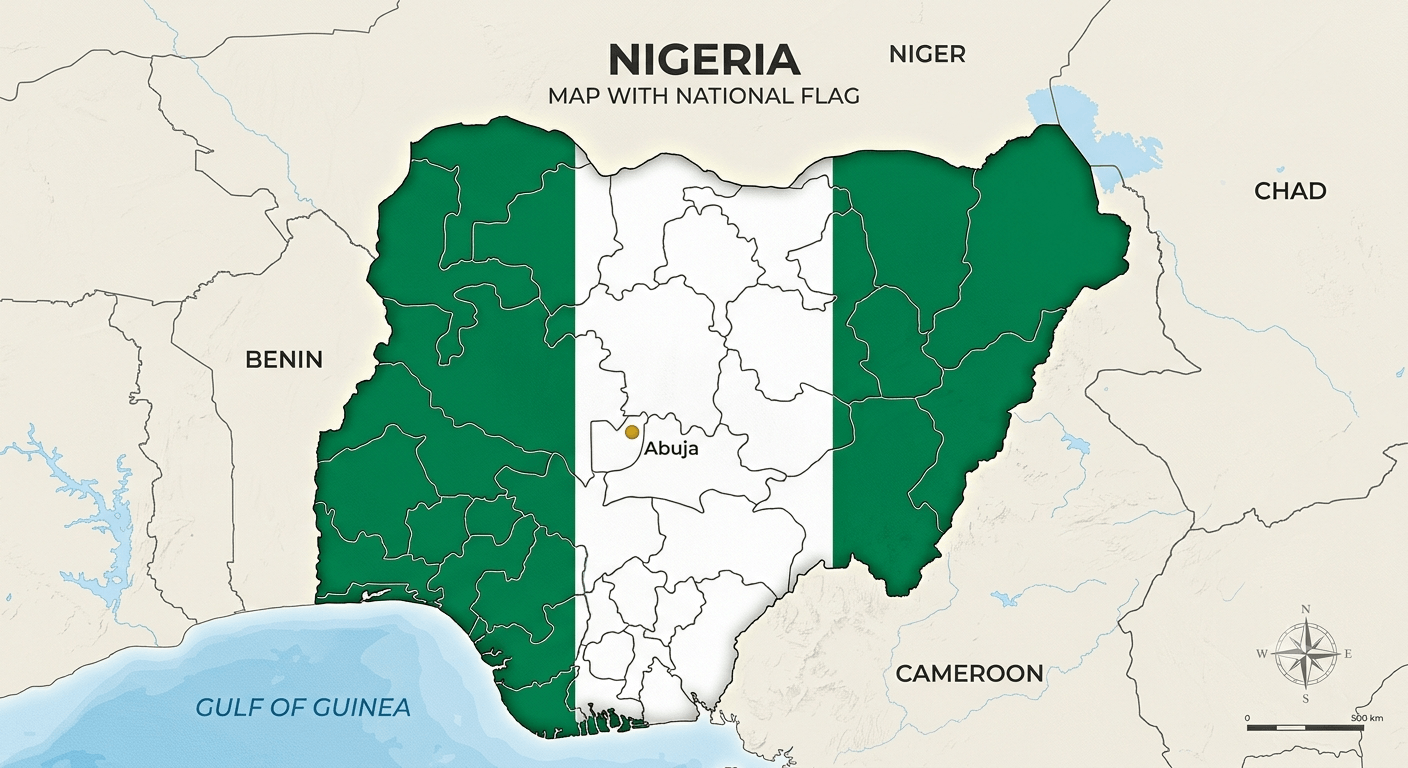
Nigeria, officially the Federal Republic of Nigeria, is located in West Africa on the Gulf of Guinea, bordered by Benin, Niger, Chad, and Cameroon, with a total land area of approximately 923,768 sq. km and a coastline on the Atlantic Ocean. Abuja is the federal capital, while Lagos remains the principal commercial hub. Nigeria operates a federal presidential republic comprising 36 states and the Federal Capital Territory, with executive power vested in an elected president and a bicameral National Assembly (Senate and House of Representatives).
1.2 Economic Overview
Nigeria is Africa’s most populous nation, with a population estimated at 232.7 million in 2025 (World Bank, Macro Poverty Outlook, 2025) and one of the continent’s largest economies. According to World Bank national accounts data, nominal GDP stood at US$187.76 billion in 2024, while the African Development Bank (AfDB, Nigeria Economic Outlook, 2026) reports real GDP growth of 4.0% in 2025 (from 4.1% in 2024), driven by services, oil, and agriculture.
The World Bank’s January 2026 Global Economic Prospects report projects growth strengthening to 4.4% in both 2026 and 2027, supported by tax reform, monetary tightening, and higher oil output. Inflation eased to 23.0% in 2025 from 33.2% in 2024 (AfDB, 2026), while the current account surplus stood at 6.0% of GDP, aided by higher oil receipts and remittances. GDP per capita was recorded at US$2,447.64 in 2024 (World Bank/Trading Economics).
1.3 Agricultural Sector
Agriculture remains structurally important, contributing 20.35% of GDP value-added in 2024 (World Bank) and employing approximately 33.5% of the labour force in 2025 (World Bank, via Statista). Crop production accounts for roughly 90% of agricultural GDP, followed by livestock (6%), fisheries (3%), and forestry (1%). The World Bank (2025) notes that agricultural exports made up 40% of Nigeria’s non-oil exports in 2023, though yields remain low — Nigerian rice yields average about 2 tonnes/ha versus 4 tonnes/ha in Ghana and Senegal — reflecting persistent structural constraints.
1.4 Industrialization and Manufacturing
Nigeria’s economy remains services-led (approximately 50–56% of GDP), with industry contributing around 15% and oil and gas roughly 11% of GDP (Trading Economics, NBS data). Manufacturing output reached N4.74 trillion in Q4 2025 (National Bureau of Statistics), while construction contributed N2.50 trillion. Manufacturing is concentrated in food and beverages, cement, petroleum refining, and light consumer goods, constrained by inadequate power supply and high input costs.
2. Trade and Economic Profile
2.1 Trade Overview
Nigeria recorded total merchandise trade of N36.21 trillion in Q4 2025, a marginal 1.07% year-on-year decline, with exports of N18.96 trillion and imports of N17.25 trillion, yielding a trade surplus of N1.71 trillion (National Bureau of Statistics, Q4 2025 Foreign Trade Statistics). In Q3 2025, exports had reached N22.81 trillion against imports of N16.12 trillion — a N6.69 trillion surplus — reflecting crude oil’s continued dominance, which alone accounted for 56.14% of total exports that quarter.
2.2 Major Export and Import Products
| Exports (HS Category) | Share, Q1 2025 |
| Mineral fuels & oils (HS 27) | 84.9% (US$11.5B) |
| Cocoa & cocoa products (HS 18) | 6.7% (US$906.9M) |
| Fertilizers (HS 31) | 4.1% (US$561.7M) |
| Edible fruits & nuts (HS 08) | 0.8% |
| Imports (Q4 2025) | Share of Total Imports |
| Machinery & transport equipment | 29.75% (N5.13tn) |
| Mineral fuels | 26.19% (N4.52tn) |
| Chemicals & related products | 15.68% (N2.70tn) |
Source: National Bureau of Statistics of Nigeria, Foreign Trade in Goods Statistics, Q1 and Q4 2025; tradeint.com trade intelligence compilation. Asia supplied 46.83% of Nigeria’s imports in Q4 2025, the single largest sourcing region.
2.3 GDP Analysis
Nigeria’s GDP expanded 13.17% quarter-on-quarter in Q3 2025 — the strongest quarterly expansion since 2010 — before moderating (NBS). Full-year 2025 growth is estimated at 4.0–4.2% (AfDB; World Bank), improving to a projected 4.4% in 2026–2027 (World Bank, Global Economic Prospects, January 2026). Public debt eased to 50.2% of GDP in 2025 from 52.3% in 2024, aided by GDP rebasing, while the fiscal deficit widened to 2.4% of GDP. By sector, services contribute roughly half of GDP, agriculture around one-fifth to just over a quarter depending on methodology, and industry (including oil) the remainder.
2.4 Major Industrial Products
Key industrial outputs include refined petroleum products, cement, processed food and beverages, textiles, and basic chemicals, with manufacturing GDP of N4.74 trillion recorded in Q4 2025 (NBS).
3. Education
Nigeria’s education system comprises 6 years of primary, 3 years of junior secondary, 3 years of senior secondary, and tertiary education, overseen by the Federal Ministry of Education, with a 2025 national education budget of approximately N2.5 trillion (Wikipedia/Federal Ministry of Education budget data). The adult (15+) literacy rate stood at 70.4% in 2024 (World Bank, World Development Indicators, via FRED), though UNESCO Institute for Statistics data show considerable regional disparity — southern states such as Imo exceed 96%, while parts of the north-east remain below 10%. UNICEF/UNESCO estimate over 18 million Nigerian children remain out of school, one of the highest totals globally, constraining long-term human capital development despite Universal Basic Education Commission (UBEC) interventions.
4. Health and Social Indicators
Nigeria’s Human Development Index (HDI) stood at 0.560 in 2023, ranking 161st of 193 countries, within the UNDP’s “medium human development” category (UNDP, Human Development Report 2025). Life expectancy at birth is estimated at approximately 55–56 years (UN World Population Prospects/World Bank-based estimates, 2024–2025), among the lower ranges globally. Nigeria’s population below the international poverty line ($2.15/day, 2017 PPP) was estimated at 30.9% in 2025, rising to 63.5% at the $3.65/day threshold (World Bank, 2025), while income inequality (Gini coefficient) stood at approximately 35.1. The World Bank/AfDB (2026) report inflation of 23%, which continues to pressure household food security and nutrition outcomes, particularly given agriculture’s dual role as both an employment source and a driver of food price volatility.
5. Bangladesh–Nigeria Bilateral Relations
Bangladesh maintains a resident High Commission in Abuja; Nigeria’s mission in Dhaka, opened in 2000, was subsequently closed, and Nigeria is presently represented in Bangladesh on a non-resident basis through its High Commission in New Delhi (Ministry of Foreign Affairs, Bangladesh, Abuja Mission). A Protocol on Bilateral Consultations between the two Foreign Ministries was signed on 28 September 2020, and diplomatic engagement has continued through reciprocal high-level visits, including discussions in 2025–2026 on strengthening energy, trade, and security cooperation (Radio Nigeria; Ministry of Foreign Affairs, Bangladesh). Trade, investment, agriculture, and tourism have been identified by both governments as priority cooperation areas, and bilateral trade was reported to have grown to over US$100 million by early 2025 (Leadership Nigeria, 2026).
6. Bilateral Trade Analysis
According to UN Comtrade data, Nigeria’s exports to Bangladesh were valued at US$131.31 million in 2024, led historically by cocoa and cocoa preparations. Bangladesh’s exports to Nigeria have historically been considerably smaller in recorded Comtrade series, with pharmaceuticals, textile articles and apparel (knit and woven), jute-related goods, and other made-up textile articles among the leading categories. Bangladesh’s Ministry of Foreign Affairs identifies pharmaceuticals, knitwear/RMG, cement, jute and jute goods, ceramics, ocean-going vessels, light engineering, leather, and plastic goods as products with strong potential in the Nigerian market. A precise, current HS-code-disaggregated breakdown of Bangladesh–Nigeria trade specific to the Export Promotion Bureau’s country-wise export database was not available in the sources accessed for this report; readers requiring transaction-level HS-code data are advised to consult the EPB’s Exporter Database (edb.epb.gov.bd) directly. Similarly, the Bangladesh Bank Annual Report does not publish country-disaggregated data on Letters of Credit or trade financing specific to Nigeria; commercial banking channels for Bangladesh–Nigeria trade operate through standard documentary credit (L/C) mechanisms under both countries’ foreign exchange regulatory frameworks (Bangladesh Bank; Central Bank of Nigeria). In 2025–2026, both sides discussed a prospective memorandum of understanding for the import of petroleum and gas products from Nigeria to Bangladesh, reflecting Bangladesh’s interest in energy source diversification.
7. International Cooperation
Bangladesh and Nigeria are both members of the Organisation of Islamic Cooperation (OIC), the Commonwealth of Nations, and the Developing 8 Countries (D-8) grouping, alongside the United Nations. Both nations have contributed substantially to UN peacekeeping operations, a shared commitment cited by officials of both countries as a foundation for closer cooperation (Nigerian Ministry of Foreign Affairs remarks, 2026). These shared platforms have provided institutional avenues for periodic consultation, though translation into concrete commercial outcomes has so far been limited relative to the scale of both economies.
8. Opportunities for Bangladeshi Citizens in Nigeria
Nigeria’s Ministry of Foreign Affairs reports approximately 300 business visa applications per month from Bangladeshi nationals in recent years, indicating rising commercial interest (Bangladesh MOFA, Abuja Mission). Opportunities exist in:
- Employment and labour migration: demand for skilled and semi-skilled labour in construction, manufacturing, and services, though formal labour migration corridors remain underdeveloped.
- Export-linked business: Bangladeshi firms in pharmaceuticals, RMG, ceramics, and light engineering can pursue direct exports or joint-venture manufacturing in Nigeria’s 200-million-person consumer market.
- Higher education: limited formal exchange currently exists; scope remains for scholarship and university partnership arrangements.
- Visa facilitation: business and investor visa categories are available through the Bangladesh High Commission in Abuja and Nigerian missions, though standard consular procedures apply, with no special bilateral concessions currently in force.
- Long-term residency/citizenship: no bilateral facilitation exists; Bangladeshi nationals are subject to Nigeria’s standard immigration and residency regulations.
9. Opportunities for Nigeria from Bangladesh
Nigerian officials have identified Bangladesh’s textile, RMG, pharmaceutical, ceramics, and shipbuilding sectors as areas of interest for technology transfer and joint ventures (Leadership Nigeria, 2026). Key opportunities include:
- High-potential imports: RMG, pharmaceuticals, ceramics, jute goods, and light engineering products from Bangladesh, an established low-cost manufacturing base.
- Investment cooperation: agro-processing joint ventures adding value to Nigerian agricultural output, leveraging Bangladeshi expertise in food processing and packaging.
- Industrial cooperation: potential Bangladeshi investment in local RMG, ceramics, and pharmaceutical manufacturing within Nigeria to serve the West African market under AfCFTA preferences.
- Shipbuilding: Nigerian officials have specifically noted interest in Bangladesh’s shipyard capacity for maritime cooperation.
10. Trade Associations and Future Prospects
An institutional Memorandum of Understanding exists between the Federation of Bangladesh Chambers of Commerce and Industry (FBCCI) and Nigeria’s apex business association, providing a framework for chamber-to-chamber engagement, though joint trade missions and B2B matchmaking events remain infrequent. Given Nigeria’s status as Africa’s largest economy and Bangladesh’s export-oriented manufacturing base, both governments have expressed intent to expand cooperation in energy (a prospective petroleum/gas import MoU), agro-processing, and textiles, alongside the pending conclusion of a double-taxation avoidance agreement.
11. Recommendations
- Conclude the pending double-taxation avoidance agreement and a bilateral investment protection framework to reduce transaction risk for exporters and investors.
- Establish a structured, EPB-facilitated trade data-sharing arrangement with Nigeria’s National Bureau of Statistics to enable accurate, HS-code-level bilateral trade monitoring.
- Organize joint FBCCI–NACCIMA trade delegations and participation in sector-specific trade fairs to raise market visibility for Bangladeshi RMG, pharmaceuticals, and ceramics.
- Explore joint-venture agro-processing and textile manufacturing investment in Nigeria to access the West African market under AfCFTA tariff preferences.
- Advance the proposed petroleum/gas import MoU as a mechanism for energy security diversification, subject to standard commercial and regulatory due diligence.
- Expand direct shipping and banking linkages (correspondent banking relationships) to reduce trade transaction costs currently routed through third-country intermediaries.
References
- African Development Bank (AfDB), Nigeria Economic Outlook, 2026.
- National Bureau of Statistics (NBS), Nigeria, Foreign Trade in Goods Statistics, Q1, Q3 & Q4 2025.
- World Bank, World Development Indicators; Macro Poverty Outlook, Nigeria, 2025.
- World Bank, Global Economic Prospects, January 2026.
- UNDP, Human Development Report 2025, Statistical Annex.
- UNESCO Institute for Statistics; World Bank literacy data (FRED series SEADTLITRZSNGA).
- UN Comtrade database, Nigeria–Bangladesh bilateral trade statistics.
- Ministry of Foreign Affairs, Bangladesh (Abuja High Commission); Developing 8 Organization for Economic Cooperation.
- Leadership Nigeria; Radio Nigeria Lagos; ThisDay; Premium Times; Punch — Nigerian print/electronic media reports, 2025–2026.
- Trading Economics (compiling NBS, Central Bank of Nigeria, and World Bank data).