Book Appointment Now

Algeria: Prepared with data from the World Bank, IMF, UN Comtrade, CIA, Bangladesh Ministry of Foreign Affairs and the Embassy of Algeria
1. Country Profile
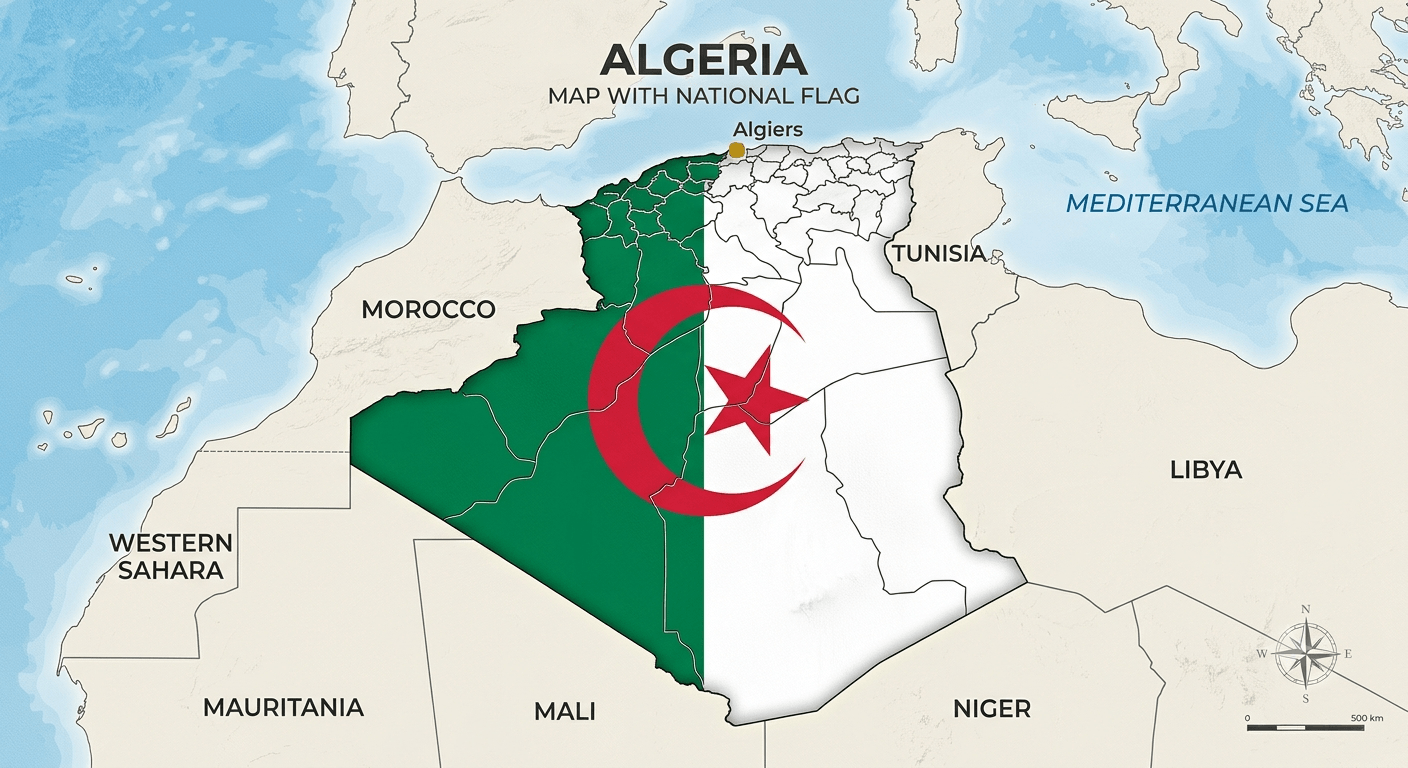
Algeria is Africa’s largest country by land area (2,381,741 km²), located in North Africa/the Maghreb, bordered by the Mediterranean, Morocco, Western Sahara, Mauritania, Mali, Niger, Libya and Tunisia. Population: 47.25 million (2025 est.). Capital: Algiers.
Official Political Name: People’s Democratic Republic of Algeria. Political System: semi-presidential republic; President Abdelmadjid Tebboune (since December 2019, re-elected September 2024) heads the executive; bicameral parliament (National People’s Assembly and Council of the Nation), under the 2020 amended Constitution.
Economic Overview: Algeria is an upper-middle-income economy (World Bank, July 2024) and the third-largest Arab economy. GDP: US$263.62 billion (2024) and US$287.03 billion (2025), World Bank/Trading Economics. Hydrocarbons accounted for ~13–14% of GDP, 83% of exports, and 46–47% of budget revenue (2019–2024, World Bank). Reforms: 2022 Investment Law, 2023 Banking and Monetary Law, 2024 AfCFTA accession.
Agricultural Sector: Agriculture contributed 13.1% of GDP in 2023 (World Bank/CIA Factbook) and employed roughly 25.8% of the labour force. Key products include wheat, barley, oats, dates, citrus, grapes, sheep and cattle. Algeria remains a major food importer, particularly of cereals, due to limited arable land (about 3% of total area).
Industrialization and Manufacturing Sector: Industry contributed 37.8% of GDP in 2023, dominated by hydrocarbons (petroleum, natural gas, petrochemicals), along with cement, steel, mining (iron ore, phosphates), light manufacturing, electrical goods, and food processing. Services contributed 45.6% of GDP in the same period.
Sources: World Bank Open Data (2025); World Bank Algeria Country Overview (2025); CIA World Factbook/Wikipedia Economy of Algeria (2024–26 est.).
2. Trade and Economic Profile
Export and Import Overview
Algeria’s merchandise exports totalled US$48.03 billion and imports US$43.62 billion in 2024 (World Bank/UN Comtrade), yielding a trade surplus driven almost entirely by hydrocarbons.
Major Export and Import Products
| Category | Top Products | Share/Value (2023-24) |
| Exports | Crude petroleum, natural gas, refined petroleum products, nitrogen fertilizers, cement | Hydrocarbons ≈ 83% of total exports |
| Imports | Machinery & equipment, cereals and food products, pharmaceuticals, iron & steel, vehicles | Capital & consumer goods dominate |
Source: World Bank, UN Comtrade, Wikipedia Economy of Algeria (2024 data).
Gross Domestic Product (GDP) — Key Indicators
| Indicator | Value | Year |
| GDP (current US$) | US$287.03 billion | 2025 |
| GDP (current US$) | US$263.62 billion | 2024 |
| GDP growth rate | 3.8% | 2025 |
| GDP per capita (current US$) | US$6,051 | 2025 |
| Inflation (CPI) | 1.4% | 2025 |
| Unemployment rate (modeled ILO est.) | 11.6% | 2025 |
| Agriculture, share of GDP | 13.1% | 2023 |
| Industry, share of GDP | 37.8% | 2023 |
| Services, share of GDP | 45.6% | 2023 |
Source: World Bank Open Data, Algeria country dashboard (accessed 2026); Trading Economics (World Bank data).
Detailed GDP Analysis
GDP grew 4.1% y-o-y in H1 2025; full-year growth is projected at 3.8%, moderating to 2.9% (2027) and 2.7% (2028), World Bank forecasts, as non-oil sectors (construction, services) gain share. Household consumption was ~40.8% of GDP, fixed investment 32.8% (2023 est.). Hydrocarbon dependence exposes the budget to oil-price volatility, driving the diversification agenda under the 2022 Investment Law and 2025 Mining Law.
Major Industrial Products
Petroleum and petroleum products, liquefied natural gas (LNG), nitrogen fertilizers, cement, steel, phosphates, iron ore, electrical equipment, processed foods and light consumer manufactures.
3. Education
Algeria has a free, state-funded system with compulsory basic education (ages 6–15) and a large public university network (100+ institutions). About 2% of primary-age children are out of school (UNESCO/EPDC, 2018).
Literacy Rate: Adult literacy (15+) is 81.41% (World Bank/UNESCO, 2018 — latest available): 87.42% male, 75.32% female. Youth literacy (15–24) was 93.77% (2008).
Educational Status and Human Capital: Education spending has historically exceeded 4% of GDP, supporting near-universal primary enrolment. The World Bank identifies human-capital development and private-sector job creation as key levers for economic diversification.
Sources: World Bank/UNESCO Institute for Statistics (literacy, SE.ADT.LITR.ZS, 2018); EPDC/UNESCO National Education Profile, Algeria (2018).
4. Health and Social Indicators
| Indicator | Value | Year/Source |
| Human Development Index (HDI) | 0.763 (High, rank 96) | 2023 – UNDP |
| Inequality-adjusted HDI | 0.601 (Medium) | 2023 – UNDP |
| Gini coefficient | 27.6 (low inequality) | 2011 – World Bank |
| Population below national poverty line | 1.5% | 2011 – World Bank |
| Population below $15.50/day (2017 PPP) | 6.2% | 2011 – World Bank |
| Adult literacy rate | 81.41% | 2018 – UNESCO/WB |
| Life expectancy at birth | ≈77 years | 2023 est. – UN/WB |
| Unemployment rate | 9.7%–11.6% | 2024/25 – CIA/WB |
Social Development: HDI rank 96 (high) reflects sustained public investment in health, education and subsidised housing/food, financed by hydrocarbon rents. Economic Development: growth is stable but narrowly based; the World Bank recommends private-sector-led diversification to reduce hydrocarbon dependence and expand youth employment. Nutrition: food security remains sensitive to cereal-import dependence, though malnutrition prevalence is low regionally. Human Development: progress depends on sustaining social transfers while creating productive jobs beyond the public/hydrocarbon sectors.
Sources: UNDP Human Development Report 2023/24; World Bank Poverty & Equity data; CIA World Factbook.
5. Bangladesh–Algeria Bilateral Relations
Algeria was the first Arab country to recognise Bangladesh, in 1971, and played a key role in Bangladesh’s admission to the Organisation of Islamic Cooperation (OIC). Diplomatic relations were established in 1971; Bangabandhu Sheikh Mujibur Rahman visited Algiers in 1973 for the Non-Aligned Movement summit, and President Houari Boumediene personally escorted him to the 1974 Islamic Summit in Lahore.
Embassy Presence: The Embassy of Algeria in Dhaka officially reopened services on 3 February 2020, currently headed by Ambassador Dr. Abdelouahab Saidani. Bangladesh maintains its Embassy in Algiers, currently headed by Ambassador Md. Najmul Huda (since May 2025).
Diplomatic Cooperation: Relations are described as grounded in ‘mutual respect and solidarity.’ Recent initiatives include the Algeria–Bangladesh Business Forum and economic-delegation exchanges, expanding cooperation into trade, agriculture, energy, defence and education (Algerian Embassy, 2025 Independence Day reception, Dhaka).
Trade Relations: Bilateral trade is modest relative to potential, historically favouring Bangladesh (apparel exports) with a deficit for Algeria — a pattern seen in Algerian Embassy analysis of 2017–2018 CNIS data.
Sources: Wikipedia ‘Algeria–Bangladesh relations’; Embassy of Algeria, Dhaka (embdhaka.mfa.gov.dz); Embassy of Bangladesh, Algiers (algiers.mofa.gov.bd); BSS News (5 July 2025).
6. Bilateral Trade Analysis
Recent trade-intelligence data (ExportGenius, compiling customs-based trade data) puts Bangladesh’s exports to Algeria at approximately US$31.86 million for the twelve months to November 2025, concentrated in knitted apparel, tobacco and substitutes, woven apparel, and vegetable textile fibres. Earlier UN Comtrade data (2017) recorded Algeria’s imports from Bangladesh at US$24.46 million, led by knit apparel (US$12.24 million), non-knit apparel (US$6.76 million), and vegetable textile fibres/woven fabric (US$4.08 million).
| HS Chapter (approx.) | Product | Direction | Indicative Value |
| 61 | Knitted/crocheted apparel | Bangladesh → Algeria | US$1.33M (2024/25); US$12.24M (2017) |
| 24 | Tobacco and substitutes | Bangladesh → Algeria | US$0.54M (2024/25) |
| 62 | Woven apparel (not knit) | Bangladesh → Algeria | US$0.30M (2024/25); US$6.76M (2017) |
| 53 | Vegetable textile fibres, paper yarn | Bangladesh → Algeria | US$0.06M (2024/25); US$4.08M (2017) |
| 63 | Other made-up textile articles | Bangladesh → Algeria | US$0.73M (2017) |
| 64 | Footwear | Bangladesh → Algeria | US$0.26M (2017) |
Products Exported by Algeria to Bangladesh: Publicly available Bangladesh Bank and NBR trade statistics do not disaggregate a large, distinct Algeria-origin import basket; Algeria’s exports to Bangladesh are not separately prominent in global trade databases, consistent with Algeria’s export profile being overwhelmingly hydrocarbon-based and directed mainly toward European and Asian energy markets rather than South Asia.
According to the Export Promotion Bureau (EPB) of Bangladesh, Bangladesh’s exports to Algeria are dominated by readymade garments (HS 61 & 62), jute and jute goods (HS 53), and textile articles (HS 63) — consistent with Bangladesh’s overall export basket, where RMG constitutes about 46.7% of total exports (EPB/BGMEA data, FY2023-24).Banking and Commercial Activity: Public disclosures in Bangladesh Bank’s Annual Report do not identify Algeria as a distinct reporting line; bilateral trade is settled through standard Letters of Credit (L/C) and correspondent-banking channels used for Bangladesh’s broader Middle East/North Africa (MENA) trade, without a dedicated bilateral payment or currency-swap arrangement currently in place.
Sources: ExportGenius Bangladesh–Algeria trade data (2024–25); UN Comtrade via Trading Economics (2017); EPB/BGMEA export composition data (FY2023-24).
7. International Cooperation
Bangladesh and Algeria share membership in the United Nations, the Organisation of Islamic Cooperation (OIC), the Non-Aligned Movement (NAM), the G77, and the World Trade Organization (WTO). Algeria is additionally a member of OPEC, the African Union, and AfCFTA, while Bangladesh is a member of SAARC, BIMSTEC and the D-8.
These shared platforms — especially the OIC and NAM, where Algeria supported Bangladesh’s early international recognition and integration — have historically reinforced political solidarity more than commercial depth. Multilateral engagement has translated into consistent diplomatic alignment (e.g., on Palestine and South-South cooperation) but has not yet produced large-scale bilateral trade or investment agreements; the 2024-established Algeria–Bangladesh Business Forum is the most concrete recent step toward converting political goodwill into economic partnership.
Sources: OIC, UN, WTO membership records; Wikipedia ‘Algeria–Bangladesh relations’; BSS News (2025).
8. Opportunities for Bangladeshi Citizens in Algeria
- Higher Education: Algeria’s over 100 public universities offer low-cost, Arabic/French-medium programmes in engineering, medicine and agriculture; scope exists for scholarship arrangements, though numbers of Bangladeshi students remain low today.
- Employment and Labour Migration: Algeria’s construction, energy and light-manufacturing sectors periodically recruit foreign skilled and semi-skilled labour; formal Bangladeshi labour migration to Algeria is currently limited compared with Gulf destinations, representing an under-tapped corridor.
- Visa Facilities: Entry currently requires a standard visa processed through the Bangladesh Embassy in Algiers or the Algerian Embassy in Dhaka; no visa-on-arrival or blanket exemption exists for Bangladeshi nationals at present.
- Export Opportunities: Algeria’s tariff structure and AfCFTA/import-substitution drive create openings for Bangladeshi RMG, jute goods, pharmaceuticals, agro-processed food, ceramics and light engineering products.
- Residency/Citizenship: No special long-term residency or citizenship pathway for Bangladeshi nationals currently exists beyond Algeria’s general foreign-investor and work-permit residency rules.
Sources: Embassy of Bangladesh, Algiers (algiers.mofa.gov.bd); Embassy of Algeria, Dhaka; general Algerian immigration and investment regulations.
9. Opportunities for Algeria from Bangladesh
Industrial cooperation: technology and skills transfer in RMG backward linkage (spinning, dyeing), agro-processing, and ICT/IT-enabled services.
High-potential import products: readymade garments and knitwear, jute and jute diversified products, leather and footwear, pharmaceuticals (generics), ceramics, light engineering and agro-processed foods — sectors where Bangladesh is a globally competitive, low-cost supplier.
Investment opportunities: joint ventures in textiles/garment manufacturing, pharmaceuticals, and light industry within Algeria, leveraging Algeria’s AfCFTA access to the wider African market and Bangladesh’s manufacturing know-how.
Other sectors: cooperation in jute-based eco-friendly packaging (relevant to Algeria’s agriculture and food-packaging needs), and pharmaceuticals given Bangladesh’s WHO-certified generic drug manufacturing base.
Sources: World Bank sectoral data on Algeria’s import basket; Bangladesh export composition (EPB); general trade-complementarity analysis.
10. Trade Associations and Future Prospects
The Algeria–Bangladesh Business Forum, referenced by the Algerian Ambassador in Dhaka in July 2025, represents the primary institutional platform connecting the two private sectors so far; formal MoUs between apex bodies such as the FBCCI (Bangladesh) and Algeria’s business chambers (CACI) are not yet widely documented in public sources, indicating an early stage of institutional cooperation.
Future Prospects: Growing high-level exchanges, Algeria’s AfCFTA membership (opening a market of 1.3+ billion people), and Bangladesh’s LDC-graduation-driven push for new export markets together create momentum for expanding trade beyond the current modest US$25–32 million range, provided both sides formalise banking, logistics and trade-facilitation arrangements.
Sources: BSS News (5 July 2025); Embassy of Algeria, Dhaka; African Continental Free Trade Area (AfCFTA) accession records (2024).
11. Recommendations
- Negotiate a Bangladesh–Algeria Preferential/Bilateral Trade Agreement to cut Algeria’s high tariffs on textiles and jute goods (up to 30% on jute fabric) and formalise the Business Forum into a standing joint economic commission.
- Establish direct banking correspondent arrangements via Bangladesh Bank and the Bank of Algeria to ease L/C settlement and cut third-country intermediation costs.
- Promote RMG, pharmaceuticals, jute goods and agro-processed foods via trade fairs/B2B missions in Algiers, leveraging Algeria’s AfCFTA access to African markets.
- Expand labour-migration and higher-education MoUs for worker mobility and scholarships, currently underdeveloped versus Bangladesh’s Gulf-focused corridors.
- Deepen OIC/NAM/WTO coordination into concrete economic cooperation, converting decades of political solidarity into higher bilateral trade and investment.