Book Appointment Now

Gabon: Prepared for market entry and trade-relations assessment purposes
1. Country Profile
Geographical Location
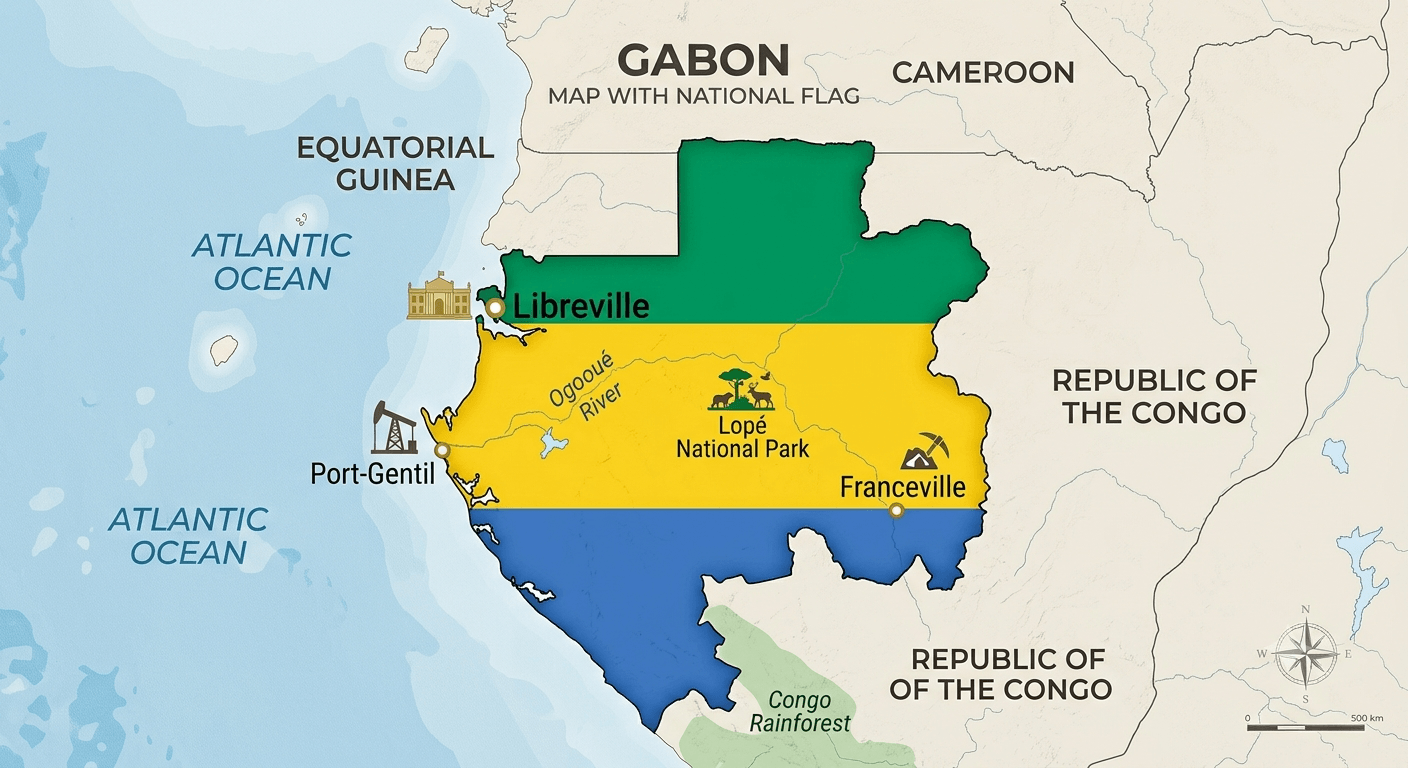
Gabon is located on the west coast of Central Africa, straddling the Equator on the Gulf of Guinea. It shares land borders with Equatorial Guinea and Cameroon to the north and the Republic of the Congo to the east and south, with the capital, Libreville, situated on the Atlantic coast (Foreign relations of Gabon; World Bank, 2025).
Official Political Name and Political System
The country’s official name is the Gabonese Republic. Gabon has undergone a significant political transition since August 2023, when a military transition ended more than five decades of rule by the Bongo family and the Gabonese Democratic Party. A November 2024 constitutional referendum introduced a Fifth Republic framework with a seven-year, once-renewable presidential term and barred spouses and direct descendants of former presidents from candidacy. General Brice Oligui Nguema was elected President on 12 April 2025, formally inaugurating the Fifth Republic, with legislative and local elections held in the second half of 2025 (World Bank Group, 2025).
Economic Overview
Gabon is an upper-middle-income economy (World Bank) with a population of approximately 2.48 million (2023) and nominal GDP of an estimated USD 20.4 billion (2025). Oil, manganese and timber together account for roughly 97% of merchandise exports (World Bank, Gabon Economic Update, 2025). 2024 growth is estimated between 2.9% and 3.4% across sources (World Bank, 2025), moderating to 2.1–2.4% in 2025–27 as mature oil fields decline (AfDB, 2026). Inflation eased to 1.2–1.6% in 2024–2025 on BEAC’s restrictive stance, while the fiscal balance swung from a 1.8% of GDP surplus (2023) to an estimated 3.7% of GDP deficit (2024) on lower oil revenue and a 24% rise in spending (World Bank, 2025).
Agricultural Sector
Agriculture contributes a modest GDP share, and domestic output cannot meet food needs; Gabon imports an estimated 60% of basic food products (U.S. ITA, 2024). A National Chamber of Agriculture (2021) mandates local sourcing by supermarkets and agri-food firms. Forestry is more developed: log production reached about 4 million m³ in 2022, with Okoumé accounting for 58% of output (U.S. ITA, 2024). Non-oil growth in 2025–27 is expected to draw on timber, palm oil and manganese-linked agro-industry (AfDB, 2026).
Industrialization and Manufacturing Sector
Industry, dominated by hydrocarbons and mining, accounts for an estimated 45% of GDP and 60% of fiscal revenue from oil alone (U.S. ITA, 2024). Gabon holds the world’s second-largest manganese reserves (~150 million tonnes) and was the world’s second-largest producer, at ~4.6 million metric tons in 2022 (USGS, cited in U.S. ITA, 2023). A USD 400 million manganese-processing plant opened in 2015, and iron-ore development at Belinga is due to begin production in 2026 (AfDB, 2026); construction activity rose 47.8% in 2024 on large state-led projects (AfDB, 2026).
2. Trade and Economic Profile
Export and Import Overview
Per WITS (World Bank) mirror data, Gabon’s merchandise exports (FOB) totalled approximately USD 12.7 billion in 2023 against imports (CIF) of about USD 4.2 billion — a surplus of roughly USD 8.5 billion. WTO-based estimates cited by Lloyds Bank instead show 2023 exports of USD 7.7 billion and imports of USD 6.1 billion; the gap reflects differing customs-mirror versus balance-of-payments methodologies. Trade equates to roughly 91% of GDP (World Bank, cited in Lloyds Bank Trade, 2024), reflecting high openness and commodity dependence.
Major Export and Import Products
| Major Exports (2023) | Value (US$) | Major Imports (2023, HS2) | Value (US$) |
| Crude petroleum | US$6.58 bn | Machinery, boilers (HS84) | US$577 m |
| Manganese ores/concentrates | US$2.95 bn | Mineral fuels (HS27) | US$290 m |
| Floating/submersible drilling structures | US$668 m | Iron or steel articles (HS73) | US$235 m |
| Floating docks/special-purpose vessels | US$644 m | Vehicles (HS87) | US$232 m |
| Sawn/chipped wood | US$432 m | Electrical machinery (HS85) | US$219 m |
Source: World Integrated Trade Solution (WITS), World Bank, Gabon Trade Summary 2023.
Gross Domestic Product (GDP) and Detailed Analysis
| Indicator | Value | Source/Year |
| Nominal GDP | US$20.4 billion | Wikipedia/IMF-based estimate, 2025 |
| GDP (PPP) | US$57.5 billion | 2025 estimate |
| GDP per capita (nominal) | US$10,840 | 2025 estimate |
| Real GDP growth | 2.9%–3.4% (2024); 2.1%–2.4% (2025–27f) | World Bank / AfDB, 2025–2026 |
| Inflation (CPI) | 1.2%–2.1% | AfDB / World Bank, 2024 |
| Fiscal balance | -3.7% of GDP (2024), from +1.8% (2023) | World Bank, 2025 |
| Sectoral GDP share | Industry ~62.7%; Services ~32.8%; Agriculture ~4.5% | Dated 2010 estimate; oil alone ~45% of GDP per 2023–24 data |
| Poverty rate | 34.6% (2024) | AfDB, 2026 |
| Unemployment | 20.1%–20.4%; youth 36.0%, women 28.7% | AfDB, 2026 |
Major Industrial Products
Crude petroleum, manganese ore and ferro-manganese, sawn timber and plywood, and, increasingly, iron ore (Belinga project, from 2026) constitute Gabon’s principal industrial products, alongside shipbuilding-related floating structures linked to offshore oil services (WITS, 2023; AfDB, 2026).
3. Education
Overview and Literacy Rate
Gabon’s education system follows a French-influenced primary–secondary–tertiary structure. Gross primary enrolment reached 108% in 2023 (over-age/repeating pupils included) versus a 103% sub-regional average; 82% complete primary school (regional average 67%), and secondary enrolment is 65% (regional 58%) (UNESCO/World Bank, cited in AllAfrica, 2025). Adult literacy was 85.69% in 2022 (UNESCO Institute for Statistics), down from a 2021 peak of 88.86%; male literacy (86.3%) marginally exceeds female (85.0%).
Educational Status and Human Capital Development
Learning outcomes lag access: CONFEMEN’s PASEC assessment found only 55% of Gabonese primary pupils reach minimum proficiency in reading and mathematics, pointing to an access-versus-quality gap constraining human capital formation (cited in AllAfrica, 2025).
4. Health and Social Indicators
| Indicator | Value | Source |
| Human Development Index | 0.733 (High); rank 108/193 | UNDP, 2023 data, cited by AfDB 2026 |
| Life expectancy at birth | 65.9 years (male); 71.1 years (female) | Our World in Data/UN, 2023 |
| Under-five mortality | 2,270 deaths (2023) | Our World in Data/UN |
| Maternal mortality ratio | 227 per 100,000 live births (2020) | WHO/UN MMEIG |
| Child stunting (under-5) | 14.4% (2020) | UNICEF/WHO/World Bank JME |
| Poverty headcount | 34.6% (2024); 33.4% national line (2017) | AfDB, 2026; World Bank |
| Food import dependence | ~60% of basic food products imported | U.S. ITA, 2024 |
| Unemployment | 20.1% overall; youth 36.0% | AfDB, 2026 |
Gabon’s HDI places it in the ‘high human development’ category, among Central Africa’s leading performers, yet poverty and unemployment remain elevated for its income level, reflecting limited job creation from resource-driven growth (World Bank; AfDB, 2026).
5. Bangladesh–Gabon Bilateral Relations
Bangladesh and Gabon maintain formal but limited diplomatic engagement. Neither maintains a resident embassy in the other’s capital; consular matters are handled on a non-resident basis, a pattern Bangladesh follows with several Central African states (Foreign Relations of Bangladesh/Gabon, Wikipedia — no dedicated bilateral treaty identified). Cooperation runs mainly through multilateral platforms such as the UN rather than dedicated bilateral mechanisms. Commercial ties remain nascent, reflecting the small trade volumes in Section 6; no bilateral trade agreement or joint economic commission was identified in public sources, and this should be verified directly with the Ministry of Foreign Affairs and Ministry of Commerce.
6. Bilateral Trade Analysis
Per UN Comtrade data (mirrored via Trading Economics), Gabon’s imports from Bangladesh totalled approximately US$1.58 million in 2023 — a marginal figure. Product breakdown:
| Product Category (HS Chapter) | Value (2023) |
| Beverages, spirits and vinegar (HS22) | US$399,880 |
| Apparel, knit or crocheted (HS61) | US$316,330 |
| Apparel, not knit or crocheted (HS62) | US$302,980 |
| Cereal, flour, starch, milk preparations (HS19) | US$283,800 |
| Vegetable, fruit, nut preparations (HS20) | US$162,630 |
| Dairy, eggs, honey, edible products (HS04) | US$26,500 |
| Fish, crustaceans, molluscs (HS03) | US$22,990 |
| Electrical/electronic equipment (HS85) | US$22,030 |
| Footwear (HS64) | US$14,480 |
Source: UN Comtrade, mirrored via Trading Economics (Gabon Imports from Bangladesh, data through 2023).
Gabon’s exports to Bangladesh do not appear among its reported top trading-partner flows in WITS or Comtrade data for 2023, indicating these are negligible or unrecorded at a disaggregated level; where they occur, they would relate to Gabon’s core export basket (petroleum, manganese, timber), but no verifiable value could be confirmed. EPB’s public country-wise bulletins do not publish a Gabon-specific HS-code breakdown; this should be sourced directly from EPB’s Statistics and Research Division. Likewise, the Bangladesh Bank Annual Report does not disaggregate Letters of Credit or trade-financing data by country for Gabon; given trade values under US$2 million annually, such transactions likely run through correspondent banking rather than dedicated credit lines. This limitation should be flagged to the client, with figures requested directly from Bangladesh Bank’s Statistics Department if precision is required.
7. International Cooperation
Bangladesh and Gabon are both members of the United Nations, the World Trade Organization, and the Non-Aligned Movement. Gabon is not a member of the Organisation of Islamic Cooperation, distinguishing it from many of Bangladesh’s closer partners in Africa; shared multilateral membership is therefore largely confined to the UN and WTO frameworks. There is no evidence in available records of these shared memberships having translated into deepened bilateral diplomatic, political or commercial engagement; cooperation to date has been largely confined to routine multilateral coordination rather than a dedicated strategic partnership.
8. Opportunities for Bangladeshi Citizens in Gabon
- Higher Education: no dedicated Bangladesh–Gabon scholarship scheme identified; options rely on Gabon’s own schemes or French-language academic routes.
- Employment/Labour Migration: Gabon’s labour force (~771,000) is dominated by oil, mining and services; no formal migration channel exists, so openings are likely limited to niche technical/construction roles on infrastructure projects.
- Visa Facilities: with no resident Bangladesh mission in Libreville, processing would route through a regional mission or Gabon’s own consular arrangements — to be confirmed with the Ministry of Foreign Affairs.
- Export Opportunities: apparel, processed foods, beverages and pharmaceuticals already have a small foothold (Section 6) and could grow given Gabon’s 60% food-import dependence.
- Residency/Citizenship: no specific bilateral facility for Bangladeshi nationals was identified.
9. Opportunities for Gabon from Bangladesh
- High-potential imports: ready-made garments, processed foods, pharmaceuticals, footwear and light consumer goods — categories where Bangladesh is globally competitive and already has modest uptake in Gabon.
- Investment: Bangladesh’s textile, agro-processing and pharmaceutical sectors could pursue joint ventures aligned with Gabon’s push to diversify beyond raw commodities.
- Industrial cooperation: light manufacturing and food-processing collaboration could help reduce Gabon’s high food-import dependence.
- Other sectors: shipping/logistics services, given Bangladesh’s growing maritime expertise, could support Gabon’s port and trade-facilitation needs.
10. Trade Associations and Future Prospects
No documented cooperation between Bangladeshi trade bodies (FBCCI, BGMEA, BKMEA) and Gabonese counterparts was identified, consistent with the limited trade volume in Section 6. Future prospects depend on basic trade-promotion infrastructure: trade-fair participation, an honorary consular presence, and direct EPB engagement with Gabon’s Ministry of Commerce or Chamber of Commerce. Given Gabon’s small, import-dependent consumer market, near-term prospects remain modest but could grow steadily in apparel, food and pharmaceutical categories with targeted promotion.
11. Recommendations
- Request verified, HS-code-level trade and trade-financing figures directly from EPB and Bangladesh Bank before finalising investment decisions, given the data limitations in Section 6.
- Explore an honorary consulate or trade desk to lower transaction costs and improve visibility for Bangladeshi exporters in Gabon’s import-dependent market.
- Prioritise apparel, processed food, beverages and pharmaceuticals as near-term export categories, building on the existing small trade base.
- Pursue exploratory trade-delegation exchanges between EPB/FBCCI and Gabon’s Chamber of Commerce to assess demand and regulatory requirements.
- Monitor Gabon’s post-transition political and fiscal environment (Fifth Republic reforms, fiscal deficit) as part of ongoing country-risk review.
References
- World Bank, Gabon Economic Update 2025; Gabon Country Overview (2025).
- African Development Bank, Gabon Economic Outlook (2026).
- WITS, World Bank — Gabon Trade Summary/Country Snapshot (2023).
- Lloyds Bank Trade — Foreign Trade Figures of Gabon.
- U.S. International Trade Administration — Gabon Market Opportunities/Overview (2024).
- UNESCO Institute for Statistics — Gabon literacy rate (2022); CONFEMEN-PASEC, cited via AllAfrica (2025).
- UNDP HDI; Our World in Data (UN health indicators); UNICEF/WHO/World Bank Joint Child Malnutrition Estimates.
- UN Comtrade via Trading Economics — Gabon Imports from Bangladesh (2023).
- EPB Bangladesh; Bangladesh Bank — institutional context; bilateral figures require direct data request (not publicly available).
- Wikipedia — Economy of Gabon; Foreign Relations of Gabon/Bangladesh (structural cross-reference only).