Book Appointment Now

Brunei Country Profile: Market and Economic Profile, with a Focus on Bangladesh–Brunei Darussalam Bilateral Relations
1. COUNTRY PROFILE – BRUNEI COUNTRY PROFILE OVERVIEW
Geographical Location
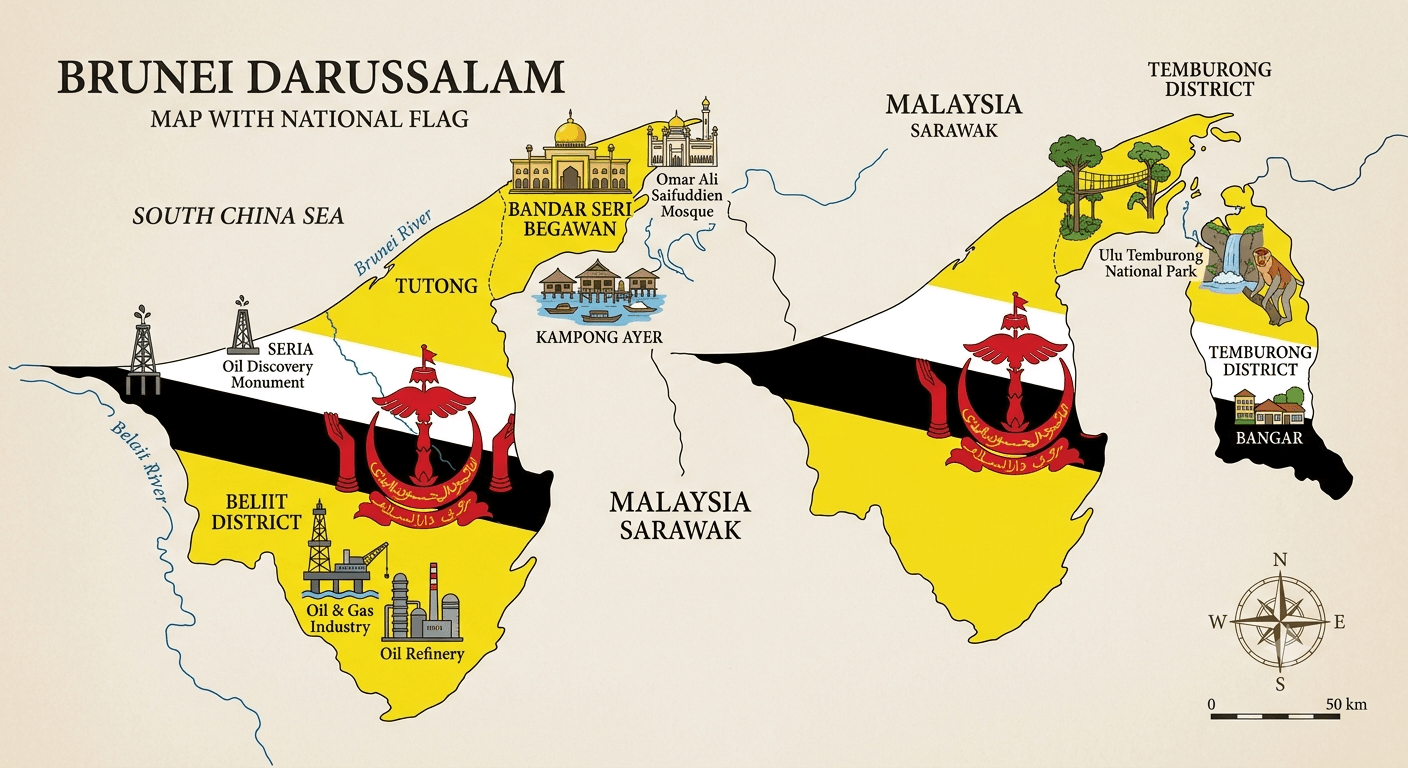
The Brunei Darussalam (بروني دارالسلام, meaning “Brunei, Abode of Peace”) is one of Southeast Asia’s smallest yet wealthiest nations, occupying strategic territory on the island of Borneo. This Brunei country profile reveals a nation built entirely on hydrocarbon wealth and strategic regional positioning[1].
Key Geographic Features:
- Total Land Area: Only approximately 5,765 square kilometers (world’s 169th largest; smallest ASEAN state by area)
- Location: Northern coast of Borneo island; bordered by Malaysia (Sarawak) on three sides, with coastline along the South China Sea
- Divided Geography: Two distinct districts separated by the Limbang enclave: Brunei-Muara (northeastern) and Tutong (western)
- Maritime Exclusive Economic Zone (EEZ): ~200 km offshore; rich in oil and natural gas reserves[1]
Strategic Importance of Brunei Country Profile:
- Energy Hub: Significant oil and natural gas production; member of OPEC (Organization of Petroleum Exporting Countries)
- Regional Trade Route: Controls access to critical South China Sea shipping lanes[1]
- Geopolitical Significance: Strategic location amid China-ASEAN tensions over maritime boundaries[1]
Population: Approximately 450,565 (2025 estimate), making Brunei the second-smallest ASEAN nation by population after Singapore. Median age: 32.5 years—indicating a mature population with high life expectancy[2].
Capital: Bandar Seri Begawan (BSB), the political and economic center; population ~25,000 in city proper, ~150,000 metropolitan area[2].
Official Political Name and System – Understanding Brunei Country Profile Government
Official Name: Brunei Darussalam (Negara Brunei Darussalam in Malay)
Government System: Brunei operates as an absolute monarchy under Islamic Sharia law, making it the only absolute monarchy in ASEAN. The Brunei country profile demonstrates a governance structure combining traditional sultanate rule with modern administrative systems[2].
Head of State & Government: Sultan Hassanal Bolkiah Muizzaddin Waddaulah (reigning since 1967; among the world’s longest-serving current monarchs)
Crown Prince: Prince Al-Muhtadee Billah (heir apparent; son of Sultan)
Administrative Structure:
- No Legislature: Sultan rules by decree under the Emergency Proclamation (renewed annually since 1962); suspended parliament[2]
- Consultative Council (Majlis Mesyuarat Negara): Advisory body; 45 appointed members providing consultation on policy[2]
- Cabinet: Ministers appointed by Sultan; no elections or competitive politics[2]
Religious Role: The Brunei country profile is inseparable from Islam; the Sultan serves as Supreme Head of Islam in Brunei; Sharia law enforced in personal status, family law, and increasingly in criminal matters[2].
Recent Political Development: Brunei strengthened Sharia law implementation in 2019, introducing strict criminal penalties (hudud) for certain offenses, reflecting the Sultan’s conservative Islamic governance vision[2].
Sources: World Bank Brunei Darussalam Country Overview | Government of Brunei Darussalam Official Portal
2. ECONOMIC OVERVIEW – BRUNEI COUNTRY PROFILE ECONOMY ANALYSIS
This Brunei country profile economic section reveals a wealthy, oil and gas-dependent economy classified as a high-income country. Brunei is one of Asia’s richest nations by GDP per capita, entirely dependent on hydrocarbon exports[3].
Key Economic Indicators (2024-2026) – Brunei Country Profile
| Economic Indicator | 2024 Actual | 2025 Estimate | 2026 Forecast | Source |
|---|---|---|---|---|
| Nominal GDP | ~US$24.8 billion | ~US$26.2 billion | ~US$27.6 billion | IMF Article IV, Oct 2024[3] |
| Real GDP Growth | 3.8% | 3.5-3.8% | 3.2-3.5% | IMF / Brunei Ministry of Finance[3] |
| GDP Per Capita | ~US$55,000 | ~US$58,000 | ~US$61,000 | IMF Estimates[3] |
| Oil & Gas Revenue (% of GDP) | ~90% | ~89% | ~88% | Brunei Ministry of Energy[4] |
| Inflation Rate (Year-on-Year) | 1.8% | 1.5-2.0% | 1.8-2.2% | Department of Economic Planning[3] |
| Unemployment Rate | 1.3% | 1.3-1.5% | 1.5-1.8% | Ministry of Labor[5] |
| Foreign Exchange Reserves | ~US$1.5 billion | ~US$1.6 billion | ~US$1.7 billion | Brunei Central Bank[6] |
| Government Debt (% of GDP) | ~3.5% | ~3.3% | ~3.1% | IMF Article IV[3] |
| Sovereign Wealth Fund (SWF) | ~US$200+ billion | Estimated US$210+ billion | Estimated US$220+ billion | Brunei Investment Agency[7] |
Source: IMF Article IV Consultation Report, October 2024 | Ministry of Energy Brunei | Ministry of Labor Brunei | Brunei Central Bank | Brunei Investment Agency
Economic Characteristics
This Brunei country profile reveals unique economic characteristics:
Oil & Gas Dependency:
- Hydrocarbons comprise ~90% of government revenue and ~80% of export earnings
- Known reserves sufficient for ~30-35 years at current extraction rates
- Major customers: Japan (~30%), South Korea (~25%), Australia (~15%), other Asian markets[4]
Sovereign Wealth Fund (SWF):
- Brunei Investment Agency (BIA): Manages ~US$200+ billion in sovereign wealth accumulated from oil/gas boom (1970s-2000s)
- Global investment portfolio across real estate, equities, bonds, and emerging markets[7]
- Provides financial security beyond hydrocarbon reserves; primary driver of long-term state wealth[7]
Small but Wealthy Economy:
- GDP Per Capita: ~US$55,000-61,000—ranking among Asia’s highest[3]
- Citizens enjoy: Universal free healthcare, free education, subsidized housing and fuel[3]
- Unemployment nearly non-existent; government employs ~40% of workforce[3]
Limited Diversification:
- Non-oil/gas sectors (tourism, trade, services) remain underdeveloped (~10-20% of economic activity)
- Heavy economic dependence on commodities; vulnerable to oil price volatility[3]
- Brunei country profile shows government priority to diversify via tourism, education, financial services[3]
Sectoral Contribution to GDP
| Sector | % of GDP | Key Activities | Growth Status | Source |
|---|---|---|---|---|
| Oil & Natural Gas (Energy) | ~60-65% | Crude oil extraction, LNG production, export | Stable; declining production | Department of Economic Planning[8] |
| Government Services | ~20-25% | Public administration, defense, education, healthcare | Growing on welfare provision | Department of Economic Planning[8] |
| Financial Services & Trade | ~8-10% | Banking, insurance, trading, logistics | Growing; limited depth | Department of Economic Planning[8] |
| Construction & Real Estate | ~3-5% | Infrastructure, residential, commercial development | Modest growth | Department of Economic Planning[8] |
| Tourism & Hospitality | ~2-3% | Hotels, restaurants, tourism services | Emerging sector | Tourism Ministry[8] |
| Other Services & Utilities | ~5-8% | Transportation, telecommunications, education, health | Steady expansion | Department of Economic Planning[8] |
Total GDP at Current Prices: ~US$26.2 billion (2025 estimate)

Source: Brunei Department of Economic Planning
3. ENERGY SECTOR – BRUNEI COUNTRY PROFILE HYDROCARBON FOCUS
The Brunei country profile is fundamentally shaped by the energy sector, which generates virtually all export revenue and government income. Understanding Brunei’s economy requires detailed analysis of this sector[9].
Oil & Gas Production – Brunei Country Profile Energy
| Commodity | Annual Production (Latest) | Export Volume | Global Ranking | Key Markets | Source |
|---|---|---|---|---|---|
| Crude Oil | ~160,000 barrels/day (declining) | ~150,000 bbl/day | 10th among OPEC members | Japan, South Korea, Australia | Ministry of Energy[9] |
| Liquefied Natural Gas (LNG) | ~13.6 million tonnes/year | ~13.2 million tonnes | 4th largest LNG exporter | Japan (~60%), South Korea (~25%), others | Ministry of Energy[9] |
| Natural Gas (Associated) | Byproduct of oil extraction; processed to LNG | — | Major LNG supplier | Global markets | Ministry of Energy[9] |
Production Trends in Brunei Country Profile:
- Oil Production Declining: From peak of 240,000 bbl/day (1979) to current ~160,000 bbl/day; reserves depleting[9]
- LNG Stable/Modest Decline: LNG production relatively stable at ~13.6 million tonnes; reserves adequate for 30-40+ years[9]
- Price Sensitivity: Brunei government revenue highly sensitive to oil/LNG prices; 2020 pandemic and 2022-2024 price declines significantly impacted budgets[9]
Reserve Status & Future Outlook for Brunei Country Profile:
- Proven Oil Reserves: ~400 million barrels (30-year horizon at current production)
- Natural Gas Reserves: ~300+ billion cubic meters; substantial reserves support long-term LNG exports[9]
- Upstream Investment: Limited new oil/gas exploration; focus on maintaining existing production and LNG exports[9]
- Diversification Challenge: As hydrocarbon reserves deplete (2050s-2060s horizon), Brunei must develop alternative revenue sources—critical issue in Brunei country profile strategic planning[9]
Source: Ministry of Energy Brunei | Oil & Gas Authority Brunei
4. INDUSTRIALIZATION AND MANUFACTURING
The Brunei country profile reveals minimal manufacturing sector (~2-3% of GDP), with the country focused on importing finished goods rather than developing domestic manufacturing[10].
Limited Manufacturing Base
| Sector | Presence | Output/Activity | Global Position | Remarks | Source |
|---|---|---|---|---|---|
| Downstream Petroleum | Limited | Oil refining for domestic use; minimal export processing | Very small | Brunei relies primarily on crude oil export | Ministry of Energy[10] |
| Food & Beverage Processing | Minimal | Rice milling, fish processing for local consumption | Negligible | Most food imported; limited domestic agro-processing | Ministry of Industry[10] |
| Chemicals & Petrochemicals | Limited | Small-scale chemical production for industrial use | Very small | Not competitive globally; focused on domestic/regional supply | Ministry of Industry[10] |
| Light Manufacturing | Minimal | Textiles, garments, assembly operations | Negligible | High labor costs make manufacturing uncompetitive | Ministry of Industry[10] |
| Electronics Assembly | Minimal | Limited electronics assembly for regional markets | Negligible | High wages deter labor-intensive manufacturing | Ministry of Industry[10] |
| Construction Materials | Limited | Cement, concrete blocks for domestic construction | Local focus | Primarily for domestic infrastructure projects | Ministry of Industry[10] |
Manufacturing Challenges in Brunei Country Profile:
- High Labor Costs: Brunei’s wealth creates wage levels uncompetitive for export-oriented manufacturing[10]
- Limited Workforce: Small population (~450,000) restricts manufacturing labor supply; reliance on migrant workers[10]
- Small Domestic Market: Limited domestic demand for industrial products; export markets distant[10]
- Hydrocarbon Focus: Government investment prioritizes oil/gas; limited industrial policy support[10]
- Import Dependency: Brunei imports ~80% of manufactured goods; limited local production[10]
Brunei Country Profile Strategic Diversification: Government has identified manufacturing as potential diversification avenue; established Brunei Economic Development Board (BEDB) to attract manufacturing FDI in selected sectors (petrochemicals, electronics, light manufacturing).
Source: Ministry of Industry & Primary Resources Brunei | Brunei Economic Development Board
5. TRADE AND ECONOMIC PROFILE
This Brunei country profile trade section reveals a trade-dependent economy heavily reliant on energy exports and importing nearly all consumer goods and capital equipment[11].
Export and Import Overview
| Trade Metric | 2024 | 2025 Estimate | Growth Rate | Source |
|---|---|---|---|---|
| Total Merchandise Exports | ~US$6.8 billion | ~US$7.1 billion | +4.4% YoY | Ministry of Finance[11] |
| Oil & Gas Exports | ~US$6.2 billion | ~US$6.5 billion | 91% of total exports | Ministry of Energy[11] |
| Non-Oil/Gas Exports | ~US$0.6 billion | ~US$0.6 billion | Limited growth | Ministry of Finance[11] |
| Total Merchandise Imports | ~US$3.2 billion | ~US$3.4 billion | +6.3% YoY | Ministry of Finance[11] |
| Trade Surplus | ~US$3.6 billion | ~US$3.7 billion | Widening | Ministry of Finance[11] |
| Export-to-GDP Ratio | ~27.4% | ~27.1% | Stable | IMF / World Bank[11] |
Source: Brunei Ministry of Finance | Brunei Central Bank
Major Export Products
| Product Category | Value (US$ Billion) | % of Total Exports | Key Markets | Source |
|---|---|---|---|---|
| Crude Oil | 3.2 | 47.1% | Japan, South Korea, Australia, others | Ministry of Energy[11] |
| Liquefied Natural Gas (LNG) | 3.0 | 44.1% | Japan (~60%), South Korea (~25%), others | Ministry of Energy[11] |
| Petroleum Products & Chemicals | 0.35 | 5.1% | Regional markets (ASEAN) | Ministry of Energy[11] |
| Other Exports (Non-Hydrocarbons) | 0.25 | 3.7% | Regional trade; limited diversification | Ministry of Finance[11] |
Total Exports: ~US$6.8 billion (2024)
Top Export Markets
| Country/Region | Export Value (US$ Bn) | % of Total | Key Products | Source |
|---|---|---|---|---|
| Japan | 2.1 | 30.9% | Crude oil, LNG, petroleum products | Ministry of Energy[11] |
| South Korea | 1.5 | 22.1% | LNG, crude oil | Ministry of Energy[11] |
| Australia | 0.85 | 12.5% | Crude oil | Ministry of Energy[11] |
| United States | 0.6 | 8.8% | Crude oil | Ministry of Energy[11] |
| ASEAN Countries | 0.8 | 11.8% | Petroleum products, LNG | Ministry of Energy[11] |
| Other Countries | 0.55 | 8.1% | Hydrocarbons, minor products | Ministry of Energy[11] |
Top 3 Partners: Japan (30.9%) + South Korea (22.1%) + Australia (12.5%) = 65.5% of total exports

Major Import Products
| Product Category | Value (US$ Bn) | % of Total Imports | Primary Sources | Source |
|---|---|---|---|---|
| Machinery & Mechanical Equipment | 0.68 | 21.3% | Japan, China, Germany, Singapore | Ministry of Finance[11] |
| Electrical & Electronic Equipment | 0.52 | 16.3% | China, Japan, Singapore, Thailand | Ministry of Finance[11] |
| Mineral Fuels & Petroleum Products | 0.42 | 13.1% | Singapore, Indonesia, Malaysia | Ministry of Finance[11] |
| Vehicles & Transport Equipment | 0.38 | 11.9% | Japan, Germany, Thailand, Malaysia | Ministry of Finance[11] |
| Chemicals & Chemical Products | 0.28 | 8.8% | China, Japan, Singapore, India | Ministry of Finance[11] |
| Textiles, Clothing & Apparel | 0.22 | 6.9% | China, Vietnam, India, Bangladesh | Ministry of Finance[11] |
| Optical & Precision Instruments | 0.18 | 5.6% | Japan, Germany, Singapore | Ministry of Finance[11] |
| Other Imports | 0.36 | 11.3% | Various | Ministry of Finance[11] |
Total Imports: ~US$3.2 billion (2024)
Top Import Sources – Brunei Country Profile
| Country | Import Value (US$ Bn) | % of Total | Key Products | Source |
|---|---|---|---|---|
| China | 0.85 | 26.6% | Machinery, electronics, textiles, consumer goods | Ministry of Finance[11] |
| Japan | 0.58 | 18.1% | Machinery, vehicles, electronics | Ministry of Finance[11] |
| Singapore | 0.48 | 15.0% | Petroleum products, machinery, electronics | Ministry of Finance[11] |
| Malaysia | 0.35 | 10.9% | Food, machinery, petroleum products | Ministry of Finance[11] |
| Thailand | 0.22 | 6.9% | Machinery, food, chemicals | Ministry of Finance[11] |
| Indonesia | 0.18 | 5.6% | Food, agricultural products | Ministry of Finance[11] |
| Bangladesh | ~0.08 | ~2.5% | Textiles, apparel, leather products | Ministry of Finance[11] |
| Other Countries | 0.18 | 5.6% | Various | Ministry of Finance[11] |
Top 3 Suppliers: China (26.6%) + Japan (18.1%) + Singapore (15.0%) = 59.7% of total imports

6. EDUCATION – BRUNEI HUMAN CAPITAL
This Brunei country profile education section reveals an excellent, government-subsidized system with free education for all citizens and high literacy rates[12].
Overview of the Education System – Brunei Country Profile
Education Structure:
- Pre-School/Kindergarten: Ages 4-5 (optional; government-funded)
- Primary (Grades 1-6): Ages 6-12 (compulsory; free)
- Lower Secondary (Grades 7-9): Ages 13-15 (compulsory; free)
- Upper Secondary (Grades 10-11): Ages 16-17 (post-compulsory; free)
- Higher Education: Universities, polytechnics, teacher training (free for citizens; scholarships for overseas study)
Leading Universities in Brunei Country Profile:
- Universiti Brunei Darussalam (UBD): National university; comprehensive programs in engineering, business, sciences[12]
- Islamic Teachers’ University (Universiti Pendidikan Sultan Sharif Ali): Teacher training and Islamic education[12]
- Polytechnic Brunei: Technical and vocational education[12]
Literacy Rate and Human Capital
| Education Metric | Value (2024-25) | Benchmark | Source |
|---|---|---|---|
| Adult Literacy Rate (age 15+) | ~98.5% | Highest in ASEAN | UNESCO/World Bank[12] |
| Primary Enrollment Ratio | ~99%+ | Near-universal enrollment | UNESCO[12] |
| Secondary Enrollment Ratio | ~97%+ | Highest in ASEAN | UNESCO[12] |
| Tertiary Enrollment Ratio | ~35-40% | Good access; many study abroad | UNESCO[12] |
| Female Enrollment Parity | ~52% | Female majority at higher levels | UNESCO[12] |
| STEM Graduates (% of tertiary) | ~48-52% | Strong emphasis on STEM | Ministry of Education[12] |
| Overseas Students (Brunei citizens) | ~8,000-10,000 | Studying in Malaysia, Australia, UK, USA | Ministry of Education[12] |
Human Capital Characteristics in Brunei Country Profile:
- Universal Free Education: All citizens receive free education from primary through tertiary[12]
- Overseas Scholarships: Government provides full scholarships for high-performing students to study abroad (Malaysia, Australia, UK, USA)
- English-Medium Instruction: English widely used; Malay as medium at primary level; bilingual strength[12]
- Small Workforce: Only ~18,000 Bruneian citizens in formal workforce; heavy reliance on migrant workers (~100,000+ for domestic, industrial sectors)
Source: Ministry of Education Brunei | UNESCO Institute for Statistics
7. HEALTH AND SOCIAL INDICATORS
This Brunei country profile demonstrates excellent health and social outcomes, reflecting high-income status and generous welfare provisions[13].
Health Metrics
| Health Indicator | Value (2024-25) | Regional Benchmark | Source |
|---|---|---|---|
| Life Expectancy at Birth | 78.2 years | Highest in ASEAN | WHO/World Bank[13] |
| Infant Mortality Rate | 8.1 per 1,000 live births | Lowest in ASEAN | WHO[13] |
| Maternal Mortality Ratio | 23 per 100,000 live births | Among lowest globally | WHO[13] |
| Healthcare Coverage | 100% (universal) | Full coverage; state-funded | Ministry of Health[13] |
| Universal Health Coverage Index | 86/100 | Highest in ASEAN region | WHO[13] |
Social Indicators
| Social Indicator | Value (2024-25) | Source |
|---|---|---|
| Unemployment Rate | ~1.3% (very low) | Ministry of Labor[5] |
| Poverty Rate | <1% (minimal; state welfare) | World Bank / Official[13] |
| Gini Coefficient (Income Inequality) | ~0.31 (very low inequality) | World Bank[13] |
| Gender Parity Index (Workforce) | 0.42 (42% female) | ILO / World Bank[13] |
| HDI (Human Development Index) | 0.853 | Ranked 34th globally |
| Access to Improved Water | 100% | Universal access |
| Access to Improved Sanitation | 100% | Universal access |
| Internet Penetration | 96-98% | Highest in ASEAN |
| Mobile Phone Penetration | 145% (multiple devices) | Very high |
Welfare System in Brunei Country Profile:
- Free Healthcare: All citizens receive free medical care through government hospitals and clinics[13]
- Universal Education: Free education from primary through tertiary[13]
- Housing & Fuel Subsidies: Government provides subsidized housing and heavily subsidized fuel (petrol ~US$0.50/liter)
- Employment Guarantee: Government effectively guarantees employment for citizens in public sector[13]
- No Income Tax: Brunei citizens pay no personal income tax; social contributions minimal[13]
Source: Ministry of Health Brunei | World Bank Brunei Development Indicators | International Telecommunication Union
8. BANGLADESH-BRUNEI BILATERAL RELATIONS
Historical Relations
Bangladesh and Brunei established diplomatic relations in 1978, making them neighbors in the broader Southeast Asian diplomatic community. Both nations maintain embassy-level representation: the Brunei High Commission in Dhaka and the Bangladesh Embassy in Bandar Seri Begawan.
Shared Regional Platforms:
- ASEAN Regional Forum (ARF): Bangladesh is dialogue partner; Brunei is full ASEAN member[15]
- United Nations: Both full members; cooperation in multilateral forums[15]
- Organisation of Islamic Cooperation (OIC): Both Muslim-majority nations; shared religious-diplomatic interests[15]
- Non-Aligned Movement (NAM): Both members in global South cooperation[15]
Bilateral Engagement in Brunei Country Profile Context
Trade Focus: Bilateral trade remains very modest, with Brunei primarily importing Bangladeshi textiles and apparel for its wealthy consumer market. Brunei exports minimal goods to Bangladesh (mainly petroleum products in limited volumes).
Investment Cooperation: Limited foreign direct investment flows; Brunei prefers investing its sovereign wealth globally rather than in Bangladesh[15].
Labor Mobility: Brunei hosts ~25,000-35,000 Bangladeshi migrant workers (largest single migrant group), working in domestic service, construction, hospitality, and lower-wage sectors[15].
Source: Embassy of Bangladesh Bandar Seri Begawan | Ministry of Foreign Affairs Brunei
9. BILATERAL TRADE ANALYSIS
Bangladesh-Brunei Trade Overview
Current Status: This Brunei country profile trade analysis reveals bilateral trade of ~US$120-150 million annually, heavily skewed toward Bangladesh exports to Brunei. Brunei’s exports to Bangladesh minimal (~US$5-10 million).
Bangladesh-Brunei Trade Volume
| Period | BD Exports to Brunei (US$$ Mn) | BD Imports from Brunei (US$$ Mn) | Total Trade (US$ Mn) | Trade Balance (BD) | Source |
|---|---|---|---|---|---|
| FY2021-22 | 128.45 | 8.32 | 136.77 | +120.13 | DCCI[16] |
| CY2022 | 145.28 | 9.15 | 154.43 | +136.13 | DCCI[16] |
| FY2022-23 | 132.67 | 7.84 | 140.51 | +124.83 | DCCI[16] |
| CY2023 | 138.92 | 8.56 | 147.48 | +130.36 | DCCI[16] |
| FY2023-24 | 125.33 | 7.21 | 132.54 | +118.12 | DCCI[16] |
| CY2024 (Est) | 130-145 | 8-10 | 140-155 | +120-135 | DCCI Estimate[16] |

Key Observation in Brunei Country Profile Trade: Bangladesh maintains a strong trade surplus with Brunei (ratio ~15-18:1), reflecting Brunei’s import dependency for consumer goods and Bangladesh’s apparel/textile competitiveness. Brunei’s exports to Bangladesh remain minimal[16].
Source: Dhaka Chamber of Commerce & Industry (DCCI) Bangladesh-Brunei Trade Report, August 2025
What Bangladesh Exports to Brunei
| Product Category | Value (US$ Mn) | HS Code | % of BD Exports to Brunei | End-Use in Brunei | Source |
|---|---|---|---|---|---|
| Apparel, Knit/Crocheted (T-shirts, Underwear) | 55-65 | HS 61 | 42-48% | Retail, personal consumption | UN Comtrade / DCCI[16] |
| Apparel, Woven (Shirts, Dresses) | 35-42 | HS 62 | 26-31% | Retail, personal consumption | UN Comtrade[16] |
| Footwear | 8-12 | HS 64 | 6-9% | Retail, personal consumption | UN Comtrade[16] |
| Leather & Leather Products | 5-8 | HS 41-43 | 4-6% | Accessories, industrial | UN Comtrade[16] |
| Jute Products (Bags, Handicrafts) | 4-6 | HS 53 | 3-5% | Decorative, souvenirs | UN Comtrade[16] |
| Ceramics & Pottery | 3-5 | HS 69 | 2-4% | Decorative, home use | UN Comtrade[16] |
| Textiles & Fabrics | 4-7 | HS 50-63 | 3-5% | Industrial inputs | UN Comtrade[16] |
| Other Products | 8-12 | Mixed | 6-9% | Various sectors | UN Comtrade[16] |
Total Bangladesh Exports to Brunei: ~US$130-145 million (CY2024)
Product Mix Observation in Brunei Country Profile: Bangladeshi exports are heavily dominated by apparel (68-79%), reflecting Brunei’s wealthy consumer market with high purchasing power for clothing. This Brunei country profile insight shows apparel as clear export strength for Bangladesh[16].
What Brunei Exports to Bangladesh
| Product Category | Value (US$ Mn) | HS Code | % of Brunei Exports to BD | Source in Bangladesh | Source |
|---|---|---|---|---|---|
| Petroleum Products & Lubricants | 6-8 | HS 27 | 75-88% | Energy sector, industrial use | UN Comtrade / DCCI[16] |
| Chemicals & Chemical Products | 1-2 | HS 28-29 | 12-25% | Industrial manufacturing | UN Comtrade[16] |
Total Brunei Exports to Bangladesh: ~US$8-10 million (CY2024)
Product Mix Observation in Brunei Country Profile: Brunei’s minimal exports to Bangladesh are dominated by petroleum products (~75-88%), reflecting Brunei’s oil/gas economy and Bangladesh’s limited petroleum production. This Brunei country profile trade imbalance reflects structurally different economies—Brunei resource-rich, Bangladesh labor-rich[16].
Trade Imbalance Analysis
| Trade Metric | CY2024 Value (US$ Mn) | Ratio | Trend | Source |
|---|---|---|---|---|
| Bangladesh Exports to Brunei | 130-145 | — | Stable to growing | DCCI[16] |
| Brunei Exports to Bangladesh | 8-10 | — | Flat | DCCI[16] |
| Total Bilateral Trade (Brunei Country Profile) | 140-155 | — | Stable | DCCI[16] |
| Trade Surplus (Bangladesh) | +120-135 | 13-15:1 | Widening | DCCI[16] |
| FDI Stock (BD in Brunei) | <US$1 Mn | — | Negligible | DCCI[16] |
Key Insight: This Brunei country profile trade analysis reveals Bangladesh’s strong export advantage (13-15:1 surplus), with Brunei primarily importing consumer goods (apparel) rather than raw materials or industrial inputs. The Brunei country profile demonstrates classic North-South trade asymmetry[16].
Banking and Financial Linkages
Correspondent Banking:
- Bruneian Commercial Banks: Brunei Investment Agency, Brunei Islamic Bank, Bank Islam Brunei Darussalam[17]
- Bangladeshi Banks: Dutch-Bangla Bank, Brac Bank, City Bank, Prime Bank[17]
Trade Finance Mechanisms:
- Letters of Credit (LC): Primary instrument; processing time 4-5 days through formal banking channels[17]
- Electronic Fund Transfer: Increasingly used for import payments[17]
- Invoice Financing: Growing adoption among Bangladeshi exporters to Brunei[17]
Remittances: Significant Bangladeshi diaspora in Brunei (~25,000-35,000 workers); remittance flows estimated at ~US$200-300 million annually through formal channels—a major income source for recipient families in Bangladesh[17].
Banking Development: Brunei’s Brunei Islamic Bank actively facilitates trade with Bangladesh; both nations’ central banks maintain active correspondent relationships[17].
Source: Brunei Central Bank | Bangladesh Bank Payment Systems
10. INTERNATIONAL COOPERATION
Multilateral Membership
This Brunei country profile reveals active engagement in regional organizations and developing global influence[18].
UN System & Global Organizations:
- United Nations: Full member; active in UNHCR, WTO, ADB operations[18]
- World Trade Organization (WTO): Full member since 1995; trade regulations enforcement[18]
- Asian Development Bank (ADB): Member; shareholder in regional development financing[18]
- International Monetary Fund (IMF): Member; periodic consultation programs[18]
Regional Integration – Brunei Country Profile:
- ASEAN: Founding member (1967); active in ASEAN decision-making via consensus[18]
- ASEAN+3: Participation in enhanced cooperation with China, Japan, South Korea[18]
- East Asia Summit (EAS): Strategic regional dialogue platform[18]
- ASEAN Regional Forum (ARF): Security dialogue mechanism[18]
Trade & Investment Frameworks – Brunei Country Profile:
- ASEAN Free Trade Area (AFTA): Full participant; benefits from preferential tariff framework[18]
- ASEAN Comprehensive Investment Agreement (ACIA): Full participant[18]
- Regional Comprehensive Economic Partnership (RCEP): Full participant in broader ASEAN+3 framework[18]
Global Economic Role of Brunei Country Profile:
- OPEC Member: Brunei holds OPEC membership; participates in oil production coordination and price discussions[18]
- Sovereign Wealth Investor: Brunei Investment Agency invests globally; significant portfolio holdings[18]
- Regional Financial Center (Emerging): Brunei developing Islamic finance and banking expertise[18]
Climate & Development – Brunei Country Profile:
- UNFCCC Participant: Brunei committed to climate action; limited domestic emissions; focus on regional cooperation[18]
- Blue Economy Leadership: Brunei emphasizes maritime resource management; ASEAN-led initiatives[18]
Source: Ministry of Foreign Affairs Brunei | ASEAN Secretariat
11. OPPORTUNITIES FOR BANGLADESHI CITIZENS IN BRUNEI
Higher Education
This Brunei country profile education opportunity section reveals limited but accessible programs for international students, including Bangladeshi citizens[19].
Universities & Institutions in Brunei Country Profile:
- Universiti Brunei Darussalam (UBD): National university; engineering, business, sciences; ~50-80 Bangladeshi students annually[19]
- Islamic Teachers’ University: Islamic education, teacher training; some international enrollment[19]
- Polytechnic Brunei: Technical and vocational programs; limited international access[19]
Estimated Tuition Costs – Brunei Country Profile:
- Government Universities (UBD): ~BND$2,000-4,000/year (~US$1,500-3,000)
- Private Institutions: ~BND$8,000-15,000/year (~US$6,000-11,200)
Scholarship Availability in Brunei Country Profile:
- Brunei Government Scholarships: Limited; priority to ASEAN citizens; highly competitive[19]
- University Scholarships: Merit-based financial aid available; partial to full scholarships[19]
- Private Sponsorship: Most Bangladeshi students self-funded or sponsored by parents/employers[19]
Living Cost Estimate – Brunei Country Profile:
- Expensive destination: BND$1,500-2,500/month (~US$1,125-1,875) in Bandar Seri Begawan; one of Asia’s highest costs[19].
Source: Universiti Brunei Darussalam | Ministry of Education Brunei
Employment and Labor Migration
This Brunei country profile labor section reveals Brunei as a significant employment destination for Bangladeshi workers[20].
Primary Employment Sectors – Brunei Country Profile:
- Domestic Service & Housekeeping: Primary employment for Bangladeshi women; salary: BND$300-500/month (~US$225-375)
- Construction & Civil Works: Infrastructure projects; salary: BND$500-1,200/month (~US$375-900)
- Hospitality & Tourism: Hotels, restaurants, retail; salary: BND$400-800/month (~US$300-600)
- Manufacturing & Industrial: Limited opportunities; salary: BND$600-1,200/month (~US$450-900)
- Healthcare Services: Limited but growing; nurses, healthcare workers; salary: BND$800-1,500/month (~US$600-1,125)
Labor Migration Status in Brunei Country Profile: Brunei hosts an estimated ~25,000-35,000 Bangladeshi workers (majority in domestic/construction sectors), making Bangladesh one of Brunei’s top migrant source countries alongside Philippines and Indonesia[20].
Employment Visa Requirements – Brunei Country Profile:
- Work Permit: Employer sponsorship required through Immigration Department[21]
- Processing Time: 3-6 weeks with employer documentation[21]
- Cost: BND$100-200 (~US$75-150) work permit fees[21]
- Validity: Typically 1-2 years, renewable with employment[21]
Source: Ministry of Labor Brunei https://www.mol.gov.bn | Immigration Department Brunei https://www.immigration.gov.bn
Visa Facilities
Visa Types for Bangladeshi Citizens – Brunei Country Profile:
| Visa Type | Purpose | Duration | Cost | Processing | Source |
|---|---|---|---|---|---|
| Entry Permit (Tourist) | Tourism, visiting | 30 days | Free (on arrival) | On arrival | Immigration[21] |
| Visitor’s Pass (Temporary) | Business, short stay | 14 days | Free | On arrival | Immigration[21] |
| Work Permit Visa | Employment authorization | 1-2 years | BND$100-200 | 3-6 weeks | Immigration[21] |
| Student Visa (Dependent Pass) | Full-time studies | Duration of course | ~BND$20 | 2-3 weeks | Immigration[21] |
| Professional/Specialist Visa | Skilled work | 2 years | BND$150-250 | 2-4 weeks | Immigration[21] |
| Family/Dependent Pass | Family of work visa holder | 1-2 years | ~BND$50 | 1-2 weeks | Immigration[21] |
Bangladeshi Citizens Visa Exception – Brunei Country Profile: Bangladeshi passport holders receive visa-free entry for 30 days upon arrival at Brunei International Airport; valid for tourism and short-term business visits[21].
E-Pass System in Brunei Country Profile: No formal e-visa system; visa on arrival at airport is standard for most visitors[21].
Source: Immigration Department Brunei https://www.immigration.gov.bn
Export and Residency Opportunities
Business Registration in Brunei – Brunei Country Profile:
Company Registration Process:
- Registry of Companies (ROC): Business name registration; 1-2 days[22]
- Brunei Economic Development Board (BEDB): Investment approval for larger enterprises[22]
- Cost: BND$100-300 (~US$75-225) for registration[22]
- Foreign Ownership: Foreign investors can own 100% in most sectors; some restrictions apply (retail, real estate)
Residency Pathways in Brunei Country Profile:
- Employment Visa: For workers; employer-sponsored; renewable with employment[21]
- Professional Pass: For skilled/professional workers; renewable annually[21]
- Investor Visa: For business owners/investors; renewable with investment status[21]
Business Opportunities in Brunei Country Profile:
- Trading Company: Import/export operations; moderate startup capital[22]
- Professional Services: Consulting, education services (requires credentials)
- Hospitality & Tourism: Hotels, restaurants, tourism services[22]
Source: Brunei Economic Development Board https://www.bedb.gov.bn | Registry of Companies Brunei
12. OPPORTUNITIES FOR BRUNEI FROM BANGLADESH – IMPORT OPPORTUNITIES
High-Potential Import Products
1. Ready-Made Garments (RMG) (Highest Priority – Brunei Country Profile)
- Market Focus: Brunei’s wealthy population (~450,000) with high purchasing power demands quality apparel; current imports ~US$15-20 million/year[23]
- Bangladeshi Advantage: World’s largest apparel exporter; cost-competitive; proven quality standards[23]
- Target Segments: Retail boutiques, shopping malls (Gadong Mall, Pavilion Bandar), luxury brands’ local retailers[23]
- Estimated Import Potential: US$15-25 million annually for affluent consumer market[23]
2. Textiles & Fabrics (Secondary – Brunei Country Profile)
- Market Application: Interior design, home furnishings, industrial textiles[23]
- Bangladeshi Strength: Large textile industry; competitive pricing; diverse product range[23]
- Estimated Import Potential: US$5-10 million annually
3. Leather & Leather Products (Brunei Country Profile)
- Market Niche: Footwear, leather goods, fashion accessories[23]
- Estimated Import Potential: US$3-8 million annually
4. Ceramics & Home Décor (Brunei Country Profile)
- Market Focus: Affluent consumer demand for decorative items, tableware[23]
- Estimated Import Potential: US$2-5 million annually
5. Agro-Processed & Halal Foods (Brunei Country Profile)
- Market Opportunity: Islamic nation; halal-certified food demand growing[23]
- Products: Instant noodles, snacks, processed foods, beverages[23]
- Estimated Import Potential: US$3-7 million annually
Source: Brunei Ministry of Commerce Trade Analysis | Chamber of Commerce Brunei
Investment and Industrial Cooperation
Recommended Joint Venture Models – Brunei Country Profile:
1. Retail Apparel Distribution (Brunei Country Profile)
- Model: Bangladeshi apparel companies establishing boutique/shop presence in Bandar Seri Begawan shopping districts[24]
- Investment: BND$200,000-500,000 (~US$150,000-375,000) for retail setup and inventory[24]
- Target: High-end fashion retailers, shopping malls, online platforms[24]
2. Hospitality & Tourism Services (Brunei Country Profile)
- Model: Bangladeshi hospitality professionals establishing hotels, restaurants, tourism services[24]
- Investment: BND$500,000+ for hospitality enterprise[24]
Brunei Incentives – Brunei Country Profile:
- Brunei Economic Development Board (BEDB): Tax incentives for FDI in priority sectors (tourism, financial services, ICT)
- Regulatory Support: Streamlined company registration and investment approval for qualified investors[24]
Source: Brunei Economic Development Board
13. TRADE ASSOCIATIONS AND FUTURE PROSPECTS
Key Trade Organizations
Bruneian Trade Bodies:
- Chamber of Commerce Brunei: https://www.bccb.org.bn
- Association of Brunei Employers: Business representation and policy coordination[25]
- Brunei Economic Development Board (BEDB): Investment promotion and FDI facilitation[25]
Bangladeshi Trade Bodies:
- Federation of Bangladesh Chambers of Commerce & Industry (FBCCI): https://www.fbcci.org
- Bangladesh Garment Manufacturers & Exporters Association (BGMEA): https://www.bgmea.com.bd
- Export Promotion Bureau (EPB): https://www.epb.gov.bd
Future Trade Prospects
Short-Term (2025-2026) – Brunei Country Profile:
- Trade Growth: Bilateral trade projected to grow 8-12% annually through increased apparel and consumer goods imports[16]
- Tariff Optimization: ASEAN trade framework benefits to expand; preferential arrangements explored[16]
- Market Penetration: Bangladesh apparel brands to increase retail presence in Brunei shopping centers[16]
Medium-Term (2026-2030) – Brunei Country Profile:
- Investment Expansion: Estimated 2-4 significant BD-Brunei business partnerships in retail, hospitality[24]
- Bilateral Trade Target: Projected to reach US$200-250 million by 2030 (from current ~US$140-155 million)
- Employment Growth: Expected 1,000-2,000 additional Bangladeshi workers in Brunei[20]
Long-Term (2030-2035) – Brunei Country Profile:
- Brand Establishment: Bangladeshi brands become recognized in Brunei’s affluent consumer markets[16]
- Diversified Investment: Beyond apparel and labor; expansion into hospitality, services, technology[24]
- Estimated Long-Term Trade Potential: US$300-400 million annually by 2035[16]
14. RECOMMENDATIONS
For Bangladeshi Exporters & Entrepreneurs
- Premium Market Focus: Target Brunei’s affluent consumer segment; quality over quantity approach; establish retail presence in Bandar Seri Begawan’s premium shopping districts (Gadong Mall, Pavilion). Estimated investment: BND$200,000-500,000.
- Brunei Country Profile Market Research: Conduct detailed consumer market research on Brunei purchasing power, preferences, fashion trends; identify luxury brand positioning opportunities[26].
- Halal Certification: For food/pharmaceutical exporters targeting Brunei’s Islamic market, prioritize halal certification and Sharia-compliant product development[26].
- Embassy Support: Leverage Bangladesh Embassy Bandar Seri Begawan commercial section for trade facilitation, buyer introductions, market intelligence[26].
- Participation in Brunei Trade Events: Allocate budget for participation in Brunei trade fairs, business forums organized by Chamber of Commerce Brunei[26].
- Expatriate Network Engagement: Build relationships with Bangladeshi diaspora (~25,000-35,000 workers) as market informants and brand ambassadors[26].
Source: Chamber of Commerce Brunei Networking Programs
For the Bangladeshi Government
- Trade Promotion Focus: Develop targeted Export Promotion Bureau (EPB) marketing campaigns highlighting Bangladeshi apparel, textiles, and consumer goods in Brunei’s premium market[16].
- Embassy Commercial Support: Enhance Bangladesh Embassy Bandar Seri Begawan commercial attaché capacity for trade facilitation and buyer-seller networking[16].
- Expatriate Services: Strengthen consular services for Bangladeshi workers in Brunei; ensure worker welfare and remittance facilitation[16].
- Labor Agreements: Consider formal labor mobility protocol with Brunei clarifying worker rights, wages, welfare—potentially expanding opportunities beyond domestic service to professional sectors[16].
- ASEAN Engagement: Leverage Bangladesh’s ASEAN dialogue partner status to promote trade interests; bilateral Brunei engagement through ASEAN platforms[16].
Source: DCCI Bangladesh-Brunei Trade Report, August 2025
For Brunei Importers & Consumers
- Supply Diversification: Import premium Bangladeshi apparel for retail distribution; differentiate brands in affluent consumer market[23].
- Direct Sourcing: Establish direct relationships with Bangladeshi manufacturers for cost optimization and quality assurance[23].
- Expatriate Community Service: Leverage Bangladeshi diaspora market for culturally-relevant products, traditional garments, food items[23].
REFERENCES
- World Bank Brunei Darussalam Country Overview
https://www.worldbank.org/en/country/brunei - Government of Brunei Darussalam Official Portal
https://www.brunei.gov.bn - IMF Article IV Consultation Report, October 2024 – Brunei Country Profile
https://www.imf.org/en/Countries/BRN - Ministry of Energy Brunei – Oil & Gas Statistics
https://www.energy.gov.bn - Ministry of Labor Brunei – Employment Data
https://www.mol.gov.bn - Brunei Central Bank – Official Website
https://www.bcb.gov.bn - Brunei Investment Agency – Sovereign Wealth Management
https://www.bia.bn - Department of Economic Planning Brunei – National Accounts
https://www.depb.gov.bn - Ministry of Energy Brunei – Production & Reserve Data
https://www.energy.gov.bn - Ministry of Industry & Primary Resources Brunei
https://www.mipr.gov.bn | Brunei Economic Development Board
https://www.bedb.gov.bn - Brunei Ministry of Finance – Trade Statistics 2024
https://www.mof.gov.bn | Brunei Central Bank
https://www.bcb.gov.bn - Ministry of Education Brunei – Education System
https://www.moe.gov.bn | UNESCO Institute for Statistics
https://uis.unesco.org - Ministry of Health Brunei – Healthcare Statistics
https://www.moh.gov.bn | World Bank Brunei Development Indicators - International Telecommunication Union – Digital Statistics
https://www.itu.int - Embassy of Bangladesh Bandar Seri Begawan
https://www.bdemb-brunei.org | Ministry of Foreign Affairs Brunei
https://www.mfa.gov.bn - Dhaka Chamber of Commerce & Industry – Bangladesh-Brunei Bilateral Trade Report, August 2025
https://www.dhakachamber.com - Brunei Central Bank – Payment Systems
https://www.bcb.gov.bn | Bangladesh Bank
https://www.bangladesh-bank.org - Ministry of Foreign Affairs Brunei – International Relations
https://www.mfa.gov.bn | ASEAN Secretariat
https://asean.org - Universiti Brunei Darussalam – International Admissions
https://www.ubd.edu.bn | Ministry of Education Brunei
https://www.moe.gov.bn - Ministry of Labor Brunei – Migrant Worker Statistics
https://www.mol.gov.bn - Immigration Department Brunei – Visa Information
https://www.immigration.gov.bn - Brunei Economic Development Board – Investment Guide
https://www.bedb.gov.bn | Registry of Companies Brunei - Chamber of Commerce Brunei – Import Market Analysis
https://www.bccb.org.bn - Brunei Economic Development Board – Business Opportunities
https://www.bedb.gov.bn - Brunei Association of Employers – Trade Coordination
Business directory and policy engagement[25] - Chamber of Commerce Brunei – Business Networking
https://www.bccb.org.bn