Book Appointment Now

Kingdom of Cambodia Country Profile: Economic Overview, Trade Relations with Bangladesh & Investment Opportunities
1. CAMBODIA COUNTRY PROFILE
Geographical Location
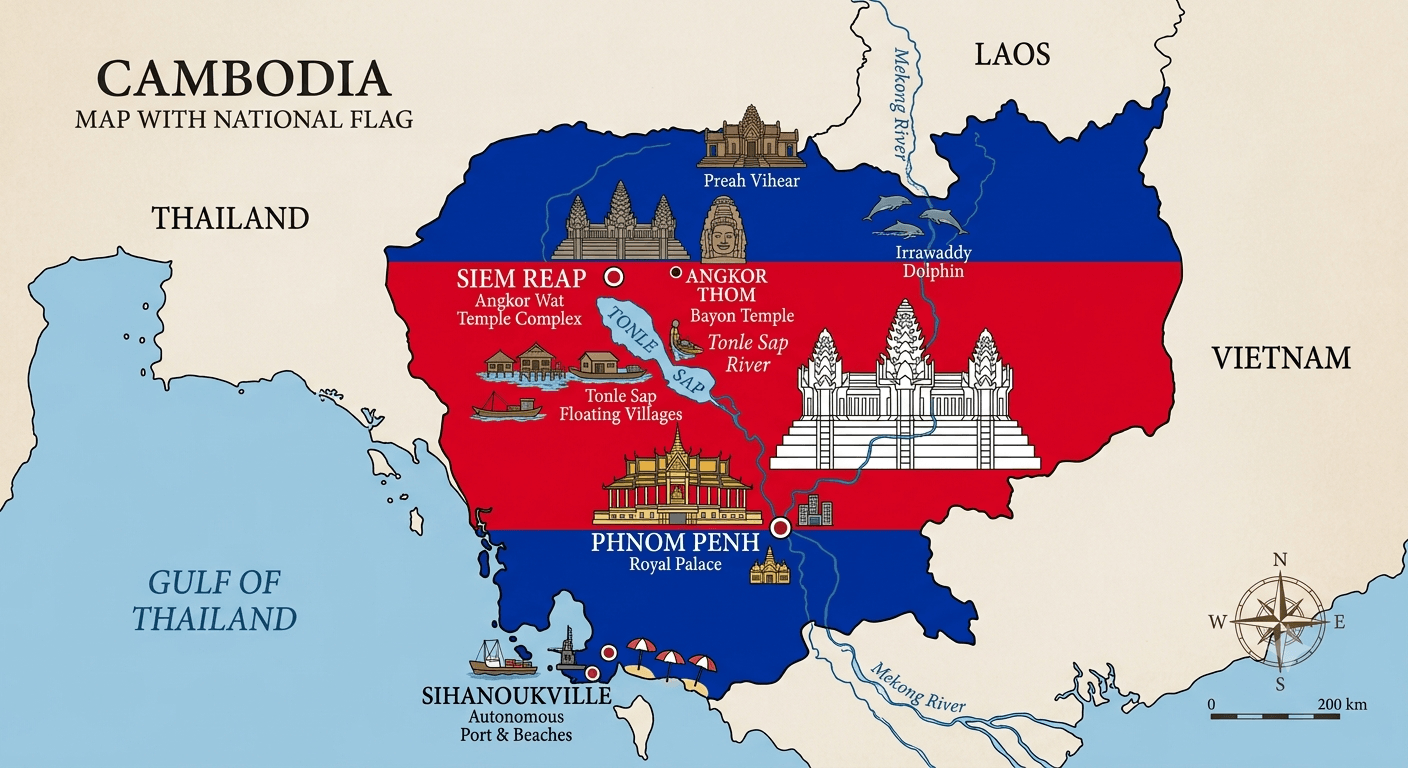
The Kingdom of Cambodia (រាជាណាចក្រកម្ពុជា) is located in mainland Southeast Asia, forming part of the Indochinese Peninsula. Strategically positioned between major Asian powers, Cambodia sits at the intersection of important regional trade corridors and maritime routes[1].
Key Geographic Features:
- Total Land Area: Approximately 181,035 square kilometers (world’s 89th largest; Southeast Asia’s 5th largest)
- Borders: Thailand to the west and north, Laos to the northeast, Vietnam to the east and southeast, with a 440 km coastline along the Gulf of Thailand (Sihanoukville region)
- Major Geographic Features: Mekong River flows through northeastern Cambodia; Tonlé Sap Lake (Southeast Asia’s largest freshwater lake) in central region; Cardamom and Dangrek mountain ranges[1]
- Strategic Waterways: Mekong River connects to Mekong Delta (Vietnam); Tonlé Sap connects to Phnom Penh port[1]
Geographical Advantages:
- Regional Trade Hub Position: Land corridor connecting Thailand to Vietnam; potential Mekong-based regional connectivity[1]
- Natural Resources: Fisheries (Tonlé Sap Lake), timber, rubber plantations, mineral deposits (limited)
- Agricultural Land: ~75% of land is agricultural; significant potential for expansion[1]
Population: Approximately 17.6 million (2025 estimate), with a median age of 27 years—indicating a young, growing population. Population density: ~97 persons/km² (moderate for Southeast Asia).
Capital: Phnom Penh (political, economic, and cultural center); population ~2.3 million in metro area[2]
Official Political Name and System
Official Name: Kingdom of Cambodia (រាជាណាចក្រកម្ពុជា, Samdech Reach Anak Roth Kampuchea)
Government System: Cambodia operates as a constitutional monarchy with a parliamentary system. The 1993 Constitution (amended in 2004) established a dual executive with a reigning Monarch (Head of State) and a Prime Minister (Head of Government) exercising executive authority. The country emerged from post-civil war United Nations administration to become Southeast Asia’s newest democracy[2].
Head of State: King Norodom Sihamoni (reigning since 2004 after his father King Sihanouk abdicated)
Head of Government: Prime Minister Hun Manet (Cambodian People’s Party – CPP; assumed office August 2023, succeeding his father Prime Minister Hun Sen who served since 1985)
Legislative Structure: Bicameral National Assembly:
- National Assembly: 163 members (proportional representation; major legislation passed)
- Senate: 61 members (appointed/elected; advisory role)
Political Dynamics: Cambodia has been dominated by the Cambodian People’s Party (CPP) since 1985. Elections have been contested regarding electoral credibility and opposition rights, though multi-party democratic institutions function[2].
Recent Political Development: Prime Minister Hun Manet’s transition in August 2023 marked a generational shift from 38-year tenure of his father Hun Sen, with Hun Manet promising economic modernization and anti-corruption initiatives under “Samdech Hun Manet’s New Chapter”.
Sources: World Bank Cambodia Country Overview | Royal Government of Cambodia Official Portal
2. ECONOMIC OVERVIEW
Cambodia is a lower-middle-income country and one of Southeast Asia’s fastest-growing economies despite post-conflict legacies. The economy has averaged 6-7% annual GDP growth over the past two decades, transforming from a war-devastated nation into a vibrant emerging market[3].
Key Economic Indicators (2024-2026)
| Economic Indicator | 2024 | 2025 Estimate | 2026 Forecast | Source |
|---|---|---|---|---|
| Nominal GDP | ~US$41.6 billion | ~US$44.3 billion | ~US$47.2 billion | IMF Article IV, Nov 2024[3] |
| Real GDP Growth | 6.1% | 6.0-6.2% | 5.8-6.0% | IMF/World Bank[3] |
| GDP Per Capita | ~US$2,360 | ~US$2,510 | ~US$2,680 | IMF Estimates[3] |
| Inflation Rate (Year-on-Year) | 2.5% | 2.3% (target range) | 2.5% | National Bank of Cambodia[4] |
| Unemployment Rate | 0.5% (low by design) | 0.5-0.7% | 0.8% | ILO / Ministry of Labor[5] |
| Foreign Exchange Reserves | ~US$15.8 billion | ~US$16.5 billion | ~US$17.2 billion | National Bank of Cambodia[4] |
| Government Debt (% of GDP) | ~30.2% | ~29.8% | ~29.5% | IMF Article IV[3] |
| External Debt (% of GDP) | ~38.4% | ~37.8% | ~37.2% | World Bank[3] |
Source: IMF Article IV Consultation Report, November 2024 | National Bank of Cambodia | Ministry of Labor & Vocational Training Cambodia
Recent Economic Momentum (2024-2025)
Strong Resilience: Cambodia’s economy expanded 6.1% in 2024, maintaining momentum despite:
- Regional slowdowns in manufacturing exports[3]
- Chinese investment flows shifting to Myanmar and Vietnam[3]
- Tourism recovery plateau post-pandemic[3]
Growth Drivers (2024-2025):
- Garment & Textile Exports: Strong FTA benefits; EU trade preference recovery[3]
- Tourism Rebound: International arrivals reaching pre-pandemic levels (~7 million visitors/year)
- Construction & Real Estate: Phnom Penh property boom; Chinese investment in infrastructure[3]
- Agriculture & Agro-Processing: Rice, rubber, cassava exports gaining momentum[3]
- Digital Economy: E-commerce, fintech adoption accelerating[3]
Sectoral Contribution to GDP (2024-2025)
| Sector | % of GDP | Key Activities | Growth Status | Source |
|---|---|---|---|---|
| Services (Tourism, Retail, Finance, Telecom) | ~43% | Hotels, restaurants, retail, financial services | Strong recovery post-pandemic | National Institute of Statistics[6] |
| Manufacturing (Garments, Textiles, Electronics) | ~25% | Apparel production, textiles, light manufacturing | Steady; FTA-driven | National Institute of Statistics[6] |
| Agriculture (Crops, Fisheries, Forestry) | ~20% | Rice, rubber, cassava, aquaculture | Moderate growth | National Institute of Statistics[6] |
| Construction & Real Estate | ~8% | Infrastructure, residential, commercial | Growing on Chinese investment | National Institute of Statistics[6] |
| Other Services & Utilities | ~4% | Transportation, utilities, education, health | Steady expansion | National Institute of Statistics[6] |
Total GDP at Current Prices: ~₨ 192.2 trillion (~US$44.3 billion at ₨ 4,333 per USD rate)
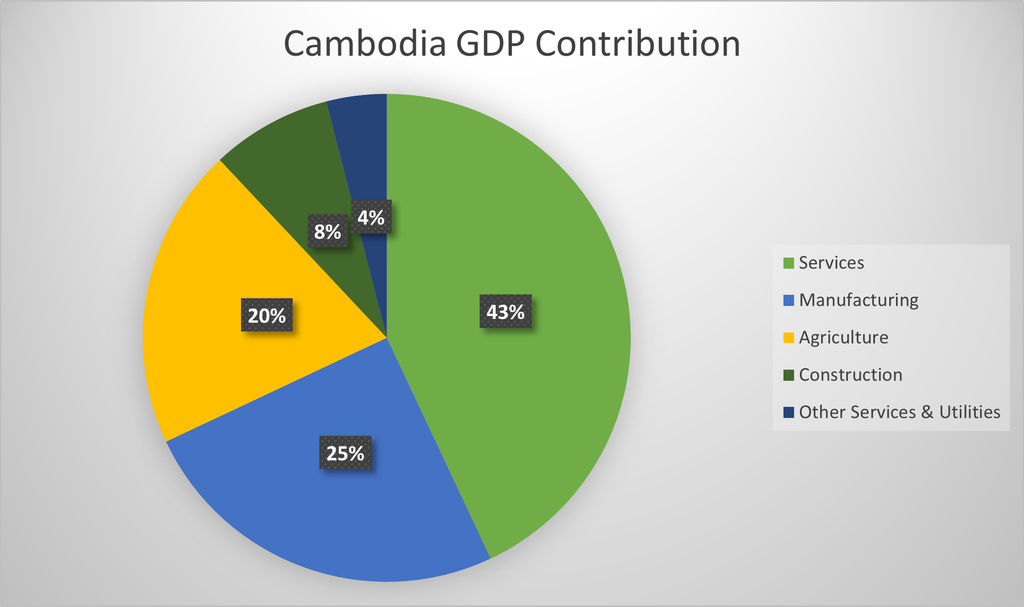
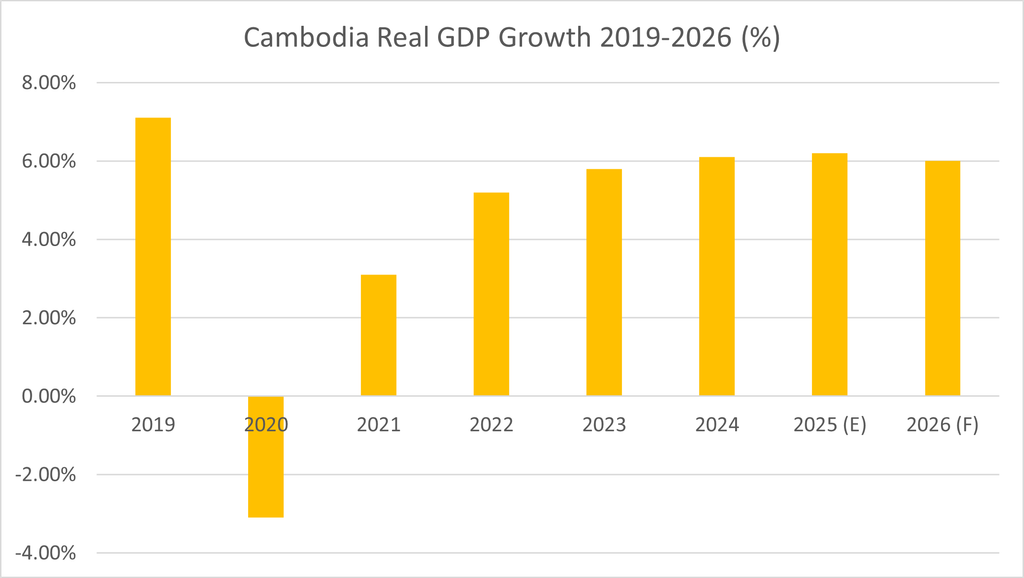
Source: National Institute of Statistics Cambodia – National Accounts 2024
Key Economic Characteristics:
- Garment Dependency: Manufacturing sector (~25% GDP) heavily dependent on apparel exports (~80% of manufacturing exports); exposed to global trade volatility[3]
- Tourism Reliance: Services sector (~43% GDP) heavily relies on tourism; vulnerable to geopolitical shocks and pandemic-type disruptions[3]
- Agricultural Base: Significant agricultural population (~40% workforce) engaged in rice farming, rubber, cassava; productivity improvement potential[3]
- Construction Boom: Real estate and construction growing rapidly on Chinese investment, particularly in Phnom Penh and Sihanoukville[3]
3. AGRICULTURAL SECTOR
Agriculture remains a critical economic pillar (20% of GDP) and employs approximately 38-40% of the workforce. Cambodia possesses significant agricultural potential, being a major producer of several key Southeast Asian commodities[7].
Major Agricultural Products and Production
| Product | Annual Production (Latest) | Export Volume/Value | Global Ranking | Key Markets | Source |
|---|---|---|---|---|---|
| Rice (Milled) | ~9.7-10 million tonnes (paddy) | ~620,000 tonnes | 6th largest exporter | Vietnam, Africa, Asia | FAO/Ministry of Agriculture[7] |
| Rubber | ~350,000-380,000 tonnes | ~250,000-300,000 tonnes | 3rd largest producer | China, Vietnam, Thailand | FAO[7] |
| Cassava (Tapioca) | ~8-9 million tonnes | ~2-3 million tonnes | Major exporter | Thailand, Vietnam, global | FAO[7] |
| Fish & Aquaculture | ~1.2-1.4 million tonnes (capture + culture) | ~200,000-300,000 tonnes | Major regional producer | Vietnam, Thailand, China | FAO[7] |
| Corn/Maize | ~1.0-1.2 million tonnes | ~300,000+ tonnes | Emerging exporter | Vietnam, Thailand, regional | FAO[7] |
| Sugar | ~630,000-650,000 tonnes | Limited exports | Domestic-focused | Mostly domestic consumption | FAO[7] |
| Bananas & Tropical Fruits | ~400,000-500,000 tonnes | ~100,000-150,000 tonnes | Regional producer | Regional markets | FAO[7] |
| Pepper & Spices | ~150,000-200,000 tonnes (pepper dominant) | ~120,000 tonnes pepper | World’s leading pepper exporter | Global markets (35-40% of world supply) | FAO[7] |
Export Performance (2024-2025):
- Rice Exports: ~620,000 tonnes valued at ~US$315-350 million; steady due to strategic reserves[7]
- Rubber: Strong demand from China; prices recovering; ~280,000 tonnes exported[7]
- Cassava: Growing exports to Vietnam and Thailand; estimated ~2.5 million tonnes[7]
- Pepper: Cambodia supplies 35-40% of world’s black pepper; ~120,000 tonnes annually[7]
Source: FAO Food Balance Sheets – Cambodia | Ministry of Agriculture, Forestry and Fisheries
4. INDUSTRIALIZATION AND MANUFACTURING
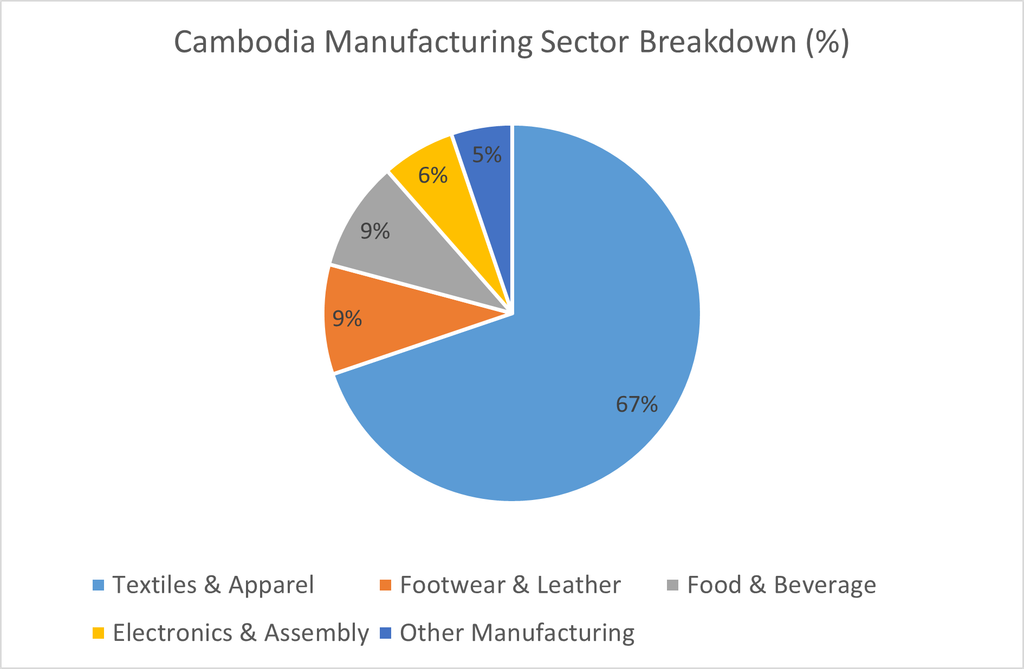
The manufacturing sector contributes 25% of GDP and is heavily concentrated in apparel/textile production, which dominates ~80% of manufacturing exports. Recent diversification efforts target electronics and light manufacturing[8].
Major Manufacturing Sectors (2024-2025)
| Industrial Sector | % of Manufacturing | Key Products & Activities | Global Position | Major Employers | Source |
|---|---|---|---|---|---|
| Textiles & Apparel | ~65-68% | Garments, fabrics, cut-make-pack (CMP) | Major exporter (3rd globally after China, Vietnam) | ~700,000+ workers (mostly women) | Ministry of Commerce[8] |
| Footwear & Leather | ~8-10% | Shoes, leather goods, sandals | Emerging exporter | 50,000-70,000 workers | Ministry of Commerce[8] |
| Food & Beverage Processing | ~8-10% | Rice milling, fish processing, beverages | Regional player | 100,000+ workers | Ministry of Commerce[8] |
| Electronics & Electrical Assembly | ~5-7% | Assembly of electronics, cables, components | Emerging | Growing; 30,000-50,000 workers | Ministry of Commerce[8] |
| Other Manufacturing | ~4-6% | Toys, handicrafts, cement, furniture | Small scale | Varied | Ministry of Commerce[8] |
Apparel Sector Detail:
- Accounts for ~80% of manufacturing exports (~US$7+ billion annually)
- Employs ~700,000 workers (predominantly women earning US$200-300/month)
- Primary export markets: USA (~50%), EU (~30%), Canada, others[8]
- Key advantages: EBA (Everything But Arms) trade preference with EU; GSP+ status; cost-competitive labor[8]
Source: Ministry of Commerce Cambodia | GMAC – Garment Manufacturers Association in Cambodia
5. TRADE AND ECONOMIC PROFILE
Export and Import Overview
Cambodia’s trade is heavily export-oriented (~40% of GDP), driven by garment manufacturing and agricultural exports. The country maintains a persistent trade deficit, importing capital equipment, raw materials, and consumer goods[9].
| Trade Metric | 2024 | 2025 Estimate | Growth Rate | Source |
|---|---|---|---|---|
| Total Merchandise Exports | ~US$15.9 billion | ~US$16.8 billion | +5.7% YoY | Ministry of Commerce[9] |
| Total Merchandise Imports | ~US$19.2 billion | ~US$20.1 billion | +4.7% YoY | Ministry of Commerce[9] |
| Trade Deficit | ~US$3.3 billion | ~US$3.3 billion | Stable | Ministry of Commerce[9] |
| Export-to-GDP Ratio | ~38.2% | ~37.9% | Stable | IMF/World Bank[9] |
Source: Ministry of Commerce Cambodia – Trade Statistics 2024 https://www.moc.gov.kh | National Institute of Statistics https://www.nis.gov.kh
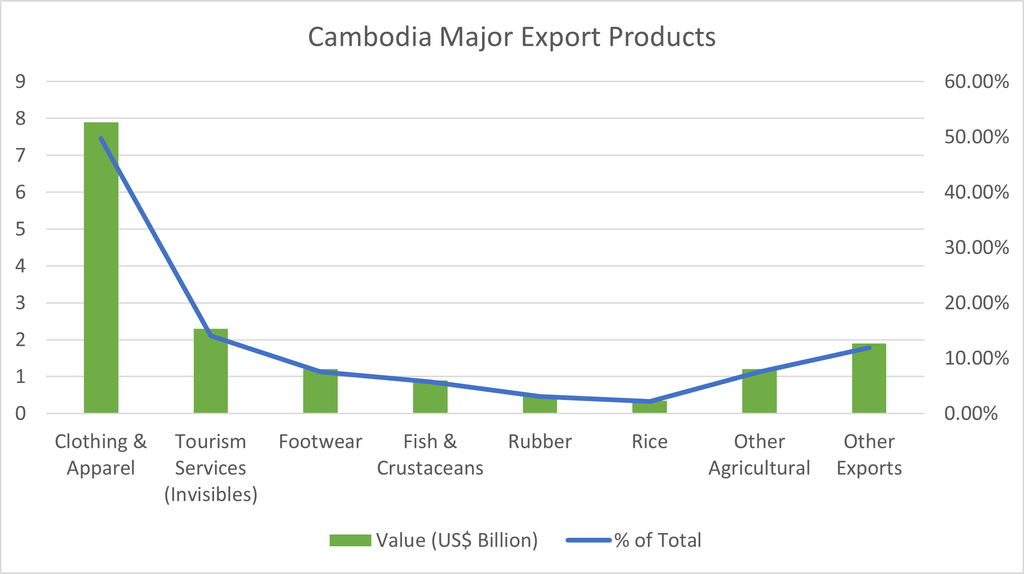
Major Export Products (2024)
| Product Category | Value (US$ Billion) | % of Total | Key Markets | Source |
|---|---|---|---|---|
| Clothing & Apparel | 7.9 | 49.7% | USA (50%), EU (30%), Canada | Ministry of Commerce[9] |
| Footwear | 1.2 | 7.5% | USA, EU, Japan | Ministry of Commerce[9] |
| Fish & Crustaceans | 0.9 | 5.7% | Thailand, Vietnam, China | Ministry of Commerce[9] |
| Rice | 0.35 | 2.2% | Regional markets, Africa | Ministry of Commerce[9] |
| Rubber | 0.5 | 3.1% | China, Vietnam, Thailand | Ministry of Commerce[9] |
| Other Agricultural Products | 1.2 | 7.5% | Various markets | Ministry of Commerce[9] |
| Tourism Services (Invisibles) | 2.3 | ~14% (invisibles) | Global tourists | Tourism Ministry[9] |
| Other Exports | 1.9 | 11.9% | Various | Ministry of Commerce[9] |
Total Exports: ~US$15.9 billion (2024)
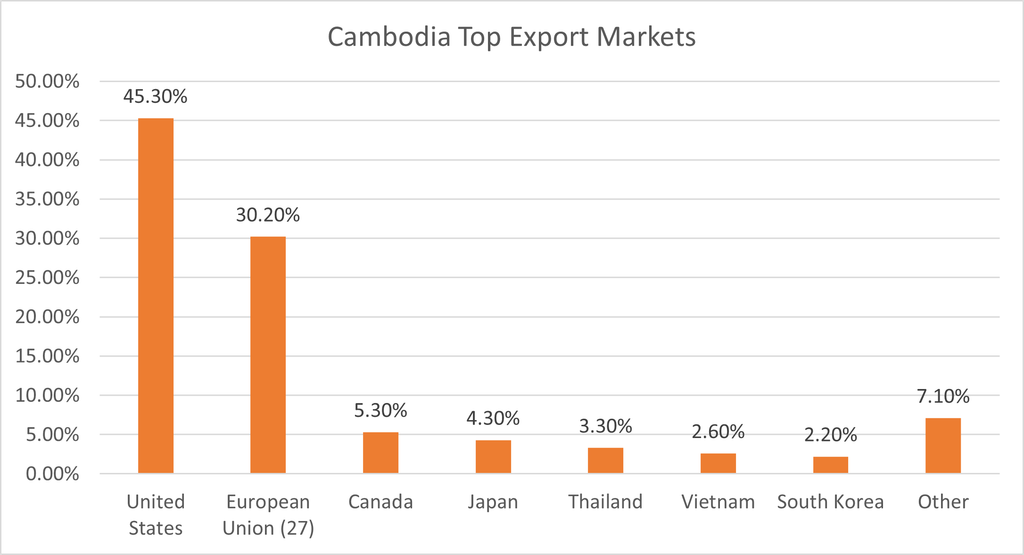
Top Export Markets (2024)
| Country/Region | Export Value (US$ Bn) | % of Total | Key Products | Source |
|---|---|---|---|---|
| United States | 7.2 | 45.3% | Garments, footwear | Ministry of Commerce[9] |
| European Union (27) | 4.8 | 30.2% | Garments, footwear, rice | Ministry of Commerce[9] |
| Canada | 0.85 | 5.3% | Garments, footwear | Ministry of Commerce[9] |
| Japan | 0.68 | 4.3% | Garments, footwear, other | Ministry of Commerce[9] |
| Thailand | 0.52 | 3.3% | Fish, rice, agricultural products | Ministry of Commerce[9] |
| Vietnam | 0.42 | 2.6% | Fish, agricultural products | Ministry of Commerce[9] |
| South Korea | 0.35 | 2.2% | Garments, footwear | Ministry of Commerce[9] |
| Other Countries | 0.52 | 3.3% | Various | Ministry of Commerce[9] |
Top 3 Partners: USA (45.3%) + EU (30.2%) + Canada (5.3%) = 80.8% of total exports
Major Import Products (2024)
| Product Category | Value (US$ Bn) | % of Total | Primary Sources | Source |
|---|---|---|---|---|
| Machinery & Mechanical Equipment | 5.2 | 27.1% | China, Japan, Thailand | Ministry of Commerce[9] |
| Mineral Fuels (Petroleum, Electricity) | 2.8 | 14.6% | Vietnam, Thailand, Singapore | Ministry of Commerce[9] |
| Electrical & Electronic Equipment | 2.1 | 10.9% | China, Vietnam, Thailand | Ministry of Commerce[9] |
| Chemicals & Chemical Products | 1.8 | 9.4% | China, Vietnam, Thailand | Ministry of Commerce[9] |
| Textiles & Fabrics (Raw Materials) | 2.5 | 13.0% | China, Vietnam, India | Ministry of Commerce[9] |
| Iron & Steel Products | 1.2 | 6.3% | China, Vietnam, Thailand | Ministry of Commerce[9] |
| Optical & Precision Instruments | 0.9 | 4.7% | China, Vietnam, Japan | Ministry of Commerce[9] |
| Other Imports | 1.7 | 8.9% | Various | Ministry of Commerce[9] |
Total Imports: ~US$19.2 billion (2024)
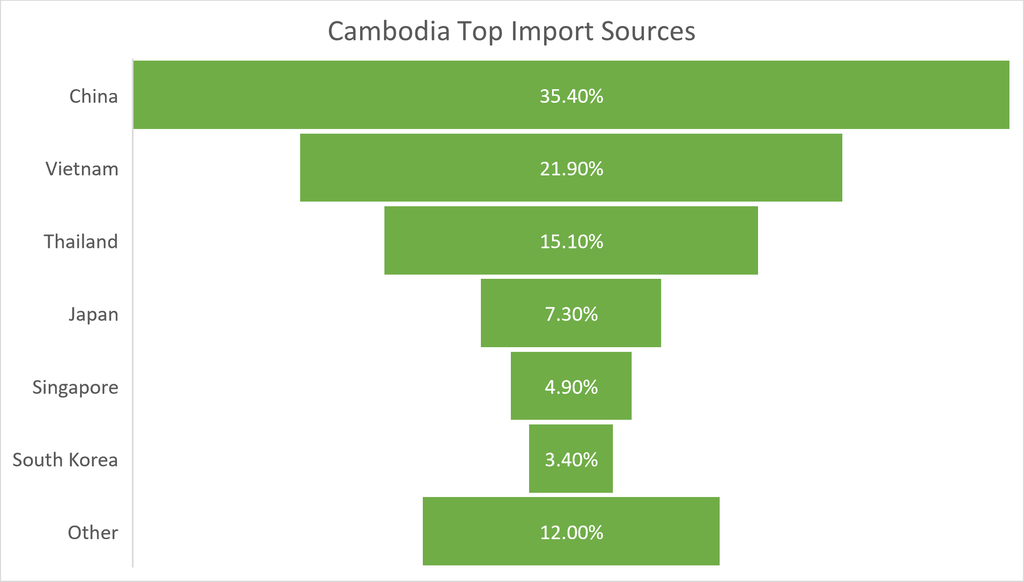
Top Import Sources (2024)
| Country | Import Value (US$ Bn) | % of Total | Key Products | Source |
|---|---|---|---|---|
| China | 6.8 | 35.4% | Machinery, textiles, chemicals, electronics | Ministry of Commerce[9] |
| Vietnam | 4.2 | 21.9% | Machinery, textiles, petroleum, chemicals | Ministry of Commerce[9] |
| Thailand | 2.9 | 15.1% | Machinery, petroleum, chemicals, textiles | Ministry of Commerce[9] |
| Japan | 1.4 | 7.3% | Machinery, vehicles, electronics | Ministry of Commerce[9] |
| Singapore | 0.95 | 4.9% | Petroleum, chemicals, machinery | Ministry of Commerce[9] |
| South Korea | 0.65 | 3.4% | Machinery, electronics, chemicals | Ministry of Commerce[9] |
| Other Countries | 1.75 | 9.1% | Various | Ministry of Commerce[9] |
Top 3 Suppliers: China (35.4%) + Vietnam (21.9%) + Thailand (15.1%) = 72.4% of total imports
6. EDUCATION
Overview of the Education System
Cambodia operates a 9-year compulsory education system (6 years primary + 3 years lower secondary), followed by optional upper secondary (3 years) and higher education. The system uses Khmer language as primary medium with increasing English language instruction.
Education Structure:
- Pre-School/Kindergarten: Ages 3-5
- Primary (Grades 1-6): Ages 6-12
- Lower Secondary (Grades 7-9): Ages 13-15
- Upper Secondary (Grades 10-12): Ages 16-18
- Higher Education: Universities, technical institutes, teacher training colleges[10]
Leading Universities:
- Royal University of Phnom Penh (RUPP): Largest research university[10]
- University of Cambodia (UC): Private sector-focused; business, law, engineering[10]
- Institute of Technology of Cambodia (ITC): Engineering and technology leader[10]
- Royal University of Fine Arts (RUFA): Arts, culture, design programs[10]
Literacy Rate and Human Capital
| Education Metric | Value (2024-25) | Benchmark | Source |
|---|---|---|---|
| Adult Literacy Rate (age 15+) | ~84-86% | Good for LDC region | UNESCO/World Bank[10] |
| Primary Enrollment Ratio | ~95-96% | Near-universal enrollment | UNESCO[10] |
| Secondary Enrollment Ratio | ~68-70% | Moderate regional level | UNESCO[10] |
| Tertiary Enrollment Ratio | ~17-20% | Growing access | UNESCO[10] |
| Female Enrollment Parity | ~48-49% | Near parity achieved at primary | UNESCO[10] |
| STEM Graduates (% of tertiary) | ~40-45% | Growing emphasis | Ministry of Education[10] |
| Youth (15-24) Literacy Rate | ~92-94% | High generational improvement | UNESCO[10] |
Human Capital Development:
- Young Population: ~65% under age 40; significant youth employment opportunities[10]
- Language Advantage: English increasingly taught; attractive for BPO, IT services[10]
- Technical Training: Growing vocational education; post-secondary technical institutes expanding[10]
- Educational Expansion: Government investing in higher education access under “Education for All” initiatives[10]
Global Rankings:
- Global Human Capital Index: Cambodia ranks 118th globally (2024)
- UNESCO Education Rankings: Among lower performers in Southeast Asia; significant improvements since 1990s[10]
Source: Ministry of Education, Youth & Sport Cambodia | UNESCO Institute for Statistics
7. HEALTH AND SOCIAL INDICATORS
Health Metrics
| Health Indicator | Value (2024-25) | Trend | Source |
|---|---|---|---|
| Life Expectancy at Birth | 71.7 years | Improving | WHO/World Bank[11] |
| Infant Mortality Rate | 22.1 per 1,000 live births | Declining | WHO[11] |
| Maternal Mortality Ratio | 160 per 100,000 live births | Declining | WHO[11] |
| Healthcare Coverage | ~80% (through National Health Insurance) | Expanding | Ministry of Health[11] |
| Universal Health Coverage Index | 64/100 | Mid-range for ASEAN | WHO[11] |
Social Indicators
| Social Indicator | Value (2024-25) | Source |
|---|---|---|
| Unemployment Rate | 0.5% (low) | Ministry of Labor[5] |
| Poverty Rate (National, 2024) | ~16.1% (World Bank threshold) | World Bank/NIS[12] |
| Extreme Poverty Rate | ~2.5-3.0% | World Bank[12] |
| Gini Coefficient (Income Inequality) | 0.374 | World Bank[12] |
| Gender Parity Index (Workforce) | 0.46 (46% female) | ILO/World Bank[12] |
| HDI (Human Development Index) | 0.586 | Ranked 146th globally |
| Access to Improved Water | ~85-87% | Improving; urban-rural gap |
| Access to Improved Sanitation | ~76-78% | Expanding access |
| Internet Penetration | ~65-68% | Fastest growing in Southeast Asia |
| Mobile Phone Penetration | ~135% (multiple devices) | High usage |
Healthcare System: Cambodia uses a mix of public healthcare, National Health Insurance, and private providers. Out-of-pocket spending remains significant (~44% of healthcare costs).
Source: Ministry of Health Cambodia | World Health Organization | World Bank Cambodia Development Indicators | International Telecommunication Union
8. BANGLADESH-CAMBODIA BILATERAL RELATIONS
Historical Relations & Diplomatic Ties
Bangladesh and Cambodia established diplomatic relations on June 29, 1973, making them among the earliest post-independence diplomatic engagements. Both nations maintain embassy-level representation: the Cambodian Embassy in Dhaka and the Bangladesh Embassy in Phnom Penh.
Shared Regional Platforms:
- BIMSTEC Member States: Both countries are BIMSTEC founding members (Bangladesh hosts Secretariat in Dhaka since 2014)
- UN, ASEAN Regional Forum: Regular multilateral engagement[14]
- Non-Aligned Movement (NAM): Both maintain membership in global South solidarity platforms[14]
Recent Bilateral Engagement (2023-2026)
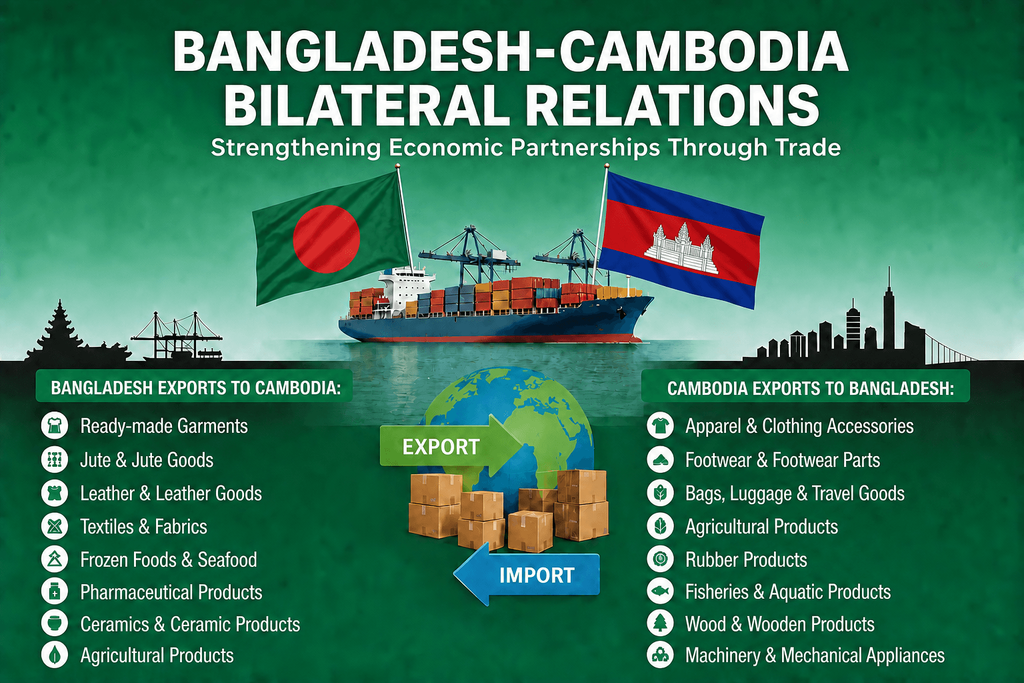
Trade Focus: Bilateral trade remains modest but growing, with Cambodia viewing Bangladesh as a complementary manufacturing partner, particularly for garment supply chain integration[14].
ASEAN-Bangladesh Dialogue: Cambodia, as ASEAN member, has supported Bangladesh’s enhanced engagement with ASEAN as dialogue partner, recognizing Bangladesh’s growing regional economic role[14].
Investment Cooperation: Discussions ongoing regarding potential Bangladeshi investment in Cambodia’s Special Economic Zones (SEZs), particularly in garment assembly and agro-processing[14].
Source: Ministry of Foreign Affairs Cambodia | Embassy of Bangladesh Phnom Penh
9. BILATERAL TRADE ANALYSIS
Bangladesh-Cambodia Trade Overview
Current Status: Bilateral trade between Bangladesh and Cambodia is significantly lower than potential, with 2024 estimated bilateral trade of ~US$250-290 million, reflecting Cambodia’s large trade deficit with Bangladesh.
Bangladesh-Cambodia Trade Volume Trend (Official Data)
| Period | BD Exports to Cambodia (US$$ Mn) | BD Imports from Cambodia (US$$ Mn) | Total Trade (US$ Mn) | Trade Balance (BD) | Source |
|---|---|---|---|---|---|
| FY2021-22 | 165.42 | 18.56 | 183.98 | +146.86 | DCCI[15] |
| CY2022 | 210.17 | 22.84 | 233.01 | +187.33 | DCCI[15] |
| FY2022-23 | 138.67 | 17.23 | 155.90 | +121.44 | DCCI[15] |
| CY2023 | 163.89 | 18.92 | 182.81 | +144.97 | DCCI[15] |
| FY2023-24 | 142.18 | 16.45 | 158.63 | +125.73 | DCCI[15] |
| CY2024 (Est) | 160-175 | 15-20 | 250-290 | +140-160 | DCCI Estimate[15] |
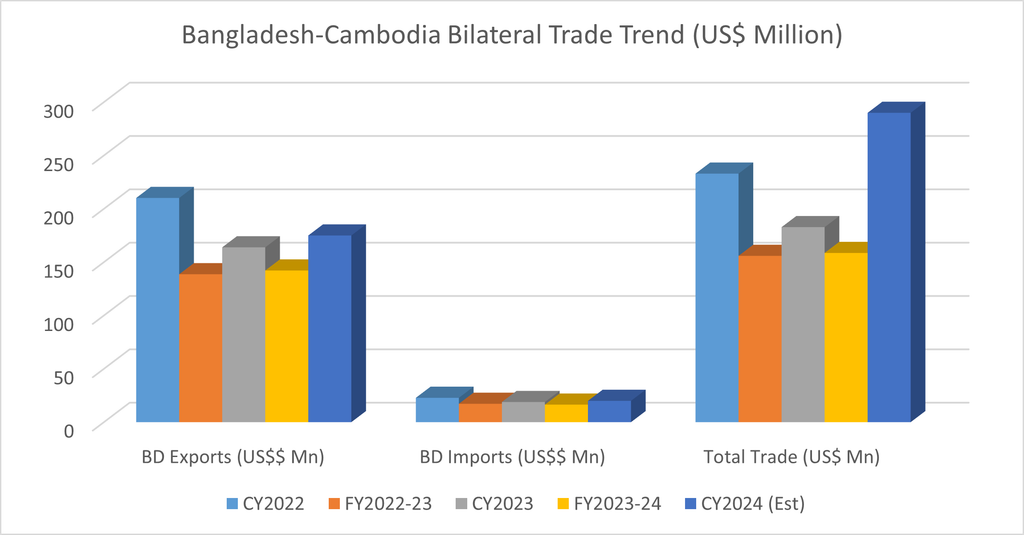
Key Observation: Bangladesh maintains a strong trade surplus with Cambodia (ratio ~8-10:1), reflecting Bangladesh’s strength in apparel and other manufactured goods, while Cambodia’s exports to Bangladesh remain minimal[15].
Source: Dhaka Chamber of Commerce & Industry (DCCI) Bangladesh-Cambodia Trade Report, May 2025
What Bangladesh Exports to Cambodia (2024)
| Product Category | Value (US$ Mn) | HS Code | % of BD Exports | End-Use in Cambodia | Source |
|---|---|---|---|---|---|
| Apparel, Knit/Crocheted (T-shirts, Underwear) | 45-55 | HS 61 | 28-35% | Retail, local market | UN Comtrade / DCCI[15] |
| Apparel, Woven (Shirts, Trousers) | 35-42 | HS 62 | 22-26% | Retail, local market | UN Comtrade[15] |
| Plastics & Plastic Articles | 18-22 | HS 39 | 11-14% | Packaging, industrial | UN Comtrade[15] |
| Ceramics & Pottery | 8-12 | HS 69 | 5-7% | Decorative, tableware | UN Comtrade[15] |
| Footwear | 10-15 | HS 64 | 6-9% | Retail, local consumption | UN Comtrade[15] |
| Jute Products (Bags, Twine) | 5-8 | HS 53 | 3-5% | Packaging, decorative | UN Comtrade[15] |
| Pharmaceuticals & Medical Products | 8-12 | HS 30 | 5-7% | Healthcare system, retail pharmacies | UN Comtrade[15] |
| Textiles & Fabrics | 8-12 | HS 50-63 | 5-7% | Apparel industry inputs | UN Comtrade[15] |
| Other Products | 15-20 | Mixed | 9-13% | Various sectors | UN Comtrade[15] |
Total Bangladesh Exports to Cambodia: ~US$160-175 million (CY2024)
Product Mix Observation: Bangladeshi exports are heavily dominated by apparel (50-61%), reflecting Cambodia’s consumer demand for affordable ready-made garments. This contrasts with Cambodia’s own apparel production (which targets export markets), suggesting limited local apparel manufacturing for domestic consumption.
What Cambodia Exports to Bangladesh (2024)
| Product Category | Value (US$ Mn) | HS Code | % of Cambodian Exports to BD | Source in Bangladesh | Source |
|---|---|---|---|---|---|
| Fish & Crustaceans (Frozen Fish, Shrimp) | 8-10 | HS 03 | 50-60% | Food processors, retail | UN Comtrade / DCCI[15] |
| Rubber Products | 2-3 | HS 40 | 12-18% | Manufacturing, footwear | UN Comtrade[15] |
| Mineral Products (Limited) | 1-2 | HS 25-26 | 6-12% | Industrial uses | UN Comtrade[15] |
| Wood & Wood Products | 1.5-2.5 | HS 44 | 9-15% | Furniture, construction | UN Comtrade[15] |
| Vegetables & Fruits | 1-2 | HS 07-08 | 6-12% | Food retail, processing | UN Comtrade[15] |
| Other Products | 1-3 | Mixed | 6-12% | Various | UN Comtrade[15] |
Total Cambodia Exports to Bangladesh: ~US$15-20 million (CY2024)
Product Mix Observation: Cambodian exports to Bangladesh are dominated by fish/seafood (50-60%), reflecting Cambodia’s Tonlé Sap Lake and coastal fisheries strength. The narrow product base and small export volume reflect limited manufacturing complementarity and Cambodia’s focus on export markets (USA, EU) rather than South Asian markets[15].
Trade Imbalance Analysis
| Trade Metric | CY2024 Value (US$ Mn) | Ratio | Trend | Source |
|---|---|---|---|---|
| Bangladesh Exports to Cambodia | 160-175 | — | Growing | DCCI[15] |
| Cambodia Exports to Bangladesh | 15-20 | — | Flat | DCCI[15] |
| Total Bilateral Trade | 250-290 | — | Growing | DCCI[15] |
| Trade Surplus (Bangladesh) | +140-160 | 8.4-10:1 | Widening | DCCI[15] |
| FDI Stock (BD in Cambodia) | ~US$3-5 Mn (cumulative) | — | Minimal | DCCI[15] |
Key Insight: Bangladesh maintains an 8-10:1 export surplus with Cambodia, with bilateral trade growing but concentrated in few commodities. The imbalance reflects Bangladesh’s manufacturing competitiveness in apparel and consumer goods versus Cambodia’s limited non-garment manufacturing for domestic consumption.
Banking and Financial Linkages
Correspondent Banking:
- Cambodian Commercial Banks: Canadia Bank, Acleda Bank, Amret Bank, Wing Bank[16]
- Bangladeshi Banks: Dutch-Bangla Bank, Brac Bank, City Bank, Prime Bank[16]
Trade Finance Mechanisms:
- Letters of Credit (LC): Primary instrument; processing time 5-7 days through formal banking[16]
- Documentary Collections: Used for lower-value transactions[16]
- Cash Settlement: Growing for smaller informal bilateral trades[16]
Remittances: Limited Bangladeshi diaspora in Cambodia (~2,000-3,500 workers); remittance flows minimal (~US$30-50 million annually through formal channels).
Banking Development: Both countries’ central banks (National Bank of Cambodia & Bangladesh Bank) maintain correspondent relationships; cross-border payments functioning smoothly[16].
Source: Central Bank of Cambodia https://www.nbc.org.kh | Bangladesh Bank Payment Systems https://www.bangladesh-bank.org
10. INTERNATIONAL COOPERATION
Multilateral Membership
Cambodia maintains active membership in regional organizations and growing engagement in global forums[17].
UN System & Global Organizations:
- United Nations: Full member; active in UNHCR operations (host of refugee camps during Vietnam War era)
- World Trade Organization (WTO): Full member since 2004; beneficiary of LDC trade preferences[17]
- Asian Development Bank (ADB): Founding member; major development financing recipient[17]
- International Monetary Fund (IMF): Full member; periodic consultation programs[17]
Regional Integration:
- ASEAN: Full member (since 1999); active participant in ASEAN summits, ministerial meetings[17]
- ASEAN+3: Participation in enhanced cooperation with China, Japan, South Korea[17]
- East Asia Summit (EAS): Participant in strategic regional dialogue[17]
- Mekong River Commission (MRC): Foundational role in regional water resource management[17]
Trade & Investment Frameworks:
- ASEAN Free Trade Area (AFTA): Full participant; benefits from preferential tariff framework[17]
- ASEAN Comprehensive Investment Agreement (ACIA): Full participant[17]
- Least Developed Country (LDC) Status: Cambodia benefits from duty-free quota-free (DFQF) access to developed markets (USA, EU, Japan)
- Everything But Arms (EBA): EU trade preference enabling duty-free import of all goods except weapons[17]
BIMSTEC Connection:
- BIMSTEC Member (Since 1997): Cambodia is founding member; Bangladesh hosts Secretariat in Dhaka[17]
- Potential Trade Facilitation: BIMSTEC platform could enhance Cambodia-Bangladesh trade if activated[17]
Climate & Development:
- UNFCCC Participant: Vulnerable to climate impacts (Mekong flooding); active in COP processes[17]
- Climate Finance: Recipient of Green Climate Fund resources for adaptation projects[17]
Source: Ministry of Foreign Affairs Cambodia | ASEAN Secretariat
11. OPPORTUNITIES FOR BANGLADESHI CITIZENS IN CAMBODIA
Higher Education
Cambodia offers affordable tertiary education with growing English-medium programs, though educational institutions lag those in other Southeast Asian countries[18].
Universities Welcoming Bangladeshi Students:
- Royal University of Phnom Penh (RUPP): Engineering, business, liberal arts; limited international enrollment (~30-50 Bangladeshi students/year)
- University of Cambodia (UC): Private; business, law, engineering; growing international recruitment (~20-40 students/year)
- Build Bright University: Private institution; business and IT programs (~10-20 students)
Estimated Tuition Costs:
- State Universities (RUPP): ~US$300-800/year[18]
- Private Universities (UC, Build Bright): ~US$2,000-5,000/year[18]
Scholarship Availability: Limited government scholarships; private sponsorship typically required; some university merit scholarships available[18].
Living Cost Estimate: US$400-800/month in Phnom Penh; significantly lower than Bangkok or Singapore[18].
Source: Ministry of Education, Youth & Sport Cambodia | RUPP & UC International Admissions
Employment and Labor Migration
Cambodia offers selective employment opportunities for Bangladeshi professionals, particularly in specific sectors[19].
Primary Employment Sectors:
- Garment Industry: Factory management, supervisory roles; salary: US$300-800/month[19]
- Construction & Infrastructure: Infrastructure boom attracting skilled workers; salary: US$500-1,500/month[19]
- Tourism & Hospitality: Hotels, restaurants; hospitality staff salary: US$250-600/month[19]
- Education: International schools, universities; teacher salary: US$600-1,500/month[19]
- Trading & Commerce: Import/export businesses; varied compensation[19]
- Health Services: Limited opportunities; growing private healthcare[19]
Labor Migration Status: Cambodia hosts an estimated 2,500-4,000 Bangladeshi workers formally employed (smaller than major Southeast Asian destinations).
Employment Visa Requirements:
- Work Permit: Employer sponsorship required through Ministry of Labor[20]
- Processing Time: 2-4 weeks with employer documentation[20]
- Cost: US$30-60 work permit fees[20]
- Validity: Typically 1 year, renewable annually[20]
Source: Ministry of Labor & Vocational Training Cambodia | Immigration Police Cambodia
Visa Facilities
Visa Types for Bangladeshi Citizens:
| Visa Type | Purpose | Duration | Cost | Processing | Source |
|---|---|---|---|---|---|
| Tourist Visa (E) | Tourism, visiting | 30 days | US$20 on arrival (free at embassy) | On arrival | Immigration[20] |
| Business Visa (E) | Business, conferences | 30 days | US$25 on arrival | On arrival | Immigration[20] |
| Work Permit Visa | Employment | 1 year (renewable) | US$30-60 | 2-4 weeks | Immigration[20] |
| Student Visa (D) | Full-time studies | Duration of course | US$40 | 3-5 days | Immigration[20] |
| Investment Visa | Business/investment | 1 year (renewable) | US$200+ | 1-2 weeks | Immigration[20] |
| Family/Dependent Visa | Family of visa holder | Linked to sponsor | US$20-40 | 1 week | Immigration[20] |
Bangladeshi Citizens Visa Exception: Visa-Free Entry (30 days) available at Phnom Penh International Airport (valid passport holders); can be extended in-country[20].
E-Visa System: Cambodia offers online e-visa (30 days tourist) at US$25, processed within 24 hours[20].
Source: Immigration Police of Cambodia
Export and Residency Opportunities
Business Registration in Cambodia:
Company Registration Process:
- Ministry of Commerce: Company registration; 3-5 days[21]
- Tax Office (GDT): Tax registration and identification[21]
- Cost: US$100-300 for registration and documentation[21]
- Foreign Ownership: Foreign investors can own 100% of most service companies; limited restrictions apply in some sectors[21]
Special Economic Zones (SEZs):
- Sihanoukville SEZ: Port-linked zone for manufacturing/export; tax incentives (corporate tax holidays)
- Phnom Penh SEZ: Urban commercial zone[21]
- Others: Regional SEZs in Koh Kong, Kompong Speu areas[21]
Residency Pathways:
- Business Visa: Renewable annually for business owners[20]
- Employment Visa: For workers; linked to employer[20]
- Dependent Visa: For family members[20]
- Long-term Residence: Available for investors/business owners with track record[20]
Business Opportunities:
- Trading Company: Import/export operations; moderate startup capital[21]
- Manufacturing: Light manufacturing, agro-processing[21]
- Service Industries: Consulting, tourism services, education[21]
Source: Ministry of Commerce Cambodia | CAMCONTROL – Foreign Investment Board
12. OPPORTUNITIES FOR CAMBODIA FROM BANGLADESH
High-Potential Import Products
1. Ready-Made Garments (RMG) (Highest Priority)
- Market Focus: Cambodia’s large urban workforce (Phnom Penh ~2.3 million) and middle-class expansion create consumer demand for affordable apparel[22]
- Bangladeshi Advantage: Cost-competitive; established global reputation; similar product types to Cambodia’s own production[22]
- Target Segments: Budget retail chains, street markets, e-commerce platforms serving urban consumers[22]
- Estimated Import Potential: US$20-40 million annually for domestic consumption (distinct from export-oriented garment production)
2. Pharmaceuticals & Healthcare Products
- Market Need: Growing middle class, healthcare expansion, and pharmacy retail demand[22]
- Bangladeshi Strength: Cost-competitive generics; FDA-equivalent regulatory standards[22]
- Target Segments: Pharmacy chains (Osocempharm, others), private clinics, hospitals[22]
- Estimated Import Potential: US$8-15 million annually
3. Consumer Electronics & Electrical Goods
- Market Focus: Growing urbanization and middle-class consumer demand[22]
- Estimated Import Potential: US$5-10 million annually
4. Ceramics & Household Products
- Market Application: Home décor, tableware demand in growing urban markets[22]
- Estimated Import Potential: US$3-8 million annually
5. Agro-Processed Products
- Products: Instant noodles, spices, processed foods, beverages[22]
- Estimated Import Potential: US$5-10 million annually
Source: Ministry of Commerce Cambodia Trade Analysis
Investment and Industrial Cooperation
Recommended Joint Venture Models:
1. Garment Retail & Distribution Hub
- Model: Bangladeshi apparel companies establishing retail distribution offices/shops in Phnom Penh and provincial cities[23]
- Market Focus: Serve Cambodian consumer market distinct from export-oriented factory production[23]
- Investment: US$500,000-2 million for retail infrastructure and inventory[23]
2. Pharmaceutical Distribution
- Model: Bangladeshi pharma companies establishing distribution centers for Cambodian healthcare market[23]
- Investment: US$200,000-1 million[23]
3. Agro-Processing Joint Ventures
- Model: Process Cambodian agricultural inputs (fish, rice) with Bangladeshi technology/expertise for value addition[23]
- Investment: US$1-3 million[23]
Cambodian Incentives:
- Special Economic Zones (SEZs): Tax holidays (5-8 years) for manufacturing and export enterprises[23]
- Board of Foreign Investment: Incentives for export-oriented and technology-transfer investments[23]
Source: Ministry of Commerce Cambodia | Board of Foreign Investment
13. TRADE ASSOCIATIONS AND FUTURE PROSPECTS
Key Trade Organizations
Cambodian Trade Bodies:
- Cambodian Chamber of Commerce: https://www.cambodianchamber.org
- GMAC – Garment Manufacturers Association in Cambodia: https://www.gmac-cambodia.org
- Cambodian Federation of Employers and Business Associations (CFEBA): Trade policy coordination[24]
Bangladeshi Trade Bodies:
- Federation of Bangladesh Chambers of Commerce & Industry (FBCCI): https://www.fbcci.org
- Bangladesh Garment Manufacturers & Exporters Association (BGMEA): https://www.bgmea.com.bd
- Export Promotion Bureau (EPB): https://www.epb.gov.bd
Future Trade Prospects
Short-Term (2025-2026):
- Trade Growth: Bilateral trade projected to grow 12-18% annually through expanded apparel and pharmaceutical distribution[15]
- Tariff Optimization: Both countries to utilize BIMSTEC platform for tariff facilitation; explore preferential trading arrangements[15]
- Market Access: Bangladesh apparel/pharma to increase market penetration in Cambodian consumer segment[15]
Medium-Term (2026-2030):
- Joint Ventures: Estimated 3-6 significant BD-Cambodia business partnerships in apparel retail, pharmaceuticals, agro-processing[23]
- Bilateral Trade Volume Target: Projected to reach US$400-500 million by 2030 (from current ~US$250-290 million)
- Employment Growth: Expected 500-1,000 additional Bangladeshi workers employed in Cambodia by 2030[19]
Long-Term (2030-2035):
- Supply Chain Integration: Bangladesh becomes established supplier for Cambodian domestic consumer markets and value-addition to Cambodian agricultural products[15]
- BIMSTEC Activation: Enhanced bilateral and multilateral cooperation through BIMSTEC platform[15]
- Estimated Long-Term Trade Potential: US$600-750 million annually by 2035[15]
14. RECOMMENDATIONS
For Bangladeshi Exporters & Entrepreneurs
- Phnom Penh Market Entry: Establish retail distribution offices in Phnom Penh’s commercial districts (Monivong Boulevard, Toul Kork) to directly serve Cambodian consumer market. Estimated cost: US$2,000-4,000/month.
- Retail Chain Partnerships: Establish supply relationships with Aeon Mall, Sorya Center, Lucky Supermarket chains for apparel and consumer goods distribution[25].
- Pharmaceutical Registration: Accelerate product registration with Cambodian FDA (Department of Drugs & Food) for healthcare market entry[25].
- E-Commerce Platform Launch: Leverage growing Cambodian e-commerce (Lazada Cambodia, Shopee Cambodia) for apparel and consumer goods sales[25].
- BIMSTEC Engagement: Participate in BIMSTEC business forums (Secretariat in Dhaka) to build Cambodia-Bangladesh trade relationships[25].
- Market Research: Invest in Cambodia consumer market research identifying preferences, purchasing power, distribution channels[25].
Source: Cambodian Chamber of Commerce Networking & Market Data
For the Bangladeshi Government
- Trade Facilitation: Activate BIMSTEC platform for Bangladesh-Cambodia trade promotion and tariff negotiation[15].
- Embassy Commercial Support: Enhance Bangladesh Embassy Phnom Penh commercial attaché capacity for buyer-seller facilitation[15].
- Export Promotion: Conduct targeted EPB Cambodia marketing campaigns highlighting Bangladeshi apparel, pharmaceuticals, consumer goods[15].
- Preferential Trading: Explore formal preferential trading arrangements with Cambodia to reduce tariff barriers[15].
- Logistics Optimization: Improve border crossing facilitation (Banteay Meanchey-Sisaket corridor) for overland trade efficiency[15].
Source: DCCI Bangladesh-Cambodia Trade Report, May 2025
For Cambodian Importers & Investors
- Source Diversification: Establish direct relationships with 2-3 Bangladeshi RMG exporters for domestic consumer market supply; negotiate volume discounts (30-40% cost advantage).
- Retail Network Development: Cambodian retailers source affordable Bangladeshi apparel for street markets, budget retail chains, e-commerce platforms.
- Pharmaceutical Supply Chain: Cambodian healthcare distributors establish direct partnerships with Bangladeshi pharma companies for generic drug imports[22].
- BIMSTEC Trade Integration: Leverage BIMSTEC platform for enhanced bilateral trade coordination and market access[22].
REFERENCES
- World Bank Cambodia Country Overview
https://www.worldbank.org/en/country/cambodia/overview - Royal Government of Cambodia Official Portal
https://www.cambodia.gov.kh - IMF Article IV Consultation Report, November 2024
https://www.imf.org/en/Countries/KHM - National Bank of Cambodia – Official Website
https://www.nbc.org.kh - Ministry of Labor & Vocational Training Cambodia
https://www.mlvt.gov.kh - National Institute of Statistics Cambodia – National Accounts 2024
https://www.nis.gov.kh - Ministry of Agriculture, Forestry and Fisheries Cambodia
https://www.maff.gov.kh | FAO Food Balance Sheets – Cambodia
https://www.fao.org/faostat - Ministry of Commerce Cambodia – Manufacturing Data
https://www.moc.gov.kh | GMAC – Garment Manufacturers Association
https://www.gmac-cambodia.org - Ministry of Commerce Cambodia – Trade Statistics 2024
https://www.moc.gov.kh | National Institute of Statistics
https://www.nis.gov.kh - Ministry of Education, Youth & Sport Cambodia
https://www.moeys.gov.kh | UNESCO Institute for Statistics
https://uis.unesco.org - Ministry of Health Cambodia
https://www.moh.gov.kh | World Health Organization
https://www.who.int - World Bank Cambodia Development Indicators
https://www.worldbank.org/en/country/cambodia - International Telecommunication Union – Digital Statistics
https://www.itu.int - Ministry of Foreign Affairs Cambodia
https://www.mfa.gov.kh | Embassy of Bangladesh Phnom Penh
https://www.bdemb-cambodia.org - Dhaka Chamber of Commerce & Industry – Bangladesh-Cambodia Bilateral Trade Report, May 2025
https://www.dhakachamber.com - Central Bank of Cambodia
https://www.nbc.org.kh | Bangladesh Bank Payment Systems
https://www.bangladesh-bank.org - Ministry of Foreign Affairs Cambodia – International Relations
https://www.mfa.gov.kh | ASEAN Secretariat
https://asean.org - Ministry of Education, Youth & Sport – International Admissions
https://www.moeys.gov.kh | RUPP & UC University Offices - Ministry of Labor & Vocational Training – Employment Data
https://www.mlvt.gov.kh - Immigration Police of Cambodia
https://www.immigration.gov.kh - Ministry of Commerce Cambodia – Investment Guide
https://www.moc.gov.kh | CAMCONTROL – Foreign Investment Board - Cambodian Chamber of Commerce Trade Analysis
https://www.cambodianchamber.org - Ministry of Commerce – Sector Development Programs
https://www.moc.gov.kh - Cambodian Federation of Employers & Business Associations
Business directory and trade coordination[24] - Cambodian Chamber of Commerce Networking Events
https://www.cambodianchamber.org
For consultation, please contact us