Book Appointment Now

Republic of Indonesia Country Profile: Economic Overview, Trade Relations with Bangladesh & Investment Opportunities
1. INDONESIA COUNTRY PROFILE
Geographical Location
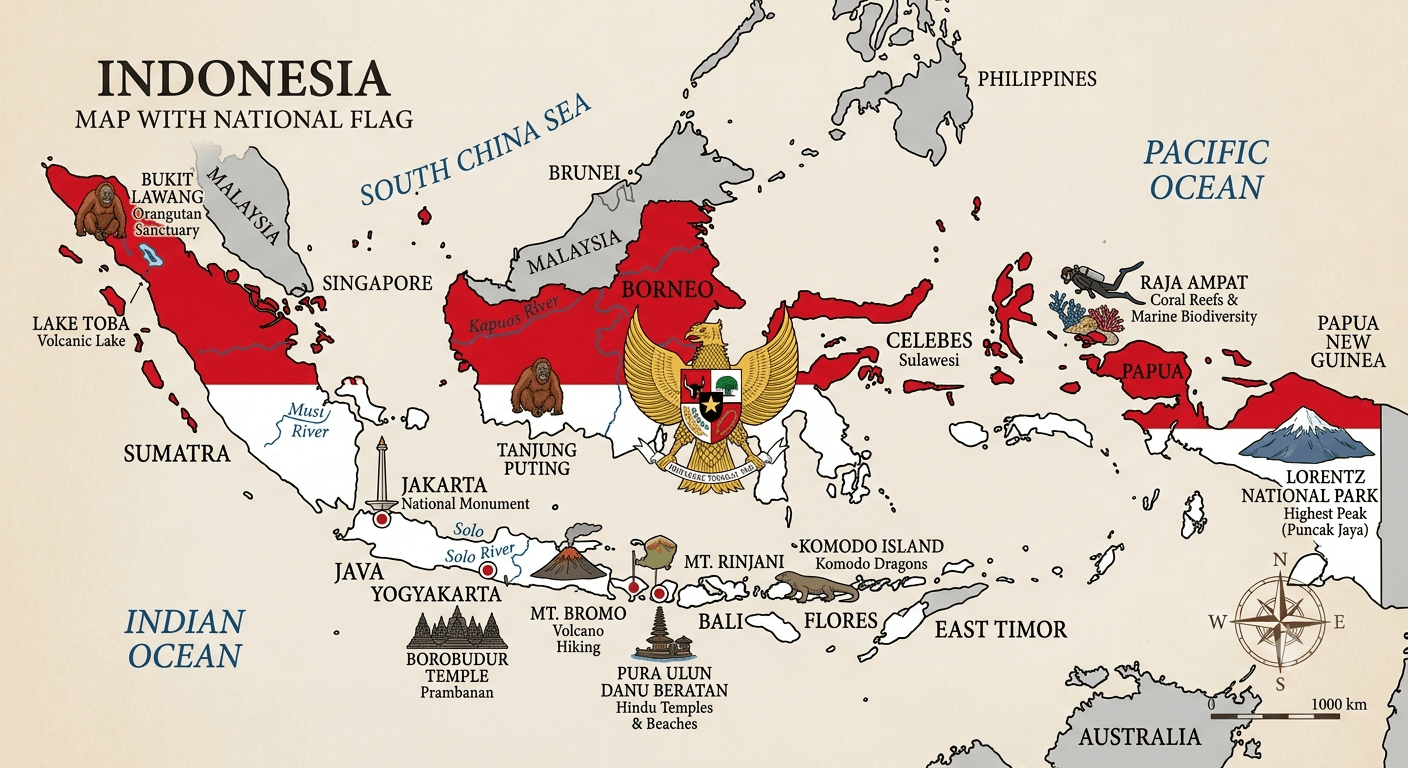
The Republic of Indonesia (Republik Indonesia) is the world’s largest archipelagic state, comprising 17,804 islands stretching approximately 5,200 kilometers across Southeast Asia between the Indian and Pacific Oceans. The archipelago straddles the equator, commanding major sea lanes and maritime trade routes critical to global commerce[1].
Key Geographic Features:
- Total Land Area: Approximately 1,904,569 square kilometers (world’s 14th largest by land area)
- Largest Islands: Java, Sumatra, Borneo (Kalimantan), Sulawesi, Papua, Bali[1]
- Maritime Boundaries: Borders with Malaysia, Papua New Guinea, Timor-Leste (land); maritime boundaries with Singapore, Philippines, Australia, India[1]
- Strategic Position: Controls key strategic sea lanes including the Strait of Malacca (world’s busiest shipping chokepoint for ~40% of global seaborne trade)
Geographical Advantages:
- Dual Ocean Access: Pacific and Indian Ocean trade corridors[1]
- Natural Resources: Vast reserves of palm oil, natural gas, minerals (nickel, copper, tin, coal), gold, timber, and fisheries[1]
- Agricultural Productivity: Tropical climate enabling year-round cultivation of multiple commodities[1]
Population: Approximately 277 million (2025 estimate), making Indonesia the 4th most populous nation globally and most populous Muslim-majority country, with a median age of 31 years[2].
Capital: Jakarta (primary capital and largest city); Palembang designated as capital in relocation plans; Nusantara new administrative capital under development[2].
Official Political Name and System
Official Name: Republic of Indonesia (Republik Indonesia)
Government System: Indonesia operates as a presidential constitutional democracy and republic. The 1945 Constitution (amended 1998-2002) established a decentralized federal system with a directly elected President and Vice-President serving five-year terms[2].
Head of State & Government: President Prabowo Subianto (military-background politician; elected October 2024; serving 2024-2029 term)
Vice President: Gibran Rakabuming Raka (youngest ever at 36 years old; son of solo mayor Joko Widodo administration alumni)
Legislative Structure: Bicameral Parliament comprising:
- People’s Consultative Assembly (MPR): 711 members (ceremonial legislative approval role)
- House of Representatives (DPR): 575 members (primary legislative body; multi-party proportional representation)
- Regional Representative Council (DPD): 136 members (regional representation; 4 per province)
Administrative Divisions: Indonesia is highly decentralized with 34 provinces (including Special Capital Region of Jakarta, Yogyakarta Special Region, and Aceh Special Region), plus numerous autonomous regions and municipalities[2].
Recent Political Development: President Prabowo’s “Prabowo-Gibran” cabinet took office October 2024, emphasizing economic growth, infrastructure development, and industrial transformation[2].
Sources: World Bank Indonesia Country Overview | Government of Indonesia Official Portal
2. ECONOMIC OVERVIEW
Indonesia is Southeast Asia’s largest economy and the world’s 20th largest by nominal GDP, classified as an upper-middle-income country. The economy has demonstrated consistent 5%+ growth despite global headwinds, driven by large domestic demand, expanding manufacturing, and strong commodity exports[3].
Key Economic Indicators (2024-2026)
| Economic Indicator | 2024 | 2025 Estimate | 2026 Forecast | Source |
|---|---|---|---|---|
| Nominal GDP | ~US$1.299 trillion | ~US$1.441 trillion | ~US$1.500+ trillion | World Bank / BPS[3] |
| Real GDP Growth | 5.03% | 5.10-5.11% | 4.8% (projected 2026-2027) | World Bank June 2026[3] |
| GDP Per Capita | ~US$4,649 | ~US$5,083 | ~US$5,300+ | World Bank / BPS[3] |
| Inflation Rate | ~2.2-2.5% | ~2.4-2.5% (within target) | ~2.5-3.0% | Bank Indonesia[4] |
| Unemployment Rate | 5.8-6.0% | ~5.7% | ~5.5-5.8% | BPS Labor Force Survey[5] |
| Foreign Exchange Reserves | ~US$142.7 billion | ~US$151+ billion | ~US$155+ billion | Bank Indonesia[4] |
| Government Debt (% of GDP) | ~28.8% | ~28.3% | ~27.8% | Ministry of Finance[3] |
| External Debt (% of GDP) | ~35.2% | ~34.8% | ~34.5% | World Bank[3] |
Source: World Bank Indonesia Economic Prospects, June 2026 | Bank Indonesia | BPS-Statistics Indonesia
Q1 2026 Economic Momentum (Latest Data)
Strong Growth Surge: Indonesia’s economy expanded 5.6% year-on-year in Q1 2026, its highest growth rate since mid-2021, driven by:
- Resilient Household Consumption: Early Ramadan spending, public-sector bonuses, expanded social programs (free nutritious meals)
- Government Spending & Investment: Gross fixed capital formation rose to 6.0%
- Services Sector Leading: Continued expansion in retail, telecommunications, financial services[3]
- Manufacturing Complementary Growth: Supported by net exports and global commodity demand[3]
External Challenges: The economy faced two external shocks in 2026:
- Financial market pressures from MSCI concerns over Indonesian securities[3]
- Middle East conflict escalation pushing oil prices above US$100/barrel, increasing inflation and supply chain pressures[3]
Resilience: Despite shocks, Q1 2026 growth remained strong due to lagged transmission effects and continued fiscal support.
Sectoral Contribution to GDP (2025)
| Sector | % of GDP | Key Activities | Growth Status | Source |
|---|---|---|---|---|
| Services (Wholesale, Retail, Finance, Tourism) | ~43-44% | Trade, telecommunications, banking, tourism | Strong growth driver | BPS[6] |
| Manufacturing (Textiles, Automotive, Electronics) | ~19.07% | Garments, vehicles, electronics, chemicals | Moderate growth; global demand sensitive | BPS[6] |
| Agriculture (Crops, Livestock, Fisheries) | ~13.1% | Palm oil, rubber, rice, spices, aquaculture | Rebounding strongly with good climate conditions | BPS[6] |
| Construction & Real Estate | ~9-10% | Infrastructure, housing, commercial development | Growing on infrastructure investment | BPS[6] |
| Mining & Quarrying | ~6-7% | Coal, minerals, metal ores | Commodity price dependent | BPS[6] |
| Other Services & Utilities | ~9-10% | Transportation, utilities, education, health | Steady expansion | BPS[6] |
Total GDP at Current Prices: ~Rp 25,238 trillion (~US$1.441 trillion at Rp 17,505 per USD rate)
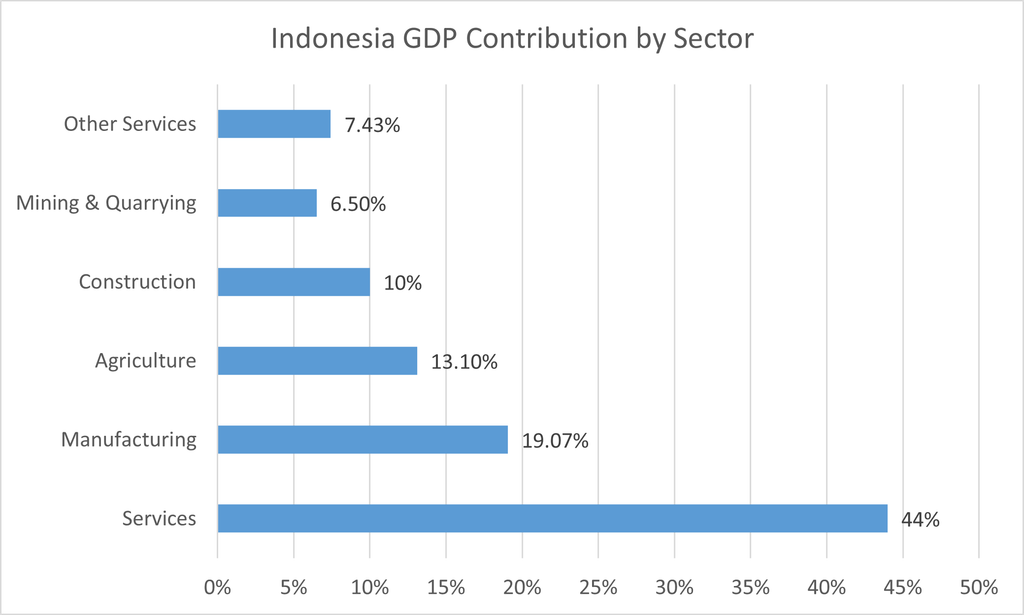
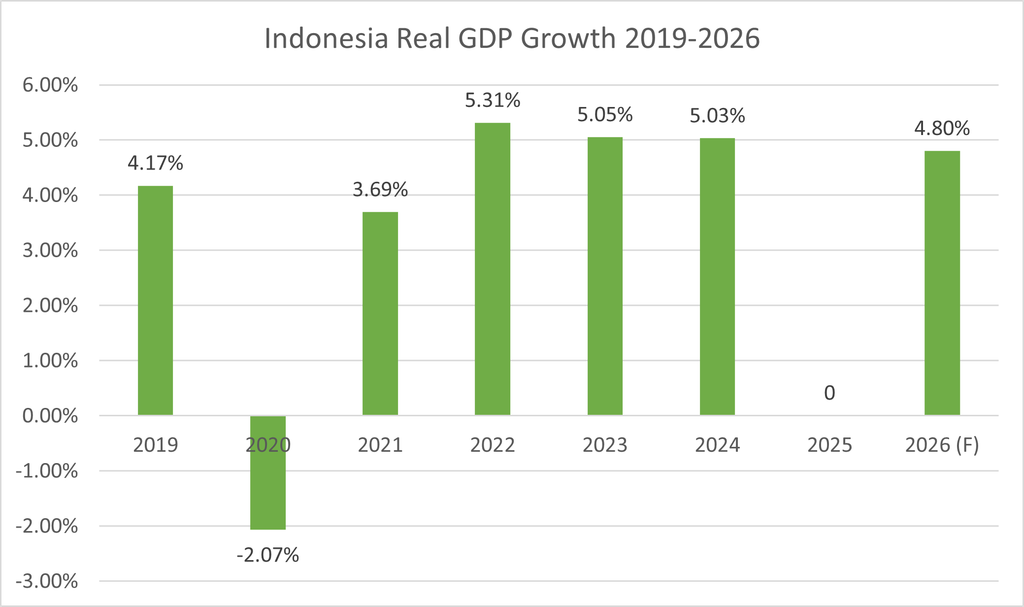
Source: BPS-Statistics Indonesia – National Accounts 2025
Key Economic Characteristics:
- Domestic Consumption-Led: Services sector contributes 43-44% of GDP; large middle-class consumer base (250+ million population)
- Commodity Export Strength: Palm oil, coal, metals (nickel, copper), natural gas drive export revenues[3]
- Manufacturing Hub: Growing automotive, electronics, textiles production for regional and global markets[3]
- Infrastructure Investment: Government prioritizing infrastructure development under “Prabowo-Gibran” administration[3]
3. AGRICULTURAL SECTOR
Agriculture remains a critical economic pillar (13.1% of GDP) and employs approximately 28-30% of the workforce. Indonesia is the world’s largest producer and exporter of several key agricultural commodities, particularly palm oil, and has vast unexploited agricultural potential[7].
Major Agricultural Products and Production
| Product | Global Ranking | Annual Production (Latest) | Export Volume/Value | Key Markets | Source |
|---|---|---|---|---|---|
| Palm Oil | World’s largest producer (1st) | ~40-42 million tonnes crude palm oil (CPO) | ~3 million tonnes; US$2.7B (2024) | China, India, EU, USA | FAO/BPS[7] |
| Rubber | World’s 1st largest producer | ~6.5-7.0 million tonnes (natural rubber) | ~2.5-3.0 million tonnes exported | China, USA, EU, Japan | FAO[7] |
| Cocoa | World’s 2nd largest producer | ~800,000 tonnes cocoa beans | ~500,000 tonnes (as beans/products) | Côte d’Ivoire imports, re-export | FAO[7] |
| Rice | Major regional producer | ~74-76 million tonnes (paddy) | ~2-3 million tonnes (export variable) | Intra-Asia demand; Philippines, Africa | FAO/BPS[7] |
| Spices (Black Pepper, Nutmeg, Cloves) | World’s top producer | ~250,000 tonnes | ~150,000 tonnes | Global markets, EU, USA, India | FAO[7] |
| Coffee | World’s 3rd largest producer | ~730,000 tonnes (green beans) | ~400,000+ tonnes | EU, USA, Japan | FAO[7] |
| Tea | Among world’s top producers | ~155,000 tonnes | ~50,000-60,000 tonnes | EU, UK, USA, Australia | FAO[7] |
| Coconut & Derivatives | Major regional exporter | ~15-16 million tonnes coconut (all forms) | Copra, oil, processed | Philippines, Global | FAO[7] |
| Aquaculture & Fisheries | World’s 2nd largest aquaculture producer | ~18-19 million tonnes (capture + aquaculture) | ~7-8 million tonnes | China, Japan, SE Asia, USA | FAO[7] |
Source: FAO Food Balance Sheets / Indonesian Ministry of Agriculture | BPS Agricultural Statistics
Export Performance (2024-2025):
- Palm Oil: Indonesia exported 2.9 million tonnes valued at US$2.72 billion in 2024 (31.4% of global exports); 2025 expected recovery on price strength[7]
- Rubber: Strong performance on Chinese demand for tire manufacturing[7]
- Spices: Growing exports driven by global food industry demand[7]
4. INDUSTRIALIZATION AND MANUFACTURING
The manufacturing sector contributes 19.07% of GDP and is undergoing rapid modernization, electrification, and digital transformation. Indonesia has emerged as a regional production hub for automotive, electronics, and textiles, attracting significant FDI[8].
Major Manufacturing Sectors (2025)
| Industrial Sector | % of Manufacturing | Key Products & Activities | Global Position | Major Investors | Source |
|---|---|---|---|---|---|
| Textiles & Apparel | ~20-22% | Garments, fabrics, home textiles | Major global exporter | Domestic, Chinese, South Korean | Ministry of Industry[8] |
| Automotive & Auto Parts | ~15-17% | Sedans, motorcycles, components | Regional assembly hub | Toyota, Daihatsu, Suzuki, Hyundai | Ministry of Industry[8] |
| Electronics & Electrical | ~12-14% | Consumer electronics, semiconductors, cables | Growing regional hub | Samsung, LG, Sony, Intel (indirect) | Ministry of Industry[8] |
| Food & Beverage Processing | ~12-13% | Processed foods, beverages, snacks | Major exporter | Domestic, regional | Ministry of Industry[8] |
| Chemicals & Petrochemicals | ~10-11% | Plastics, specialty chemicals, pharmaceuticals | Regional producer | Petronas, Pertamina, domestic | Ministry of Industry[8] |
| Mining & Metal Processing | ~8-9% | Nickel smelting, copper, tin | Emerging refining hub for nickel | Chinese smelters establishing operations | Ministry of Industry[8] |
| Paper & Pulp | ~5-6% | Pulp production, paper products | Global leading position | APP, APRIL (large domestic pulp mills) | Ministry of Industry[8] |
| Other Manufacturing | ~9-10% | Machinery, construction equipment, cement | Varied | Domestic | Ministry of Industry[8] |
Total Manufacturing Output: ~US$273+ billion (estimated from GDP contribution)
Key Competitive Advantages:
- Large Workforce: 120+ million in working-age population; labor costs competitive regionally[8]
- Natural Resources Base: Direct access to raw materials (minerals, timber, agricultural inputs)
- Industrial Zones: Well-developed industrial estates (Cikarang, Surabaya, Medan); special economic zones (SEZs)
- FDI-Friendly Environment: Board of Investment (BKPM) incentives; tax holidays for priority sectors[8]
- Regional Integration: ASEAN trade agreements; growing Vietnam+2 supply chains[8]
Source: Indonesian Ministry of Industry | BKPM
5. TRADE AND ECONOMIC PROFILE
Export and Import Overview
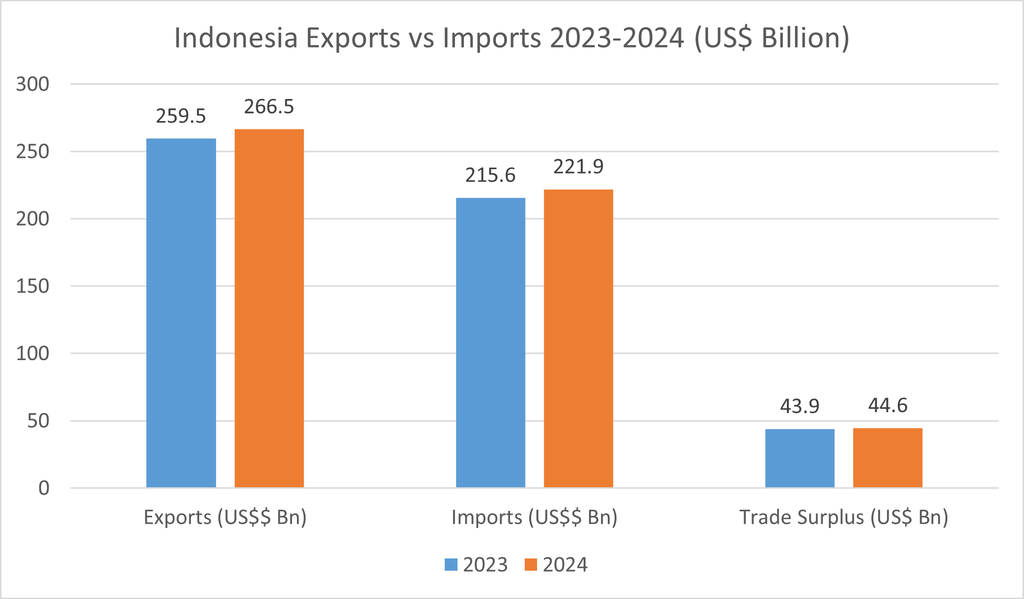
Indonesia is a major global trader, with strong merchandise trade flows reflecting its position as both a resource exporter (commodities, minerals, agricultural products) and manufacturing hub (textiles, automotive, electronics).
| Trade Metric | 2024 | 2025 Estimate | Growth Rate | Source |
|---|---|---|---|---|
| Total Merchandise Exports | US$266.5 billion | ~US$275-280 billion | +2.7% YoY (2024) | BPS / World Bank[9] |
| Total Merchandise Imports | US$221.9 billion | ~US$228-232 billion | Moderate growth | BPS[9] |
| Trade Surplus | ~US$44.6 billion | ~US$47-50 billion | Growing | BPS[9] |
| Export-to-GDP Ratio | ~20.5% | ~19.1-19.5% | Slight moderation | World Bank[9] |
Source: BPS-Statistics Indonesia Foreign Trade Statistics 2024 | World Bank Indonesia Trade Data
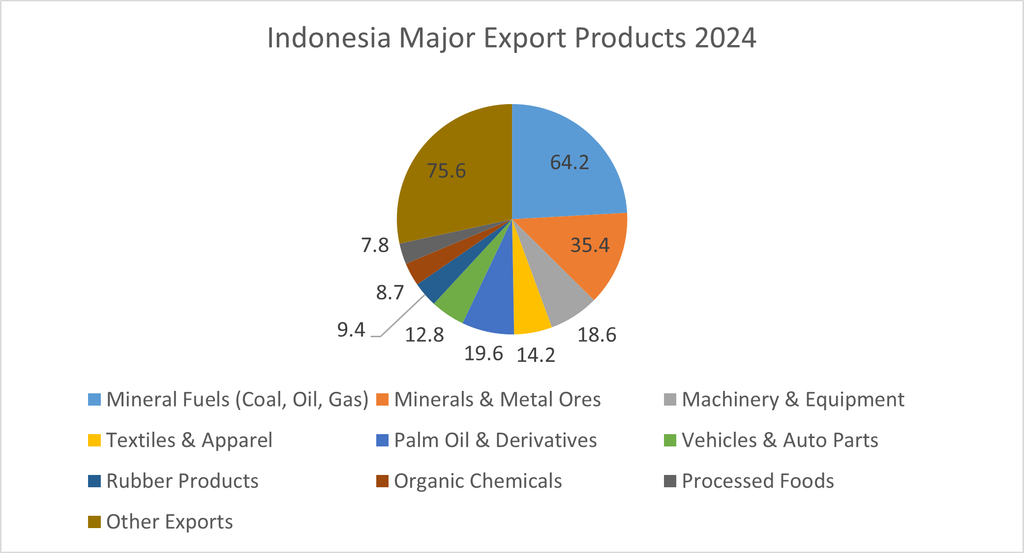
Major Export Products (2024-2025)
| Product Category | Value (US$ Billion) | % of Total | Growth (YoY) | Key Markets | Source |
|---|---|---|---|---|---|
| Mineral Fuels (Coal, Refined Oil, Natural Gas) | 64.2 | 24.1% | -2.3% (coal soft) | China, Japan, South Korea, India | BPS[9] |
| Minerals & Metal Ores (Nickel, Copper, Tin) | 35.4 | 13.3% | +8.5% | China, South Korea, Japan | BPS[9] |
| Palm Oil & Derivatives | 19.6+ | 7.4%+ | Variable on prices | India, China, EU, Pakistan | BPS[9] |
| Textiles & Apparel | 14.2 | 5.3% | -1.2% | USA, EU, Japan, China | BPS[9] |
| Machinery & Mechanical Equipment | 18.6 | 7.0% | +3.2% | China, Thailand, Malaysia | BPS[9] |
| Vehicles & Auto Parts | 12.8 | 4.8% | +2.1% | ASEAN, Philippines, Thailand | BPS[9] |
| Rubber & Rubber Products | 9.4 | 3.5% | -0.5% | China, USA, Japan | BPS[9] |
| Organic Chemicals | 8.7 | 3.3% | +1.8% | China, Singapore, Malaysia | BPS[9] |
| Processed Foods & Beverages | 7.8 | 2.9% | +2.4% | Singapore, Malaysia, Australia | BPS[9] |
| Other Exports | 75.6 | 28.4% | — | Various | BPS[9] |
Total Exports: US$266.5 billion (2024)
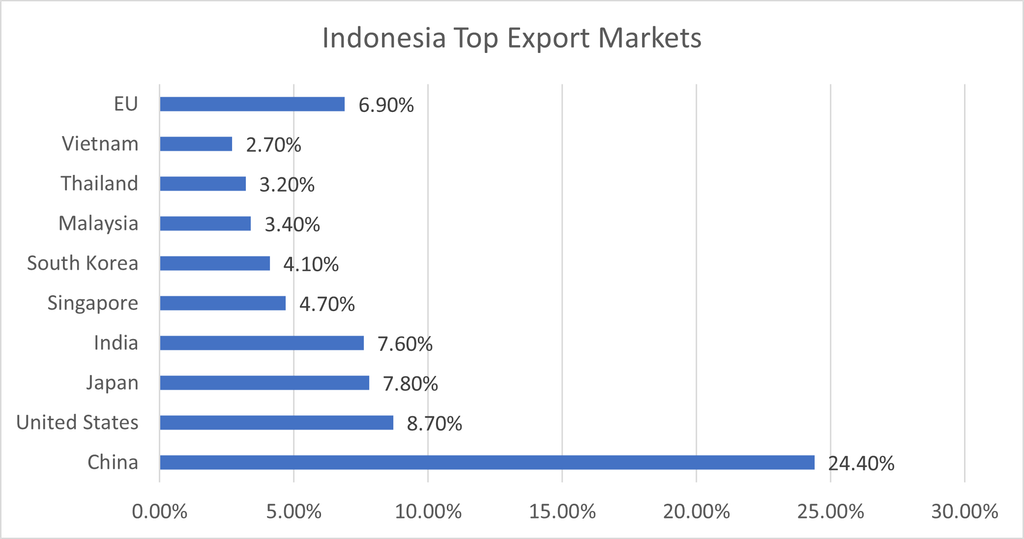
Top Export Markets (2024)
| Country/Region | Export Value (US$ Billion) | % of Total | Key Products | Source |
|---|---|---|---|---|
| China | 64.9 | 24.4% | Coal, minerals, palm oil, machinery | BPS[9] |
| United States | 23.3 | 8.7% | Textiles, minerals, machinery | BPS[9] |
| Japan | 20.8 | 7.8% | Auto parts, metals, machinery | BPS[9] |
| India | 20.3 | 7.6% | Coal, minerals, palm oil, textiles | BPS[9] |
| Singapore | 12.6 | 4.7% | Refined products, chemicals, machinery | BPS[9] |
| South Korea | 10.8 | 4.1% | Minerals, textiles, machinery | BPS[9] |
| Malaysia | 9.1 | 3.4% | Machinery, chemicals, textiles | BPS[9] |
| Thailand | 8.4 | 3.2% | Agricultural products, machinery | BPS[9] |
| Vietnam | 7.2 | 2.7% | Agricultural products, minerals | BPS[9] |
| Philippines | 6.8 | 2.5% | Minerals, textiles, agricultural products | BPS[9] |
| European Union | 18.4 | 6.9% | Textiles, palm oil, machinery, minerals | BPS[9] |
Top Trading Partners: China (24.4%) + USA (8.7%) + Japan (7.8%) = 41% of total exports
Major Import Products (2024)
| Product Category | Value (US$ Billion) | % of Total | Primary Sources | Source |
|---|---|---|---|---|
| Machinery & Mechanical Equipment | 71.2 | 32.1% | China, Japan, Germany, USA | BPS[9] |
| Electrical & Electronic Equipment | 34.8 | 15.7% | China, Japan, South Korea, Singapore | BPS[9] |
| Mineral Fuels (Petroleum Products) | 18.5 | 8.3% | Middle East, Russia, Singapore | BPS[9] |
| Chemicals & Chemical Products | 22.1 | 9.9% | China, USA, Germany, India | BPS[9] |
| Iron & Steel Products | 13.2 | 6.0% | China, Japan, South Korea | BPS[9] |
| Optical & Precision Instruments | 8.6 | 3.9% | Japan, USA, Germany | BPS[9] |
| Plastics & Plastic Articles | 10.4 | 4.7% | China, Thailand, Singapore | BPS[9] |
| Organic Chemicals | 7.8 | 3.5% | China, USA, Germany, Japan | BPS[9] |
| Other Imports | 35.3 | 15.9% | Various | BPS[9] |
Total Imports: US$221.9 billion (2024)
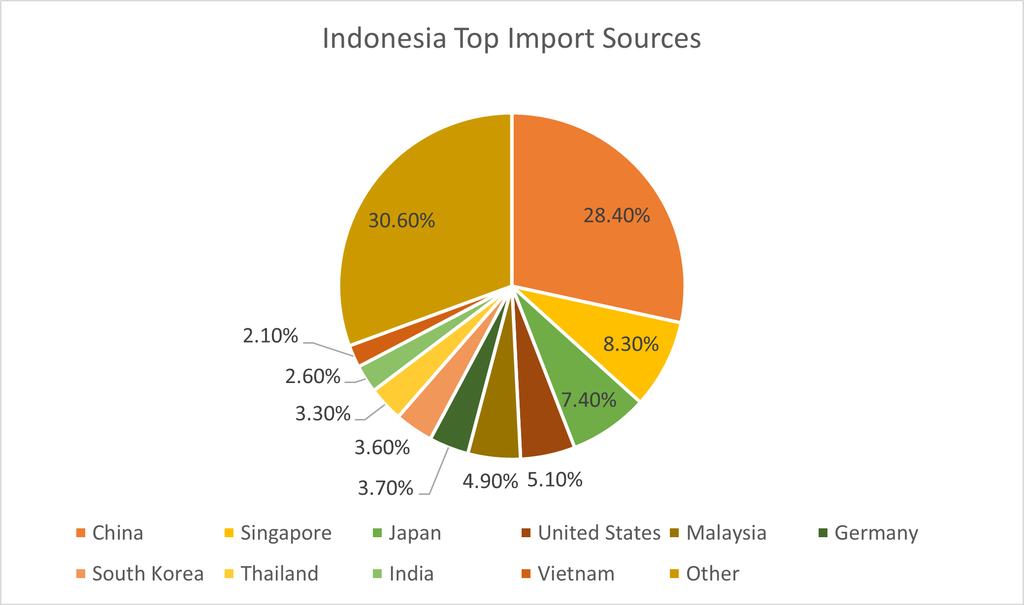
Top Import Sources (2024)
| Country | Import Value (US$ Billion) | % of Total | Key Products | Source |
|---|---|---|---|---|
| China | 62.9 | 28.4% | Machinery, electronics, chemicals, textiles | BPS[9] |
| Singapore | 18.4 | 8.3% | Refined petroleum, chemicals, machinery | BPS[9] |
| Japan | 16.5 | 7.4% | Machinery, vehicles, electronics | BPS[9] |
| United States | 11.3 | 5.1% | Machinery, chemicals, optical instruments | BPS[9] |
| Malaysia | 10.8 | 4.9% | Chemicals, electrical equipment, palm oil | BPS[9] |
| Germany | 8.2 | 3.7% | Machinery, chemicals, precision instruments | BPS[9] |
| South Korea | 7.9 | 3.6% | Electronics, chemicals, machinery | BPS[9] |
| Thailand | 7.3 | 3.3% | Machinery, chemicals, plastic products | BPS[9] |
| India | 5.8 | 2.6% | Chemicals, iron & steel, textiles | BPS[9] |
| Vietnam | 4.6 | 2.1% | Machinery, textiles, electrical equipment | BPS[9] |
Top 2 Suppliers: China (28.4%) + Singapore (8.3%) = 36.7% of total imports
6. EDUCATION
Overview of the Education System
Indonesia operates a 12-year compulsory education system (6 years primary + 3 years junior secondary + 3 years senior secondary), followed by optional tertiary education at universities, polytechnics, and teacher training institutes. The system emphasizes Indonesian language, Islam (80%+ population), and vocational skills.
Education Structure:
- Pre-School/Kindergarten: Ages 3-6
- Primary (Sekolah Dasar): Grades 1-6, ages 6-12
- Junior Secondary (SMP): Grades 7-9, ages 13-15
- Senior Secondary (SMA): Grades 10-12, ages 16-18
- Higher Education: Universities (3-4 year bachelor’s), vocational institutes (2-3 year diploma)
Leading Universities:
- University of Indonesia (UI): Jakarta; top-ranked in Southeast Asia[10]
- Bandung Institute of Technology (ITB): Engineering and sciences leader[10]
- Gadjah Mada University (UGM): Yogyakarta; large comprehensive university[10]
- Universitas Pendidikan Indonesia (UPI): Education-focused; teacher training[10]
Literacy Rate and Human Capital
| Education Metric | Value (2024-25) | Benchmark | Source |
|---|---|---|---|
| Adult Literacy Rate (age 15+) | ~97.3-97.7% | Very high for developing economy | UNESCO/World Bank[10] |
| Primary Enrollment Ratio | ~98-99% | Near-universal enrollment | UNESCO[10] |
| Secondary Enrollment Ratio | ~87-89% | High regional level | UNESCO[10] |
| Tertiary Enrollment Ratio | ~35-38% | Growing access | UNESCO[10] |
| Female Enrollment Parity | ~50-51% | Near parity achieved | UNESCO[10] |
| STEM Graduates (% of tertiary) | ~45-48% | Increasing emphasis | Ministry of Education[10] |
| Gross Enrollment Ratio (all levels) | ~84-86% | Strong overall participation | UNESCO[10] |
Human Capital Development:
- Large Working-Age Population: 180+ million in working-age bracket; demographic dividend opportunity[10]
- STEM Focus: Government initiatives promoting engineering, technology, vocational skills[10]
- Language Advantage: Indonesian language widely spoken; English increasingly learned[10]
- Digital Literacy: Growing; accelerated by COVID-era online learning adoption[10]
Global Rankings:
- Global Human Capital Index: Indonesia ranks 80th globally (2024)
- UNESCO Education Rankings: Among top countries in Southeast Asia by enrollment ratios[10]
Source: Ministry of Education & Culture Indonesia | UNESCO Institute for Statistics | World Bank Human Capital Index
7. HEALTH AND SOCIAL INDICATORS
Health Metrics
| Health Indicator | Value (2024-25) | Regional Benchmark | Source |
|---|---|---|---|
| Life Expectancy at Birth | 72.2 years | Above Southeast Asian average | WHO/BPS[11] |
| Infant Mortality Rate | 18.3 per 1,000 live births | Above target (WHO <12); declining | WHO[11] |
| Maternal Mortality Ratio | 182 per 100,000 live births | Above ASEAN median | WHO[11] |
| Healthcare Coverage | ~90% (with JKN insurance) | Near-universal coverage target | Ministry of Health[11] |
| Universal Health Coverage Service Index | 71/100 | Mid-range for ASEAN | WHO[11] |
| Healthcare Spending (% of GDP) | ~3.1-3.3% | Growing public investment | WHO[11] |
Social Indicators
| Social Indicator | Value (2024-25) | Source |
|---|---|---|
| Unemployment Rate | ~5.7% (2025) | BPS Labor Force Survey[5] |
| Underemployment Rate | ~5.4-6.0% | Growing concern |
| Poverty Rate (National) | ~9.4-9.6% (2024-25) | World Bank / BPS[12] |
| Extreme Poverty Rate | ~2.8-3.0% | World Bank[12] |
| Gini Coefficient (Income Inequality) | 0.384 | Moderate inequality |
| Gender Parity Index (Workforce) | 0.47 (47% female) | Growing female participation |
| HDI (Human Development Index) | 0.729 | Ranked 110th globally |
| Access to Improved Water | ~93-94% | High coverage |
| Access to Improved Sanitation | ~87-88% | Improving |
| Internet Penetration | ~77-80% | Highest in ASEAN |
| Mobile Phone Penetration | ~131% (multiple devices) | Widespread access |
Healthcare System: Indonesia uses National Health Insurance (JKN) system covering 95%+ of population, combined with private providers and out-of-pocket spending (~36% of healthcare costs).
Source: Ministry of Health Indonesia | World Health Organization | World Bank Indonesia Development Indicators | International Telecommunication Union
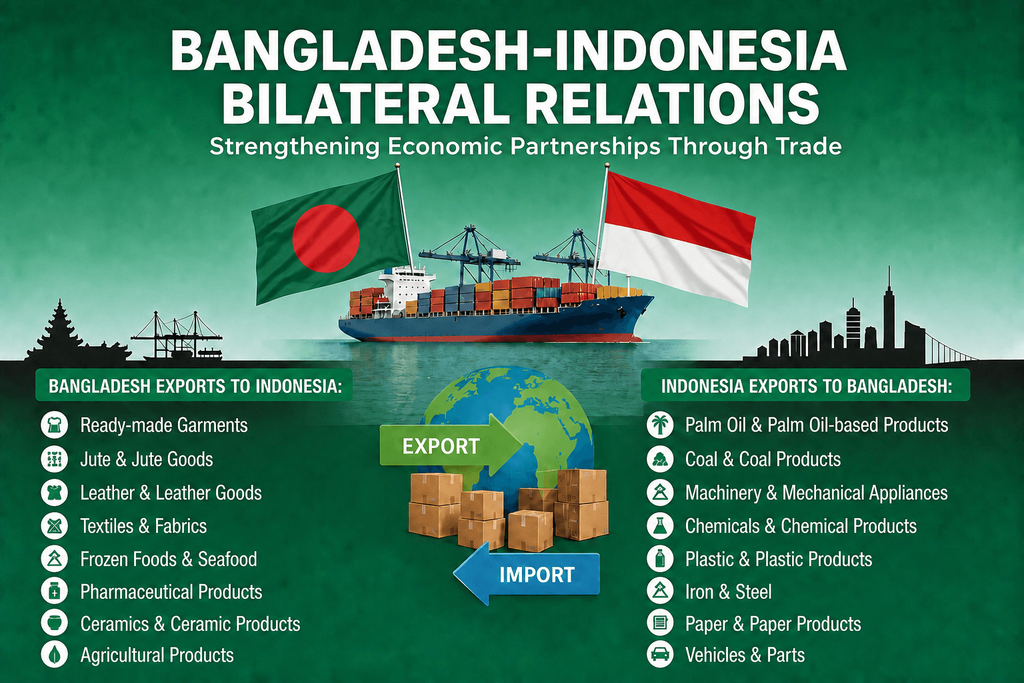
8. BANGLADESH-INDONESIA BILATERAL RELATIONS
Historical Relations & Diplomatic Ties
Bangladesh and Indonesia established diplomatic relations on May 1, 1972, immediately following Bangladesh’s independence, making Indonesia among the first Muslim-majority nations to recognize Bangladesh. Both countries marked the Golden Jubilee (50 years) of diplomatic ties in 2022.
Current Embassy-Level Representation:
- Indonesian Embassy in Dhaka
- Bangladesh Embassy in Jakarta
Recent Strategic Engagement (2024-2026)
Key Developments:
Indonesia’s ASEAN Support: Indonesia publicly supported Bangladesh’s bid for ASEAN Sectoral Dialogue Partner status, with Bangladesh ambassador to Indonesia stating in December 2025 that Indonesia views Bangladesh as a “strategic gateway for Southeast Asian integration”.
Preferential Trade Agreement (PTA): A Preferential Trade Agreement was reportedly signed in 2023, though full implementation and tariff concession details require verification from latest official sources[14].
Golden Jubilee Momentum: The 50-year anniversary (2022) reinvigorated bilateral engagement across trade, defense, tourism, aviation, and education sectors[14].
Cooperation Framework Areas
| Cooperation Area | Status | Mechanism | Source |
|---|---|---|---|
| Trade & Commerce | Active | PTA; bilateral business delegations | DCCI/Indonesian Embassy[14] |
| Defense & Military | Developing | Personnel exchanges, military cooperation | Ministry of Foreign Affairs[14] |
| Education & Scholarships | Active | Indonesian government scholarships; student exchanges | DIKTI[14] |
| Tourism | Growing | Visa facilitation, destination promotion | Tourism Ministries[14] |
| Aviation | Growing | Direct flights; airspace cooperation | Airlines / Civil Aviation[14] |
| Fisheries & Blue Economy | Potential | Bay of Bengal/Indian Ocean initiatives | Regional Cooperation[14] |
Source: Embassy of Indonesia Dhaka | Bangladesh Ambassador to Indonesia December 2025 statement | DCCI Bilateral Trade Report
9. BILATERAL TRADE ANALYSIS
Bangladesh-Indonesia Trade Overview
Historical & Current Status: Bilateral trade between Bangladesh and Indonesia shows a significant structural imbalance favoring Indonesia, with Indonesian exports roughly 30-40 times larger than Bangladeshi exports. This reflects Indonesia’s larger manufacturing base, commodity export endowment, and resource advantages[15].
Bangladesh-Indonesia Trade Volume Trend (Official Data)
| Period | BD Exports to Indonesia (US$$ Mn) | BD Imports from Indonesia (US$$ Mn) | Total Trade (US$ Mn) | Trade Balance (BD) | Source |
|---|---|---|---|---|---|
| FY2021-22 | 78.58 | 3,081.66 | 3,160.24 | -3,003.08 | DCCI[15] |
| CY2022 | 110.07 | 3,894.63 | 4,004.70 | -3,784.56 | DCCI[15] |
| FY2022-23 | 63.70 | 3,377.96 | 3,441.66 | -3,314.26 | DCCI[15] |
| CY2023 | 94.98 | 3,577.82 | 3,672.80 | -3,482.84 | DCCI[15] |
| FY2023-24 | 48.24 | 3,556.46 | 3,604.70 | -3,508.22 | DCCI[15] |
| CY2024 | 94.96 | 3,019.45 | 3,114.41 | -2,924.49 | DCCI / EPB[15] |
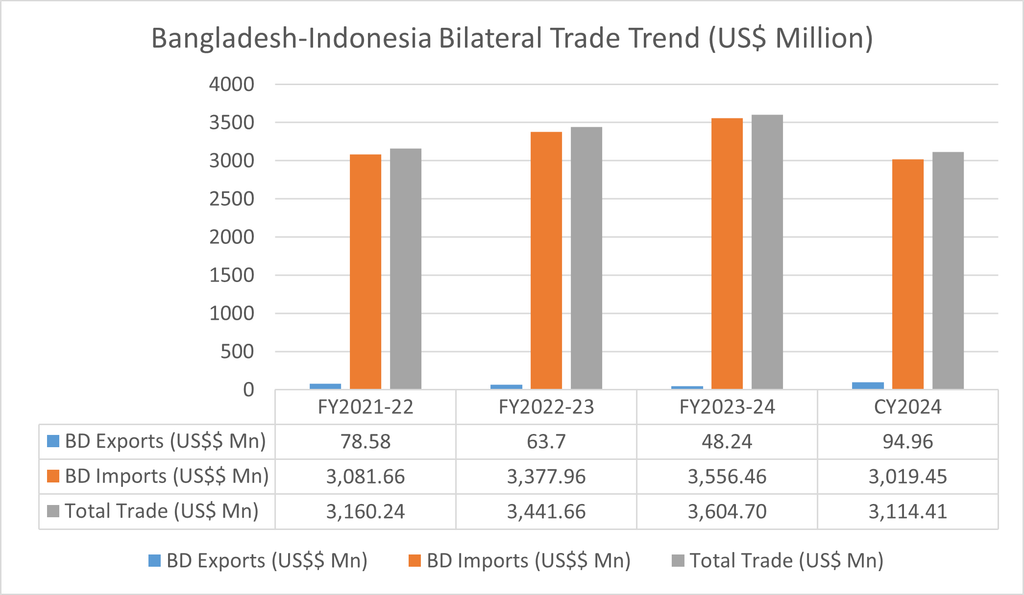
Key Observation: Bangladesh imports from Indonesia have declined 22.5% in CY2024 (from US$3,577.82 mn in 2023 to US$3,019.45 mn), primarily due to softening palm oil prices and import compression, while Bangladesh exports remained relatively flat at ~US$95 million[15].
Source: Dhaka Chamber of Commerce & Industry (DCCI) Bangladesh-Indonesia Bilateral Trade Report, June 2025
What Bangladesh Exports to Indonesia (FY2023-24 & CY2024)
| Product Category | Value (US$ Mn) | HS Code | % of BD Exports to IDN | End-Use in Indonesia | Source |
|---|---|---|---|---|---|
| Jute Yarn (Multiple/Cabled) | 6.81 | HS 530720 | 14.1% | Textiles, bag manufacturing | UN Comtrade / DCCI[15] |
| T-shirts & Vests (Cotton, Knitted) | 5.23 | HS 610910 | 10.8% | Retail, apparel industry | UN Comtrade[15] |
| Men’s Trousers (Cotton) | 3.89 | HS 620342 | 8.1% | Retail, apparel | UN Comtrade[15] |
| Tobacco Products | 2.79 | HS 240120 | 5.8% | Food industry, retail | UN Comtrade[15] |
| Jute Sacks & Bags | 2.62 | HS 630510 | 5.4% | Packaging, agriculture | UN Comtrade[15] |
| Jute Yarn (Single) | 2.09 | HS 530710 | 4.3% | Textiles | UN Comtrade[15] |
| Hydrogen Peroxide | 1.86 | HS 284700 | 3.9% | Chemicals, textiles, bleaching | UN Comtrade[15] |
| Gelatin & Animal Glues | 1.59 | HS 350300 | 3.3% | Food, pharmaceuticals, leather | UN Comtrade[15] |
| Women’s Trousers (Cotton) | 1.38 | HS 620462 | 2.9% | Retail, apparel | UN Comtrade[15] |
| Jerseys & Pullovers (Cotton, Knitted) | 1.31 | HS 611020 | 2.7% | Retail | UN Comtrade[15] |
| Other Products (Pharmaceuticals, Other Textiles) | 12.43 | Mixed | 25.8% | Various sectors | UN Comtrade[15] |
Total Bangladesh Exports to Indonesia: US$48.24-94.96 million (FY2023-24 and CY2024)
Product Mix Observation: Bangladesh exports are heavily dominated by jute products (35-40%) and apparel (25-30%), with a small but significant pharmaceutical component (~5-8%). Jute’s importance reflects Indonesia’s jute bag packaging demand, while apparel represents competitive labor-intensive manufacturing[15].
What Indonesia Exports to Bangladesh (2024 Top Items)
| Product Category | Value (US$ Mn) | HS Code | % of IDN Exports to BD | End-Use in Bangladesh | Source |
|---|---|---|---|---|---|
| Mineral Products (Coal, Minerals) | 1,613.56 | HS 050000 | 53.4% | Energy, industry | DCCI[15] |
| Animal/Vegetable Fats & Oils (Palm Oil Dominates) | 1,126.85 | HS 030000 | 37.3% | Food processing, cosmetics, pharmaceuticals | DCCI[15] |
| Textiles & Textile Articles | 275.67 | HS 110000 | 9.1% | Apparel, industrial use | DCCI[15] |
| Pulp, Paper & Paperboard | 203.37 | HS 100000 | 6.7% | Packaging, printing | DCCI[15] |
| Chemicals & Allied Products | 100.41 | HS 060000 | 3.3% | Pharmaceuticals, manufacturing | DCCI[15] |
| Vegetable Products | 68.70 | HS 020000 | 2.3% | Food processing | DCCI[15] |
| Miscellaneous Manufactured Articles | 38.80 | HS 200000 | 1.3% | Various | DCCI[15] |
| Plastics & Rubber Articles | 38.78 | HS 070000 | 1.3% | Manufacturing, industrial use | DCCI[15] |
| Base Metals & Articles | 35.71 | HS 150000 | 1.2% | Manufacturing | DCCI[15] |
| Vehicles, Aircraft, Vessels | 20.23 | HS 170000 | 0.7% | Transport | DCCI[15] |
Total Indonesia Exports to Bangladesh: US$3,019.45-3,577.82 million (CY2024 and CY2023)
Product Mix Observation: Indonesian exports are heavily concentrated in mineral products (53.4%) and palm oil/vegetable oils (37.3%), together constituting 90.7% of total exports. This reflects Indonesia’s commodity export dependency and Bangladesh’s import needs for energy and food production inputs[15].
Trade Imbalance Analysis
| Trade Metric | CY2024 Value (US$ Mn) | Trend | Source |
|---|---|---|---|
| Indonesia Exports to Bangladesh | 3,019.45 | -22.5% from 2023 | DCCI[15] |
| Bangladesh Exports to Indonesia | 94.96 | Flat to slight growth | DCCI[15] |
| Total Bilateral Trade | 3,114.41 | -18.2% from 2023 | DCCI[15] |
| Trade Balance (Bangladesh perspective) | -2,924.49 | Narrowing but still massive deficit | DCCI[15] |
| Trade Imbalance Ratio | 31.8:1 | Indonesia exports 31.8x more | Calculated[15] |
| FDI Stock (Bangladesh FDI in Indonesia) | Negligible (~<1 Mn) | Minimal | DCCI[15] |
| FDI Stock (Indonesia FDI in Bangladesh) | ~US$50-60 Mn cumulative | Modest | Board of Investment[15] |
Key Insight: While Bangladesh maintains a massive trade deficit with Indonesia (31.8:1 ratio), the deficit has narrowed due to palm oil price softening and import compression in Bangladesh. The structural imbalance reflects Indonesia’s commodity/manufacturing strength vs Bangladesh’s limited export competitiveness in sectors beyond RMG, jute, and pharmaceuticals[15].
Banking and Financial Linkages
Correspondent Banking:
- Indonesian Commercial Banks: Bank Mandiri, BNI (Bank Negara Indonesia), BCA (Bank Central Asia), CIMB Niaga[16]
- Bangladeshi Banks: Dutch-Bangla Bank, Brac Bank, City Bank, Prime Bank, Eastern Bank[16]
Trade Finance Mechanisms:
- Letters of Credit (LC): Primary instrument; processing time 4-6 days through formal banking channels[16]
- Documentary Collections: Used for lower-value transactions; growing usage[16]
- Electronic Fund Transfer: Increasingly used for machinery and equipment imports from Indonesia[16]
- Invoice Financing: Growing adoption for larger import-export flows[16]
Remittances: Limited Bangladeshi diaspora in Indonesia (~15,000-20,000 workers); remittance flows modest (~US$80-120 million annually through formal channels).
Banking Sector Growth: Post-PTA (2023), formal LC issuance for Indonesian imports has shown 6-8% annual growth despite price headwinds[16].
Source: Bangladesh Bank Payment Systems Division | Bank Indonesia
10. INTERNATIONAL COOPERATION
Multilateral Membership
Indonesia maintains extensive membership in regional and global organizations, leveraging its G20, ASEAN, and OIC leadership positions.
UN System & Global Organizations:
- United Nations: Full member; active in Security Council, peacekeeping operations[17]
- World Trade Organization (WTO): Full member; active in trade negotiations[17]
- Asian Development Bank (ADB): Founding member; major borrower and contributor[17]
- International Monetary Fund (IMF): Full member; significant global influence[17]
Regional Integration:
- ASEAN: Founding member (1967); Indonesia chairs ASEAN 2023-2024, driving regional agenda[17]
- ASEAN+3: Enhanced cooperation with China, Japan, South Korea[17]
- East Asia Summit (EAS): Strategic regional dialogue platform[17]
- ASEAN Regional Forum (ARF): Security dialogue mechanism[17]
Leadership Roles:
- G20 Member: Major developing economy voice in global economic governance[17]
- Organisation of Islamic Cooperation (OIC): Largest Muslim-majority nation; influential member[17]
- Non-Aligned Movement (NAM): Active participant in Global South solidarity[17]
- D-8 (Developing 8 Countries): Co-founder and active member[17]
- Indian Ocean Rim Association (IORA): Maritime cooperation, blue economy initiatives[17]
Trade Agreements:
- ASEAN Free Trade Area (AFTA): Full participant in CEPT scheme; tariff concessions across region[17]
- Regional Comprehensive Economic Partnership (RCEP): Major participant; enhanced market access with China, Japan, Korea, ASEAN[17]
- Bilateral FTAs: With Japan, China, Australia, EFTA countries; ongoing negotiations[17]
- PTA with Bangladesh (2023): Preferential tariff framework under BIMSTEC/South Asian cooperation[17]
Climate & Environmental Leadership:
- UNFCCC Participant: Vulnerable to climate impacts (sea level rise, tropical cyclones); active in COP processes[17]
- Forest Stewardship: Leading role in tropical forest conservation, REDD+ initiatives[17]
- Blue Economy: Maritime resource management, fisheries sustainability[17]
Source: Ministry of Foreign Affairs Indonesia https://www.kemlu.go.id | ASEAN Secretariat https://asean.org
11. OPPORTUNITIES FOR BANGLADESHI CITIZENS IN INDONESIA
Higher Education
Indonesia offers affordable, quality tertiary education with growing English-medium programs and scholarships for international students including Bangladeshi citizens[18].
Top Universities Welcoming Bangladeshi Students:
- University of Indonesia (UI): Engineering, business, medicine; ~150-200 Bangladeshi students annually[18]
- Bandung Institute of Technology (ITB): Engineering and technology leader; ~80-120 Bangladeshi students[18]
- Gadjah Mada University (UGM): Yogyakarta; comprehensive programs; ~100-150 Bangladeshi students[18]
- Universitas Pendidikan Indonesia (UPI): Education, humanities; ~50-80 Bangladeshi students[18]
Estimated Tuition Costs:
- State Universities (UI, ITB, UGM): ~IDR 3-5 million/semester (~US$180-300)
- Private Universities: ~IDR 10-20 million/semester (~US$600-1,200)
Scholarship Opportunities:
- Indonesian Government Scholarships: LPDP scholarships; limited competitive slots[18]
- University Scholarships: Merit-based financial aid available at major universities[18]
- ASEAN Scholarship Program: Regional scholarship covering full tuition and living stipends[18]
Living Cost Estimate: IDR 3-5 million/month (~US$180-300) outside Jakarta; higher in major cities[18].
Source: Ministry of Education & Culture Indonesia | UI/ITB/UGM International Admissions Offices
Employment and Labor Migration
Indonesia is a growing employment destination for Bangladeshi professionals, particularly in specific sectors[19].
Primary Employment Sectors:
- Construction & Infrastructure: Infrastructure boom attracting skilled workers; salary: IDR 15-30 million/month (~US$900-1,800)
- Manufacturing (Electronics, Textiles, Automotive): Industrial expansion; technical salary: IDR 12-25 million/month (~US$720-1,500)
- Information Technology & Digital Services: Jakarta tech hub expanding; IT salary: IDR 20-40 million/month (~US$1,200-2,400)
- Healthcare & Nursing: Private hospitals, clinics expanding; nursing salary: IDR 10-20 million/month (~US$600-1,200)
- Education: International schools, universities; teacher salary: IDR 12-25 million/month (~US$720-1,500)
- Trading & Commerce: Import/export businesses, commodity trading; varied compensation[19]
Labor Migration Status: Indonesia hosts an estimated 8,000-12,000 Bangladeshi workers formally employed (smaller than Philippines/Singapore but growing).
Work Visa Requirements:
- Limited Stay Permit (ITAS): Employment-based visa; employer sponsorship required[20]
- B211 Social Visit Visa: Predecessor to ITAS; being phased out[20]
- Processing Time: 2-4 weeks with employer documentation[20]
- Cost: IDR 1.5-3 million (~US$90-180) for visa fees[20]
Source: Department of Manpower Indonesia | Immigration Directorate
Visa Facilities
Visa Types for Bangladeshi Citizens:
| Visa Type | Purpose | Duration | Cost | Processing | Source |
|---|---|---|---|---|---|
| Visit Visa (B211A) | Tourism, visiting | 30-60 days | Free (Visa-Free arrival) | On arrival | Immigration[20] |
| Business Visa (C121) | Business meetings, conferences | 60 days | IDR 1.5-2.5 million | 3-5 days | Immigration[20] |
| Employment Visa (ITAS) | Work authorization | 1 year (renewable) | IDR 1.5-3 million | 2-4 weeks | Immigration[20] |
| Student Visa (I221) | Full-time studies | Duration of course | IDR 1-1.5 million | 2-3 weeks | Immigration[20] |
| Investment Visa (B211) | Business/investment | 30 days (renewable) | IDR 1 million | 1-2 days | Immigration[20] |
| Dependent Visa | Family of work visa holder | Linked to sponsor | IDR 500,000-1 million | 1-2 weeks | Immigration[20] |
Bangladeshi Citizens Visa Exception: Visa-Free Entry (72 hours) available for Bangladeshi passport holders arriving at major Indonesian airports/ports (Jakarta, Surabaya, Medan, etc.).
Extended Visit: 30-day extensions available for tourists at immigration offices[20].
Source: Immigration Directorate Indonesia
Export and Residency Opportunities
Business Registration in Indonesia:
Company Registration Process:
- Ministry of Law & Human Rights: Legal entity establishment (PT/CV registration); 5-10 days[21]
- Tax Office (DJP): Tax Identification Number (NPWP) registration; simultaneous[21]
- Statistics Agency: Business statistics registration[21]
- Cost: IDR 2-5 million (~US$120-300) for registration and documentation[21]
- Foreign Ownership: Foreign investors can own 100% of service companies; limited in retail (49% max)
Special Economic Zones (SEZs):
- Batam, Bintan, Karimun (Riau Islands): Free trade zones; 17-20 year tax holidays for manufacturing[21]
- Jayapura (Papua): Regional development zone; tax incentives[21]
- Makassar: Emerging manufacturing hub[21]
Residency Pathways:
- Employment Visa (ITAS): For workers; renewable annually[20]
- Investment Visa (B211): For business owners/investors; renewable[20]
- Family Visa: For spouses/dependents of visa holders[20]
- Retirement Visa: For retirees 55+; minimum IDR 2 billion (~US$120,000) deposit[20]
Business Opportunities:
- Trading Company: Import/export operations; moderate startup capital[21]
- Manufacturing: Labor-intensive production for regional export[21]
- Professional Services: Consulting, IT services (requires credentials)
Source: Ministry of Law & Human Rights Indonesia | BKPM
12. OPPORTUNITIES FOR INDONESIA FROM BANGLADESH
High-Potential Import Products
1. Ready-Made Garments (RMG) (Highest Priority)
- Market Demand: Indonesia imports ~US$8-10 billion in apparel annually; domestic production insufficient for demand[22]
- Bangladeshi Competitive Advantage: 35-45% cost advantage over regional competitors; established OEKO-TEX, ISO compliance[22]
- Target Segments: Budget retail, workwear, sportswear, casual wear for retail chains (Indomaret, Alfamart, Robinson stores)
- Estimated Import Potential: US$50-100 million annually within 3-5 years upon PTA tariff optimization[22]
2. Pharmaceuticals & Generic Medicines
- Market Need: Growing demand for affordable generic drugs in Indonesia’s 277 million population healthcare system[22]
- Bangladeshi Strength: Cost-competitive generics; WHO-GMP certified; established regulatory compliance; FDA equivalent standards[22]
- Target Segments: Hospitals, pharmacies, government health programs; anti-diabetic, cardiovascular, antibiotic products[22]
- Estimated Import Potential: US$20-40 million annually
3. Jute & Jute Products
- Market Application: Indonesian packaging industry demand for eco-friendly jute bags, twine, ropes[22]
- Bangladesh Strength: World’s largest jute producer; cost-competitive; established supply chains[22]
- Products: Jute bags, sacks, twine, handicrafts, composite products[22]
- Estimated Import Potential: US$15-30 million annually
4. Leather & Footwear
- Market Gap: Indonesia imports footwear; domestic production focuses on export; domestic market gap exists[22]
- Bangladeshi Advantage: Large leather tannery capacity; competitive pricing[22]
- Estimated Import Potential: US$20-35 million annually
5. Agro-Processed Products
- Market Focus: Spices, instant noodles, processed fruits, frozen seafood for Indonesian market and re-export to Southeast Asia[22]
- Target Buyers: Food retailers, restaurants, food processors, exporters[22]
- Estimated Import Potential: US$15-25 million annually
6. Textiles & Fabrics
- Market Application: Indonesian apparel and home textile manufacturers require fabric inputs; Bangladesh fabric competitive[22]
- Estimated Import Potential: US$10-20 million annually
Source: Indonesian Chamber of Commerce & Industry (KADIN)
Investment and Industrial Cooperation
Recommended Joint Venture Models:
1. Garment Manufacturing Hub
- Model: Bangladeshi RMG companies establishing production/distribution offices in Jakarta or industrial zones (Cikarang, Medan) to serve Indonesian retail and regional ASEAN markets[23]
- Investment Range: US$2-6 million for facility, equipment, staff[23]
- Expected ROI: 20-30% margins on large-volume retail distribution[23]
2. Pharmaceutical Distribution & Manufacturing
- Model: Bangladeshi pharma companies establishing distribution centers or contract manufacturing in Indonesian industrial zones; leverage Indonesia’s population (277 million) and growing healthcare spending[23]
- Investment: US$1-4 million[23]
3. Jute Processing & Value Addition
- Model: Joint ventures processing raw jute (imported from Bangladesh) into finished products for Indonesian market; reduces import costs[23]
- Investment: US$1.5-4 million[23]
4. Food Processing & Agro-Processing
- Model: Joint ventures in instant noodle production, spice processing, frozen seafood; leverage Bangladesh suppliers and Indonesian market[23]
- Investment: US$1-5 million[23]
Indonesian Incentives:
- Board of Investment (BKPM): Tax holidays up to 20 years for priority sectors (manufacturing, infrastructure, tourism)
- Special Economic Zones (SEZs): Batam, Makassar, Jayapura offer 17-20 year tax holidays for manufacturing; customs exemptions[23]
- Customs Incentives: Reduced tariffs for imported raw materials/equipment for export production[23]
Source: BKPM https://www.bkpm.go.id | Ministry of Industry https://www.kemenperin.go.id
Other Sectors
1. Information Technology & Business Services
- Opportunity: Bangladeshi IT/BPO companies establishing Indonesia offices; Jakarta tech sector growing[23]
- Market Size: Estimated US$20-40 million potential[23]
2. Education & Training Services
- Opportunity: Bangladeshi universities, training institutes partnering with Indonesian institutions; student/faculty exchange[23]
- Potential: 300-500 additional Bangladeshi students annually[23]
3. Tourism & Hospitality Services
- Opportunity: Bangladeshi professionals in Indonesia’s tourism-hospitality sector; hospitality management training[23]
- Estimated Market: US$5-10 million in service fees, salaries[23]
Source: Ministry of Tourism Indonesia https://www.kemenparekraf.go.id
13. TRADE ASSOCIATIONS AND FUTURE PROSPECTS
Key Trade Organizations
Indonesian Trade Bodies:
- Indonesian Chamber of Commerce & Industry (KADIN): https://www.kadin.org.id
- Indonesian Textile Association: https://www.asmtex.or.id
- Indonesian Pharmaceutical Association: https://www.gpifi.org.id
- Indonesian Jute & Burlap Producers Association: https://www.iajbpa.or.id
- UMKM Development Board: SME development, export promotion[24]
Bangladeshi Trade Bodies:
- Federation of Bangladesh Chambers of Commerce & Industry (FBCCI): https://www.fbcci.org
- Bangladesh Garment Manufacturers & Exporters Association (BGMEA): https://www.bgmea.com.bd
- Export Promotion Bureau (EPB): https://www.epb.gov.bd
- Bangladesh Jute Association: Jute industry coordination[24]
Future Trade Prospects
Short-Term (2025-2026):
- PTA Optimization: Bangladesh to utilize full potential of 2023 PTA; tariff concession implementation acceleration[15]
- Trade Growth Projection: Bilateral trade targeted to grow 15-25% annually with active PTA utilization[15]
- Market Access: Bangladesh RMG to capture 2-5% of Indonesian market share; pharma expanding door-to-door[15]
- Tariff Concessions: Expected 20-30% tariff reductions on Bangladeshi apparel, jute, pharmaceuticals upon full PTA implementation[15]
Medium-Term (2026-2030):
- Joint Ventures: Estimated 8-15 significant BD-Indonesia business partnerships in apparel, pharma, jute processing[23]
- Cumulative Investment: Expected Bangladeshi FDI in Indonesia: US$80-150 million over 5 years[23]
- Bilateral Trade Volume Target: Projected to reach US$5-6 billion by 2030 (from current ~US$3.1 billion)
- Employment Growth: Expected 2,000-3,000 additional Bangladeshi workers employed in Indonesia by 2030[19]
Long-Term (2030-2035):
- Supply Chain Integration: Bangladesh becomes established apparel, pharma, jute supplier for Indonesian market and ASEAN re-export[15]
- Regional Hub Development: Indonesia-Bangladesh cooperation strengthens as South Asia-Southeast Asia bridge[15]
- Estimated Long-Term Trade Potential: US$7-9 billion annually by 2035 under full normalization and industrial cooperation[15]
14. RECOMMENDATIONS
For Bangladeshi Exporters & Entrepreneurs
- Jakarta Trade Office Establishment: Set up regional headquarters in central business districts (Sudirman, Citibank Tower) to manage Indonesian market operations. Estimated cost: IDR 200-400 million/month (~US$12,000-24,000).
- PTA Tariff Maximization: Immediately leverage 2023 PTA for preferential tariff access; conduct tariff analysis on RMG, jute, pharma products to identify maximum concessions[15].
- Retail Chain Partnerships: Establish supply relationships with Indomaret, Alfamart, Transmart, Robinson chains for apparel distribution; negotiate volume discounts and shelf space[25].
- Pharma Registration: Accelerate pharmaceutical product registration with Indonesian FDA (BPOM) for market entry; target hospital and pharmacy procurement[25].
- Participation in KADIN Events: Join Indonesian Chamber of Commerce (KADIN) events, trade fairs (Indonesia Textile Expo, Jakarta Fashion Week, Indonesia Pharma Expo) to build buyer relationships[25].
- Logistics & Shipping: Establish direct Jakarta (Tanjung Priok) or Surabaya shipping lines with Bangladeshi exporters to reduce freight costs and transit time[25].
- Compliance & Certification: Obtain ISO 9001, OEKO-TEX (apparel), BPOM (pharma) certifications ensuring market-ready compliance[25].
Source: Indonesian Chamber of Commerce Networking Events & Trade Fair Calendar
For the Bangladeshi Government
- PTA Full Implementation: Activate all tariff concessions under 2023 PTA; publish HS-code specific tariff schedules for Indonesian market transparency[15].
- Trade Commission Establishment: Form Bangladesh-Indonesia Joint Trade Commission meeting bi-annually; resolve trade barriers, coordinate sector-specific cooperation[15].
- Embassy Commercial Expansion: Strengthen Bangladesh Embassy Jakarta commercial attaché capacity; add trade officers for market intelligence and buyer-seller facilitation[15].
- EPB Indonesia Desk: Establish dedicated Export Promotion Bureau Indonesia market team providing real-time market research, buyer databases, tariff updates[15].
- Export Financing Support: Expand Bangladesh Export Development Fund (BEDF) credit lines for Indonesia-focused RMG, pharma, jute exporters at below-market interest rates[15].
- Standards & Certification: Provide government co-financing for ISO, OEKO-TEX, BPOM certifications for qualifying Bangladeshi exporters targeting Indonesia[15].
- Visa Facilitation: Streamline Indonesian business visa issuance; reduce fees for trade delegation missions to encourage buyer-seller engagement[15].
Source: DCCI Bangladesh-Indonesia Trade Report, June 2025
For Indonesian Importers & Investors
- Source Diversification: Establish relationships with 3-5 Bangladeshi RMG exporters for cost-competitive apparel supply; negotiate volume discounts (35-45% cost advantage vs. regional competitors).
- Investment in Bangladesh: Indonesian companies establish manufacturing or sourcing operations in Bangladesh SEZs leveraging 10-year tax holidays and labor cost advantage (30-40% lower vs. Indonesia).
- Supply Chain Resilience: Reduce China-dependency by sourcing RMG, jute, pharmaceuticals from Bangladesh; achieve geographical supply diversification reducing geopolitical risk[22].
- Pharmaceutical Supply: Indonesian healthcare distributors establish direct supply relationships with Bangladeshi pharma companies for generic drug imports; explore joint distribution agreements[22].
- ASEAN Regional Trading: Establish Indonesia-based trading company sourcing Bangladesh-made apparel, jute, pharma for re-export to Philippines, Thailand, Vietnam via ASEAN tariff networks.
- Sustainability Alignment: Partner with Bangladeshi jute producers/exporters for eco-certified packaging addressing growing environmental compliance needs in Indonesia[22].
REFERENCES
KADIN Events Calendar & Networking Programs
https://www.kadin.org.id
World Bank Indonesia Country Overview
https://www.worldbank.org/en/country/indonesia/overview
Government of Indonesia Official Portal
https://www.indonesia.go.id
World Bank Indonesia Economic Prospects, June 2026
https://www.worldbank.org/en/country/indonesia/publication/indonesia-economic-prospects
Bank Indonesia – Official Website
https://www.bi.go.id
BPS-Statistics Indonesia – Labor Force Survey
https://www.bps.go.id/en/publication
BPS-Statistics Indonesia – National Accounts 2025
https://www.bps.go.id
FAO Food Balance Sheets – Indonesia
https://www.fao.org/faostat | Indonesian Ministry of Agriculture
https://www.pertanian.go.id
Indonesian Ministry of Industry
https://www.kemenperin.go.id | BKPM – Board of Investment
https://www.bkpm.go.id
BPS-Statistics Indonesia – Foreign Trade Statistics 2024, Book I
https://www.bps.go.id/en/publication/2025/07/07/6de51ef555c018f6ba7168d1/indonesia-foreign-trade-statistics-exports-2024–book-i.html
Ministry of Education & Culture Indonesia
https://www.kemdikbud.go.id | UNESCO Institute for Statistics
https://uis.unesco.org
Ministry of Health Indonesia
https://www.kemkes.go.id | World Health Organization Indonesia
https://www.who.int/countries/idn
World Bank Indonesia Development Indicators
https://www.worldbank.org/en/country/indonesia
International Telecommunication Union – Digital Statistics
https://www.itu.int
Embassy of Indonesia, Dhaka
https://www.kemlu.go.id/dhaka | Bangladesh Ambassador to Indonesia Statement, December 2025
Dhaka Chamber of Commerce & Industry – Bangladesh-Indonesia Bilateral Trade Report, June 2025
https://www.dhakachamber.com/storage/bilateral-trades/October2025/rlpu6YxIp7YTatTQ7DkJ.pdf
Bangladesh Bank – Payment Systems Division
https://www.bangladesh-bank.org | Bank Indonesia
https://www.bi.go.id
Ministry of Foreign Affairs Indonesia
https://www.kemlu.go.id | ASEAN Secretariat
https://asean.org
Ministry of Education & Culture Indonesia – International Admissions
https://www.kemdikbud.go.id | UI/ITB/UGM International Offices
Department of Manpower Indonesia
https://www.kemnaker.go.id
Immigration Directorate Indonesia
https://imigrasi.go.id
Ministry of Law & Human Rights Indonesia
https://www.kemenkumham.go.id | BKPM Investment Guide
https://www.bkpm.go.id
Indonesian Chamber of Commerce & Industry (KADIN)
https://www.kadin.org.id
Ministry of Industry Indonesia – Investment Opportunities
https://www.kemenperin.go.id
Indonesian Textile Association
https://www.asmtex.or.id | Trade Association Directories
For more information – Contact us