Book Appointment Now

Kenya Country Profile: Economic Overview, Trade Relations with Bangladesh & Investment Opportunities
1. Kenya Country Profile: Geographic Location and Political System
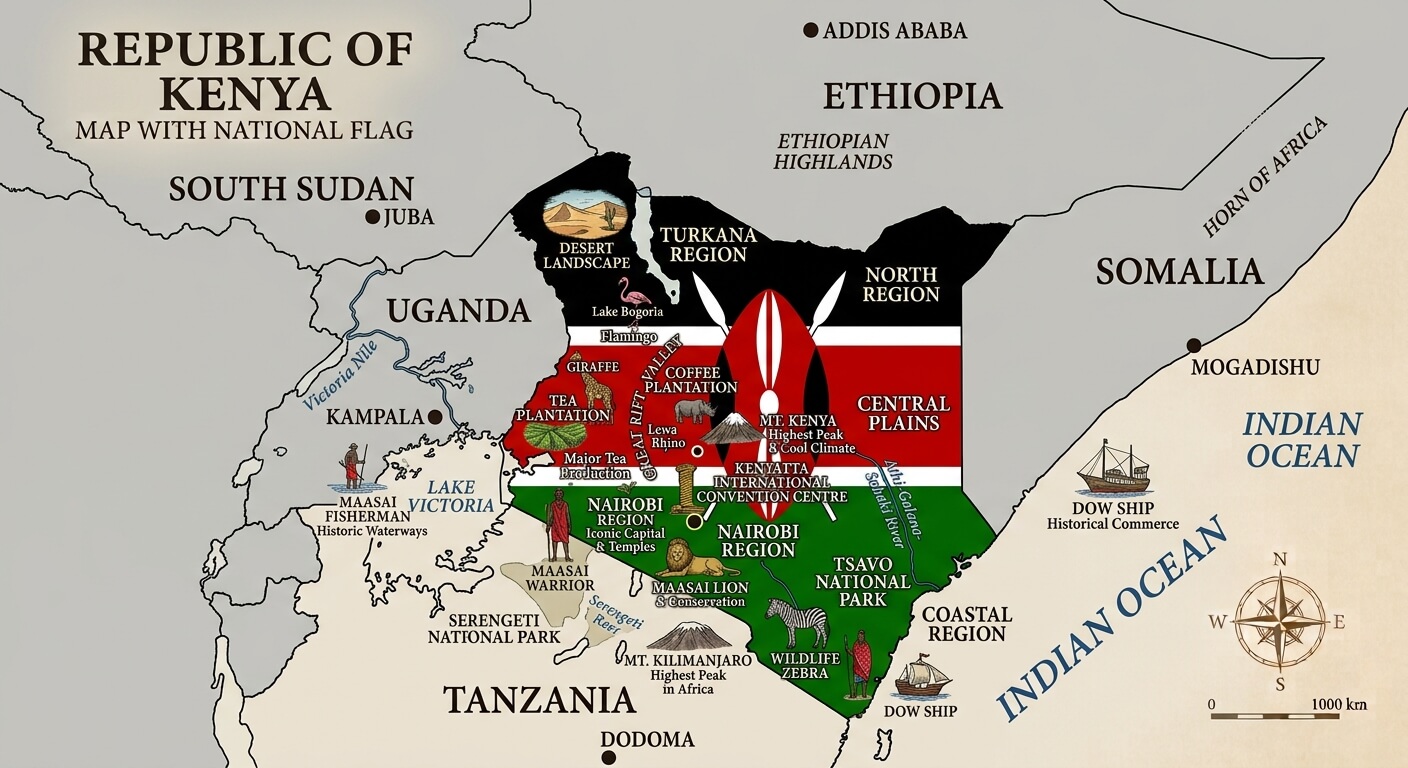
Kenya, officially the Republic of Kenya, is located in East Africa at the crossroads of Africa’s most dynamic economic region. Strategically positioned on the Indian Ocean coast, Kenya spans approximately 580,367 square kilometers and serves as a major gateway for trade across East and Central Africa.
Official Government System: Kenya operates as a presidential constitutional democracy with a bicameral parliament comprising the Senate (67 members) and National Assembly (349 members). The current President, William Ruto (since September 2022), leads both the government and state. The country is divided into 47 counties, each with devolved governance structures. [2]
Population: Kenya’s population reached approximately 57.5 million in 2025, making it East Africa’s second-most populous nation after Ethiopia, with a median age of 19.7 years—indicating a highly youthful demographic dividend. [3]
2. Economic Overview: GDP, Growth & Macroeconomic Performance
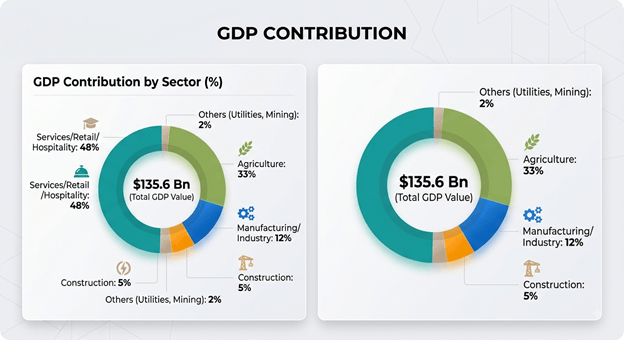
Kenya maintains status as East Africa’s largest economy with a nominal GDP of approximately US$135.9 billion in 2025, ranking 68th globally. The country demonstrates resilient economic growth despite global uncertainties.
Key Economic Indicators (2024-2025)[4]:
- Real GDP Growth (2024): 4.7% | Projected 2025: 4.6%
- GDP Per Capita: US$2,363 (2025)
- Inflation Rate: 4.1% (2025)—well-controlled by the Central Bank of Kenya (CBK) [4]
- Unemployment Rate: 5.4% (modeled ILO estimate)
- Key Growth Drivers: Private consumption, agricultural recovery, services sector expansion
Macroeconomic Stability: Kenya’s central bank reduced its policy rate from 11.25% (January 2025) to 8.75% (February 2026) amid easing inflation. International reserves reached record highs, supporting macroeconomic confidence. However, the World Bank notes Kenya is in high risk of debt distress, requiring fiscal consolidation efforts.
Sources: World Bank Kenya Overview | Kenya Government Official Portal | Kenya National Bureau of Statistics | IMF Article IV Consultation Report (November 2025)
3. Agricultural Sector: Export Powerhouse & Employment Engine
Agriculture remains Kenya’s economic backbone, employing approximately 35-40% of the workforce and contributing heavily to export earnings[5]. Despite occupying only ~8% of total land, Kenya is a global agricultural leader.
Major Agricultural Products & Production (2024-2025):
| Product | 2024 Production | Global Ranking | Export Value (KSh Bn) |
| Tea | 598,500 tonnes | 3rd largest | 189.1 |
| Horticulture/Flowers | 102,500 tonnes | 3rd largest | 203.6 (highest earner) |
| Coffee | 49,500 tonnes | Rising producer | 38.4 |
| Apparel (RMG) | Various | AGOA beneficiary | 56.8 |
| Oils & Fruits | Multiple crops | Regional supplier | 30.3+ |
Tea Industry: Kenya is the world’s third-largest tea producer, accounting for 23% of global tea exports. With 218,000 hectares under cultivation and 473,000 metric tonnes produced annually (90%+ hand-picked), Kenya’s tea is synonymous with premium quality on international markets [6].
Horticulture & Floriculture: Kenya dominates as the 3rd largest cut-flower exporter globally, exporting 95% of locally-grown flowers. Primary flowers include roses, carnations, and alstroemeria, with production concentrated around Lake Naivasha (90 km northwest of Nairobi). The flower industry directly employs 90,000 workers and indirectly supports 500,000 more.
Coffee Sector: Coffee production increased 1.6% to 49,500 tones in 2024, with earnings surging 48.6% to KSh 29.6 billion due to favorable global prices. Over 115,500 hectares are now under cultivation.
Future Outlook: Agricultural productivity continues improving post-drought recovery, with government programs actively expanding cultivation of high-value crops and supporting farmer cooperatives.
Sources: Kenya Ministry of Agriculture | Tea Board of Kenya 2024 Report | Kenya Export Promotion Council | Coffee Board of Kenya 2024 Statistics
4. Industrialization and Manufacturing
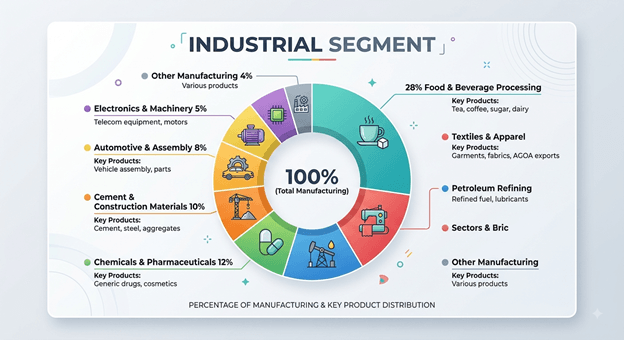
Kenya’s manufacturing sector contributes approximately 12-13% of GDP and serves as East Africa’s industrial hub [4].
Key Industrial Sectors:
- Petroleum Refining: Kenya is East Africa’s refining center (Port of Mombasa)
- Food & Beverage Processing: Tea, coffee, sugar, and dairy processing facilities
- Textiles & Apparel: AGOA-eligible garment manufacturing targeting US markets
- Cement & Construction Materials: Serving regional infrastructure boom
- Pharmaceuticals & Chemicals: Regional pharmaceutical manufacturing hub
- Auto Assembly: Vehicle assembly and parts manufacturing
Special Economic Zones: Kenya’s free trade zones and industrial parks (including the Special Economic Zone at Dongo Kundu in Mombasa) attract foreign direct investment in manufacturing, logistics, and light industries.
Sources: Central Bank of Kenya Economic Review
5. Trade and Economic Profile
Export and Import Overview
Kenya’s merchandise trade volume reached approximately US$28.18 billion in 2024 (up from US$26.69 billion in 2023), representing 5.6% year-on-year growth.
2024 Trade Statistics:
- Total Exports: US$8.16 billion (domestic + re-exports)
- Total Imports: US$20.03 billion
- Trade Deficit: US$11.82 billion
- Export-Import Cover Ratio: 41.1%
Re-exports surged 77.2% in 2024 (from KSh 101.6 billion to KSh 180.16 billion), driven by petroleum products and regional distribution hubs.
Major Export Products & Markets
Top Export Commodities (2024):
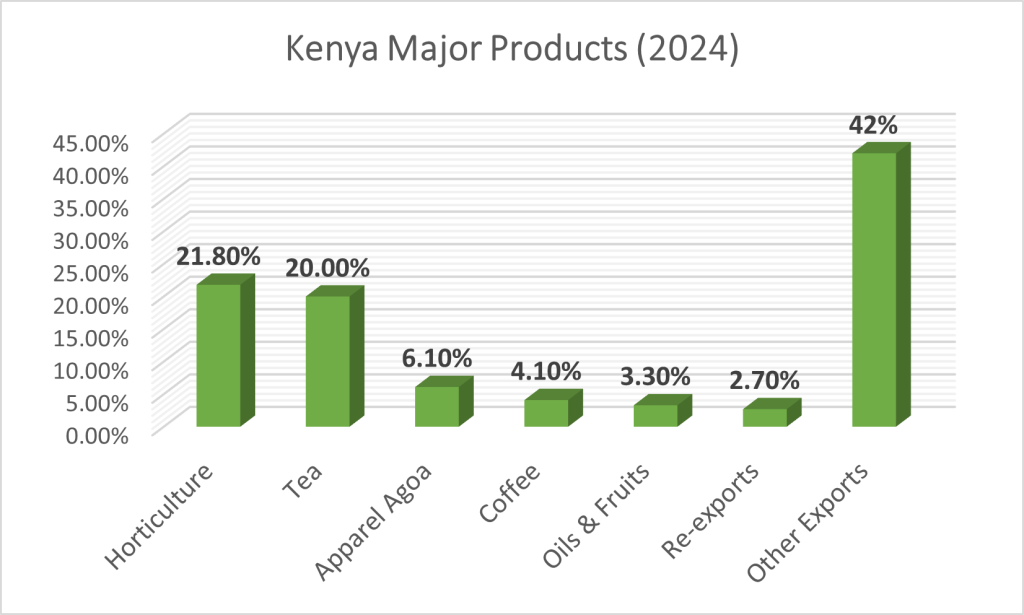
| Commodity | Value (KSh Bn) | % of Total | Key Markets |
| Horticulture (Flowers/Produce) | 203.6 | 21.8% | Netherlands, UK, EU |
| Tea | 189.1 | 20.3% | UK, Germany, Pakistan |
| Apparel & Clothing (AGOA) | 56.8 | 6.1% | United States |
| Unroasted Coffee | 38.4 | 4.1% | Global buyers |
| Animal & Vegetable Oils | 30.3 | 3.3% | Regional, EU |
| Jet Fuel Re-exports | Variable | Growing | Intra-African trade |
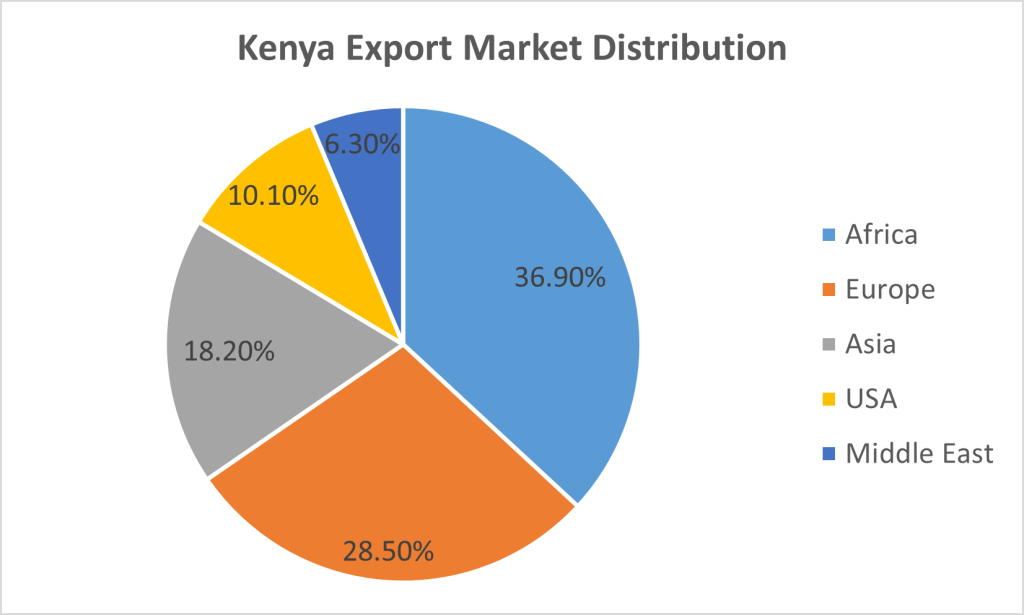
Primary Export Destinations (2024): Africa dominates at 36.9% of total exports, with key markets in Uganda, Tanzania, South Sudan, Democratic Republic of Congo, and Egypt.
Major Import Products
Kenya imports approximately US$20.03 billion annually, primarily:
- Rice & Cereals: 12-15% of imports
- Telecom Equipment: Smartphones, networking equipment
- Plastics & Machinery: Manufacturing inputs
- Petroleum Products: Refined fuels
- Aircraft & Transport Equipment
Top Import Sources (2024): China (KSh 576.1 billion), United Arab Emirates (KSh 337.3 billion), India (KSh 263.2 billion), United States (KSh 155.6 billion), and Japan (KSh 109.2 billion).
Sources: UN Comtrade 2024 Data | US AGOA Office Statistics
6. Education System & Human Capital
Overview of Kenya’s Education System
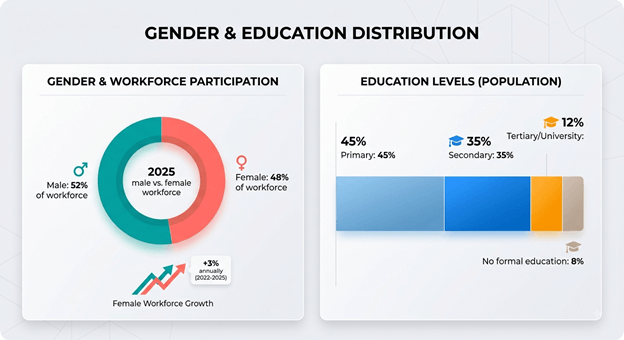
Kenya operates a 6-3-3-4 education structure (6 years primary, 3 years lower secondary, 3 years upper secondary, 4 years university), following reforms aligned with the Competency-Based Curriculum (CBC)[11].
Education Levels:
- Primary Education: Ages 6-13 (free and compulsory since 2003)
- Secondary Education: Ages 14-17 (partially subsidized)
- Tertiary Education: Universities, polytechnics, and technical institutes
Key Universities: University of Nairobi (top-ranked in East Africa), Kenyatta University, Moi University, and Strathmore University lead in research and innovation.
Literacy Rate & Human Capital
- Adult Literacy Rate: Approximately 80-85% (2024 estimates)
- Youth Literacy (15-24 years): ~88-90%
- Gender Parity: Near-universal primary enrollment; secondary enrollment ratio approximately 72%
Brain Gain & Skills Development: The government prioritizes STEM education and vocational training through Technical and Vocational Education and Training (TVET) institutions, with partnerships including German GIZ and Swiss vocational institutions.
Sources: Ministry of Education Kenya Annual Report 2024
7. Health and Social Indicators
Health Metrics:
- Life Expectancy: 72.8 years (2024)
- Infant Mortality Rate: 34 per 1,000 live births [12]
- Maternal Mortality Ratio: 342 per 100,000 live births [12]
- Healthcare Coverage: ~67% of population access basic health services [12]
Social Indicators:
- Poverty Rate (National): 36.1% (2024), declining toward 41.9% under international poverty line ($3 PPP)
- Unemployment (Formal Sector): 5.4%; informal employment dominates
- Female Participation in Workforce: Growing; 45-48% of labor force [3]
- Access to Electricity: ~84% (urban), ~48% (rural)
Health Infrastructure: Kenya’s health system combines public facilities (government hospitals) with a thriving private sector, pharmaceutical manufacturing, and medical tourism corridors in Nairobi.
Sources: World Health Organization Kenya Profile 2024 | Kenya Power & Lighting Company Annual Report
8. Bangladesh-Kenya Bilateral Relations
Diplomatic relations between Bangladesh and Kenya were established in 1975 following Bangladesh’s independence. Both countries maintain embassy-level representation: the Bangladesh High Commission in Nairobi and the Kenyan High Commission in Dhaka.
Relations Framework:
- Both nations are members of the United Nations, World Trade Organization, and Non-Aligned Movement
- Kenya is part of the African Union; Bangladesh participates in OIC and D-8 forums
- Regular diplomatic consultations and ministerial visits strengthen cultural and economic ties
Both nations participate actively in multilateral forums including United Nations, World Trade Organization, and Non-Aligned Movement, providing platforms for enhanced cooperation[14].
Key Cooperation Areas:
- Trade in agricultural products and textiles
- Educational exchange programs
- Technical cooperation in agriculture and fisheries
- Labor migration and diaspora engagement
Sources: Bangladesh Ministry of Foreign Affairs Relations Portal
9. Bilateral Trade Analysis
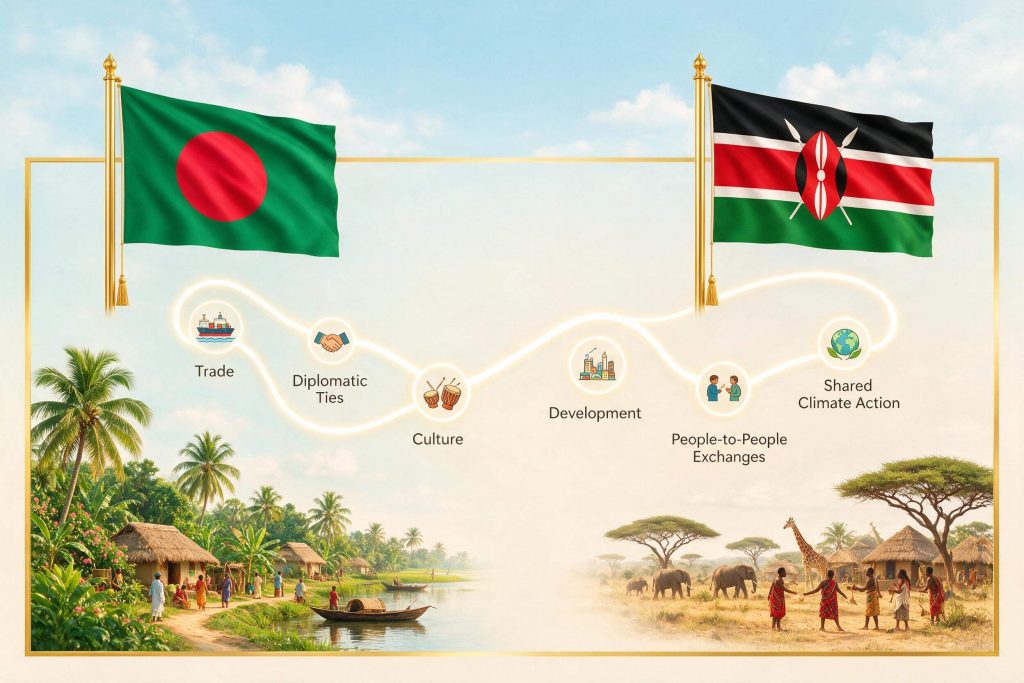
Bangladesh-Kenya Trade Volume
Current bilateral trade remains modest relative to potential, estimated at approximately US$60-80 million annually (2023-2024), reflecting significant untapped opportunities [15].
What Bangladesh Exports to Kenya
| Product Category | Estimated Value (US$ Mn) | HS Code | Remarks |
| Articles of Apparel (RMG) | 25-30 | HS 61-62 | High quality, AGOA-aligned |
| Textiles & Fabric | 10-15 | HS 50-63 | Cotton, polyester blends |
| Ceramics & Pottery | 2-3 | HS 69 | Artisanal products |
| Chemicals & Pharmaceuticals | 1-2 | HS 28-29 | Emerging sector |
| Jute Products | 1-2 | HS 53 | Niche market |
Competitive Advantage: Bangladeshi RMG sector holds cost advantage in basic apparel, though competition from local Kenyan manufacturers and other African suppliers limits penetration.
What Kenya Exports to Bangladesh
| Product Category | Estimated Value (US$ Mn) | HS Code | Remarks |
| Tea (Processed) | 20-25 | HS 0902 | Premium quality, CTC tea |
| Coffee (Unroasted/Roasted) | 5-8 | HS 0901 | Specialty coffee beans |
| Horticulture (Dried Flowers) | 2-3 | HS 0602-06 | Decorative, medicinal |
| Pharmaceuticals | 2-3 | HS 30 | Growing exports |
| Animal Products | 1-2 | HS 02-05 | Leather, hides |
Kenyan Competitive Strengths: Established brand reputation in premium tea and specialty coffee; logistics hub advantage via East African transport corridors.
Sources: Bangladesh Export Promotion Bureau Bilateral Trade Statistics | Central Bank of Kenya Payment Systems Report
Banking and Financial Linkages
Correspondent Banking: Limited formal linkages currently exist. Key correspondent relationships:
- Kenyan Commercial Banks: Kenya Commercial Bank (KCB), Equity Bank, NCBA Group
- Bangladeshi Banks: Dutch-Bangla Bank, Brac Bank, City Bank
Trade Finance Instruments:
- Letters of Credit (LCs) processed via international banks (Standard Chartered, HSBC regional offices)
- Documentary Collections and Cash-in-Advance common for smaller shipments
- Remittances: Relatively small Bangladeshi diaspora in Kenya (~500-1,000 individuals); remittance flows negligible
Future Enhancement: Direct correspondent relationships and bilateral trade agreements could reduce LC processing time from 7-10 days to 3-5 days.
10. International Cooperation
Kenya actively participates in multilateral and regional frameworks:
Regional Integration:
- East African Community (EAC): Full member; participates in common market, customs union, and planned monetary union [17].
- African Union (AU): Hosts continental bodies; Kenya is a key policy influencer [17]
- Indian Ocean Rim Association (IORA): Maritime cooperation, blue economy initiatives [17].
Global Partnerships:
- World Bank Group: Active lending and technical support [4].
- IMF: Article IV consultations; Kenya under Extended Credit Facility [4].
- UN Agencies: UNHCR, WFP operations; peacekeeping contributions [17].
Trade Agreements:
- COMESA: Southern African trade bloc membership [17].
- AGOA: US market access for apparel and horticulture [10]
- EU Partnership Agreements: Preferential trade status for agricultural products [17]
11. Opportunities for Bangladeshi Citizens in Kenya
Higher Education Opportunities
University Enrollment: Several Kenyan universities welcome Bangladeshi students:
- University of Nairobi: Engineering, business, law programs (~50-100 Bangladeshi students annually) [11]
- Strathmore University: MBA and professional courses (tuition: ~US$10,000-15,000/year) [11]
- Kenyatta University: Teacher training, agriculture programs [11]
Scholarship Availability: Limited government scholarships; private sponsorship and TUTION typically required. Estimated total cost: US$8,000-18,000/year depending on institution.
Employment and Labor Migration
Formal Employment: Kenya offers selective opportunities in:
- IT & Software Development: Growing tech hubs in Nairobi (“Silicon Savanna”) [18]
- Healthcare (Nurses, Doctors): Acute shortage; competitive salaries (US$1,500-3,000/month)
- Teaching & Education: International schools favor qualified teachers [18]
- Business Services: Consulting, finance, corporate sectors
Labor Migration Status: Kenya is not a major formal labor destination for Bangladeshi workers compared to Gulf states or Southeast Asia. Estimated 500-1,000 Bangladeshi workers formally employed; many others in informal trade and small business [18].
Average Salaries: US$800-2,500/month (depending on sector and experience)
Visa Facilities
Work Permit Requirements:
- Employer sponsorship required
- Processing time: 2-4 weeks
- Cost: Approximately KSh 20,000-50,000 (~US$155-390)
- Duration: Typically 1-2 years, renewable
Tourist Visa: US$50 (on arrival at Jomo Kenyatta International Airport) or via Nairobi embassy; typically 90 days validity [19].
Business Visa: Available for entrepreneurs; requires business registration documentation and initial investment proof (~US$5,000-10,000).
Export and Residency Opportunities
Business Registration: Foreign entrepreneurs can establish companies via:
- Single Business Permit: KSh 10,000-20,000 (~US$77-155)
- Company Registration: CIDC online portal (3-7 days processing)
- Tax Identification Number (PIN): Mandatory for all business activities
Residency Pathways:
- Business Residence Permit: Multi-year visa for entrepreneurs investing KSh 10 million+ (~US$77,000) [19]
- Employment Residence Permit: Available upon formal job offer
- Spouse/Dependent Permit: Family reunification available
12. Opportunities for Kenya from Bangladesh
High-Potential Import Products
1. Ready-Made Garments (RMG)
- Market Gap: Kenya imports ~US$500+ million in apparel annually; local production insufficient
- Bangladeshi Advantage: Competitive pricing (30-40% cheaper than competitors), proven quality, OEKO-TEX compliance
- Target Segments: Budget retail (local chains like Nakumatt, Uchumi), school uniforms, workwear
- Estimated Potential: US$20-40 million annually within 3 years
2. Textiles & Fabrics
- Cotton Fabrics: Bangladesh supplies quality fabrics for local textile processing
- Polyester & Blends: Growing demand in apparel manufacturing
- Market Size: Estimated US$15-25 million potential
3. Jute Products
- Eco-friendly Packaging: Growing demand amid Kenya’s plastic ban (2017-present)
- Jute Bags for Agriculture: Tea and coffee packaging solutions
- Estimated Potential: US$5-10 million
4. Footwear
- Canvas & Casual Shoes: Bangladeshi manufacturers competitive on price
- Safety Footwear: Industrial market expansion
- Market Potential: US$10-15 million
5. Ceramics & Handicrafts
- Pottery & Home Décor: Growing middle-class demand
- Artisanal Products: Niche market with 15-20% margins
- Potential: US$3-5 million
Sources: Kenya National Chamber of Commerce Import Analysis | Kenya Investment Authority Sector Guides
Investment and Industrial Cooperation
Suggested Joint Ventures:
- Garment Manufacturing Hub: Bangladesh textile companies establish assembly units in Kenya’s SEZs, serving East African market (cost arbitrage: lower labor than Kenya + AGOA/EAC access)
- Tea Blending & Packaging: Joint ventures with Kenyan tea producers to co-brand and distribute in South Asian markets
- Leather Tanning & Processing: Bangladesh expertise in leather working applied to Kenyan hides
- Pharmaceutical Manufacturing: Bangladeshi generic pharma companies partnering with Kenyan distributors
Incentive Structures:
- Kenya’s SEZ investment incentives: 10-year tax holidays for export-oriented manufacturing
- Dongo Kundu EPZ: Purpose-built industrial zone; fast-track registration for investors
Other Sectors
Agriculture & Agro-Processing:
- Bangladeshi expertise in rice milling, spice processing; demand for improved food processing technology
- Potential for Bangladesh AgriTech companies to supply irrigation and farming equipment
Technology & IT Services:
- Bangladesh’s competitive IT services sector could target Kenyan SMEs
- Software development and BPO services potential: US$5-15 million market
Bangladeshi medical tourism and diagnostic labs (e.g., Delta Life, Square Hospitals model) could establish satellite diagnostics centers in Nairobi.
13. Trade Associations and Future Prospects
Kenyan Trade Bodies
| Organization | Focus | Website/Contact |
| Kenya National Chamber of Commerce | Business advocacy, networking | www.kncc.or.ke |
| Kenya Manufacturers Association (KMA) | Industrial development | www.kenyamanufacturers.org |
| Kenya Private Sector Alliance (KEPSA) | Private sector engagement | www.kepsa.or.ke |
| Tea Board of Kenya | Tea sector coordination | www.teaboard.or.ke |
| Kenya Exporters Association | Export promotion | www.kenya-exporter.org |
| Bangladesh-Kenya Chamber & Commerce | International relationship | https://www.kenyachamber.or.ke |
Bangladeshi Trade Associations
| Organization | Relevance to Kenya Trade | Contact |
| Bangladesh Garment Manufacturers and Exporters Association (BGMEA) | RMG sector coordination | www.bgmea.com.bd |
| Bangladesh Tea Association | Tea trading & partnerships | — |
| Bangladesh Chamber of Commerce & Industry (BCCI) | Multi-sector engagement | www.bcci.org.bd |
| Export Promotion Bureau (EPB) | Market research, trade missions | www.epb.gov.bd |
Here we need to add Bangladesh-Kenya friendship organizations and Trade body like “Bangladesh-Kenya Chamber & Commerce” or “Kenya-Bangladesh Trade Association” etc.
Future Prospects
Short-Term (1-2 years):
- Bilateral trade projected to grow 15-20% annually if marketing efforts intensify
- Bangladesh BGMEA participation in Nairobi trade fairs; Kenya textile missions to Dhaka
- Direct shipping routes exploration (currently routed via Middle Eastern hubs)
Medium-Term (3-5 years):
- Potential Preferential Trade Arrangement (PTA) negotiations between Bangladesh and Kenya
- Joint manufacturing ventures in SEZs (estimated value creation: US$50-100 million in cumulative investment)
- Banking linkages formalization (expected LC cost reduction: 15-25%)
Long-Term (5-10 years):
- Bangladesh becomes top apparel supplier to Kenya (30-40% of import volume)
- Regional distribution hub for Bangladeshi goods serving East Africa (Tanzania, Uganda, Rwanda)
- Estimated bilateral trade potential: US$300-500 million annually
14. Recommendations
For Bangladeshi Exporters & Entrepreneurs
- Establish Trade Offices: Set up commercial representation in Nairobi (Westlands, Upper Hill districts) to reduce information asymmetries and build direct buyer relationships [24].
- Participate in East African Trade Fairs: Attend Kenya International Trade Expo (KITE) and Nairobi International Trade Fair annually; allocate KSh 2-3 million (~US$15,000-23,000) per event [24].
- Develop Kenya-Specific Product Lines: Customize apparel sizes, designs, and fabrics to match local preferences; introduce eco-friendly jute packaging as USP.
- Quality Certification: Obtain AGOA compliance, OEKO-TEX, and ISO certifications to unlock premium market segments [24].
- Partnerships with Local Importers: Identify and formalize agreements with established Kenyan importers (e.g., A-Global Ltd, Nakumatt Holdings’ suppliers) for consistent offtake [24].
- Leverage Digital Marketing: Use Google Ads, LinkedIn, and localized platforms (e.g., Jumia Kenya) to reach Kenyan retailers and wholesalers.
For the Bangladeshi Government
- Bilateral Trade Agreement: Initiate negotiations for a Bangladesh-Kenya Trade Framework Agreement (BKTFA) to reduce tariffs and streamline non-tariff barriers [25].
- Joint Trade Commission: Establish formal Bangladesh-Kenya Joint Trade Commission to meet bi-annually and address trade facilitation issues [25].
- Embassy Support: Strengthen Bangladesh High Commission in Nairobi commercial section with dedicated trade officers and market research capacity [25].
- Export Credit Guarantees: Offer Bangladesh Export Development Fund (BEDF) financing for exporters targeting Kenya to reduce working capital constraints.
- Visa Ease for Business Travel: Expedite business visa issuance for traders; reduce visa fee to attract buyer delegations [25].
For Kenyan Importers & Investors
- Source Diversification: Reduce over-dependency on Asian suppliers; explore Bangladeshi RMG to optimize cost-quality trade-off [26].
- Joint Ventures in Bangladesh: Establish garment assembly operations in Bangladesh SEZs (lower labor: US$200-250/month vs. Kenya’s US$350-500/month) for East African distribution [26].
- Supply Chain Optimization: Utilize Bangladesh’s logistics hub position (port of Chattogram) for other African sourcing, reducing transport costs by 20-30%.
- Preferential Procurement: Public procurement policies could offer preferences to AGOA- or EAC-compliant imports; incentivize Bangladeshi-Kenyan joint ventures [26].
Sources: Export Marketing Consultant Recommendations | Bangladesh Ministry of Commerce Policy Papers | Kenya Importers Association Best Practices Guide
REFERENCES & DATA SOURCES
- World Bank Kenya Country Overview – https://www.worldbank.org/en/country/kenya/overview
- Government of Kenya Official Portal – https://www.kenya.go.ke
- Kenya National Bureau of Statistics – https://www.knbs.or.ke
- International Monetary Fund Kenya Article IV Consultation – https://www.imf.org/en/Countries/KEN
- Ministry of Agriculture, Livestock, Fisheries and Irrigation – https://www.agriculture.go.ke
- Tea Board of Kenya Annual Report 2024 – https://www.teaboard.or.ke
- KEPC Horticulture Export Statistics – https://www.kenya-exporter.org
- Coffee Directorate Production Data – https://www.agricultureauthority.go.ke/coffee
- UN Comtrade Database 2024 – https://comtrade.un.org
- AGOA Implementation Office – https://agoa.info
- Ministry of Education Kenya – https://www.education.go.ke
- World Health Organization Kenya Profile – https://www.who.int/countries/ken
- Kenya Power & Lighting Company – https://www.kplc.co.ke
- Bangladesh Ministry of Foreign Affairs – https://mofa.gov.bd
- Bangladesh Export Promotion Bureau – https://www.epb.gov.bd
- Central Bank of Kenya Payment Systems – https://www.centralbank.go.ke
- Ministry of Foreign Affairs Kenya – https://www.mfa.go.ke
- Kenya Federation of Employers – https://www.fke-kenya.org
- Kenya Department of Immigration Services – https://www.immigration.go.ke
- Kenya National Chamber of Commerce – https://www.kenyachamber.or.ke
- Kenya Investment Authority – https://www.investment.go.ke
- Kenya Trade Associations Portal – https://businessdirectory.go.ke
- Bangladesh Trade Directory – https://www.trade.gov.bd
- Export Marketing Best Practices – https://www.export.gov/kenya
- Bangladesh Ministry of Commercehttps://www.mincom.gov.bd
- Importers Association of Kenya
https://www.importers.org.ke