Book Appointment Now

Egypt: Prepared with data from the World Bank, IMF, UNDP, UNESCO, Central Bank of Egypt, Export Promotion Bureau (Bangladesh) and Bangladesh Bank
1. Country Profile
Geographical Location
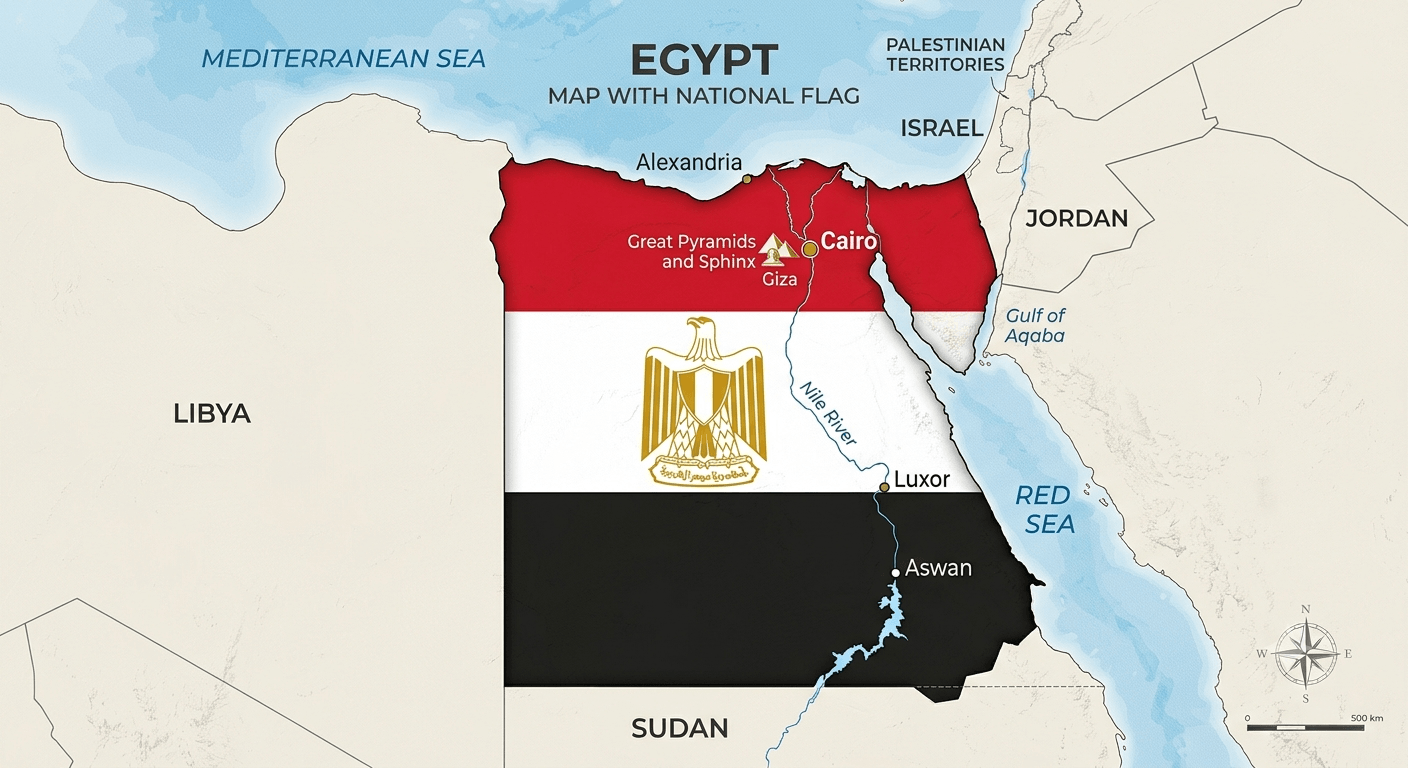
Egypt sits in the northeast corner of Africa, with the Sinai Peninsula extending into Southwest Asia. It borders Libya to the west, Sudan to the south, and Israel and the Gaza Strip to the northeast, with coastlines on the Mediterranean Sea and the Red Sea. The Suez Canal, one of the world’s busiest shipping lanes, runs through Egyptian territory and links the two seas.
Official Political Name and System
The country’s official name is the Arab Republic of Egypt. It is a semi-presidential republic with executive power concentrated in the presidency; President Abdel Fattah El-Sisi has led the country since 2014. Egypt is a founding member of the Arab League and holds regional weight through the African Union, COMESA and the WTO.
Economic Overview
Egypt’s nominal GDP stood at roughly $383 billion in 2024, with GDP per capita (PPP) at about $20,799 (IMF, 2024). Real GDP growth reached 4.4% in FY2024/25 and is projected at 4.3% for FY2025/26 (World Bank, Global Economic Prospects, January 2026). Inflation fell from a peak of 38% in late 2023 to 13.4% in February 2026, allowing 825 basis points of policy-rate cuts since April 2025. Central government debt eased to 82.5% of GDP at end-FY2025 from 90.1% a year earlier, while foreign reserves reached $67.5 billion by end-February 2026. Net FDI hit a record $46.1 billion in FY2023/24, driven largely by the Ras El Hekma coastal deal with the UAE.
Agricultural Sector
Agriculture contributes about 11.6% of GDP and employs roughly 19% of the workforce (World Bank), concentrated in the Nile Valley and Delta around cotton, rice, wheat, maize, sugarcane and citrus. Egypt remains one of the world’s largest wheat importers, and cotton anchors the textile value chain supplying both domestic mills and export garment production.
Industrialization and Manufacturing Sector
Industry accounts for about 32.7% of GDP, with manufacturing alone contributing close to 15% (FocusEconomics/Ministry of Planning). Non-oil manufacturing grew 18.8% in FY2024/25, and non-petroleum industrial exports surged 73.8% to $32.5 billion in FY2023/24. Core activity spans textiles, cement, steel, chemicals, pharmaceuticals, automotive assembly and food processing, alongside hydrocarbons centred on the Zohr gas field.
2. Trade and Economic Profile
Export and Import Overview
Egypt’s total foreign trade reached about $104.7 billion in FY2023/24 ($72.1 billion in imports and $32.6 billion in exports), per the Central Bank of Egypt. Calendar-year 2023 WITS/World Bank data put merchandise exports at $42.6 billion and imports at $84.2 billion, across roughly 2,990 exported and 4,048 imported HS6 product lines. The UAE was Egypt’s top trading partner in FY2023/24 with $9.3 billion in two-way trade, followed by the US ($7.5bn), Saudi Arabia ($7.2bn) and China ($7.2bn).
Major Export and Import Products
Leading exports are mineral fuels and oil products (about 32% of the total), chemicals (12%), agricultural goods (11%) and cotton-based textiles (10.5%), alongside gold, nitrogenous fertilizer and insulated wire (Trading Economics, 2024). Imports are led by mineral and chemical products (about 25%), agricultural products and foodstuffs (24%), machinery and electrical equipment (15%), and base metals (13%); China alone supplied 16.4% of Egypt’s 2024 imports, ahead of Saudi Arabia (7.2%) and the US (5.9%).
Detailed GDP Analysis
By sector, services generate about 51.6% of GDP, industry 32.7%, and agriculture 10.6% (CAPMAS/World Bank). Household consumption is unusually high at 82.6% of GDP, with net exports negative at around -2.3%. GDP per capita (nominal) is about $3,574-3,904, well below the global average of roughly $10,600, against a population of approximately 110-114 million. The labour force totals 33.75 million (45.5% participation), and unemployment stood at 7.4% overall and 18.8% among youth.
Major Industrial Products
Key output includes refined petroleum and petrochemicals, cement, iron and steel, fertilizers, garments and cotton textiles, pharmaceuticals, ceramics, and automotive parts, alongside Suez Canal transit services, worth roughly 5% of GNP in a normal year.
3. Education
Egypt runs a large, centrally administered public education system supplemented by Al-Azhar’s parallel religious-education track (roughly 2 million students) and a growing private-school segment. Net primary enrolment reached 97.5% in 2023 and secondary enrolment 86.1%, up from 76.8% in 2015 (UNESCO Institute for Statistics, 2024).
The adult literacy rate is 74.5% (UNESCO, 2024), split between 80.0% for men and 68.95% for women, still below the global average of about 81%. The 2025 UNDP Human Development Report puts expected years of schooling at 13.1 years and mean years actually completed at 10.1 years, but the share of youth not in employment, education or training (NEET) remains high, disproportionately affecting women (about 40%), pointing to a gap between schooling and labour-market outcomes.
4. Health and Social Indicators
Egypt’s Human Development Index rose to 0.754 in 2023, placing it 100th of 193 countries in the “high human development” tier (UNDP HDR 2025), up from 0.572 in 1990. The Inequality-adjusted HDI is lower, at 0.582, and the Gini coefficient is 28.5 (2021). Life expectancy at birth is 71.6 years.
The World Bank estimates the national poverty rate at 33.5% in 2021/22 using the $4.20/day (2021 PPP) line, rising roughly five points between 2022 and 2024 amid the 2023-24 inflation shock; the national poverty line measure stood at 29.7% in 2019 (CAPMAS).
Nutrition indicators show continuing strain: 22.3% of children under five are stunted and 9.5% wasted (Global Nutrition Report/UNICEF-WHO-World Bank estimates), while roughly 27.2% of under-fives and 25% of women suffer from anaemia (UNICEF Egypt). Egypt scored 10.5 on the 2025 Global Hunger Index, ranking 57th of 123 countries, a “moderate” hunger classification.
5. Bangladesh-Egypt Bilateral Relations
Bangladesh and Egypt maintain friendly, uninterrupted diplomatic relations, formalised through Egypt’s embassy in Dhaka, established in 1975. Egypt’s ambassador to Bangladesh is Mahmoud Ezzat, while Bangladesh’s ambassador to Egypt is Samina Naz.
Egypt’s embassy in Dhaka is its only diplomatic mission in Bangladesh; Bangladesh operates an embassy in Cairo and a consulate in Alexandria. Cooperation spans political consultations, cultural exchange, and consular support; an estimated 15,000 Bangladeshi nationals were resident in Egypt as of the last embassy estimate (2013), many linked to education, trade and religious study.
Commercially, ties are modest but longstanding: Bangladesh has historically imported Egyptian cotton for its ready-made garment (RMG) industry, and in 2005 Egypt’s Orascom Telecom acquired Sheba Telecom, parent of Bangladeshi mobile operator Banglalink – one of the largest Egyptian investments in Bangladesh to date.
6. Bilateral Trade Analysis
Two-way merchandise trade remains small relative to each country’s overall trade. Egypt’s imports from Bangladesh totalled $70.62 million in 2024, while Egypt’s exports to Bangladesh reached $76.77 million (UN Comtrade, via Trading Economics), leaving trade broadly balanced but at a fraction of Bangladesh’s global export base of $58.8 billion (2024).
Products Bangladesh Exports to Egypt (with indicative HS chapters)
| HS Chapter | Product Category | 2024 Value (US$ million) |
| 52 | Cotton yarn / vegetable textile fibres, woven fabric | 20.48 |
| 61 | Knit apparel (articles of apparel, knit/crocheted) | 20.35 |
| 62 | Non-knit apparel (woven garments) | 15.93 |
| 52 | Raw and processed cotton | 6.69 |
| 24 | Tobacco and tobacco substitutes | 2.88 |
| 69 | Ceramic products | 2.29 |
| 64 | Footwear | 0.81 |
Products Egypt Exports to Bangladesh (with indicative HS chapters)
| HS Chapter | Product Category | 2024 Value (US$ million) |
| 08 | Edible fruits, nuts and citrus peel | 46.02 |
| 25 | Salt, sulphur, stone, plaster and cement | 8.90 |
| 52 | Raw cotton | 7.79 |
| 09 | Coffee, tea, mate and spices | 2.62 |
| 07 | Edible vegetables and roots/tubers | 2.32 |
| 23 | Food-industry residues and animal fodder | 2.07 |
| 41 | Raw hides, skins and leather | 1.57 |
The Export Promotion Bureau (EPB) of Bangladesh tracks these flows within its country-wise export statistics; knit and woven apparel (HS 61/62) and cotton-based textile inputs (HS 52) dominate Bangladesh’s shipments to Egypt, consistent with Bangladesh’s broader export profile, where RMG alone generated $38.48 billion of the country’s $58.8 billion in 2024 exports (BGMEA/ITC data). On Bangladesh Bank’s side, the Annual Report does not publish a country-specific breakdown of Letters of Credit or trade-financing volumes for Egypt; in practice, bilateral trade is settled mainly through irrevocable Letters of Credit opened by Bangladeshi authorised-dealer banks with correspondent institutions such as the National Bank of Egypt and Banque Misr, governed by UCP 600 rules, with non-LC transactions (cash-in-advance, documentary collection) following ICC’s Uniform Rules for Collections.
7. International Cooperation
Bangladesh and Egypt are both members of the United Nations, the Organisation of Islamic Cooperation (OIC), the D-8 Organization for Economic Cooperation, the Non-Aligned Movement, and the World Trade Organization. Both countries are also active contributors to UN peacekeeping operations.
These shared platforms have supported modest but steady cooperation – notably OIC-affiliated scholarship schemes that fund Bangladeshi students at Al-Azhar University – though they have not yet translated into a large step-up in bilateral trade or investment volumes. No major bilateral free-trade or investment-protection agreement is currently in force between the two countries; cooperation instead proceeds through periodic bilateral consultations and D-8/OIC ministerial channels.
8. Opportunities for Bangladeshi Citizens in Egypt
Higher education is the strongest current channel: Al-Azhar University, with over 500,000 students from 102 countries, doubled its scholarship allocation for Bangladeshi students from 12 to 24 seats in 2025, alongside separate government and OIC schemes covering tuition and sometimes accommodation for Islamic studies, engineering and medicine.
Employment and labour migration remain limited and largely informal, concentrated in religious education and small trade rather than organised labour export; Egypt is not a significant formal destination compared with the Gulf states or Malaysia. Bangladeshi citizens require a visa, obtainable through Egypt’s Dhaka embassy, while Cairo issues tourist, business, investor, work-permit, NGO and research visas to Bangladeshi nationals. Export opportunities lie chiefly in expanding RMG shipments, given Egypt’s sizeable, price-sensitive apparel market. Long-term residency or citizenship routes are not distinct for Bangladeshis; standard Egyptian immigration law applies, generally requiring investment, marriage, or extended legal residence.
9. Opportunities for Egypt from Bangladesh
For Egypt, Bangladesh offers high-potential import lines beyond current small volumes: knit and woven RMG products (Bangladesh’s core strength, with $38.48 billion in global RMG exports in 2024), pharmaceuticals, light engineering goods, jute and jute-diversified products, leather and footwear, and processed foods and seafood. Given Egypt’s cotton base, joint-venture manufacturing – Egyptian cotton and yarn feeding Bangladeshi garment-finishing expertise – is a natural area for industrial cooperation, alongside investment in Bangladesh’s pharmaceutical export sector and Special Economic Zones, which actively court Middle Eastern investors.
10. Trade Associations and Future Prospects
Institutional links between Bangladeshi and Egyptian trade bodies remain thin and largely ad hoc, typically arranged around multilateral trade shows (such as OIC/D-8 business forums) rather than a standing joint chamber of commerce. The Bangladesh Garment Manufacturers and Exporters Association (BGMEA) and Export Promotion Bureau have engaged African and Middle Eastern markets more systematically since 2024-25 through platforms such as the Africa-Bangladesh Business Forum, which could plausibly be extended to include Egypt-specific outreach given Cairo’s role as a regional trade hub.
Future prospects hinge on Egypt’s own growth trajectory – the World Bank projects average real GDP growth near 6% a year through 2050 under its baseline reform scenario – which should widen Egyptian demand for affordable consumer goods, including Bangladeshi garments, precisely the segment where Bangladesh already holds a comparative advantage.
11. Recommendations
Use shared OIC and D-8 platforms more deliberately as a springboard for a formal bilateral economic cooperation agreement, rather than relying on multilateral forums alone.
Negotiate a bilateral Preferential Trade Arrangement or at least a Trade and Investment Framework, since no such instrument currently exists despite 50 years of diplomatic relations.
Establish a joint Bangladesh-Egypt Chamber of Commerce or a standing BGMEA-Egyptian textile-association dialogue to convert the $70-77 million trade base into a multi-year growth plan.
Target Egypt’s apparel and pharmaceutical import demand directly through EPB-led trade missions and participation in Cairo’s international trade fairs, building on the existing Africa-Bangladesh Business Forum model.
Expand educational cooperation beyond Al-Azhar scholarships into technical and vocational exchange, given Egypt’s stated NEET and skills-gap challenges and Bangladesh’s RMG and light-engineering training capacity.
Encourage Bangladeshi commercial banks to formalise correspondent banking relationships with Egyptian banks (National Bank of Egypt, Banque Misr) to reduce Letter of Credit costs and processing time for traders on both sides.