Book Appointment Now

TUNISIA: Collect data from World Bank, IMF, UNDP, UNESCO, UN Comtrade, Export Promotion Bureau (EPB) Bangladesh, Bangladesh Bank, and national statistical agencies of Tunisia.
1. Country Profile
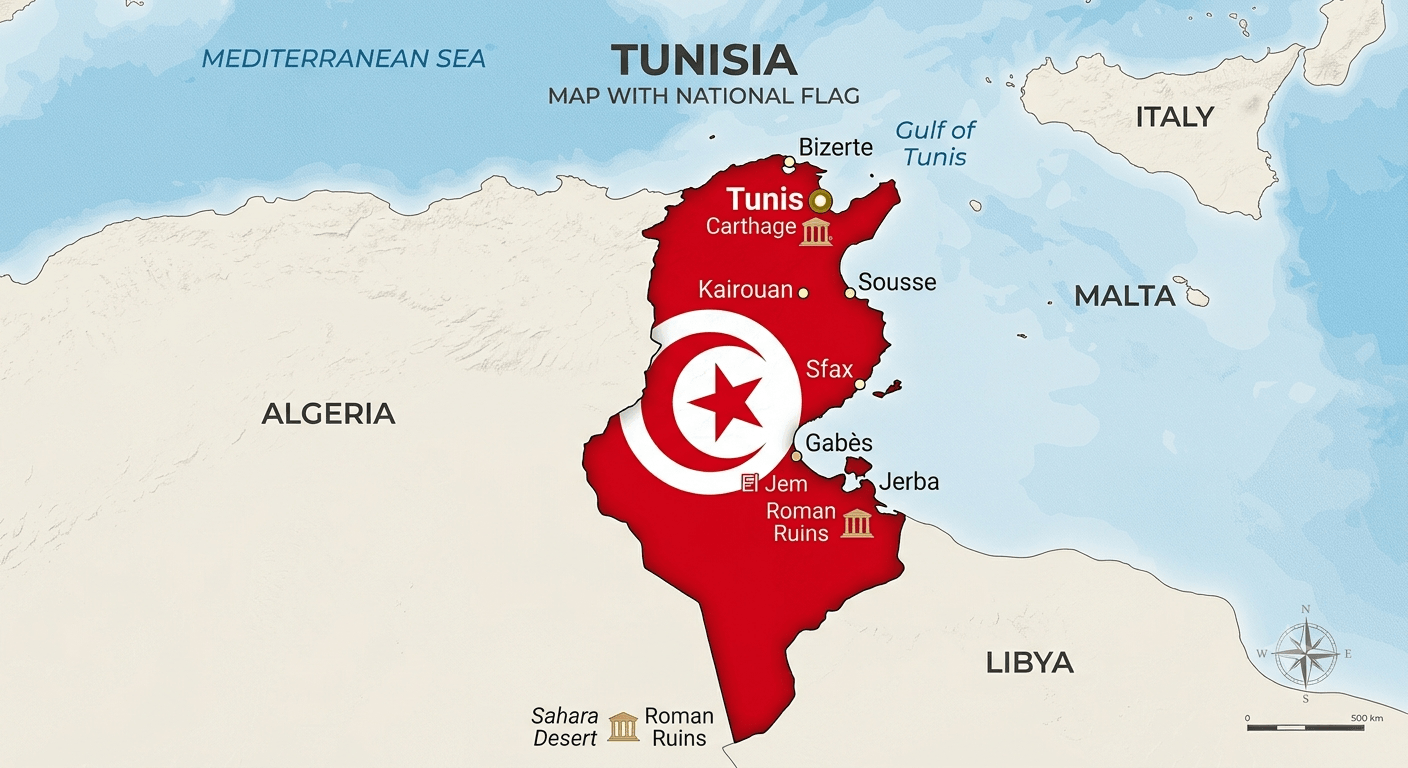
Tunisia (officially the Republic of Tunisia) is located in North Africa, bordered by Algeria to the west, Libya to the southeast, and the Mediterranean Sea to the north and east. It covers 163,610 sq. km and had a population of approximately 12.39 million in 2025 (World Bank; Tunisia Country Data).
Tunisia operates a unitary semi-presidential republic, with executive authority shared between the President and a Council of Ministers under the 2022 Constitution.
Real GDP grew 2.5% in 2025, following growth of 4.7% (2021), 2.8% (2022), 0.2% (2023) and 1.6% (2024), supported by an agricultural rebound, tourism recovery and private consumption (World Bank, Tunisia Country Overview, 2026). Inflation averaged 5.7% in 2025, down from 10.4% in February 2023, while the fiscal deficit moderated to 5.2% of GDP (from 6.1% in 2024) and the current account deficit widened to 2.4% of GDP. Unemployment stood at 15.2% in Q4 2025 (World Bank).
Agriculture contributes approximately 10.1% of GDP and employs around 15% of the workforce (World Bank/national accounts, 2024). Olive oil is Tunisia’s leading agricultural export, generating USD 1.5 billion in 2024 (+27% y-o-y), followed by dates (USD 299 million, +20%) and citrus (USD 6.2 million, +55.5%); total agri-food export revenue reached USD 2.6 billion in 2024, up 15.8% from USD 2.2 billion in 2023 (Onagri/International Trade Portal). Tunisia remains a net importer of cereals, importing 1.8 million tonnes of soft wheat in 2024/25.
Industry accounts for approximately 26.2% of GDP, of which manufacturing represents around 16%. Key sub-sectors include phosphate and chemical processing, textiles and leather, mechanical and electrical components (notably automotive wiring harnesses), and petroleum refining. Services contribute the remaining 63.8% of GDP, led by tourism, whose revenues rose 5.3% in 2025.
2. Trade and Economic Profile
According to Ministry of Commerce/Central Bank of Tunisia data, merchandise exports totalled USD 20.0 billion in 2024 (+7.6%) while imports reached USD 25.5 billion (-4.4%), leaving a merchandise trade deficit; the services account recorded exports of USD 6.1 billion against imports of USD 4.0 billion (International Trade Portal, 2025). Export performance was driven by agri-food (+14.6%), energy (+0.5%) and mechanical/electrical industries (+1.2%), while textiles and leather fell 4.8% and phosphates declined 26.3%.
Major Export Products (2023, UN Comtrade)
| Product Group | Value (USD) |
| Electrical and electronic equipment | 5.39 billion |
| Apparel, not knit or crocheted | 1.86 billion |
| Animal/vegetable fats and oils (incl. olive oil) | 1.38 billion |
| Mineral fuels and distillation products | 1.24 billion |
| Apparel, knit or crocheted | 0.79 billion |
| Machinery, boilers, mechanical appliances | 0.77 billion |
Major Import Products (2024, National Institute of Statistics)
| Product Group | Value (TND billion) |
| Coal, oil and derivatives | 15.2 (+7.8%) |
| Machinery and electrical equipment | 9.8 (-0.6%) |
| Boilers, reactors, mechanical machinery | 6.3 (+3.4%) |
| Vehicles, bicycles, tractors | 5.5 (+22%) |
| Plastics | 5.0 (+0.1%) |
| Cereals | 3.5 (-15.5%) |
| Pharmaceuticals | 2.0 (+12.7%) |
GDP Analysis
| Indicator | Value |
| GDP (nominal, 2024) | USD 53.4 billion (World Bank) |
| GDP per capita (2024) | USD 3,987 (World Bank) |
| GDP growth, 2021-2025 | 4.7% / 2.8% / 0.2% / 1.6% / 2.5% |
| Sectoral share of GDP | Services 63.8%; Industry 26.2% (mfg. 16%); Agriculture 10.1% |
| Inflation (avg., 2025) | 5.7% |
| Fiscal deficit (2025) | 5.2% of GDP |
| Public debt (est.) | ~81% of GDP by 2028 (World Bank projection) |
Major industrial products include phosphates and derivative chemicals, refined petroleum, textiles/apparel/footwear, automotive wiring harnesses and mechanical components, and processed olive oil.
3. Education
Tunisia maintains a free, compulsory basic education system (ages 6-16) followed by secondary and tertiary tracks; public universities are the dominant providers of higher education, with instruction chiefly in French and Arabic. The adult literacy rate stood at 86.25% in the most recent UNESCO estimate, with a marked gender gap: 92.69% for males versus 80.07% for females; youth literacy (ages 15-24) exceeds 96%, indicating continued generational improvement (UNESCO Institute for Statistics). Tunisia ranked 82nd of 141 countries in the Global Knowledge Index 2024, reflecting moderate but improving human capital infrastructure relative to regional peers.
4. Health and Social Indicators
Tunisia’s Human Development Index (HDI) stood at 0.746 in 2023, placing it in the “high human development” category (UNDP Human Development Report, 2025). Life expectancy at birth reached 77.4 years in 2023, supported by broad public health coverage, though disparities persist between urban and rural areas. The Gender Inequality Index was 0.259 in 2021 (rank 61 of 191 countries). Poverty incidence was last estimated by the World Bank at 15.2% of the population (national poverty line, 2015 series; more recent nationally representative estimates were not identified and should be verified against the forthcoming Tunisia household survey). On food security, Tunisia’s structural dependence on imported cereals (1.8 million tonnes of soft wheat in 2024/25) underscores continued vulnerability in nutrition-related supply chains despite strong performance in olive oil and horticultural exports.
5. Bangladesh-Tunisia Bilateral Relations
Bangladesh and Tunisia maintain formal but limited diplomatic engagement. Neither country maintains a resident embassy in the other’s capital: Bangladesh’s interests in Tunisia are covered on a non-resident basis by its Embassy in Tripoli, Libya, while Tunisia’s interests in Bangladesh are covered by its Embassy in Islamabad, Pakistan (Wikipedia, “Bangladesh-Tunisia relations”, 2026; citing respective foreign ministry mission lists). An honorary consulate of Tunisia previously operated in Dhaka but has since closed. Both countries are members of the Organisation of Islamic Cooperation (OIC) and the Non-Aligned Movement (NAM), which provide recurring multilateral engagement, though this has not yet translated into structured bilateral trade or investment mechanisms.
6. Bilateral Trade Analysis
Bilateral merchandise trade between Bangladesh and Tunisia remains modest and imbalanced in Tunisia’s favour, driven overwhelmingly by fertilizer shipments. According to UN Comtrade data, Tunisia’s exports to Bangladesh totalled USD 50.42 million in 2023, while Bangladesh’s exports to Tunisia were valued at USD 4.25 million in the most recent year with a detailed product breakdown (2015); more recent aggregated country-level EPB figures specific to Tunisia were not separately published and would require direct verification with EPB’s bilateral trade tables.
Tunisia’s Exports to Bangladesh (2023, UN Comtrade)
| Product (indicative HS Chapter) | Value (USD) |
| Fertilizers (HS 31) | 43.43 million |
| Edible fruits/dates (HS 08) | 4.28 million |
| Food industry residues, animal fodder (HS 23) | 2.02 million |
| Animal/vegetable fats and oils (HS 15) | 0.27 million |
| Raw hides and leather (HS 41) | 0.13 million |
Bangladesh’s Exports to Tunisia (2015, latest itemised UN Comtrade data)
| Product (indicative HS Chapter) | Value (USD) |
| Woven vegetable textile fibres/fabric (HS 53) | 1.99 million |
| Apparel, knit or crocheted (HS 61) | 1.04 million |
| Other made-up textile articles (HS 63) | 0.57 million |
| Apparel, not knit or crocheted (HS 62) | 0.33 million |
| Footwear (HS 64) | 0.06 million |
Bangladesh Bank’s Annual Report does not separately disclose country-level data on Letters of Credit or trade financing specific to Tunisia, consistent with the low absolute trade volume; transactions are understood to be processed through standard correspondent-banking L/C arrangements rather than a dedicated bilateral trade-finance facility. This should be confirmed directly with Bangladesh Bank’s Statistics Department for the latest reporting period.
7. International Cooperation
Bangladesh and Tunisia share membership in the United Nations, the Organisation of Islamic Cooperation (OIC), the Non-Aligned Movement (NAM), the World Trade Organization (WTO) and the Group of 77. These platforms provide standing diplomatic touchpoints and access to OIC-affiliated bodies such as the Islamic Chamber of Commerce, Industry and Agriculture (ICCIA) and the Islamic Development Bank, but available public records do not indicate that shared membership has yet been leveraged into a specific bilateral cooperation agreement, joint commission, or preferential trade arrangement between the two countries.
8. Opportunities for Bangladeshi Citizens in Tunisia
- Higher education: Tunisian public universities offer relatively low-cost engineering, medical and technical programmes, though instruction is predominantly in French and Arabic, limiting accessibility without language preparation.
- Employment and labour migration: Tunisia’s own unemployment rate of 15.2% (Q4 2025) and labour force participation of 45.9% indicate limited absorptive capacity for foreign labour; Tunisia is not currently a significant migration destination for Bangladeshi workers compared with Gulf Cooperation Council markets.
- Visa facilities: Bangladesh’s lack of a resident mission in Tunisia (coverage via Tripoli) adds administrative steps to visa processing; applicants should verify current requirements directly with the relevant mission.
- Export opportunities: Tunisia’s import dependence on machinery, textile inputs, plastics and consumer goods presents an opening for Bangladeshi apparel, jute goods, ceramics, leather, agro-processed food and generic pharmaceutical exports.
- Citizenship/residency: No bilateral treaty or preferential residency arrangement between the two countries was identified; standard Tunisian immigration law applies.
9. Opportunities for Tunisia from Bangladesh
- High-potential import products: ready-made garments and knitwear, jute and jute diversified products, ceramics, leather goods, generic pharmaceuticals, and processed agricultural goods, sectors in which Bangladesh has demonstrated export scale and cost competitiveness.
- Investment and industrial cooperation: Tunisia’s textile and leather exports declined 4.8% in 2024, suggesting scope for joint ventures or technology/knowledge transfer drawing on Bangladesh’s RMG manufacturing experience, particularly in compliance, productivity and value-chain integration.
- Other sectors: pharmaceuticals manufacturing partnerships and light engineering/component assembly, aligned with Tunisia’s existing mechanical and electrical export base.
10. Trade Associations and Future Prospects
No publicly documented institutional cooperation was identified between Bangladeshi trade bodies (e.g., FBCCI, BGMEA, BKMEA) and Tunisian counterparts such as UTICA (the Tunisian Confederation of Industry, Trade and Handicrafts). Given the modest but growing trade base and shared OIC/ICCIA membership, prospects exist for a future Joint Business Council, participation in reciprocal trade fairs, or an MOU between apex chambers, though none currently exists on record and this should be confirmed directly with FBCCI and UTICA.
11. Recommendations
- Establish a structured bilateral trade dialogue, potentially through upgrading non-resident diplomatic coverage or a Ministry of Commerce-level MOU, to formalise trade promotion channels.
- Diversify bilateral trade beyond fertilizer imports by actively promoting Bangladeshi RMG, jute goods, pharmaceuticals and agro-processed exports to Tunisian importers.
- Facilitate B2B engagement between FBCCI/BGMEA and UTICA, including participation in each other’s trade fairs and exploratory trade missions.
- Use Tunisia’s free-trade access to the European Union and the African Continental Free Trade Area (AfCFTA) as a potential re-export or joint-venture manufacturing gateway for Bangladeshi products into these markets.
- Leverage OIC/ICCIA and Islamic Development Bank platforms for trade financing facilitation and capacity-building support.
- Commission updated, transaction-level data from Bangladesh Bank and EPB specifically covering the Tunisia corridor to support evidence-based policy and private-sector decision-making, given the dated nature of currently available bilateral trade breakdowns.
References
- World Bank, Tunisia Country Overview (2026).
- World Bank, “Improved Connectivity Offers a Path to Stronger Growth in Tunisia” (May 2025).
- World Bank/Trading Economics, Tunisia GDP per Capita and Macroeconomic Indicators (2024-2025).
- UN Comtrade / Trading Economics, Tunisia and Bangladesh Bilateral Trade Data (2015, 2023).
- International Trade Portal (Lloyds Bank), Tunisia Foreign Trade Figures (2025).
- African Manager, “Tunisia’s Top 10 Import and Export Products in 2024” (January 2025).
- UNESCO Institute for Statistics, Tunisia Literacy Rate Data.
- UNDP, Human Development Report 2025 (Tunisia HDI data).
- Wikipedia, “Bangladesh-Tunisia relations” (accessed July 2026), citing Bangladesh and Tunisia Ministry of Foreign Affairs mission records.
- Wikipedia, “Economy of Tunisia” (2026), compiling CIA World Factbook and national accounts data.
Note: Figures on bilateral Bangladesh-Tunisia trade and banking transactions are drawn from the most recent itemised UN Comtrade releases identified; more granular or recent EPB/Bangladesh Bank country-specific breakdowns were not located in public sources and should be verified directly with those institutions before final client submission.