Book Appointment Now

Republic of the Union of Myanmar Country Profile: Economic Overview, Trade Relations with Bangladesh & Investment Opportunities
1. COUNTRY PROFILE
Geographical Location
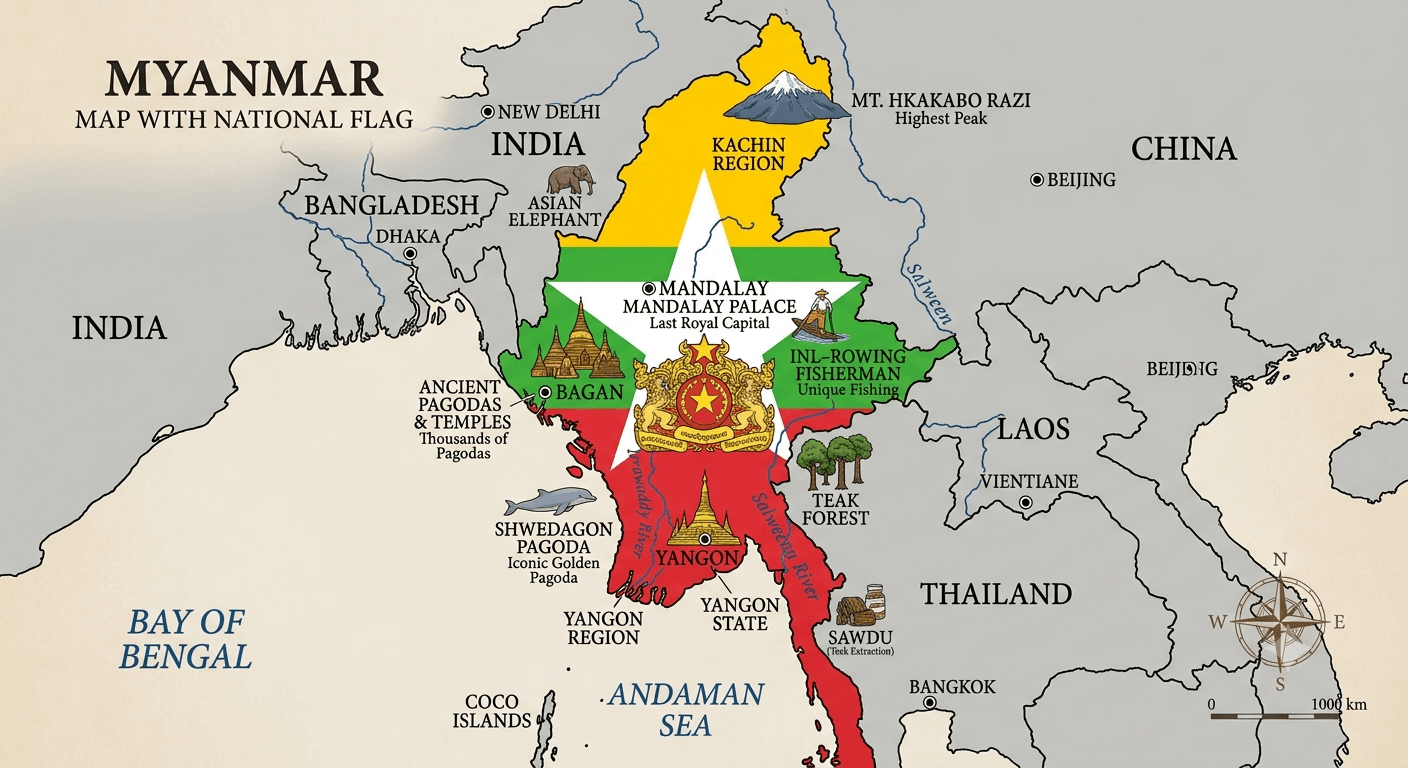
Myanmar, officially the Republic of the Union of Myanmar, is strategically located in mainland Southeast Asia at the crossroads of South Asia, China, and ASEAN. The country shares land borders with Bangladesh and India to the west, China to the northeast, Laos to the east, and Thailand to the southeast, with an extensive coastline along the Bay of Bengal and the Andaman Sea.
Key Geographic Features:
- Total Land Area: Approximately 676,578 square kilometers (largest mainland Southeast Asian country)
- Shared Border with Bangladesh: Approximately 271 kilometers of land and maritime border, making Myanmar Bangladesh’s direct eastern neighbor[1]
- Coastline: ~2,832 kilometers along the Bay of Bengal and Andaman Sea; rich marine resource base[1]
- Major Rivers: Ayeyarwady (Irrawaddy), Salween, Chindwin—critical for agriculture and internal transport[1]
Geographic Advantages:
- Bay of Bengal Access: Strategic maritime routes connecting Indian Ocean trade lanes[1]
- China-India Bridge: Land corridor connecting South Asia to ASEAN and East Asia[1]
- Natural Resource Endowment: Rich in natural gas, minerals, gems, jade, timber, and fisheries[1]
Population: Approximately 54.85 million (2025 World Bank estimate), making Myanmar the 5th most populous nation in Southeast Asia. Population growth is constrained by internal conflict-driven displacement, with over 3 million internally displaced persons (IDPs) as of 2025[2].
Capital: Naypyidaw (administrative capital since 2006); Yangon remains the largest commercial and financial center[2].
Official Political Name and System
Official Name: Republic of the Union of Myanmar (ပြည်ထောင်စု သမ္မတ မြန်မာနိုင်ငံတော်)
Government System (Post-2021): Following the military coup of February 2021, Myanmar has been governed by the State Administration Council (SAC) under Senior General Min Aung Hlaing, who serves as both Commander-in-Chief and head of government. The SAC suspended the democratically-elected government of the National League for Democracy (NLD).
Parallel Government: A National Unity Government (NUG) formed by ousted NLD lawmakers and elected members of parliament claims democratic legitimacy and operates from exile. The NUG is recognized by several Western governments and democratic stakeholders but lacks physical control of most territories[2].
Civil Conflict Status: Myanmar remains in protracted civil conflict between the SAC military (Tatmadaw) and a coalition of resistance forces including the People’s Defence Force (PDF), ethnic armed organizations (EAOs), and regional militias. Conflict intensity escalated significantly following the March 2025 earthquake (7.7 magnitude), compounding humanitarian and economic crises[2].
Administrative Divisions: 7 regions, 7 states, 1 Union Territory (Naypyidaw), and 5 self-administered zones/divisions[2].
Sources: World Bank Myanmar Country Overview | BTI Bertelsmann Stiftung Country Report Myanmar 2024
2. ECONOMIC OVERVIEW
Myanmar is classified as a Least Developed Country (LDC) by the United Nations and a lower-middle-income economy by the World Bank. Since the 2021 military coup, the economy has experienced severe contraction, worsened by international sanctions, banking system disruptions, currency depreciation, capital flight, and sustained internal conflict[3].
Key Economic Indicators (2024-2026)
| Economic Indicator | FY2023-24 (Apr-Mar) | FY2024-25 (Estimate) | FY2025-26 (Forecast) | Source |
|---|---|---|---|---|
| Nominal GDP (US$ Billion) | ~74.1 | ~81.0-81.67 | ~83.83 | World Bank Open Data / IMF[3] |
| Real GDP Growth (%) | +1.0% | -1.0% | -2.0% | World Bank Myanmar Economic Monitor, June 2025[3] |
| GDP Per Capita (US$) | ~1,158 | ~1,489-1,502 | ~1,519 | World Bank Open Data[3] |
| GDP Per Capita (PPP, US$) | ~5,276 | — | ~5,168 | IMF/Worldometer[3] |
| CPI Inflation (annual avg %) | 26.5% | ~28.8% | ~31.0% | World Bank Myanmar Economic Monitor[3] |
| Unemployment Rate (%) | 3.0% | 3.0% | 3.2% | World Bank Open Data / ILO[3] |
| Public Debt (% of GDP) | 62.2% | 62.4% | ~62.5-63.0% | World Bank MPO[3] |
| Current Account Balance (% of GDP) | -3.7% | -3.6% | -2.4% | World Bank Myanmar Economic Monitor[3] |
Source: World Bank Myanmar Economic Monitor, June 2025 | World Bank Open Data
Sectoral Contribution to GDP (2024-2025)
| Sector | % of GDP | Real Growth (FY2024-25) | Key Activities | Source |
|---|---|---|---|---|
| Services | ~38% | -0.2% | Trade, transport, telecommunications | Trading Economics / World Bank[4] |
| Agriculture | ~36% | -3.8% | Rice, pulses, beans, fisheries, rubber | World Bank MPO[4] |
| Industry | ~26% | -0.2% | Garments, food processing, construction, gems | World Bank MPO[4] |
Total GDP at Current Prices: ~US$81.0-81.67 billion (FY2024-25)
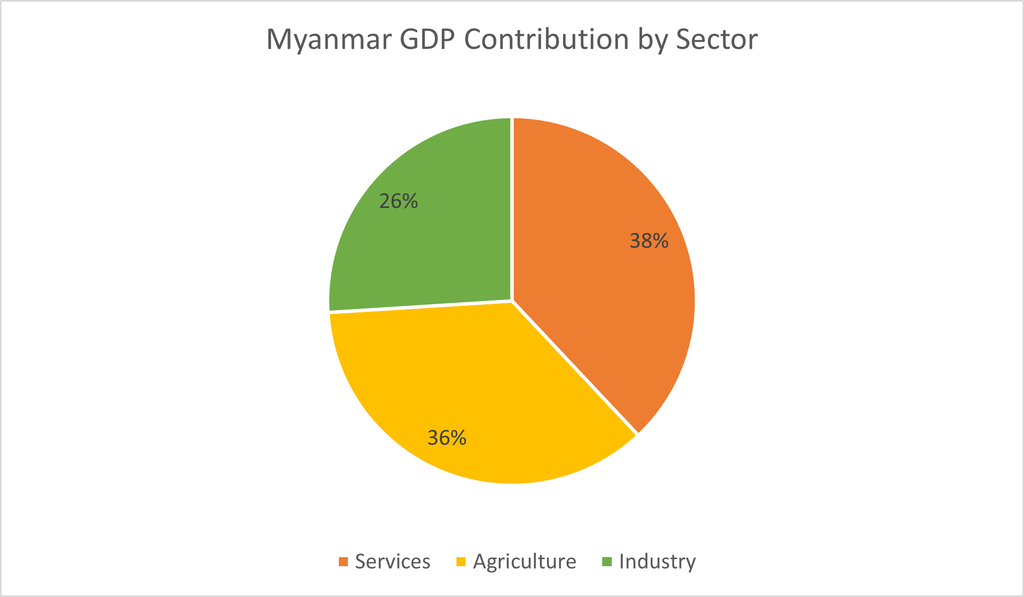
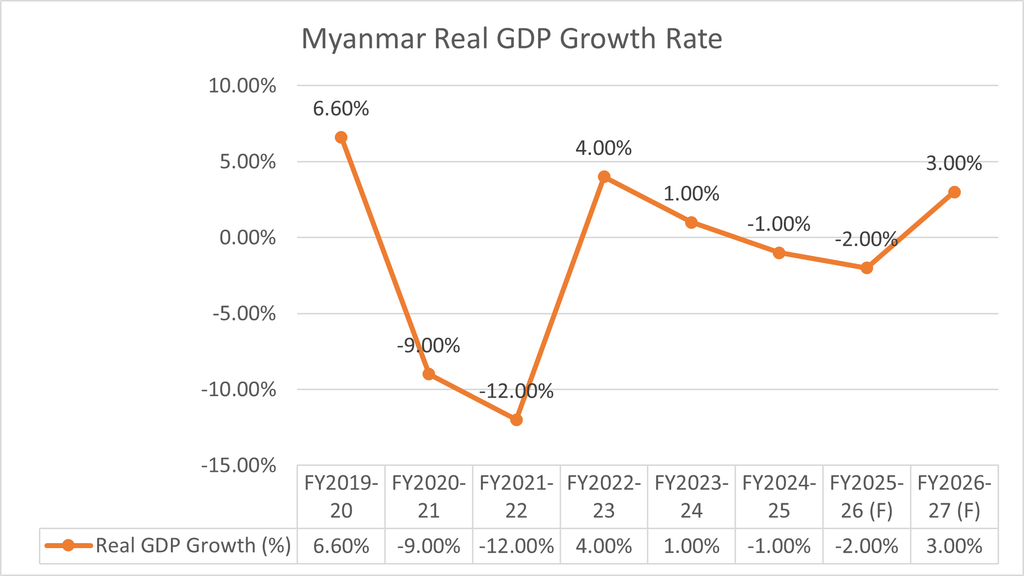
Source: Trading Economics Myanmar Economy | World Bank Myanmar Economic Monitor June 2025
Key Economic Challenges:
- Persistent Inflation: CPI inflation averaging 26-31% annually since 2022, significantly eroding purchasing power[3]
- Currency Depreciation: Myanmar Kyat (MMK) has lost over 50% of its value against the US dollar since the 2021 coup[3]
- Banking System Crisis: Widespread banking restrictions, capital controls, and limited access to international financial systems (SWIFT)
- Sanctions Impact: Western sanctions (USA, EU, UK) have constrained formal trade, investment, and financial flows[3]
- Earthquake Impact (2025): March 2025 earthquake (7.7 magnitude) caused ~US$2.6 billion in output losses (~4% of GDP)
- Conflict-Driven Displacement: 3+ million IDPs disrupting agricultural production and supply chains[2]
3. AGRICULTURAL SECTOR
Despite civil conflict and natural disasters, agriculture remains Myanmar’s largest economic sector (36% of GDP) and employs the largest share of the workforce (~50%). The sector has shown partial resilience in export-oriented crops even as domestic production declines[5].
Major Agricultural Products and Production
| Product | Annual Production (Latest) | Export Volume | Key Markets | Status (2024-25) | Source |
|---|---|---|---|---|---|
| Rice | 16.3 million tonnes (paddy, FY2024-25) | 2.2 million tonnes exported (+27% YoY in volume) | China, Bangladesh, Africa | Production -5.2% YoY; exports rose due to subdued domestic demand | World Bank MEM[5] |
| Pulses & Beans | ~4.5-5.0 million tonnes | ~1.8-2.0 million tonnes | India (declining), China (growing) | Pulse exports declined due to India’s import reduction; China increasing | World Bank MEM[5] |
| Natural Gas | ~350-370 million cubic feet/day | Exported to China, Thailand | China, Thailand | Gas exports declined 8% in FY ending March 2025; ongoing[5] | |
| Marine Fisheries | ~2.4 million tonnes | ~500,000 tonnes | China, Thailand, EU | Fishery exports to China +7%, Thailand +7% (H2 FY2024-25) | World Bank MEM[5] |
| Rubber | ~700,000 tonnes | ~350,000 tonnes | China, India, Thailand | Moderate performance; conflict-affected in some regions | FAO[6] |
| Sugarcane | ~8.5 million tonnes | Limited exports | Domestic primary use | — | FAO[6] |
| Corn/Maize | ~2.5-3.0 million tonnes | Corn exports to Thailand +27% YoY | Thailand (primary) | Strong export growth in H2 FY2024-25 | World Bank MEM[5] |
| Sesame/Oilseeds | ~700,000 tonnes | ~300,000 tonnes | China, India | Moderate; conflict-affected regions | FAO[6] |
Agricultural Export Performance (H2 FY2024-25):
- Rice exports rose 6% in value and 27% in volume to 2.2 million metric tonnes, reflecting strong external demand and subdued domestic consumption[5]
- Corn exports to Thailand grew 27% year-on-year
- Fishery exports to China and Thailand rose 7% each
- Pulse exports declined due to India’s reduced pulse imports (key market), partially offset by growing Chinese demand[5]
Source: World Bank Myanmar Economic Monitor June 2025 | FAO STAT Database
4. INDUSTRIALIZATION AND MANUFACTURING
Myanmar’s industrial sector (26% of GDP) is concentrated in garment manufacturing, food and beverage processing, construction materials, gems/jade extraction, and petroleum refining. The Thilawa Special Economic Zone (SEZ) near Yangon serves as the primary industrial hub attracting foreign investment, though post-coup sanctions and conflict have severely constrained FDI inflows[7].
Major Manufacturing Sectors (2024-2025)
| Industrial Sector | % of Industry | Key Products | Status (2024-25) | Major Markets | Source |
|---|---|---|---|---|---|
| Garments & Apparel | ~35-38% | Woven garments, cut-make-pack (CMP) products | +3% growth H2 FY2024-25; EU declined, Asia grew | EU, Japan, South Korea, UK, US | World Bank MEM[7] |
| Food & Beverage Processing | ~18-20% | Rice milling, edible oil, seafood processing, beverages | Moderate; constrained by conflict | Domestic, China, Thailand | BOI Myanmar[7] |
| Construction Materials | ~12-14% | Cement, bricks, steel products | Constrained by conflict and import controls | Domestic | BOI Myanmar[7] |
| Gems & Jade Mining | ~10-12% | Rubies, sapphires, jade, pearls | Mining exports fell ~40% H2 FY2024-25 due to conflict | China (dominant) | World Bank MEM[7] |
| Petroleum Refining | ~8-10% | Refined petroleum, lubricants | Declining due to sanctions and trade restrictions | Domestic, limited export | BOI Myanmar[7] |
| Pharmaceutical Production | ~4-5% | Generic drugs, basic formulations | Limited capacity; mostly import-dependent | Domestic | BOI Myanmar[7] |
| Ceramics & Wood Products | ~4-6% | Furniture, handicrafts, tiles | Declining due to conflict and export restrictions | China, Thailand, Japan | BOI Myanmar[7] |
Garment Sector Detail: Garment exports represent Myanmar’s 2nd largest export category (US$2.6 billion, ~17% of total exports in 2024). Key development:
- Exports to Japan and South Korea increased significantly in H2 FY2024-25, offsetting EU decline[7]
- EU brands’ withdrawal (-1% H2 FY2024-25) reflecting human rights concerns[7]
- Myanmar garment sector employs an estimated 700,000-800,000 workers (predominantly women)
Source: World Bank Myanmar Economic Monitor June 2025 | UN Comtrade Myanmar Trade Profile 2024
5. TRADE AND ECONOMIC PROFILE
Export and Import Overview
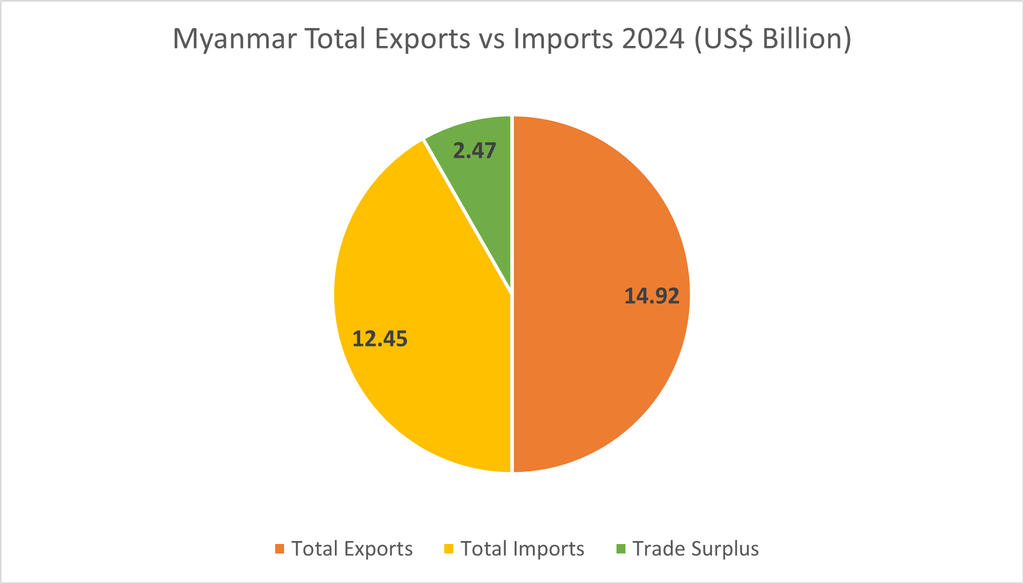
Myanmar’s merchandise trade showed a surprising improvement in 2024 despite ongoing civil conflict, driven by agricultural export growth, import compression through restrictive licensing, and a partial recovery in garment shipments[8].
| Trade Metric | FY2023-24 | 2024 (Calendar Year) | FY2024-25 (H2 Estimate) | Source |
|---|---|---|---|---|
| Total Exports | ~US$13.8-14.9 billion | US$14.92 billion | Trade surplus of US$1.3 billion (H2 only) | UN Comtrade / World Bank MEM[8] |
| Total Imports | ~US$11.8-12.5 billion | US$12.45 billion | Imports declined 12% YoY | UN Comtrade / World Bank MEM[8] |
| Trade Balance | Near balance | +US$2.47 billion surplus | +US$1.3 billion surplus (H2) | UN Comtrade[8] |
| Export Growth | — | — | +7% (H2 FY2024-25 vs prior period) | World Bank MEM[8] |
| Import Growth | — | — | -12% (H2 FY2024-25 vs prior period) | World Bank MEM[8] |
Key Observation: Myanmar achieved a trade surplus of US$2.33-2.47 billion in 2024, a major reversal from prior deficits, driven by agricultural export growth and aggressive import compression through restrictive licensing policies[8].
Source: UN Comtrade Myanmar Trade Profile 2024 | World Bank Myanmar Economic Monitor June 2025
Major Export Products (2024)
| Product Category | Value (US$ Billion) | % of Total | Key Markets | Source |
|---|---|---|---|---|
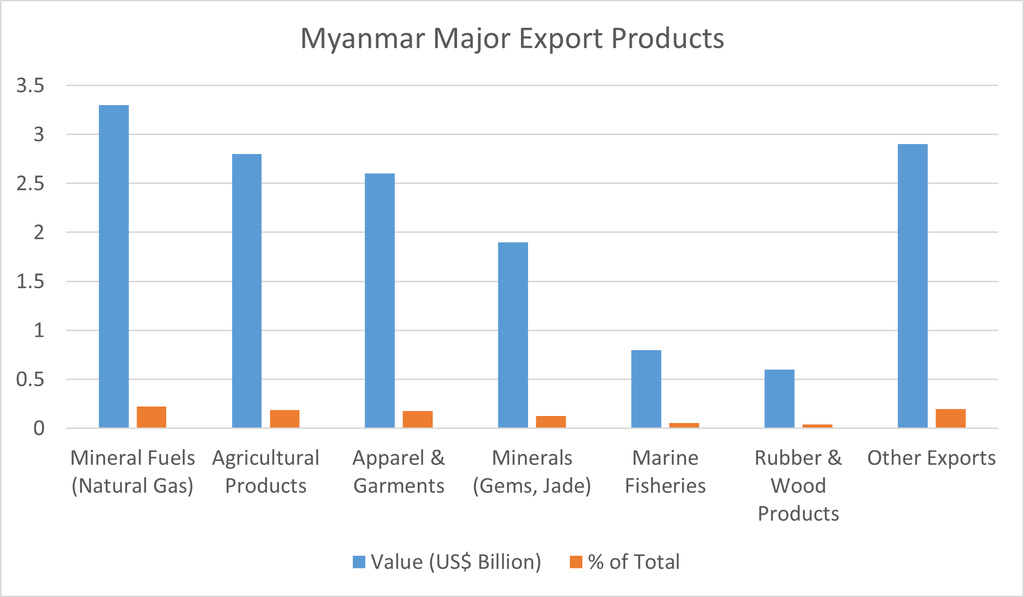
| Mineral Fuels (Natural Gas, Oil) | 3.3 | 22.1% | China, Thailand | UN Comtrade[8] |
| Apparel & Garments | 2.6 | 17.4% | EU, Japan, South Korea, UK, US | UN Comtrade[8] |
| Agricultural Products (Rice, Pulses, Corn) | 2.8 | 18.8% | China, India, Bangladesh, Africa | World Bank MEM / UN Comtrade[8] |
| Minerals (Gems, Jade, Ores) | 1.9 | 12.7% | China (dominant) | World Bank MEM[8] |
| Marine Fisheries | 0.8 | 5.4% | China, Thailand | UN Comtrade[8] |
| Rubber & Wood Products | 0.6 | 4.0% | China, India, Thailand | UN Comtrade[8] |
| Other Exports | 2.9 | 19.5% | Various | UN Comtrade[8] |
Total Exports: ~US$14.92 billion (2024, Calendar Year)
Top Export Markets (2024)
| Country | Export Value (US$ Billion) | % of Total | Key Products | Source |
|---|---|---|---|---|
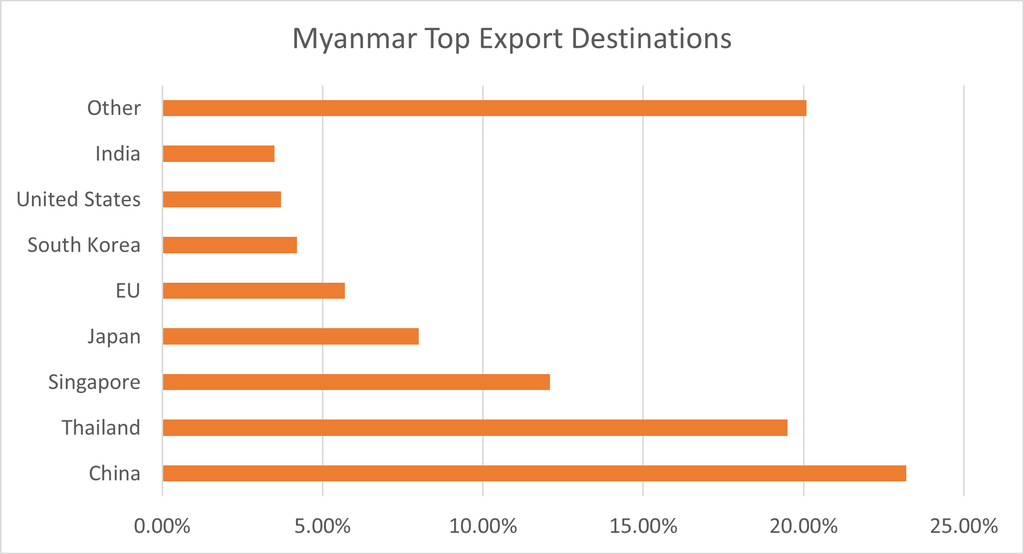
| China | 3.46 | 23.2% | Minerals, agricultural products, timber | UN Comtrade[8] |
| Thailand | 2.90 | 19.5% | Natural gas, agricultural products, garments | UN Comtrade[8] |
| Singapore | ~1.80 | ~12.1% | Minerals, garments, agricultural products | UN Comtrade[8] |
| Japan | ~1.20 | ~8.0% | Garments, agricultural products, seafood | UN Comtrade[8] |
| European Union | ~0.85 | ~5.7% | Garments, agricultural products | UN Comtrade[8] |
| South Korea | ~0.62 | ~4.2% | Garments, agricultural products | UN Comtrade[8] |
| United States | ~0.55 | ~3.7% | Garments, agricultural products | UN Comtrade[8] |
| India | ~0.52 | ~3.5% | Agricultural products (pulses, rice) | UN Comtrade[8] |
| Other Countries | ~2.92 | ~19.6% | Various | UN Comtrade[8] |
Top 2 Partners: China (23.2%) + Thailand (19.5%) = 42.7% of total exports
Major Import Products (2024)
| Product Category | Value (US$ Billion) | % of Total | Primary Sources | Source |
|---|---|---|---|---|
| Mineral Fuels (Refined Petroleum) | 4.5 | 36.1% | Singapore, China, Thailand | UN Comtrade[8] |
| Man-Made Staple Fibres (Textile inputs) | 0.72 | 5.8% | China, South Korea | UN Comtrade[8] |
| Machinery & Transport Equipment | 1.2 | 9.6% | China, Japan, Singapore | UN Comtrade[8] |
| Construction Materials & Steel | 0.85 | 6.8% | China, India | UN Comtrade[8] |
| Chemicals & Pharmaceuticals | 0.62 | 5.0% | India, China, Bangladesh | UN Comtrade[8] |
| Consumer Goods & Food Products | 0.58 | 4.7% | China, Thailand, India | UN Comtrade[8] |
| Fertilizers & Agricultural Inputs | 0.45 | 3.6% | China, India | UN Comtrade[8] |
| Other Imports | 3.53 | 28.3% | Various | UN Comtrade[8] |
Total Imports: ~US$12.45 billion (2024)
Top Import Sources (2024)
| Country | Import Value (US$ Billion) | % of Total | Key Products | Source |
|---|---|---|---|---|
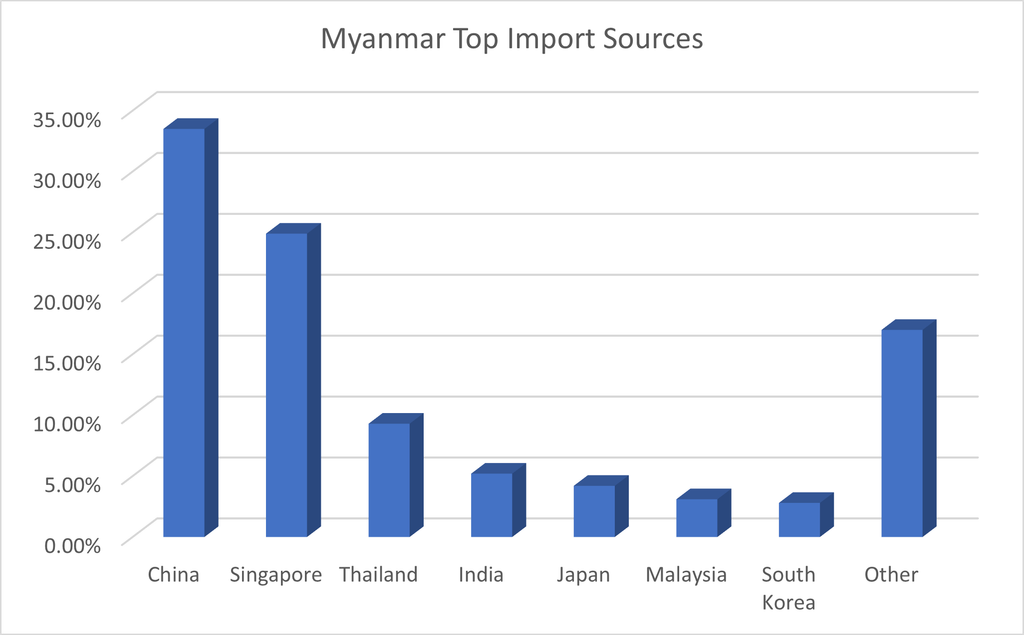
| China | 4.17 | 33.5% | Machinery, textiles, consumer goods, chemicals | UN Comtrade[8] |
| Singapore | 3.10 | 24.9% | Refined petroleum, machinery, electronics | UN Comtrade[8] |
| Thailand | 1.16 | 9.3% | Petroleum products, agricultural inputs, machinery | UN Comtrade[8] |
| India | ~0.65 | ~5.2% | Pharmaceuticals, chemicals, iron & steel | UN Comtrade[8] |
| Japan | ~0.52 | ~4.2% | Machinery, vehicles, electronics | UN Comtrade[8] |
| Malaysia | ~0.38 | ~3.1% | Petroleum products, palm oil, chemicals | UN Comtrade[8] |
| South Korea | ~0.35 | ~2.8% | Electronics, chemicals, machinery | UN Comtrade[8] |
| Other Countries | ~2.12 | ~17.0% | Various | UN Comtrade[8] |
Top 2 Import Partners: China (33.5%) + Singapore (24.9%) = 58.4% of total imports
6. EDUCATION
Overview of the Education System
Myanmar operates a 10+2 education structure (10 years of basic education + 2 years matriculation), though the system has been severely disrupted by the civil conflict since 2021. Military attacks on schools and education facilities, teacher strikes, and widespread displacement have resulted in millions of children out of school.
Education Structure:
- Pre-Primary: Ages 3-5 (government and community-based)
- Primary: Grades 1-5 (ages 5-10)
- Lower Secondary: Grades 6-9 (ages 11-14)
- Upper Secondary: Grades 10-11 (ages 15-16)
- Higher Education: Universities (3-5 year programs)
Key Universities (Pre-Coup Status):
- University of Yangon: Largest research university (suspended/disrupted post-2021)
- Mandalay University: Northern regional education center[9]
- Technological University Yangon: Engineering and technology programs[9]
- Myanmar Institute of Information Technology: IT-focused programs[9]
Literacy Rate and Human Capital
| Education Metric | Value | Pre-Coup Benchmark | Current Status | Source |
|---|---|---|---|---|
| Adult Literacy Rate (age 15+) | ~89-91% | Among higher in ASEAN LDCs | Declining in conflict zones | UNESCO/UNDP[9] |
| Primary Net Enrollment Ratio | ~85-88% | Improving pre-coup | Declining post-2021 | UNESCO[9] |
| Secondary Enrollment Ratio | ~55-60% | Growing pre-coup | Severely disrupted | UNESCO[9] |
| Tertiary Enrollment Ratio | ~18-22% | Low regional level | Disrupted by conflict | UNESCO[9] |
| Female Enrollment Parity | ~48% | Near parity at primary level | Worsening in conflict zones | UNESCO[9] |
| HDI Score (2021-22) | 0.585 | 116th globally | Declining | UNDP[9] |
Source: UNDP Human Development Report Myanmar | UNESCO Institute for Statistics
7. HEALTH AND SOCIAL INDICATORS
Health Metrics
| Health Indicator | Value (2024-25) | Trend | Source |
|---|---|---|---|
| Life Expectancy at Birth | 67.1 years | Declining post-coup | WHO Myanmar Profile[10] |
| Infant Mortality Rate | 38.4 per 1,000 live births | Worsening | WHO[10] |
| Maternal Mortality Ratio | 250 per 100,000 live births | Elevated | WHO[10] |
| Healthcare Coverage | ~60-65% (urban); <30% (conflict zones) | Severely disrupted | WHO/UNICEF[10] |
| Universal Health Coverage Index | 61/100 | Declining | WHO[10] |
Social Indicators
| Social Indicator | Value (2024-25) | Source |
|---|---|---|
| Poverty Rate (National, 2024) | 31.0% (MSPS Survey, Dec 2024-Mar 2025) | World Bank MSPS[11] |
| Previous Poverty Rate (2017 official) | 24.8% (last official census-based) | World Bank[11] |
| Poverty Depth | 8% below poverty line | World Bank MSPS[11] |
| Extreme Poverty Rate | ~12-15% (estimated) | World Bank[11] |
| Unemployment Rate (modeled ILO) | 3.0% (2025) | World Bank Open Data[3] |
| Internally Displaced Persons (IDPs) | 3.0+ million | UNHCR[11] |
| Food Insecurity | ~15.2 million people severely food insecure | WFP/FAO DIEM[11] |
| Access to Improved Water | ~82% | WHO/UNICEF[10] |
| Access to Improved Sanitation | ~75% | WHO/UNICEF[10] |
| Internet Penetration | ~28-32% | ITU[12] |
Source: World Health Organization Myanmar Profile | World Bank Myanmar Macro Poverty Outlook 2025-2026 | ITU Digital Statistics
8. BANGLADESH-MYANMAR BILATERAL RELATIONS
Historical Context and Current Status
Bangladesh and Myanmar share longstanding but deeply strained diplomatic relations, fundamentally dominated by the Rohingya refugee crisis since the August 2017 mass exodus. Both nations maintain embassy-level representation: the Myanmar Embassy in Dhaka and the Bangladesh Embassy in Yangon.
Critical Bilateral Issues:
Rohingya Crisis (Dominant Issue):
- Since August 2017, Bangladesh has hosted over 1 million Rohingya refugees in Cox’s Bazar—the world’s largest refugee camp concentration[13]
- Repatriation remains the central, largely unresolved bilateral agenda item
- A China-brokered pilot repatriation program was discussed in 2023; however, large-scale repatriation has not materialized as of 2025-2026[13]
- The Rakhine State conflict (between SAC military and Arakan Army) has worsened displacement and made repatriation conditions untenable[13]
Key Diplomatic Milestones:
- 1972: Formal diplomatic relations established post-Bangladesh independence[13]
- 2018: Joint Task Force on Trade, Investment and Border Infrastructure established; identified Teknaf-Maungdaw/Sittwe corridor as priority[13]
- 2021 (Post-coup): Institutional bilateral cooperation effectively suspended; reduced to consular/diplomatic communication[13]
- 2023: China-brokered pilot repatriation discussions; limited implementation[13]
- 2024-2026: Bilateral trade severely disrupted by Rakhine conflict (see Section 9)
Regional Cooperation Frameworks
| Organization | Bangladesh Role | Myanmar Role | Relevance | Source |
|---|---|---|---|---|
| BIMSTEC | Secretariat host (Dhaka) | Member (since 1997) | Regional connectivity, trade corridor | BIMSTEC[14] |
| United Nations | Full member | Full member | Rohingya repatriation, humanitarian | UN[14] |
| World Trade Organization | Full member | Observer | Trade facilitation | WTO[14] |
| Non-Aligned Movement | Member | Member | Historical diplomatic alignment | NAM[14] |
BIMSTEC Framework: Both countries are BIMSTEC members (Bangladesh hosts the Secretariat in Dhaka since 2014). BIMSTEC provides the most viable framework for trade and connectivity normalization[14].
Source: The Business Standard, “Bangladesh-Myanmar trade and investment: Opportunities and way forward,” 2023 | The Diplomat, “How the Rakhine War Affects Bangladesh’s Economy,” February 2026 | BIMSTEC Secretariat
9. BILATERAL TRADE ANALYSIS
Bangladesh-Myanmar Trade Overview
Current Status: Severely Disrupted
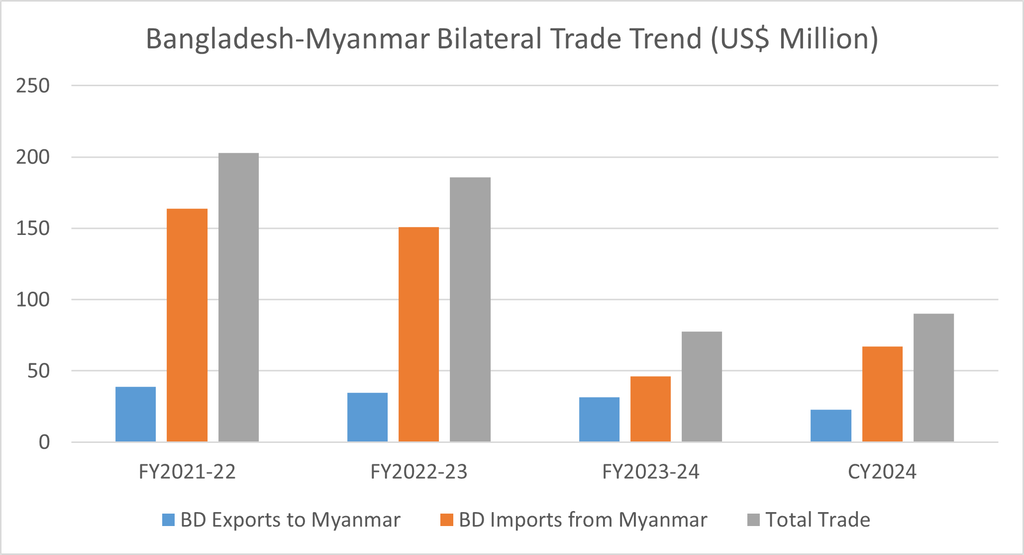
Bilateral trade between Bangladesh and Myanmar has collapsed sharply since the intensification of Rakhine State conflict in 2023-2024. Trade peaked at US$223.22 million in FY2018-19 and slumped to just US$90.1 million in 2024 (calendar year), representing a 60% decline from peak levels.
Bangladesh-Myanmar Trade Volume Trend (Official Data)
| Period | Bangladesh Exports to Myanmar (US$$ Mn) | Bangladesh Imports from Myanmar (US$$ Mn) | Total Trade (US$ Mn) | Trade Balance (BD) | Source |
|---|---|---|---|---|---|
| FY2021-22 | 38.89 | 163.90 | 202.79 | -125.01 | DCCI/EPB[15] |
| FY2022-23 | 34.79 | 150.98 | 185.77 | -116.19 | DCCI/EPB[15] |
| FY2023-24 | 31.42 | 46.28 | 77.70 | -14.86 | DCCI/EPB[15] |
| CY2022 | 36.89 | 181.10 | 217.99 | -144.21 | DCCI/EPB[15] |
| CY2023 | 24.98 | 67.20 | 92.18 | -42.22 | DCCI/EPB[15] |
| CY2024 | 22.88 | 67.18 | 90.06 | -44.30 | DCCI/EPB[15] |
Key Observation: Bangladesh imports from Myanmar fell 62% in FY2023-24 (from US$150.98 mn to US$46.28 mn), driven by Rakhine conflict disruptions to supply chains. Bangladesh exports to Myanmar similarly declined 76.1% in FY2023-24[15].
Source: Dhaka Chamber of Commerce & Industry (DCCI) Bilateral Trade Report, September 2025 | The Diplomat, February 2026
What Myanmar Exports to Bangladesh (2024)
| Product Category | Value (US$ Million) | HS Code | % of Myanmar Exports to BD | End-Use in BD | Source |
|---|---|---|---|---|---|
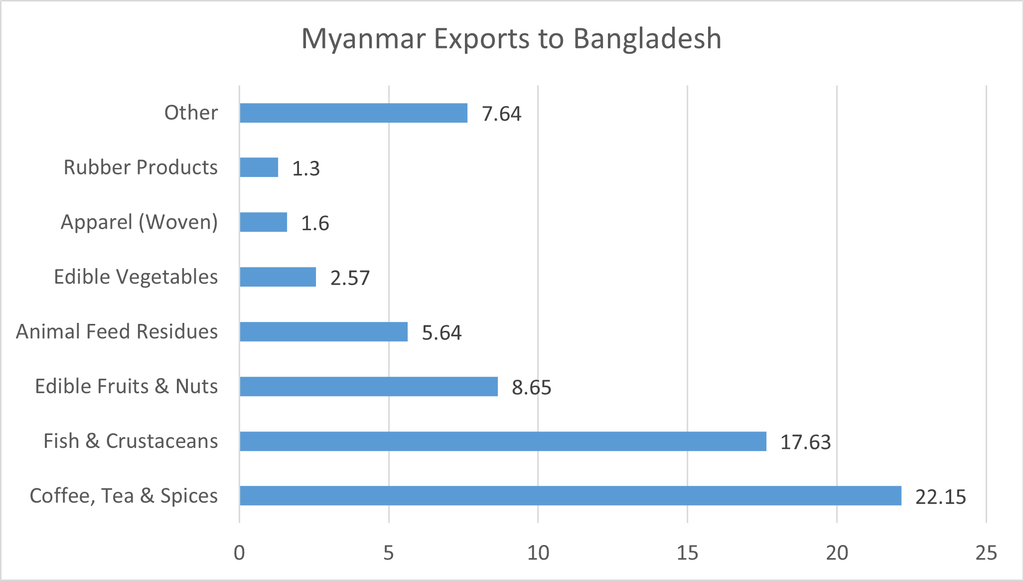
| Coffee, Tea, Spices | 22.15 | HS 09 | 33.0% | Food industry, retail | UN Comtrade[16] |
| Fish, Crustaceans & Molluscs | 17.63 | HS 03 | 26.2% | Food processing, retail, restaurants | UN Comtrade[16] |
| Edible Fruits & Nuts | 8.65 | HS 08 | 12.9% | Food retail, processing | UN Comtrade[16] |
| Food Industry Residues / Animal Feed | 5.64 | HS 23 | 8.4% | Livestock, poultry, aquaculture feed | UN Comtrade[16] |
| Edible Vegetables & Roots | 2.57 | HS 07 | 3.8% | Food retail, processing | UN Comtrade[16] |
| Apparel (Woven) | 1.60 | HS 62 | 2.4% | Retail | UN Comtrade[16] |
| Rubber & Rubber Products | 1.30 | HS 40 | 1.9% | Manufacturing, footwear | UN Comtrade[16] |
| Other Products | 7.64 | Mixed | 11.4% | Various | UN Comtrade[16] |
Total Myanmar Exports to Bangladesh: US$67.18 million (CY2024)
What Bangladesh Exports to Myanmar
| Product Category | Value (US$ Million) | HS Code | % of BD Exports to Myanmar | End-Use in Myanmar | Source |
|---|---|---|---|---|---|
| Pharmaceutical Products | 20.19 | HS 30 | 71.0% | Hospitals, pharmacies, healthcare | UN Comtrade (2018 data*) |
| Apparel, Knit/Crocheted | 1.23 | HS 61 | 4.3% | Retail, garment industry | UN Comtrade[16] |
| Products of Animal Origin | 1.03 | HS 05 | 3.6% | Processing, industrial | UN Comtrade[16] |
| Other Made Textile Articles | 0.97 | HS 63 | 3.4% | Retail, industrial | UN Comtrade[16] |
| Electrical & Electronic Equipment | 0.68 | HS 85 | 2.4% | Telecom, industrial use | UN Comtrade[16] |
| Other Products | 4.33 | Mixed | 15.2% | Various sectors | UN Comtrade[16] |
Total Bangladesh Exports to Myanmar: US$22.88-31.42 million (2024 estimate)
Source: UN Comtrade Myanmar-Bangladesh Bilateral Trade Statistics 2018 & 2024 | DCCI Report, September 2025
Trade Imbalance Analysis
| Trade Metric | CY2024 Value (US$ Mn) | Trend | Source |
|---|---|---|---|
| Myanmar Exports to Bangladesh | 67.18 | -55% since 2022 | DCCI[15] |
| Bangladesh Exports to Myanmar | 22.88 | -41% since 2022 | DCCI[15] |
| Total Bilateral Trade | 90.06 | -59% from FY2018-19 peak (US$223.22 mn) | DCCI[15] |
| Trade Balance (Bangladesh) | -44.30 | Narrowed; Bangladesh deficit shrinking | Calculated[15] |
| FDI Stock (Bangladesh in Myanmar) | US$0.08 million (cumulative to June 2024) | Negligible | DCCI[15] |
Key Insight: Bangladesh’s trade deficit with Myanmar has actually narrowed dramatically (from US$125 million in FY2021-22 to US$14.86 million in FY2023-24), but this reflects trade collapse rather than improvement—Myanmar’s exports to Bangladesh fell faster due to Rakhine State conflict blocking supply routes[15].
Banking and Financial Linkages
Correspondent Banking:
- Myanmar Banks (Limited): Myanmar Economic Bank, KBZ Bank, AYA Bank, CB Bank[17]
- Bangladeshi Banks: Dutch-Bangla Bank, Brac Bank, City Bank, Prime Bank[17]
Trade Finance Challenges:
- International financial restrictions on Myanmar banks following Western sanctions severely limit formal LC processing[17]
- Cash settlement dominance: Most small-scale bilateral trade conducted in cash (US dollars, Thai Baht)
- Alternative channels: Hawala/hundi informal networks widely used; compliance risk for Bangladeshi banks[17]
- BIMSTEC financial corridor: Potential platform for normalized banking if political stabilization occurs[17]
Border Trade (Teknaf-Maungdaw):
- Primary formal border crossing suspended/severely disrupted by Rakhine conflict since 2023[17]
- Sittwe (Akyab) sea route remains partially operational for bulk agricultural commodity trade[17]
Source: DCCI Trade Research Division Bangladesh-Myanmar Overview, 2025 | Bangladesh Bank Payment Systems
10. INTERNATIONAL COOPERATION
Multilateral Membership and Current Status
Myanmar’s international cooperation is severely constrained by post-coup sanctions, international diplomatic isolation of the SAC government, and ongoing conflict[18].
UN System:
- United Nations: Full member; UN Security Council resolutions on Myanmar conflict[18]
- UNHCR: Active; managing IDPs and Rohingya refugee coordination[18]
- WFP/FAO: Active humanitarian operations; 15.2 million food-insecure people[18]
- UNICEF: Education and child welfare programming in displacement contexts[18]
ASEAN:
- ASEAN Member (since 1997): Myanmar participation suspended from high-level ASEAN meetings since 2021; excluded from ASEAN Summits and Ministerial Meetings[18]
- “Five-Point Consensus” (2021): ASEAN framework for Myanmar crisis management; largely unimplemented[18]
BIMSTEC:
- Full member (since 1997): Participates through diplomatic channels despite internal conflict[18]
- Bangladesh-hosted Secretariat: Dhaka provides platform for Bangladesh-Myanmar dialogue[18]
Trade Frameworks:
- WTO Observer Status: Not a full WTO member; observer since 1995[18]
- ASEAN Free Trade Area (AFTA): Member benefits partially suspended due to ASEAN exclusion[18]
- Sanctions Framework: US, EU, and UK sanctions on military-linked entities; constraining formal trade and investment[18]
ADB and Development Partners:
- Asian Development Bank (ADB): Suspended new sovereign lending post-2021 coup; humanitarian programs continue[18]
- World Bank: Paused government-directed programs; humanitarian operations continue via NGO channels[18]
- ASEAN Humanitarian Assistance (AHA Centre): Earthquake relief coordination (March 2025)
Source: Ministry of Foreign Affairs Myanmar | ASEAN Secretariat | World Bank Myanmar Country Overview
11. OPPORTUNITIES FOR BANGLADESHI CITIZENS IN MYANMAR
Higher Education
Formal higher education cooperation between Bangladesh and Myanmar is extremely limited due to Myanmar’s ongoing conflict and institutional disruption[19].
Pre-Conflict Status (For Reference):
- University of Yangon: Engineering, sciences, business; limited pre-coup bilateral enrollment (~30-50 Bangladeshi students annually)
- Mandalay University: Regional academic center; some Bangladeshi student exchanges pre-2021[19]
Current Reality: University operations severely disrupted across Myanmar since 2021; not a recommended destination for Bangladeshi students at this time[19].
Estimated Tuition Costs (Pre-Conflict Reference):
- State Universities: ~MMK 50,000-100,000/year (~US$24-48 at current rates)
Source: UNESCO Myanmar Education Disruption Reports 2023-2025
Employment and Labor Migration
Current Status: Highly Restricted
Employment opportunities for Bangladeshi citizens in Myanmar are severely constrained by conflict, sanctions, and administrative disruption[20].
Limited Active Opportunities (Where Conditions Permit):
- Pharmaceutical & Healthcare: Bangladesh has demonstrated competitive advantage in supplying generic medicines; potential for technical sales staff[20]
- Agricultural Trade: Specialist traders in pulse/rice commodity markets retain limited operational capacity[20]
- Border Trade (When Operational): Teknaf-Maungdaw corridor specialists; cross-border logistics[20]
- NGO/Humanitarian Sector: International NGOs, UN agencies employing Bengali-speaking staff in Cox’s Bazar-adjacent operations[20]
Estimated Formally Employed Bangladeshis in Myanmar: <500 (severely reduced from pre-coup levels of ~2,000-3,000)
Source: DOLE Myanmar Labor Market Reports | ILO Myanmar Country Office https://www.ilo.org/myanmar
Visa Facilities
Visa Types for Bangladeshi Citizens (Current):
| Visa Type | Status | Duration | Notes | Source |
|---|---|---|---|---|
| Tourist Visa | Technically available; not recommended | 28 days | Extreme security risk; travel advisory against non-essential travel | Myanmar Immigration[21] |
| Business Visa | Technically available | 70 days | Severe banking/financial limitations; sanctions compliance risk | Myanmar Immigration[21] |
| Work Permit | Extremely limited processing | 1 year | Very limited processing capacity post-coup | Myanmar Labor Dept[21] |
| Transit Visa | Available | 24 hours | Changi/Bangkok transit more common | Myanmar Immigration[21] |
Source: Myanmar Ministry of Immigration | Bangladesh Ministry of Foreign Affairs Travel Advisory
Export and Residency Opportunities
Business Registration:
- Business registration technically possible via Myanmar Investment Commission (MIC) or Directorate of Investment and Company Administration (DICA)
- Practical Reality: Severely limited by banking restrictions, SAC sanctions implications, and security conditions[22]
- Recommendation: Any business engagement should undergo thorough sanctions compliance screening (US OFAC, EU, UK)
Border Trade Opportunities (When Operational):
- Teknaf (Bangladesh) – Maungdaw (Myanmar) corridor: Border trade in agricultural commodities, consumer goods[22]
- Sittwe Sea Route: Bulk agricultural trade; operational with disruptions[22]
Source: Myanmar Investment Commission
12. OPPORTUNITIES FOR MYANMAR FROM BANGLADESH
High-Potential Export Products from Bangladesh
1. Pharmaceutical Products (Highest Priority)
- Market Dominance: Pharmaceuticals historically represent ~71% of Bangladesh’s exports to Myanmar
- Market Need: Myanmar’s healthcare system severely strained by conflict; critical shortage of medicines[16]
- Bangladeshi Advantage: Cost-competitive generic drugs; WHO-GMP certified factories; established pre-coup supply relationships[16]
- Current Barrier: Banking sanctions limit formal transactions; cash-based trade operating at reduced scale[16]
- Estimated Potential (Post-Stabilization): US$30-50 million annually
2. Ready-Made Garments (RMG)
- Market Gap: Myanmar’s own garment industry serves primarily export markets; domestic apparel import demand exists[23]
- Bangladeshi Advantage: Competitive pricing; established regional reputation[23]
- Estimated Potential (Post-Stabilization): US$10-20 million annually
3. Agro-Processed Products
- Products: Instant noodles, processed foods, spices, condiments[23]
- Market Demand: Growing urban consumer demand for affordable processed foods[23]
- Estimated Potential: US$8-15 million annually
4. Textiles & Fabric
- Market Application: Myanmar’s large garment sector requires fabric inputs; Bangladesh textile sector competitive[23]
- Estimated Potential: US$5-10 million annually
5. Ceramic & Construction Materials
- Post-Reconstruction Demand: March 2025 earthquake and conflict-driven reconstruction will require construction materials[23]
- Bangladeshi Products: Ceramic tiles, sanitary ware, glass products[23]
- Estimated Potential (Post-Stabilization): US$5-8 million annually
Source: DCCI Trade Facilitation Department Bangladesh-Myanmar Overview, 2025
Investment and Industrial Cooperation (Long-Term)
Potential Joint Ventures (Post-Stabilization):
1. Pharmaceutical Manufacturing
- Model: Bangladeshi pharma companies establishing distribution warehouses and/or contract manufacturing in Yangon or Thilawa SEZ[24]
- Investment: US$1-3 million per facility[24]
2. Agricultural Processing
- Model: Joint ventures in rice milling, pulse processing, and seafood cold-chain facilities[24]
- Rationale: Myanmar produces agricultural commodities Bangladesh needs; Bangladesh has processing technology[24]
- Investment: US$2-5 million[24]
3. Border Trade Infrastructure
- Model: Joint investment in Teknaf-Maungdaw border trade facilitation infrastructure (warehousing, customs, cold chain)
- Investment: US$500,000-2 million[24]
Myanmar Incentive Structures (Pre-Conflict Reference):
- Thilawa SEZ: Purpose-built industrial zone (Zone A fully developed); 5-year tax holidays[24]
- Myanmar Investment Commission (MIC): Foreign investment approvals; reduced corporate tax for promoted sectors[24]
Source: Myanmar Investment Commission | Thilawa SEZ Management Committee
13. TRADE ASSOCIATIONS AND FUTURE PROSPECTS
Key Trade Organizations
Myanmar Trade Bodies:
- Union of Myanmar Federation of Chambers of Commerce & Industry (UMFCCI): https://www.umfcci.com.mm
- Myanmar Garment Manufacturers Association (MGMA): Primary garment sector body[25]
- Myanmar Rice Federation: Rice export coordination[25]
- Myanmar Investment Commission (MIC): https://www.dica.gov.mm
Bangladeshi Trade Bodies:
- Federation of Bangladesh Chambers of Commerce & Industry (FBCCI): https://www.fbcci.org
- Bangladesh Garment Manufacturers & Exporters Association (BGMEA): https://www.bgmea.com.bd
- Export Promotion Bureau (EPB): https://www.epb.gov.bd
- Dhaka Chamber of Commerce & Industry (DCCI): https://www.dhakachamber.com
Future Trade Prospects
Short-Term (2025-2026) — Contingent on Security Conditions:
- Border Trade Restoration: If Rakhine conflict reduces, Teknaf-Maungdaw corridor could resume; bilateral trade target US$120-150 million possible within 12-18 months[15]
- Pharmaceutical Priority: Bangladesh EPB to intensify pharmaceutical export promotion to Myanmar (both formal and semi-formal channels)
- BIMSTEC Utilization: Use BIMSTEC platform for Bangladesh-Myanmar trade facilitation dialogue[14]
Medium-Term (2026-2030) — Post-Stabilization:
- Trade Normalization: Bilateral trade could recover to US$180-220 million upon Rakhine conflict resolution and banking normalization[15]
- Formal Banking Channels: BIMSTEC-facilitated correspondent banking establishment reducing reliance on cash transactions[17]
- Joint Trade Commission Revival: FBCCI-UMFCCI cooperation renewal; sector-specific working groups on pharma, agro-processing, garments[14]
- FDI Growth: Bangladesh-Myanmar FDI stock (currently negligible at US$0.08 million) could grow to US$5-10 million upon normalization[15]
Long-Term (2030-2035) — Full Normalization Scenario:
- Trade Potential: Bilateral trade could reach US$400-500 million annually under full political normalization[15]
- Rohingya Repatriation: Durable repatriation solution as fundamental precondition for full bilateral normalization[13]
- BIMSTEC Connectivity: Regional connectivity projects linking Chittagong-Cox’s Bazar-Maungdaw-Sittwe corridor[14]
- Supply Chain Integration: Myanmar agricultural raw materials (rice, pulses, fisheries) + Bangladesh processing/value addition for export to third markets[23]
Source: UMFCCI Myanmar https://www.umfcci.com.mm
14. RECOMMENDATIONS
For Bangladeshi Exporters & Entrepreneurs
- Pharmaceutical Focus (Immediate Priority): Pharmaceutical exporters should maintain and expand existing supply relationships through cash-based formal channels; ensure sanctions compliance screening before each transaction[23].
- Border Trade Monitoring: Monitor Teknaf-Maungdaw/Sittwe corridor status continuously; prepare to rapidly scale border trade operations when security conditions improve[22].
- Sanctions Compliance: All Bangladeshi businesses engaging with Myanmar must complete US OFAC, EU, and UK sanctions screening before financial transactions to avoid designation risks[24].
- Product Focus: Prioritize pharmaceuticals, processed foods, textiles, and ceramic products—sectors with demonstrated Bangladesh comparative advantage and Myanmar demand[23].
- BIMSTEC Engagement: Join BIMSTEC business forums and trade delegations to build relationships with Myanmar counterparts in anticipation of market normalization[14].
- Risk Management: Maintain conservative exposure limits; avoid long-term capital commitments until political stabilization is confirmed[13].
Source: DCCI, The Business Standard Analysis
For the Bangladeshi Government
- Rohingya Repatriation Diplomacy: Maintain sustained international pressure through UN, ASEAN, and BIMSTEC for a durable, voluntary, safe Rohingya repatriation framework as the essential precondition for bilateral normalization[13].
- Border Trade Formalization: Invest in Teknaf border infrastructure (customs, warehousing, cold chain) to capture informal trade flows in formal channels when security permits[22].
- BIMSTEC Activation: Leverage Bangladesh’s role as BIMSTEC Secretariat host to facilitate multilateral pressure on Myanmar for humanitarian access and trade normalization[14].
- Embassy Continuation: Maintain Bangladesh Embassy in Yangon for diplomatic engagement and trade intelligence; strengthen commercial section capacity[13].
- EPB Market Research: Export Promotion Bureau to maintain real-time monitoring of Myanmar pharmaceutical, food, and textile import opportunities[23].
- Banking Channels: Bangladesh Bank to explore BIMSTEC-compatible payment mechanisms enabling trade with Myanmar while maintaining sanctions compliance[17].
Source: BIMSTEC Secretariat
For Myanmar Importers & Investors
- Agricultural Complementarity: Myanmar agricultural exporters (rice, pulses, fisheries) should formalize trading relationships with Bangladesh food processors for mutual benefit[5].
- Pharmaceutical Supply Continuity: Myanmar healthcare distributors should maintain Bangladesh pharma supply relationships; Bangladesh is the most cost-competitive quality generic supplier in the region[16].
- Border Infrastructure: Myanmar private sector to advocate for restoration of Maungdaw-Teknaf border infrastructure for agricultural commodity trade[22].
- Standards Compliance: Myanmar exporters targeting Bangladesh market should align with Bangladesh Standards and Testing Institution (BSTI) requirements for food and consumer goods[23].
REFERENCES
Union of Myanmar Federation of Chambers of Commerce & Industry (UMFCCI)
https://www.umfcci.com.mm
World Bank Myanmar Country Overview
https://www.worldbank.org/en/country/myanmar/overview
BTI Bertelsmann Stiftung Country Report Myanmar 2024
https://bti-project.org/en/reports/country-report/MMR
World Bank Myanmar Economic Monitor, June 2025
https://www.worldbank.org/en/country/myanmar/publication/myanmar-economic-monitor-reports
Trading Economics – Myanmar GDP and Economic Data
https://tradingeconomics.com/myanmar/gdp-growth-annual
World Bank Myanmar Economic Monitor – Agricultural Data
https://openknowledge.worldbank.org/server/api/core/bitstreams/d30a26bb-b292-4d2d-bb48-4e67caa3df67/content
FAO STAT Database – Myanmar Agricultural Production
https://www.fao.org/faostat
World Bank Myanmar Economic Monitor – Manufacturing & Garment Sector
https://thedocs.worldbank.org/en/doc/aa690e043f003ea6b1ac4d2a63437af4-0070062025/original/MEM-presentation-June-2025.pdf
UN Comtrade – Myanmar Trade Profile 2024
https://comtrade.un.org (via https://tradevedia.com/country/MMR/)
UNDP Human Development Report Myanmar
https://hdr.undp.org
World Health Organization Myanmar Country Profile
https://www.who.int/countries/mmr
World Bank Myanmar Macro Poverty Outlook 2025-2026 (MSPS Survey)
https://documents1.worldbank.org/curated/en/099061125205014652/pdf/P507203-cbcf81b5-0107-4517-8ad7-82b588a6328f.pdf
International Telecommunication Union – Myanmar Digital Statistics
https://www.itu.int
The Business Standard – Bangladesh-Myanmar Trade and Investment, 2023
https://www.tbsnews.net | The Diplomat – How the Rakhine War Affects Bangladesh’s Economy, February 2026
https://thediplomat.com/2026/02/how-the-rakhine-war-affects-bangladeshs-economy/
BIMSTEC Secretariat
https://www.bimstec.org
Dhaka Chamber of Commerce & Industry (DCCI) – Bangladesh-Myanmar Bilateral Trade Report, September 2025
https://www.dhakachamber.com/storage/bilateral-trades/October2025/CKtc2d5YEGw8I77MFSOb.pdf
UN Comtrade – Myanmar-Bangladesh Bilateral Trade Statistics 2018 & 2024
https://comtrade.un.org
Bangladesh Bank – Payment Systems Division
https://www.bangladesh-bank.org
ASEAN Secretariat – Myanmar Status
https://asean.org
UNESCO Myanmar Education Disruption Reports 2023-2025
https://www.unesco.org/en/articles/myanmar-education-system-brink
ILO Myanmar Country Office
https://www.ilo.org/myanmar
Myanmar Ministry of Immigration and Population
https://www.moi.gov.mm
Myanmar Investment Commission / DICA
https://www.dica.gov.mm
DCCI Trade Facilitation Department – Bangladesh-Myanmar Overview 2025
https://www.dhakachamber.com
Thilawa SEZ Management Committee
https://www.thilawasez.com
For more information, please contact us